

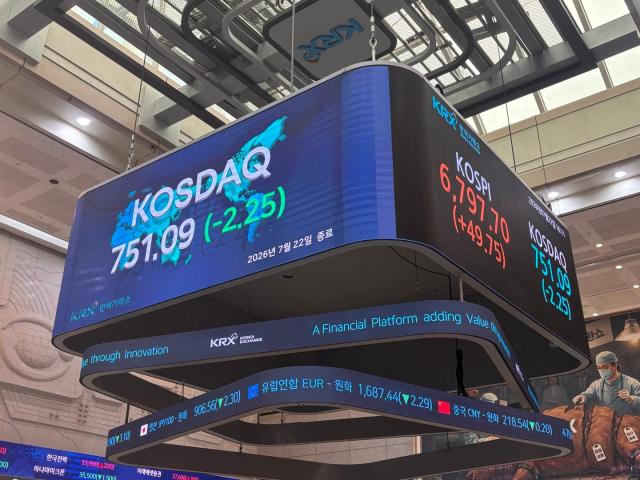
Wonpung Mulsan, one of the KOSDAQ's earliest-listed companies and once the South Korean licensee of French fashion brand Nina Ricci, failed to recover the minimum market capitalization of 20 billion won (US$14.5 million).
Its shares plunged more than 40 percent on Wednesday, the first day of liquidation trading ahead of its delisting.
Its stock was trading at 141 won at around 1:40 p.m. on Thursday, down 43.15 percent from the previous close, after plunging more than 40 percent the previous day, the first day of liquidation trading ahead of its delisting. The stock opened at 172 won and fell as low as 134 won during the session.
Wonpung Mulsan will continue trading until Sept. 18 before being delisted from the junior stock market on Sept. 21. During the liquidation period, the usual daily price limits do not apply. Instead, trades are matched every 30 minutes between 9 a.m. and 3:30 p.m., rather than continuously throughout the trading session.

Under the revised rules, a KOSDAQ company is designated as an administrative issue if its market value remains below 20 billion won for 30 consecutive trading days. Once designated, it has a 90-session recovery period.
During that window, its market capitalization must reach at least 20 billion won and remain there for 45 consecutive sessions. Failure to do so creates grounds for delisting.
The company had been placed on the administrative list on July 3 but failed to restore its valuation before the deadline.
Founded as a garment maker in 1972, the company was listed on the KOSDAQ in July 1997, a year after the junior stock market was launched. It brought Nina Ricci to South Korea in 1999 and currently operates menswear labels including Kinloch Anderson, a Scottish heritage fashion brand, and Kinloch by Kinloch Anderson, a more contemporary line under the same brand.
Its core apparel business has deteriorated sharply since 2023. Revenue fell from 28.9 billion won in 2023 to 22.7 billion won in 2024 and 16.9 billion won last year, down 41.5 percent over two years.
Operating losses widened from 1.9 billion won in 2023 to 4.7 billion won in 2024 and 7.2 billion won last year, pushing its operating loss margin to 42.5 percent.
The company remained in the red in the first half of this year, posting 7.6 billion won in revenue and a 1.4 billion won operating loss.
In March, Wonpung Mulsan's shareholders approved a two-for-one reverse stock split to help improve trading conditions. This raised the face value of each share from 500 won to 1,000 won.
But the move only reduced the number of shares and raised the share price, leaving the company's total market value unchanged. As a result, it did little to help the company meet the listing requirement.
The delisting will have a direct impact on thousands of minority shareholders. According to the company's half-year report, 5,687 minority investors held 59.23 percent of its outstanding shares as of May 4.
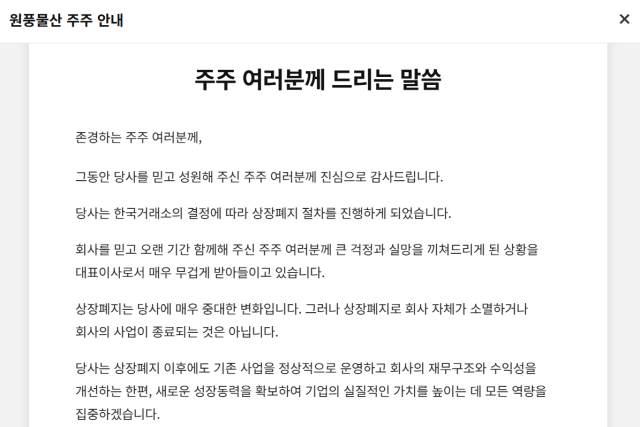
That has fueled concern among retail investors online, with some questioning whether tighter delisting rules leave small shareholders bearing most of the losses despite having little control over a company's decline.
"This just does not seem right. What are small shareholders supposed to do? If investors are simply left to absorb the losses, the system needs to be reconsidered," one commenter wrote.
The concern is likely to extend beyond a single company as several other micro-cap stocks move closer to their own deadlines.
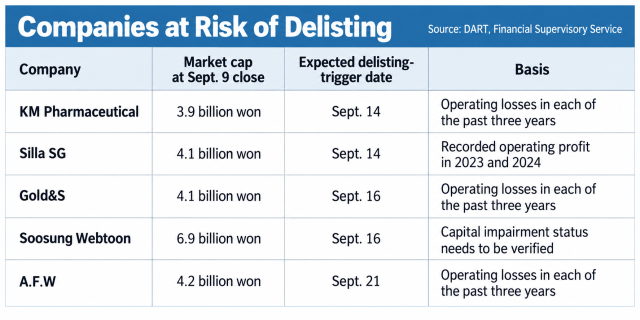
Gold&S, an education company that operates foreign-language learning and publishing businesses, dropped 17.38 percent to 713 won. Soosung Webtoon, which operates industrial equipment and webtoon-related businesses, plunged 28.35 percent to 273 won. A.F.W, a manufacturer of friction-welded parts used in electric vehicles and other automotive applications, tumbled 19.42 percent to 166 won.
For several of them, meeting the requirement would demand a dramatic rebound in their share prices. Some would need to rise more than fivefold from current levels.
A weaker broader market has also added to the pressure on smaller companies. The KOSDAQ was trading at 831.87 as of 1:56 p.m. Thursday, up 0.18 percent on the day but still well below 929.35 on July 1.
Despite Thursday's rebound, the KOSDAQ remained about 10.5 percent below its July 1 level, making it harder for the smallest companies to restore their market value within the limited recovery period.
Not every company facing removal, however, would necessarily disappear from the public market altogether.
Companies that meet certain profitability and other financial criteria may instead transfer to the Korea New Exchange (KONEX), a smaller market for early-stage and small businesses, without going through the usual liquidation trading period.
OSP, a pet food maker, SEJIN T.S, an LCD component manufacturer, and RYUK-IL C&S, a cover-glass maker, also appear to meet the basic financial requirements based on their latest financial statements.
Under Korea Exchange (KRX) rules, companies may qualify for a transfer to KONEX if they are not in a state of capital impairment and have posted operating profits in at least two of the past three years. They may also qualify with one profitable year and equity of at least 20 billion won.
AJP Takeaways
- Wonpung Mulsan is set to be delisted from South Korea's KOSDAQ on Sept. 21, 2026, after failing to restore its market capitalization above the 20 billion won threshold. The company entered liquidation trading on Sept. 10, with its shares down 43.15 percent at 141 won as of 1:38 p.m.
- The Korea Exchange's tougher KOSDAQ delisting rules are putting more micro-cap companies under pressure. Under the revised system, companies that remain below 20 billion won in market capitalization for 30 consecutive trading days receive a 90-session recovery period and must stay above the threshold for 45 consecutive sessions to avoid delisting.
- Several small-cap companies including KM Pharmaceutical, Silla SG, Gold&S, Soosung Webtoon and A.F.W were trading sharply lower on Sept. 10, 2026, as investors assessed their ability to meet KOSDAQ listing requirements. Some companies that satisfy profitability and financial criteria may instead transfer to the Korea New Exchange, or KONEX, rather than leave the public market entirely.

Copyright ⓒ Aju Press All rights reserved.
