
Journalist

Lee Hugh
=
-
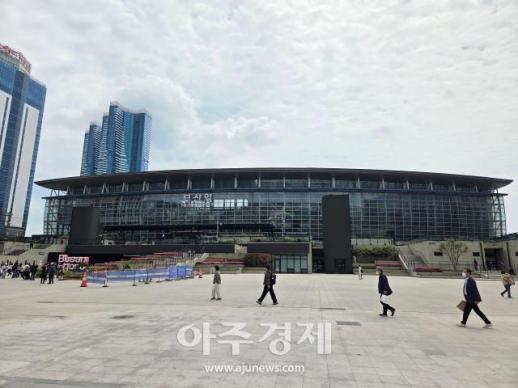 Busan mayoral race tight as voters weigh change vs conservative unity "For 75 years we’ve picked conservatives, but I think it may be time to change. The People Power Party doesn’t even seem sorry to the public. They say Jeon Jae-soo gets things done." Bae, a 75-year-old taxi driver in Busan, said he plans to vote for Jeon Jae-soo of the Democratic Party in the June 3 local elections, saying he has little expectation of the conservative bloc or incumbent Mayor Park Hyung-joon of the People Power Party. In interviews across Busanjin, Haeundae and Buk districts on April 29, many residents said they believe the city needs a change. The mood contrasted with the 66.4% support Park received four years ago. Busan also gave 51.4% support to People Power Party candidate Kim Moon-soo in the presidential election two years ago, but voters now described an unpredictable race. Kim Jun-gyu, 37, who runs a private academy in Dongnae District, said Democratic Party support appears to be rising among younger voters. He said Park’s policies seem focused on Haeundae District, home to Marine City, leaving other areas feeling overlooked. "It also feels like there isn’t enough communication in carrying out policies," he said, adding that he supports Jeon because "change is needed." Others said Busan should back Jeon to better align with the central government. Kim Jin-woo, a 37-year-old office worker who has lived in Busan since age 7, said Park’s administration "wasn’t bad" but may struggle to secure cooperation from the government. He said the next mayor should address Busan’s aging population by ensuring companies such as HMM relocate to the city without setbacks. Support for Park also remained strong, reflecting Busan’s long conservative tilt and his status as incumbent. Some supporters said they were satisfied with city administration over the past five years, while voicing sharp criticism of allegations that Jeon received money and valuables from the Unification Church. Park, a 67-year-old electrical contractor in Busan, said Park Hyung-joon "did fine" during his term. She added that Jeon "should clear up" the money-and-valuables issue before seeking office. A man in his 30s living in Nam District said he hears the race is "about half and half," but added that more people than expected say they will not vote for Jeon because of "Cartier." As the election nears, some residents said conservatives are rallying. An 80-something woman who has lived in Buk District for more than 30 years said the belief that "you should vote for the People Power Party" remains strong in Busan. She said that because the Democratic Party holds a majority in the National Assembly and is acting "recklessly," she plans to back the People Power Party for mayor. Taxi driver Kim, 70, said conservatives "need to unite," arguing that politics has become too lopsided and that voters should strengthen the opposing side. A poll showed a similar split. In a survey commissioned by KBS Busan and conducted by Hankook Research from April 17 to 19 among 1,000 Busan residents age 18 and older, Jeon had 40% support and Park 34%, within the margin of error (95% confidence level, plus or minus 3.1 percentage points). The poll used wireless phone interviews. Details are available on the website of the National Election Survey Deliberation Commission. Some analysts said a by-election in Buk-gu Gap, held alongside the local elections because of Jeon’s run, could influence the mayoral vote. A Buk District resident who described himself as a supporter of Han Dong-hoon, the former leader of the People Power Party, said he had not planned to vote but will go to the polls to cast a ballot for Han. "Once you take the (mayoral) ballot, you’re more likely to vote than leave it blank," he said, adding he expects that could benefit the conservative candidate. 2026-04-29 17:45:20
 -
 Kumho Resort Upgrades Asiana CC Course and Facilities to Boost Premium Rounds Kumho Resort said its members-only Asiana Country Club has completed course and facility maintenance and will offer an upgraded premium-round environment. Located in Yongin, Gyeonggi Province, Asiana CC said it has improved overall operations with priority on course competitiveness, on-course convenience and member satisfaction. In line with the lifestyle trend known as “quiet luxury,” the club said it is emphasizing course management that highlights natural scenery and strengthening core golf-club value, including the clubhouse, rather than flashy additions. The club consists of a dramatic East Course and a more delicate West Course, and is known for scenery that blends with nature and closely maintained playing conditions. This year, Asiana CC said it is focusing on improving course quality. To respond proactively to climate change, it plans to complete by May the replacement of greens with “Pure Distinction,” a new turf variety that was introduced on a trial basis last year, across nine holes on the East Course. The club said Pure Distinction offers better disease resistance and maintenance efficiency than the existing Dominant variety, while keeping more consistent color and density year-round. Asiana CC said it plans to replace greens across the entire course with the variety by 2028 to improve summer green speed and reinforce a high-end image. The club also said it has finished infrastructure work aimed at member convenience. In March, it repaved 7.6 kilometers (4.7 miles) of cart paths on the West Course and updated guidance lines between holes to improve driving stability. It also renovated five banquet rooms on the first floor of the clubhouse, creating private rest areas with open garden views. “Asiana CC is strengthening premium value that members can feel by raising the overall completeness of the course, including green quality,” a Kumho Resort official said. “We will continue to enhance competitiveness as a leading golf club through differentiated course-quality management and member-focused operations.”* This article has been translated by AI. 2026-04-29 17:43:59
 -
 EU Finds Meta Failed to Protect Minors on Facebook and Instagram Under DSA, Risking Huge Fine The European Union has found that Meta’s protections for minors on Facebook and Instagram are inadequate, putting the company at risk of a massive fine. In a statement issued on April 29 (local time), the European Commission said its preliminary findings show that Meta’s Instagram and Facebook violated the EU’s Digital Services Act because they failed to properly identify, assess and mitigate risks of underage access by children younger than 13. The DSA requires online platforms to ensure safer social media use for minors, including stronger age verification and measures to limit access to commercial and harmful content. The EU said Meta did not take sufficient steps. While Facebook and Instagram set the minimum age at 13, children under 13 could bypass the rule by entering a false birth date when creating an account, and Meta lacked effective controls to prevent that, the commission said. The finding comes about two years after the EU opened its DSA probe into Meta in May 2024. The commission said the preliminary results do not prejudge the final outcome. Meta said it disagrees with the EU’s assessment and signaled it will respond. A Meta spokesperson said the company makes clear that Instagram and Facebook are for users 13 and older and has measures in place to detect and delete accounts created by younger users. Meta can submit its response before the EU issues a final decision. If the EU ultimately finds Meta in breach of the DSA, it could impose a fine of up to 6% of the company’s global revenue. With Meta reporting $201 billion in revenue last year, the fine could reach about $12.1 billion (about 17.8 trillion won). The EU previously fined X 120 million euros in December, citing DSA violations related to its advertising policies. Across Europe, governments have been moving to tighten rules aimed at protecting minors on social media. France has passed a measure to ban social media use by children and teenagers under 15, and Spain is pursuing legislation to set the minimum age for social media use at 16.* This article has been translated by AI. 2026-04-29 17:42:47
 -
 Samsung Family Wealth Doubles on AI Chip Rally, Easing Inheritance Tax Pressure Samsung’s founding family has more than doubled its wealth over the past year, helped by a boom in artificial intelligence-related semiconductors, according to a Bloomberg tally. The surge has eased pressure on the family after the late Samsung Chairman Lee Kun-hee’s death brought an inheritance tax bill of about 12 trillion won and as legal risks involving Samsung Electronics Chairman Lee Jae-yong weighed on the group. As of March, the combined wealth of Lee Jae-yong’s family stood at $45.5 billion, up from $20.1 billion a year earlier, according to the Bloomberg Billionaires Index. The family rose to No. 3 among Asia’s richest clans from No. 10 last year. The family is set to complete the final installment payment this month on the 12 trillion won inheritance tax. The jump was driven largely by a sharp rise in Samsung Electronics shares. The stock gained 126% last year, its best annual increase in more than 20 years. Expectations for a semiconductor upturn lifted the shares as investment in AI infrastructure expanded and demand grew for memory chips used in AI. The rally has reduced the need for additional stake sales to raise funds for the inheritance tax. Lee Jae-yong’s personal wealth rose to $26.9 billion, reclaiming his position as South Korea’s richest person, Bloomberg said. Samsung’s weight in the domestic economy has also increased. Bloomberg calculations showed revenue at seven major Samsung affiliates, including Samsung Electronics, amounted to 19.3% of South Korea’s gross domestic product last year, up from 15.1% a decade earlier. Separately from the wealth gains, analysts said Samsung still faces pressure to improve corporate governance. While South Korean stocks have remained strong on expectations of narrowing the so-called Korea discount, Samsung has been viewed as lagging other large conglomerates in governance changes and measures to expand shareholder benefits. In a March report, Morgan Stanley said the Samsung Group was behind other major groups in plans aimed at boosting corporate value for investors. Park Sang-in, a professor at Seoul National University’s Graduate School of Public Administration, said the sharp rise in the stock price reduces the controlling family’s incentive to pursue additional governance improvements.* This article has been translated by AI. 2026-04-29 17:41:56
 -
 KOSPI rebounds to fresh high, shrugging off AI jitters SEOUL, April 29 (AJP) - Korea’s benchmark KOSPI stood out in Asia on Wednesday, closing at a fresh record high after rebounding from early losses driven by concerns over the sustainability of the artificial intelligence-driven rally. The KOSPI rose 0.8 percent to close at 6,690.90, after hitting a low of 6,596.03 throughout the trading session. The index later reversed course to hit today's high of 6,702.38, highlighting resilient buying momentum despite external headwinds. Institutional investors led the gains, purchasing 478.3 billion won ($323.6 million), worth of shares, as retail investors added 166.9 billion won. Foreign investors, however, sold 607.1 billion won, indicating persistent external selling pressure even as domestic investors absorbed the outflows. The market opened weaker after concerns intensified over the profitability of artificial intelligence investments, following reports that OpenAI had fallen short of internal targets for user growth and revenue. The news weighed on global technology sentiment and pressured semiconductor shares early in the session. Heavyweight chipmakers showed mixed performances. Samsung Electronics rose 1.8 percent to 226,000 won, helping support the broader index, while SK hynix slipped 0.5 percent to 1,293,000 won, reflecting sensitivity to shifts in AI-related sentiment. Gains were led by energy, defense and industrial shares, as investors rotated into sectors benefiting from rising oil prices and escalating geopolitical tensions. Hanwha Aerospace advanced 1.8 percent, while HD Hyundai Heavy Industries climbed 3.5 percent. SK Square gained 2.3 percent and Doosan Enerbility rose 1.1 percent. Oil prices remained elevated amid supply concerns linked to tensions surrounding the Strait of Hormuz, with Brent crude trading above $113 per barrel and West Texas Intermediate holding above $101, reinforcing inflation concerns and supporting energy-related stocks. Investors also remained cautious ahead of the United States Federal Reserve’s policy decision, focusing on its outlook for inflation as rising energy prices add to global cost pressures. The KOSDAQ also closed higher, rising 0.4 percent to 1,220.30 after moving between 1,206.11 and 1,220.94 during the session. On the secondary bourse, retail investors bought 143.2 billion won worth of shares, while foreign and institutional investors sold 19.6 billion won and 83.8 billion won, respectively, reflecting a divergence in investor positioning. Among KOSDAQ stocks, performance was mixed, with gains in select biotech names offset by declines in semiconductor and robotics shares. Alteogen rose 0.9 percent, while Rainbow Robotics fell 0.6 percent and Ecopro BM slipped 0.5 percent. The Korean won weakened to 1,477.9 per dollar, down 4.3 won from the previous session. In other parts of Asia, Hong Kong’s Hang Seng Index rose 1.4 percent to 26,032.7 and China’s Shanghai Composite gained 0.7 percent to 4,107.5, while Japan’s Nikkei 225 fell 1.0 percent to 59,917.5. 2026-04-29 17:41:28
 -
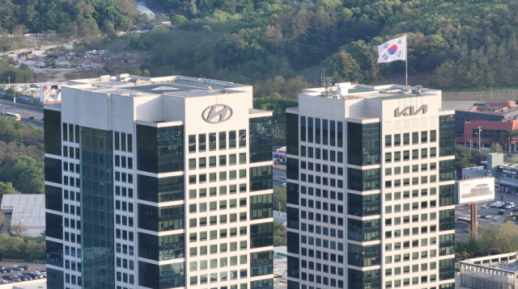 Hyundai flags battery subscription to spark EV boom from high fuel cost SEOUL, April 29 (AJP) - Contrary to the expectation that the Gulf-triggered energy crisis could renew the appetite for "plugging in," EV demand remains subdued. South Korea’s Hyundai Motor Group hopes to make the choice easier through a novel concept: lending battery chargers and subscriptions. Energy costs have climbed sharply amid the prolonged conflict between the United States and Iran. In Korea, gasoline prices rose from 1,819.2 won per liter in the fourth week of March to 2,003.8 won in the fourth week of April—an increase of nearly 200 won in just one month. Despite the pain at the pump, EV sales have not picked up as purchasing power remains constrained by a prolonged economic slowdown in Korea. Hyundai’s EV sales posted an overall decline in March, despite gains in some entry-level models. Ioniq 5 sales fell from 3,222 units in February to 2,382 in March and Ioniq 9 dropped from 1,751 to 1,239. Only the entry-level Casper Electric provided a rare boost, rising from 472 to 1,201 units. Overall, Hyundai's total EV sales declined from 5,445 to 4,822 units. Its sister carmaker, Kia, fared better. EV3 sales increased to 4,303 units, the EV5 surged from 2,524 to 6,884 units, and the PV5 jumped from 3,967 to 8,086 units, lifting Kia's total EV sales from 9,960 to 19,273 units. The broader market trend points to a shift in consumer behavior. Global auto demand fell 7.2 percent year-on-year in the first quarter, reflecting uncertainty tied to geopolitical risks. In this climate, hybrids are gaining traction as a more practical alternative. Hyundai Motor reported that global hybrid (HEV) sales reached 174,000 units in the first quarter—outselling its EVs (59,000 units) by nearly three times. HEV sales rose about 27 percent from a year earlier, with their share of total sales reaching a record 17.8 percent. In the United States, hybrids accounted for a record 24.8 percent of Hyundai’s sales. The gap between EV adoption and hybrid growth highlights ongoing concerns over EV ownership, particularly regarding battery life. “Since you usually keep a car for over 10 years, there is always concern about how long the battery will last,” said Oh Jun-su, a 34-year-old brand designer in Seoul who has driven a Kia EV4 for a year. He noted that EVs lack appeal on the used car market due to the battery factor. Replacement costs are a major hurdle, with industry estimates suggesting a new battery for a Kia EV6 can cost around 25 million won ($17,000). Hyundai is aiming to solve this through a battery subscription model. The conglomerate will begin a pilot program in the first half of the year, starting with Ioniq 5 taxis in the Seoul metropolitan area. The program focuses on corporate fleets whose warranties have expired. Under this model, users pay a monthly fee instead of purchasing the battery and can replace it when performance drops. This approach is supported by a regulatory sandbox that allows vehicles and batteries to be registered separately. In parallel, the company is expanding subscription-based charging. EV charging provider Chaebi has launched a package in partnership with Hyundai, offering discounted rates for monthly fees of 9,900 won or 19,900 won. Together, these efforts suggest automakers are experimenting with new usage models to finally lower the barriers to EV adoption. 2026-04-29 17:36:53
 -
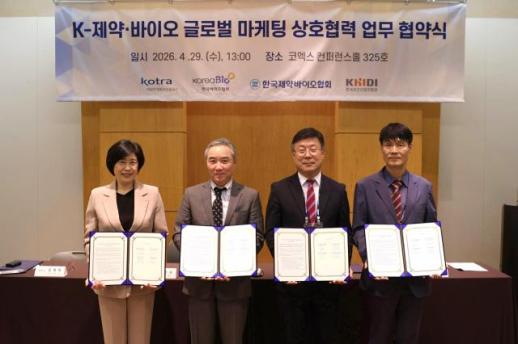 Korean Drug, Biotech Groups Form ‘One Team’ to Streamline Global Expansion Support A “K-Pharma Bio One Team” initiative aimed at strengthening the global competitiveness of South Korea’s pharmaceutical and biotech industry has officially launched. The Korea Pharmaceutical and Bio-Pharma Manufacturers Association said Tuesday it signed a memorandum of understanding at COEX in Seoul with the Korea Health Industry Development Institute, the Korea Bio Association and the Korea Trade-Investment Promotion Agency to cooperate on global marketing. The goal is to consolidate overseas expansion support programs that had been spread across different ministries and improve efficiency. The agreement was 추진됐다 to systematize support for Korean drug and biotech companies entering overseas markets through cooperation among affiliated and related organizations under the Ministry of Health and Welfare and the Ministry of Trade, Industry and Energy. As an industry representative, the association said it will set support priorities reflecting company demand and serve as a channel linking the private sector and government. Under the pact, the four organizations will cooperate on jointly analyzing demand for global market entry, identifying and resolving export difficulties, providing overseas market and company information, and marketing tied to major global exhibitions. They said they will strengthen end-to-end support, from strategy development to partner searches and commercialization. The cooperation will accelerate around the BIO International Convention, known as BIO USA, set for June in San Diego. BIO USA is the world’s largest life sciences exhibition, drawing pharmaceutical and biotech companies and research institutions. About 250 Korean companies are expected to take part this year. The four organizations said they will jointly support participating companies and, with other Korean organizations, hold a combined “Korea Night” reception. More than 600 industry participants are expected to attend, with the event aimed at expanding networks with global companies and investors. Noh Yeon-hong, chairman of the Korea Pharmaceutical and Bio-Pharma Manufacturers Association, said the agreement will be “an opportunity to further advance” the country’s support system for global expansion. “Through one-team cooperation, we will actively support strengthening corporate competitiveness and raising the industry’s standing,” he said.* This article has been translated by AI. 2026-04-29 17:36:51
 -
 Chinese Hot Pot, Malatang and Milk Tea Chains Rush Into South Korea Chinese-language food and beverage franchises are rapidly expanding their presence in South Korea’s dining market, with once-budget Chinese fare increasingly repositioned as trendy, premium spending through malatang, hot pot and milk tea. According to industry officials on April 29, Chinese milk tea brand Chagee plans to open stores simultaneously on April 30 in Gangnam, Sinchon and Yongsan. Chagee, which reinterprets traditional tea in a modern style, opened its first store in China’s Yunnan province in 2017 and has expanded quickly. It now operates about 7,000 stores across Greater China and in Malaysia, Thailand, Singapore, Indonesia, the Philippines, Vietnam and the United States. Other tea brands have already entered South Korea. Chinese milk tea brand Chabaidao entered in 2024 and is preparing to open its 28th store. Heytea, which arrived around the same time, has expanded from Apgujeong to major retail districts including Hongdae, Myeongdong and Garosu-gil. Milk tea brand Misher, which entered in 2022, operates 16 stores centered on university areas in Seoul. Meal-focused brands are also growing. Hot pot chain Haidilao, which entered South Korea in 2014 with its first store in Myeongdong, has expanded to locations including Jeju and Daegu and now directly operates 11 stores nationwide. Despite a per-person check of about 40,000 to 60,000 won, it has drawn strong interest among younger consumers, with waits of more than three hours reported. Its sales rose 50.9% to 117.7 billion won last year from 78.1 billion won a year earlier, topping 100 billion won. Operating profit nearly doubled to 20.2 billion won from 11.0 billion won. Malatang franchise Tanghua Kungfu, which arrived in 2013, had 560 stores as of March, becoming the first malatang brand in South Korea to surpass 500 outlets. Sales rose 14.6% last year to 25.4 billion won, and operating profit increased to 11.0 billion won from 10.5 billion won. Its operating margin was 43.5%. Analysts link the overseas push to slowing growth at home. China’s National Bureau of Statistics said 2024 restaurant revenue rose 5.3% from a year earlier to 5.5718 trillion yuan, a sharp slowdown from growth above 20% in 2023. With competition intensifying in the domestic market, brands that already run thousands of stores are increasingly looking abroad. South Korea is seen as an attractive target because of strong consumer purchasing power and the speed at which trends spread on social media, helping new brands gain traction. Industry officials also point to the deep penetration of Chinese e-commerce platforms such as AliExpress, Temu and Shein, which they say makes it easier to gauge Korean consumer preferences and data. “South Korea is a market with strong cultural influence,” a representative of a Chinese-language dining brand said. “Success in Korea is seen as a signal that a brand can work in global markets, so it is viewed as an important test bed.” Some warn the trend could add pressure to South Korea’s dining industry as competition intensifies amid weak domestic demand. The number of franchised food-service outlets in South Korea rose 1.5% last year to 183,714, while the franchise closure rate hit a record 15.8%. “Chinese franchises enter the Korean market with experience operating large-scale stores and strong cost competitiveness,” a South Korean dining franchise official said. “For domestic brands and self-employed owners, the competitive environment is bound to become even tougher.”* This article has been translated by AI. 2026-04-29 17:35:17
 -
 Nexen Tire Q1 Operating Profit Rises 33.1% to 54.2 Billion Won on Record Sales Nexen Tire said it posted record quarterly revenue despite slowing global demand, helped by stronger sales in Europe and the United States and a higher share of higher-margin products. In an earnings filing on April 29, the company said first-quarter operating profit rose 33.1% from a year earlier to 54.2 billion won. Revenue increased 8.7% to 838.3 billion won, the highest quarterly figure on record, it said. Net profit was estimated at 61.9 billion won, up 55.3% from a year earlier. Nexen Tire said solid sales in major markets including Europe and the U.S. lifted both revenue and operating profit. It said the sales mix shifted further toward higher-value products, including premium original equipment tires and tires for SUVs and electric vehicles. Tires of 18 inches and larger accounted for 40% of revenue, it said. The company also cited management efficiency efforts as improving overall profitability. During the first quarter, Nexen Tire launched its high-performance N'Fera Sport and all-weather N'Blue 4Season 2 in the domestic market after rolling them out in Europe and the U.S., targeting premium demand. In Latin America and the Asia-Pacific region, it introduced the N'Blue S, a high-efficiency summer tire, and said it is working with local distributors to strengthen retail competitiveness. It said it is seeing strong growth in key strategic markets such as Australia and Japan as it seeks to diversify its global sales structure. With external uncertainty expected to persist in the second quarter, Nexen Tire said it plans to continue efforts to strengthen its mid- to long-term growth foundation. "Despite an uncertain business environment, we delivered solid results," a company official said. "We will respond flexibly to market changes while continuing to strengthen product competitiveness and operational efficiency to sustain sound growth."* This article has been translated by AI. 2026-04-29 17:34:11
 -
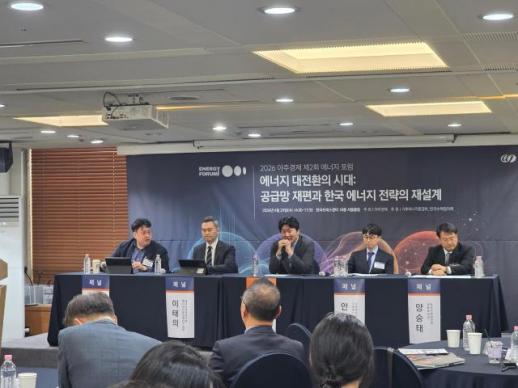 Experts urge balanced renewables-nuclear energy mix as supply chain risks grow Global geopolitical shifts and rising supply-chain risks are reshaping energy supply lines, prompting experts to call for a clear energy-mix strategy to secure South Korea’s stable power supply. Ajou Economy held the “2026 Ajou Economy Energy Forum” at the Press Center on the 29th and hosted a panel discussion on “Energy Mix Strategy for South Korea in the Era of Energy Security.” The session was moderated by Kim Hyeong-jun, a professor at KAIST’s Moon Soul Graduate School of Future Strategy. Panelists were Andre, a senior official in the Climate and Energy Policy Division at the Ministry of Climate, Energy and Environment; Lee Tae-ui, head of the Energy Security Policy Research Office at the Korea Energy Economics Institute; Yang Seung-tae, head of the Fuel Department at Korea Hydro & Nuclear Power; and Choi Deok-hwan, head of external cooperation at the Korea Wind Industry Association. Yang said nuclear power does not conflict with renewable energy, describing it as baseload generation that supports the national grid as renewables expand. He also said nuclear power’s cost advantages should be reflected in energy-mix policy. “Nuclear power produced about 31% to 32% of the nation’s electricity with an investment of 1.2 trillion won last year, and it is economical and highly resilient even if uranium prices rise,” Yang said. “We should make good use of nuclear power’s strengths to address issues such as renewables and transmission networks and move forward.” Andre pointed to expanding global supply-chain risks and urged policies that incorporate on-the-ground input to strengthen energy security. “After announcing the 2040 NDC last November, the recent Middle East war has brought a new perspective and many concerns about energy security,” he said. “To change the existing energy system, we need to consider not only production, consumption and distribution, but also the market tariff structure.” He added that the forum’s detailed discussions underscored the need for complex, multi-track solutions. Lee said countries must move quickly, warning that greenhouse gases already in the atmosphere will linger for centuries even if emissions are reduced. “The greenhouse gases on Earth have been here since 100 years ago,” Lee said. “Even if we cut emissions starting now, it could take hundreds of years for the greenhouse gases themselves to decline.” He added that cutting carbon emissions is difficult and requires major effort and time, and said countries should work aggressively to meet their Nationally Determined Contributions. Choi said economic hurdles must be overcome to maximize renewable energy use, warning that when regulatory deposits shrink, discussion of practical issues such as emissions permits and carbon reductions can fade. “When economic problems arise, the reality is that tools to respond to climate change, such as carbon reduction, are weakened,” Choi said. “Scope 3 greenhouse gases are not even being tracked in the current situation.” Choi also called for incentives for companies investing in renewables. “Right now, only state-run power generation companies are investing in renewables to score well in management evaluations,” he said. “We need to think about how to manage and revitalize this. Strengthening tax credits for companies that purchase renewable energy could also be an alternative.”* This article has been translated by AI. 2026-04-29 17:32:45