
Journalist

Lee Hugh
=
-
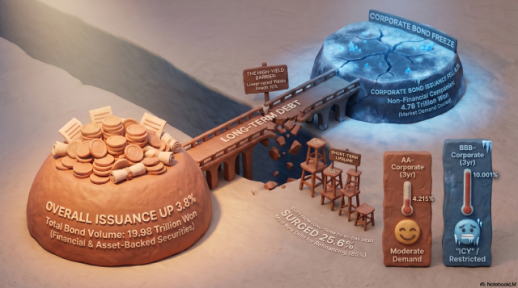 Korean Inc. turns to 91-day financing as corporate debt market remains icy SEOUL, April 29 (AJP) — South Korean companies are turning to three-month financing to meet debt obligation, as new bond issues become increasingly difficult with lower-rated yields hovering above 10 percent amid icy demand. Bond issuance by non-financial companies fell 6.5 percent from a month earlier to 4.78 trillion won in March, even as overall bond issuance rose 3.8 percent to 19.98 trillion won ($13.56 billion), according to data released Wednesday by the Financial Supervisory Service (FSS). The increase was driven largely by financial issuers and asset-backed securities (ABS), while corporate bond issuance was mostly limited to refinancing existing debt. “Excluding the first quarter, April is a period with a heavy repayment burden, with 10.7 trillion won in corporate bonds reaching maturity,” said Kim Eun-ki, a researcher at Samsung Securities. “The overall atmosphere for issuers is to wait out the storm as bond yields are rising fast.” Corporate bonds recorded a net repayment of 449 billion won in March, following a 3.41 trillion won net repayment in February, marking two consecutive months of net outflows. About 85.6 percent of general corporate bonds issued in March were used to repay existing debt, while 98.5 percent of issuance came from A-rated or higher investment-grade companies, underscoring risk aversion on both the demand and supply sides. Companies are cancelling or downsizing debt offerings as bookbuilding demand weakens and yields rise rapidly. Recent deals also point to growing market bifurcation. Mid-tier issuers such as Lotte Hi-Mart and LG HelloVision were forced to price bonds at around 20 to 40 basis points above fair value, with order books barely covering the deal size. By contrast, top-tier borrowers continued to draw demand several times the amount offered. Maturities are also getting shorter. Long-term bonds with maturities of more than five years amounted to just 120 billion won, or 2.5 percent of total issuance. Medium-term bonds of one to five years accounted for 97.5 percent, showing that companies are avoiding long-term financing amid persistent rate pressure. Issuers are raising only the minimum needed to meet debt obligations. An estimated 10.7 trillion won in general corporate bonds comes due this month, adding pressure to refinance in an unfavorable rate environment. As of Wednesday morning, the three-year government bond yield stood at 3.525 percent, while the three-year AA- corporate bond yield was 4.185 percent. The resulting credit spread of about 65 basis points has widened from around 50 basis points in the second half of last year, indicating that the credit premium paid by companies is rising again. The gap is far wider in the lower-rated market. The three-year BBB- corporate bond yield reached 10.001 percent, pushing the spread against AA- bonds to about 580 basis points. That is approaching levels seen during the 2022 Legoland crisis, when the credit market tightened sharply and the AA- to BBB- spread widened to around 600 basis points. Market watchers say access to bond financing is again becoming effectively restricted for lower-rated companies. Their lifeline are 91-day commercial papers whose rate stood at 3.06 percent, about 115 basis points lower than the AA- corporate bond yield. That makes short-term borrowing a much cheaper option for companies trying to bridge near-term maturities. Total issuance of commercial paper and short-term bonds reached 200.47 trillion won in March, up 25.6 percent from the previous month. The surge suggests that corporate funding strategies are shifting from long-term debt to short-term financing, rather than merely reflecting a temporary rise in liquidity demand. 2026-04-29 16:44:11
 -
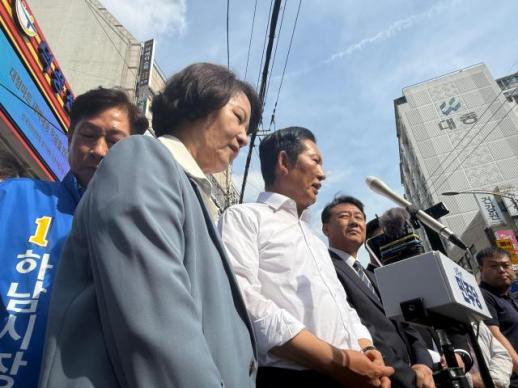 Democratic Party leader Jeong Cheong-rae campaigns in Hanam for Choo Mi-ae and Lee Kwang-jae Jeong Cheong-rae, leader of the Democratic Party, visited Hanam in Gyeonggi Province on April 29 to rally support for Choo Mi-ae, the party’s candidate for Gyeonggi governor, and Lee Kwang-jae, who is running in the Hanam-gap by-election. Jeong joined Choo and Lee that afternoon at Hanam’s Deokpung traditional market to begin campaign activities. Their first stop was a rice-cake shop, where Jeong fed rice cakes to Choo, Lee, Rep. Kim Yong-man, and Kang Byeong-deok, the Democratic Party’s Hanam mayoral candidate, among others. They then visited dried-goods and produce shops. Introducing Choo, Lee and Kang, Jeong said, “I will work for Hanam. Choo has come back bigger, and Lee has come to become bigger.” Jeong also highlighted the achievements of President Lee Jae-myung. When a produce-shop owner thanked him, saying, “Thank you for doing well. You’ve worked hard,” Jeong replied, “The president is working hard.” Some market users objected to the visit. A male vendor complained to security guards protecting Jeong, saying, “What are you doing in someone else’s market? The guards are pushing people.” A middle-aged woman, upset by the congestion caused by the Democratic Party group, scolded Jeong, saying, “Why are you doing this here? Let me shop.”* This article has been translated by AI. 2026-04-29 16:43:35
 -
 GM Korea Union Seeks 30 Million Won Bonus, 149,600-Won Monthly Base Pay Raise The GM Korea branch of the Korean Metal Workers' Union said Tuesday it has finalized its 2026 wage and labor contract demands, calling for a performance bonus of about 30 million won per union member and a 149,600-won increase in monthly base pay. The union said it confirmed the proposal through a recent meeting of interim delegates. It said the bonus was calculated by allocating 15% of 10% of GM Korea's total sales last year, which it put at 12.6 trillion won, to about 6,300 union members and others. In special demands aimed at future growth prospects and job security, the union included assigning production of follow-up models, future vehicles and next-generation engines. It also called for investing more than 50% of retained earnings in South Korea, restoring domestic market share to 10% and diversifying export markets. The proposal also includes launching the Buick Envista in South Korea, a model the company currently produces domestically and exports entirely. The union said it plans to discuss with management measures to ensure and strengthen the sustainability of the service technology center and high-tech center, as well as issues involving nonregular workers.* This article has been translated by AI. 2026-04-29 16:39:51
 -
 Nvidia executive Madison Huang meets Samsung, SK hynix and Doosan to expand physical AI ties Madison Huang, a senior director for Omniverse and robotics product marketing at Nvidia and the eldest daughter of CEO Jensen Huang, has been meeting with executives at major South Korean companies including Samsung Electronics, SK hynix and Doosan Robotics to pursue cooperation on physical artificial intelligence, industry officials said. Officials said Huang, who is visiting South Korea, met Wednesday morning with key executives from Samsung Electronics and SK hynix to discuss ways to build a physical AI ecosystem spanning semiconductors and robot platforms. The talks were seen as a review of supply chains for high-performance AI chips that serve as a robot’s “brain,” and as an effort to identify practical cooperation models that combine Nvidia’s robot simulation platform, Omniverse, with the manufacturing capabilities of South Korean hardware makers. Omniverse, sometimes described as Nvidia’s metaverse, is used to train robots in a virtual environment. Later Wednesday, Huang visited the Doosan Robotics Innovation Center for a meeting with Doosan Robotics CEO Kim Min-pyo. The two discussed ways to integrate Nvidia’s AI and robotics ecosystem into Doosan Robotics’ intelligent robot solutions and industrial humanoids, officials said. Doosan Robotics aims to link its robot-dedicated execution software, described as an “agentic robot operating system,” with Nvidia’s AI, robotics simulation and training infrastructure to build a robot execution platform that can be deployed at industrial sites. Huang held broad discussions on cooperation a day earlier with Hyundai Motor and LG Electronics. Hyundai Motor Group Executive Chair Chung Euisun met Huang in person to review ways to strengthen a next-generation physical AI partnership spanning semiconductors and mobility, the report said. Hyundai and Nvidia have recently been expanding their technology alliance from software-defined vehicles to humanoid robots, in what was described as a strategic move to go beyond product cooperation and secure an edge in physical AI standards. With LG Electronics, Huang discussed specific steps centered on robots and AI infrastructure. After meeting for about 1 hour and 10 minutes with LG Electronics President Ryu Jae-cheol and other executives, Huang said they had “fantastic discussions” on “physical AI, AI infrastructure solutions and robotics.” The report said the talks included in-depth discussion of applying Nvidia’s robotics platform, Isaac, to LG’s next-generation home robot, “Cloyd,” unveiled at CES 2026. Under the concept described, Nvidia would provide graphics processing units and simulation technology, and LG would use them to build an “AI home partner” capable of autonomous decision-making. In February, Huang also attended a meeting in Silicon Valley between SK Group Chairman Chey Tae-won and Nvidia CEO Jensen Huang. Industry watchers expect Huang’s latest trip to help turn that coordination into concrete business cooperation.* This article has been translated by AI. 2026-04-29 16:38:40
 -
 Science Ministry Checks Deployment of Homegrown AI Chips as Commercial Use Expands South Korea’s Ministry of Science and ICT has begun on-site checks at major AI companies as it moves to speed adoption of Korean-made neural processing units, or NPUs. The ministry said it visited SK Telecom’s Incheon data center and LG AI Research on the 29th to review how domestic AI semiconductors are being used in real services and to hear feedback from companies. The visit was arranged to assess the rollout of Korean-made NPUs. At SK Telecom’s Incheon data center, Lee Do-gyu, director general for ICT Policy at the ministry, toured the site with Park Byeong-gwan, head of SKT’s core platform, and Park Seong-hyeon, CEO of Rebellions. Servers installed there use Rebellions’ data center NPUs, ATOM and ATOM MAX. Park said SKT is applying servers based on ATOM and ATOM MAX to A.Dot’s phone-call summary service and to X Caliber, a companion-animal video diagnostic support service. He said the company plans to keep expanding commercial services based on ATOM MAX. SKT said A.Dot’s call-summary service, built on its in-house large language model A.Dot X (A.X), handles up to 50 million API calls a day. At LG AI Research, the ministry was briefed on AI service development that combines the institute’s in-house large language model EXAONE with FuriosaAI’s NPU, Renegade (RNGD). Renegade is a Korean-made AI chip that uses high-bandwidth memory, or HBM, and is designed to deliver the data-processing performance needed to run large AI models. The ministry described it as a case of building an “AI full stack” by pairing a domestic LLM with a domestic semiconductor. Lee said the ministry confirmed on the ground that Korean-made AI semiconductors are being applied to real services. He said the government will continue policy support so AI chips that have entered full-scale mass production can spread quickly in the market.* This article has been translated by AI. 2026-04-29 16:37:43
 -
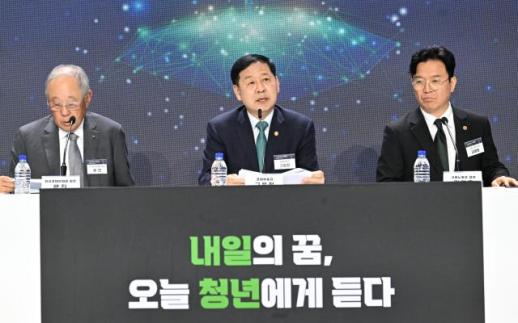 South Korea Unveils Youth New Deal to Expand Training and Help 100,000 Find Jobs Unemployed young people total 171, and the youth employment rate stood at 43.5% in the first quarter, underscoring a prolonged hiring slump for people in their 20s and 30s. The government said it drew on feedback from young people to craft a “Youth New Deal implementation plan” built around three tracks — advancement, experience and recovery — to support entry into the workforce. The government announced the plan on the 29th at a public-private Youth New Deal briefing chaired by Deputy Prime Minister and Minister of Economy and Finance Koo Yun-cheol, in a joint release with related ministries. Under the advancement track, the government will provide job training and education programs to 19,000 young people through private companies and universities. It will also launch the “K-New Deal Academy,” a 10,000-person program designed and run directly by private companies that hire, offering training for jobs in areas such as artificial intelligence and semiconductors, as well as youth-preferred fields including finance and content. Companies will also run voluntary programs such as psychological and career counseling and workplace adjustment support. Young people facing barriers to employment, including long-term unemployment, will be given priority in selection. Companies and participants outside the Seoul metropolitan area will receive preferential support for training costs and participation allowances. Short, intensive university courses previously limited to enrolled students will be linked to a “Youth Advancement Talent Boot Camp” and opened to 4,000 job-seeking young people who are not currently students. Two tracks — advanced-talent and practical-talent — will offer level-based curricula tailored from non-majors to majors. The experience track will expand work-experience programs by 22,000 slots and centrally manage participation records to support practical, job-relevant career building. In the public sector, the government will newly hire 9,500 staff to verify the status of delinquent national taxes and non-tax revenues and pursue tailored collection by debtor type. It will also hire 4,000 workers for a comprehensive farmland survey, including building databases to curb farmland speculation and track ownership and use. New programs will allow 2,500 young people to gain experience in social solidarity economy organizations — including social enterprises, village enterprises and cooperatives — in areas such as care, culture and the environment. The government also plans to expand public-institution youth internships by 3,000 from last year. In the private sector, the government will create or expand job-linked courses in youth-preferred fields such as tourism, content, culture and arts, and digital. It will also increase existing private work-experience programs by 1,500, focusing on in-demand internship-type placements and environmental, social and governance support roles. Participation records in Youth New Deal programs will be integrated and issued through an online platform, Employment 24, so they can be recognized as official experience in the job market. Under the recovery track, the government will run a close-support program covering the full cycle from counseling and daily-life recovery to job training and employment. It will expand Youth Future Centers that provide tailored services from four to 17 locations, and increase by 1,000 the Youth Challenge Support Program for young people who have given up job searching. Additional recovery programs — including parent and family relationship education and economic camps — will be offered to a total of 11,000 participants. To support job searches and hiring, the government will also redesign and upgrade youth employment support infrastructure. It will create a youth-focused track within the National Employment Support System and expand support, including job-search promotion allowances, to 30,000 more people. The government will broaden eligibility for the Youth Job Leap Subsidy — which pays up to 7.2 million won each to youth-hiring companies and to young workers who stay long term — from mid-sized firms in non-metropolitan industrial complexes to all mid-sized firms outside the Seoul metropolitan area. It will also expand low-interest loan support for young small business owners or small business owners who hire young people. A ministry official said the plan is expected to provide employment-related services to about 100,000 young people. “The government will prepare the programs without disruption so young people can quickly benefit from these measures,” the official said.* This article has been translated by AI. 2026-04-29 16:36:47
 -
 South Korea Lawmakers Push Strategic Export Finance Fund to Boost Arms Sales South Korea’s National Assembly began accelerating debate on legislation aimed at closing a financing gap that has hindered defense exports, as competition in large export projects increasingly hinges on bundled financial support. The Assembly’s Fiscal and Economic Planning Committee held a public hearing April 29 at the main Assembly building to discuss the need for the proposed Strategic Export Finance Support Act. The bill, introduced by Democratic Party lawmakers Han Jeong-ae and Ahn Do-geol and others, would establish a Strategic Export Finance Fund to build a system for timely financing in export projects where competition between countries is intense. Speakers said the global defense market has shifted beyond price competition to “financial package” competition, with buyers often demanding technology transfer, offset deals and investment as part of contract terms — burdens difficult for companies to shoulder alone. Korea’s defense firms, despite favorable conditions tied to the Middle East and the Russia-Ukraine war, have struggled to secure policy financing. Data released from the Export-Import Bank of Korea showed defense industry lending accounted for just 4.7% last year, compared with ships at 19.3%, construction plants at 11.1%, autos at 9.9% and electronics at 9.9%. To supplement limited lending, the bill calls for creating the fund through contributions from exporters that receive support such as buyer’s credit. Companies would pay about 1% of the disbursed amount, or up to 5% if linked to export industry cooperation, to help backfill financing shortfalls. Kwon Heon-cheol, a professor of defense economics at Korea National Defense University, said fast-growing defense exports face heavy burdens including offset deals. “Large-scale exports require buyer’s credit and guarantees to be combined, so national-level financial support is needed,” he said. Park Chang-gyun, a research fellow at the Korea Capital Market Institute, said existing policy finance has limits in spreading risk across individual firms, making a separate fund necessary for a stable supply of support. The hearing also cited recent defense exports to Poland as an example of constraints. In a $44 billion project, the Export-Import Bank of Korea and the Korea Trade Insurance Corp. provided about $15 billion, but later faced limited additional capacity, affecting the bidding competitiveness of major Korean defense companies. Some participants urged revisions to avoid overlap with a separate bill introduced by the National Defense Committee to create a defense industry development and export promotion fund. Attorney Park In-yong of law firm Yulchon said he agreed with the purpose of the export finance bill but called for clarifying the relationship and scope of the bills to prevent double charges. Industry representatives also warned that contributions of up to 5% could be burdensome. Ahn Sang-nam, head of the defense promotion division at the Korea Defense Industry Association, said requiring an additional 5% payment on supported amounts could create a double cost burden that small and partner firms may struggle to bear. He urged lowering the contribution rate from 5% to 1% to strengthen competitiveness across the defense supply chain. The Fiscal and Economic Planning Committee is set to hold a full meeting April 30 to decide whether to send the bill to a plenary session. If passed, officials plan to pursue institutional steps with a goal of establishing the fund in September. Committee Chair Lim I-ja said there are concerns that exporters’ burdens could be excessive during the fund-raising process and said the bill needs improvements, including addressing potential overlap with policy finance and fairness issues in profit distribution.* This article has been translated by AI. 2026-04-29 16:34:55
 -
 Samsung C&T Construction Q1 Operating Profit Falls 30% to 111 Billion Won Samsung C&T Corp.’s construction division said April 29 that its first-quarter operating profit fell 30.1% from a year earlier to 111 billion won. Revenue for the quarter slipped 5.7% to 3.413 trillion won, it said. A company official cited one-time costs and the completion of major projects as reasons revenue and operating profit declined from a year earlier. The official said results are expected to improve gradually as key businesses continue to move forward steadily. For Samsung C&T overall, the company reported revenue of 10.466 trillion won and operating profit of 720 billion won. Another company official said the firm maintained solid results despite an uncertain business environment, including geopolitical risks, and the impact of one-time costs, citing a diversified business portfolio and competitiveness.* This article has been translated by AI. 2026-04-29 16:34:00
 -
 Ador seeks property seizure as Danielle and Min Hee-jin face deepening legal rift SEOUL, April 29 (AJP) - Ador has secured a provisional attachment on the real estate assets of former NewJeans member Danielle, her mother, and former chief executive Min Hee-jin as the legal fallout from the K-pop industry’s most high-profile corporate schism intensifies. According to Legal sources, the court filing was confirmed on Wednesday, ahead of a full-scale trial scheduled for May, and would represent a tactical shift by the Hybe-owned label to freeze the financial resources of its former star artist and executive leadership. The move underscores the volatile transition of NewJeans from a unified global chart-topper to a fractured group caught in a precedent-setting battle over corporate control and creative independence. At its core, the dispute tests the durability of the multi-label model pioneered by Hybe, demonstrating how the intense loyalty between artists and their creative directors can destabilize the financial foundations of billion-dollar entertainment conglomerates. The conflict traces back to April 2024, when Hybe launched an unexpected audit of Ador, its subsidiary label founded by Min. Hybe accused the former executive of orchestrating a plan to seize independent control of the label and its primary asset, NewJeans, by seeking outside investment and leaking confidential business data. Min denied the allegations, characterizing the audit as a retaliatory strike after she raised concerns that another Hybe-managed group had plagiarized the artistic concept of NewJeans. The ensuing months were marked by a series of public press conferences and court injunctions that divided the K-pop industry and its global fanbase. While a Seoul court initially blocked Hybe’s attempt to fire Min as chief executive, citing a lack of evidence for actual implementation of a takeover, the corporate relationship remained untenable. By late 2024, Min was replaced as chief executive, leading to a direct confrontation between the members of NewJeans and the new Ador management. The members of the group, known for their distinct Y2K-inspired aesthetic and massive streaming success, took the unprecedented step of airing their grievances in a live broadcast, demanding the reinstatement of their former Ador chief. This internal friction eventually led to the departure of Danielle, also known as Mo Ji-hye, who has since aligned herself with Min’s newly established venture, OK Records. The upcoming May proceedings are expected to address the broader financial claims leveled by Ador, which has sought damages for what it describes as catastrophic disruption to the group’s activities. The real estate attachment serves as a legal guarantee to ensure that any potential financial penalties can be collected if the court rules in favor of the label. Lawyers representing Min and Danielle have not issued a formal statement regarding the specific property filings. The Seoul Central District Court is expected to begin hearing oral arguments on the merit of the underlying damages claim within the next month. 2026-04-29 16:33:49
 -
 LG Electronics Cites Uncertainty, Plans B2B, Subscription and Online Push LG Electronics said on April 29 that external uncertainty, including the war in the Middle East and concerns about U.S. inflation, has delayed a recovery in consumer sentiment and weighed on revenue. The company said operating profit faced pressure from some higher raw material prices and the impact of tariffs that intensified in the second half of last year, but it is maintaining solid profitability by expanding higher-margin businesses. LG Electronics said uncertainty will remain high in the second quarter, citing volatility in U.S. tariff policy and the possibility that interest-rate cuts could be delayed. It added that the war in the Middle East and rising prices make it difficult to expect a demand rebound. As a response, the company said it will strengthen its product lineup and expand its B2B, subscription and online businesses. LG Electronics said it will continue revenue growth by stepping up its push into Global South markets, focusing on the fast-growing B2B, subscription and online segments. On its vehicle components business, LG Electronics said a clear recovery in global automaker demand is likely to remain limited for the time being. It said it will respond to market volatility by expanding mass production for new projects and reshaping its portfolio toward higher value-added products. The company added that it plans to sustain profit-based growth by focusing on strategic customer collaboration and cost efficiency.* This article has been translated by AI. 2026-04-29 16:33:15