
Journalist

Lee Hugh
=
-
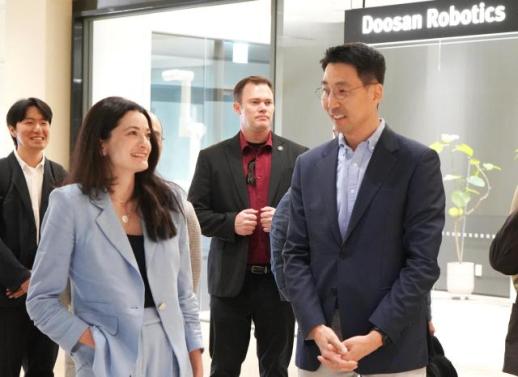 Nvidia Executive Visits Doosan Robotics to Discuss Industrial Humanoid Commercialization Doosan Robotics and Nvidia are teaming up to prepare for the next phase of humanoid robotics. Doosan Group said on the 29th that Madison Hwang, Nvidia’s senior director for Omniverse and robotics product marketing, visited the Doosan Robotics Innovation Center in Bundang-gu, Seongnam, and met with Doosan Robotics CEO Kim Min-pyo to discuss technical cooperation between the two companies. The visit was arranged to explore how Nvidia’s AI and robotics ecosystem could be applied to Doosan Robotics’ intelligent robot solutions and industrial humanoids now under development. At the center of the talks is linking Doosan Robotics’ robot-dedicated execution software, the “Agentic Robot O/S,” with Nvidia’s AI and robotics simulation and training infrastructure. The companies said they aim to build a robot execution platform that can be deployed in real industrial workplaces. Doosan Robotics described the Agentic Robot O/S as software that uses AI to understand a work environment, optimize routes and support safe, precise operations. To advance the operating system, the company said it is reviewing steps including building a robot-to-AI interface, developing standard robot-control protocols, connecting specialized task models and applying technical guardrails for safety control, with plans to flesh out those efforts through cooperation with Nvidia. Doosan Robotics said it plans to roll out an intelligent robot solution based on the Agentic Robot O/S in 2027, followed by an industrial humanoid product in 2028. It also said it is pursuing a plan to present the results of the collaboration with Nvidia at major global exhibitions such as CES in 2027. “The success of physical AI depends not only on how smart the AI model is, but also on the stability of the execution platform that runs it in the field without error,” Kim said. “Based on today’s discussions, we will combine Doosan’s hardware manufacturing capabilities with Nvidia’s software ecosystem to push commercialization of intelligent robot solutions and industrial humanoids.”* This article has been translated by AI. 2026-04-29 15:52:49
 -
 Philip Morris Korea Names Heated-Tobacco Specialist Lee Hong-seok as New CEO Philip Morris Korea has appointed an internal marketing and strategy executive to lead its push for a “smoke-free future,” naming Lee Hong-seok, head of its smoke-free products business, as its next chief executive. The company said Tuesday that Lee, currently director in charge of smoke-free products, will become CEO effective May 1. Lee joined Philip Morris Korea in 1999 and has spent more than 25 years across key roles, the company said, earning recognition for results in domestic commercial operations and marketing. The company also cited his overseas leadership. Lee worked in Singapore and Hong Kong before becoming head of Philip Morris’ Taiwan unit in 2018, where he led efforts to develop business models and drive organizational changes amid a rapidly shifting market. After returning to Korea in 2021, he led commercial operations and later oversaw smoke-free products. Philip Morris Korea said he expanded its lineup of smoke-free products, including heated tobacco, and strengthened customer satisfaction, supporting qualitative growth in its local business. Lee said he will deepen cooperation with the government, public health experts and other stakeholders so that efforts to shift to smoke-free products can contribute to Korea’s broader public health goals. He also pledged to play a constructive role in Korean society through “open and scientific dialogue” and continued innovation.* This article has been translated by AI. 2026-04-29 15:47:25
 -
 Japan Pushes Defense Spending Hike While Pursuing Tax Cuts, Subsidies Japan is pursuing an unusual fiscal course: sharply increasing defense spending while also pushing consumption-tax cuts and continuing subsidies, according to a report by the Nihon Keizai Shimbun, or Nikkei, on April 28. With the Donald Trump administration pressing allies to spend more on defense, many major countries are seeking new revenue or cutting other outlays to pay for it. Japan, by contrast, is trying to do both — fund “guns” and “butter” at the same time, the report said. According to Nikkei, the Takaichi Cabinet on April 27 launched an expert panel on strengthening defense capabilities. The government plans to pursue revisions this year to the “three security documents,” with expanded defense spending emerging as a central issue alongside policies such as the use of drones and artificial intelligence. The report said the backdrop is strong pressure from Washington. The United States is calling on allies to raise “core defense spending” to 3.5% of gross domestic product and total security-related spending, including infrastructure, to 5%. Japan is maintaining its position that it will not present a single total defense-spending figure, instead adding up individual budget items. But as NATO, South Korea and Australia announce plans aligned with U.S. demands, Japan faces a tougher environment for holding out, Nikkei said. Other countries have already begun tightening budgets. France has moved to strengthen taxation on the wealthy and curb increases in some spending, including education, to support military expansion. Britain has decided to allocate cuts in its foreign aid budget to higher defense spending. Nikkei said the moves reflect deepened awareness of fiscal discipline after the so-called “Truss shock,” which triggered a surge in interest rates. Australia, too, has announced plans to nearly double defense spending from 59 billion Australian dollars (about 55 trillion won) to 112.1 billion Australian dollars (about 105 trillion won) by fiscal 2035, while considering restraint in spending for a large disability insurance program used by 760,000 people. Japan is taking a different approach. Under what it calls “responsible, proactive fiscal policy,” the Takaichi administration has kept alive discussions of cutting the consumption tax and has continued gasoline subsidies, citing higher oil prices tied to instability in the Middle East. Spending is estimated at about 500 billion yen a month, the report said, and there are no parallel steps aimed at curbing demand. With both ruling and opposition parties broadly favorable to tax cuts and expanded spending, political checks are not functioning, Nikkei said. The approach runs against the classic economic “guns versus butter” tradeoff, in which military spending and domestic programs compete for limited resources. Nikkei noted that there is little domestic pushback against Takaichi’s election pledge to “catch both rabbits at once.” Concerns about fiscal sustainability remain. When the three security documents were drawn up in 2022, a government advisory body listed “stability of the fiscal foundation” as a precondition for strengthening defense capabilities and stressed the importance of maintaining market confidence. Keishi Ono, a senior researcher at the National Institute for Defense Studies, told Nikkei that Japan must consider defense, public finances and the economy in an integrated way. He said a strategy is needed that goes beyond simple spending increases, including steps tied to productivity gains such as investment in defense-sector startups. Nikkei said whether Japan’s “guns and butter” approach can become a sustainable growth model — or instead weaken another pillar of security by undermining fiscal health — is expected to come into clearer view during the planned revisions to the three security documents later this year. * This article has been translated by AI. 2026-04-29 15:46:30
 -
 Korea FTC Names Coupang Chair Kim Beom-seok as Group Head, Raising Regulatory Stakes South Korea’s Fair Trade Commission has designated Coupang’s “same person” — the group head for oversight purposes — as Kim Beom-seok, chair of Coupang Inc., replacing the current designation of the company as a corporate entity. The FTC said its assessment that Kim’s younger brother, Kim Yu-seok, is involved in management was a decisive factor. The change is expected to tighten governance scrutiny as Coupang also faces multiple pending FTC investigations. According to industry officials on Tuesday, Kim Yu-seok’s role inside the company was widely seen as the key variable behind the shift. The FTC first designated Coupang as a large business group subject to disclosure in 2021, but named the corporation — not Kim — as the group head. While the agency viewed Kim as effectively controlling Coupang, it cited the lack of precedent for naming a foreign national as group head and concerns that enforcement tools, including curbs on self-dealing, would be less effective in such cases. In May 2024, the FTC revised and implemented an enforcement decree under the Monopoly Regulation and Fair Trade Act to set exception requirements for corporate group-head designations, and it concluded Coupang met them. However, during a National Assembly hearing last year, the FTC said it determined the company no longer satisfied the exception conditions — including the requirement that relatives not participate in management of domestic affiliates — after Kim Yu-seok was identified as holding the title of vice president. The FTC is also reported to have confirmed his status through on-site inspections, including checking compensation for other registered executives. Choi Jang-gwan, director general of the FTC’s Corporate Group Monitoring Bureau, said at a briefing that what mattered was not “formal aspects” such as title or pay, but whether the person’s involvement and compensation were comparable to registered executives who substantially take part in management. He said Coupang has internal tiers for participation in major decisions and that Kim Yu-seok was “almost at the top level” by that measure. The redesignation is expected to significantly increase regulatory requirements across Coupang’s governance structure. Disclosure obligations will expand to include overseas affiliates. Once a year, Coupang must disclose general and shareholder information for foreign affiliates in which Kim and his relatives together hold at least 20% of total issued shares. Coupang must submit related materials to authorities by the end of next month. The company is also expected to fall under Article 47 of the fair trade law, which bans unfair provision of benefits to related parties, often described as restrictions on self-dealing. When the corporation was designated as group head, Coupang was not subject to that provision. With Kim designated as the individual group head, regulators are expected to closely monitor whether group companies provide business opportunities or improper benefits on favorable terms to firms controlled by relatives. Analysts also said pressure could rise on Kim to shoulder social responsibility as the group’s de facto controller. They said that in the event of major issues such as serious safety accidents or labor disputes, it would be harder to justify refusing requests to appear before the National Assembly, and scrutiny could intensify. With the designation process completed, the FTC may also accelerate deliberations on sanctions in major pending cases involving Coupang. Those include allegations of tying related to the Wow membership program and allegations that Coupang Eats demanded most-favored treatment. 2026-04-29 15:45:29
 -
 EcoPro BM Q1 Operating Profit Jumps 823% as ESS Cathode Sales Rise EcoPro BM said in a regulatory filing on Tuesday that it posted first-quarter consolidated revenue of 605.4 billion won and operating profit of 20.9 billion won. Revenue fell 3.9% from a year earlier, while operating profit surged 822.6%. The company attributed the results to increased cathode material supply for electric vehicles in Europe and rising global demand for energy storage systems driven by the spread of AI infrastructure. Sales of cathode materials for ESS used to provide stable power for data centers rose 140% from a year earlier. As AI-related semiconductor production facilities expand and more large-scale data centers are built, shipments for power applications such as power tools increased 44% from a year earlier. Kim Jang-woo, EcoPro BM’s CEO, said the company will continue to expand supplies of high value-added cathode materials in line with the spread of AI and a recovery in the electric vehicle market. “Through the successful mass production at our Hungary plant, we will establish ourselves as a key player in the European supply chain and maintain a steady growth trajectory,” Kim said.* This article has been translated by AI. 2026-04-29 15:44:43
 -
 Ajinomoto Breaks Ground on New Plant in Tarlac, Philippines Aboitiz Group’s industrial park unit said on the 27th that Ajinomoto has started construction of a new plant at the TARI industrial park it operates in Tarlac province, north of Metro Manila. The facility is expected to reach full operation by April 2028. A groundbreaking ceremony was held locally on the 22nd. Ajinomoto will invest about 9.1 billion pesos (about 23.8 billion yen) to build the plant on a 16-hectare site. The new facility will handle manufacturing and packaging of locally popular products including the flavor seasoning “AJI GINISA” and chicken powder “Crispy Fry.” Aboitiz Economic Estates, which develops and operates the TARI industrial park, said a combination of proximity to demand centers, supply-chain responsiveness and room to expand has become decisive for manufacturers choosing new production bases. It added that Central Luzon, including Tarlac, is strengthening its position as a leading industrial base that could replace the existing manufacturing cluster in the Calabarzon (Southern Tagalog A) region. 2026-04-29 15:43:36
 -
 Blue House Unveils Plan to Strengthen Civil Service, Including Fast-Track Promotions The Blue House said April 29 it will pursue a broad overhaul to strengthen the civil service, including training specialist officials, revamping promotion systems and expanding recruitment from the private sector. Presidential Chief of Staff Kang Hoon-sik told a briefing at the Blue House press center that the government needs stronger expertise and skills among public officials “not only to overcome emergency situations, but to turn crises into opportunities and make a leap forward.” The government has operated a task force at the Blue House since late last year and, with relevant ministries, prepared five major initiatives aimed at boosting public-sector capacity. First, it plans to develop specialist civil servants who are not rotated through posts. In areas requiring high expertise — including artificial intelligence, international trade and labor supervision — officials would serve for at least seven years, and the government would manage them across ministries rather than within individual agencies. By converting existing general-service officials into specialists, the government plans to secure more than 700 this year and increase the total to more than 1,200 by 2028. When adding new positions, it would designate a set share as specialist posts and run a “two-track” personnel system. The plan also introduces a “fast-track” promotion program for fifth-grade officials to help capable working-level staff move more quickly into management. Promotions would come earlier after performance and competency reviews, starting with 100 people this year and expanding gradually to embed a results-oriented culture. To increase openness, the government will expand the inflow of private-sector talent. It plans to raise the share of open recruitment posts at the director-general and division director levels in central ministries to at least 12% by 2030, abolish salary caps tied to positions, and ease the burden of restrictions on post-retirement employment, Kang said. It also plans to step up personnel exchanges between local and central governments and among ministries. A project-based exchange system to provide “one-stop” support for large regional projects will be piloted in integrated local governments, with the aim of leveling up government capacity and flexibly using talent inside and outside government to deliver policy results more quickly. The government will also build a tailored training system to strengthen job skills. It plans to introduce self-directed learning accounts that officials can use for items such as AI subscriptions or professional certifications, along with “learning days” of up to three days a year dedicated to capacity building. In addition, it will systematically manage overseas human networks and gradually integrate and link network information scattered across overseas missions, ministries and public institutions, with the goal of maximizing national interests and protecting citizens. Kang said the government will “immediately revise relevant laws and regulations and move quickly to implement” the initiatives, adding that the measures will help the government and civil service “make a breakthrough leap” in a rapidly changing environment. He said the government will continue to pursue reforms to remove entrenched practices in the civil service to support more proactive and responsible administration.* This article has been translated by AI. 2026-04-29 15:37:54
 -
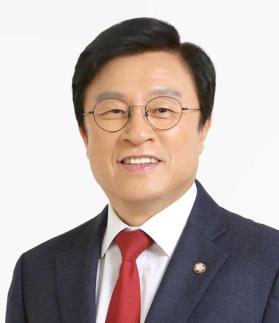 Rep. Park Hyeong-su urges balanced expansion of renewables and nuclear power Rep. Park Hyeong-su of the People Power Party said South Korea needs a major shift to an “energy mix” that can deliver both stable power supplies and carbon reductions, calling for balanced expansion of renewable energy and nuclear power. In written remarks for the “2026 Ajunews Energy Forum” held Tuesday at the Korea Press Center in central Seoul, Park said the country should not repeat “past mistakes” of concentrating national capacity on a single energy source based on ideology or bloc politics. Park, whose constituency includes Uiseong, Cheongsong, Yeongdeok and Uljin counties in North Gyeongsang Province, said Shin Hanul nuclear power plant is operating in Uljin and plans are being pursued to build a national industrial complex for nuclear hydrogen. He added that Yeongdeok is also seeking to attract a new nuclear plant, saying he feels the importance of energy policy “more keenly than anyone.” He cited a government outlook that new electricity demand from future core industries such as semiconductors, artificial intelligence data centers and electric vehicles will more than double, saying a supply environment is emerging that would be difficult to handle with a structure centered only on fossil fuels and renewables. According to demand projections released during the government’s work on the 12th Basic Plan for Long-term Electricity Supply and Demand, South Korea’s power consumption in 2040 is expected to rise to as much as 694.1 TWh, with peak demand reaching up to 128.2 GW. Compared with the previous plan, projected new demand from future core industries jumped to 173 TWh from 79 TWh. Park said choices made by the current generation should not cause future generations to lose competitiveness on the global stage, adding that he hopes the forum will help find practical solutions to protect both South Korea’s energy security and industrial competitiveness.* This article has been translated by AI. 2026-04-29 15:37:01
 -
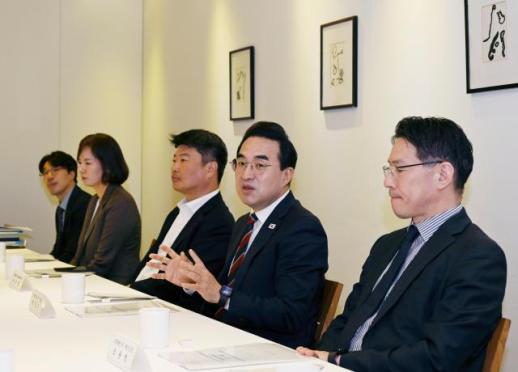 Budget Minister Park Hong-geun Pledges Constant Dialogue With Private Fiscal Advisers Park Hong-geun, minister of the Ministry of Planning and Budget, said on the 29th that he will strengthen communication between the government and the private sector by building a standing communication system for the Fiscal Policy Advisory Council. Park held a luncheon meeting that day with the council’s private-sector members to discuss policy issues broadly. He shared key points from a town hall meeting held the previous day and stressed the importance of government-private sector communication and cooperation. “The Fiscal Policy Advisory Council has played a central role as a channel for government-private communication in key national fiscal decisions,” Park said, thanking members for their work and dedication, which he said helped improve the quality of fiscal policy. He also called for more active engagement, saying that with policy conditions changing faster and more widely than ever, holding only two to four regular meetings a year could limit the government’s ability to reflect diverse policy needs raised in the field in a timely way. He said closer government-private communication is needed more than ever. In response, Park said the council plans to move beyond a regular-meeting format and establish an always-on communication system. He added that after the luncheon, the ministry plans to open and operate a group chat to enable ongoing exchanges. Private-sector members who attended freely discussed a range of views on overall fiscal policy, including institutional improvements and priority investment directions. Park said the government will closely review issues raised at the meeting as well as suggestions later posted in the group chat and reflect them in major policies, including the 2027 budget proposal. * This article has been translated by AI. 2026-04-29 15:36:11
 -
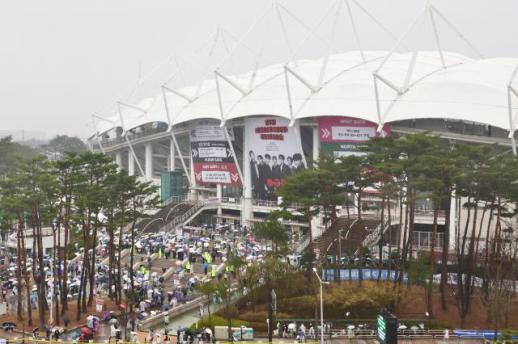 South Korea benchmarks BTS tourism success as Goyang visitor numbers surge SEOUL, April 29 (AJP) - Foreign arrivals in a satellite city northwest of the capital increased 35 times during a three-day BTS concert series that took place on April 9, 11, and 12, providing South Korean authorities with a statistical mandate to overhaul regional tourism strategies, a report released by the culture ministry showed Tuesday. The massive influx of travelers into Goyang, traditionally overlooked in favor of Seoul's central districts, suggests that high-profile cultural events can serve as a primary engine for provincial economic growth if integrated with local infrastructure. This sudden wave of visitors has provided a blueprint for the government’s transition toward a scalable model for provincial revitalization. By analyzing high-density data on spending and movement, the ministry said that it aims to anchor transient global fandom into long-term growth for cities struggling with stagnant local economies. According to the Ministry of Culture, Sports, and Tourism report, foreign visitor arrivals in Goyang City's Daehwa area increased by 3,377 percent compared to the same period last year. This surge in foot traffic translated into a 3,699 percent jump in credit card spending by international visitors within the immediate neighborhood. The data indicates that these travelers are staying longer and spending more than the average visitor to South Korea. Fans attending BTS' Goyang shows remained in the country for an average of 7.4 days, compared to the 6.1-day average recorded for general tourists in the first quarter of 2026. Individual spending also trended higher, with concertgoers averaging 2.91 million won ($1,969) in expenses, outstripping the 2.45 million won spent by typical visitors. In total, foreign credit card spending in the area injected 337.8 million won into the local economy over the three-day period. Central to this economic ripple effect was "The City," an integrated program that linked BTS' stadium event to pop-up stores and exhibitions in Seoul's tourist hubs, including Myeong-dong and the Dongdaemun Design Plaza. This strategy effectively widened the tourist footprint, drawing visitors to the National Museum of Modern and Contemporary Art and other regional sites. The government now intends to apply these findings to other metropolitan areas to counter the concentration of tourism in the capital. Minister Choe Hwi-yeong has authorized a two-week "Welcome Week" in Busan this June to coincide with upcoming performances, featuring specialized exhibition spaces and travel routes focused on music video filming locations. Later this year, the ministry plans to utilize this data-driven approach to support four upcoming K-pop concerts and two new cultural exhibition spaces across the country. Kang Jeong-won, the ministry's tourism policy chief, stated, "The important thing is to move beyond the 'performance' itself as a single tourism product and connect 'K-culture' with regional tourism contents so that visits to the metropolitan area can lead to the regions". 2026-04-29 15:35:28