
Journalist

Lee Hugh
=
-
 President Lee Jae-myung to Host Lunch With Minor-Party, Independent Lawmakers President Lee Jae-myung will host a lunch meeting April 29 at Cheong Wa Dae with lawmakers from minor parties and independents. It will be the first time Lee has invited all lawmakers from non-negotiating parties to such a meeting. Earlier this month, on April 7, Lee held a meeting and lunch of the ruling-opposition-government consultative body on the people’s economy with Democratic Party leader Jung Cheong-rae and People Power Party leader Jang Dong-hyeok. Cheong Wa Dae said 21 people will attend the April 29 meeting, including lawmakers from five non-negotiating parties — the Rebuilding Korea Party, the Progressive Party, the Reform New Party, the Basic Income Party and the Social Democratic Party — as well as independents. Cheong Wa Dae attendees will include Chief of Staff Kang Hoon-sik, political affairs adviser Cho Jung-sik and Senior Secretary for Political Affairs Hong Ik-pyo. Lee is expected to urge bipartisan cooperation on issues affecting people’s livelihoods. Cheong Wa Dae described the meeting as reflecting Lee’s “inclusive commitment to communication,” extending outreach beyond negotiating parties to include minor parties and independents.* This article has been translated by AI. 2026-04-29 09:21:29
 -
 Saemaul Geumgo Foundation to Provide 400 Million Won to Social Welfare Facilities Nationwide MG Saemaul Geumgo Regional Hope Sharing Foundation said Tuesday it provided 400 million won this year through its “MG Warmth Sharing Event Support Program” to help expand community culture and strengthen solidarity with local communities. The program is the foundation’s flagship, locally focused social contribution effort, providing operating funds so social welfare facilities can run programs they plan themselves based on needs in the field. Supported projects include special meals for Family Month and Parents’ Day, summer camps for low-income children, performances in culturally underserved areas, and outings for people with severe disabilities. The foundation said the support is intended to go beyond providing goods by offering new experiences and emotional lift. The foundation said it ran the program last year, providing 390 million won to 78 social welfare facilities nationwide. This year, it provided 5 million won each to 80 organizations last month, enabling facilities to operate tailored programs reflecting participants’ needs and local conditions. Chairman Kim In said the program is meaningful because it is built on needs identified by local welfare facilities. He said the foundation will continue practical support for neighbors in need through a range of community-based sharing activities.* This article has been translated by AI. 2026-04-29 09:17:00
 -
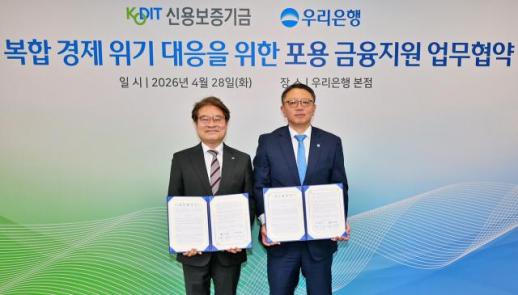 Woori Bank, Credit Guarantee Fund to Provide 240 Billion Won in Support for Small Firms Woori Bank said Tuesday it will work with the Korea Credit Guarantee Fund to provide 240 billion won ($2400억원) in financial support to help small and medium-sized businesses weather a crisis. The bank and the fund signed a business agreement Monday on inclusive financial support to respond to a complex economic downturn. The program is aimed at easing financing burdens for SMEs facing difficulties from a global slowdown and increased volatility in financial markets, while supporting a stable recovery in the real economy. Woori Bank will contribute a total of 6 billion won ($60억원) to the fund, enabling about 240 billion won in support. Eligible firms include small businesses and vulnerable industries tied to oil and price stabilization; companies involved in supply-chain management, including materials, parts and equipment; businesses directly or indirectly affected by changes in external conditions such as the war in the Middle East; and exporters, importers and companies expanding overseas. Participating firms will receive higher guarantee coverage, raised to 100% from 85%, and support equivalent to 0.7 percentage points of guarantee fees. Separately, Woori Bank said it signed another agreement with the fund on April 10 to provide 310 billion won ($3100억원) in stage-by-stage financing for innovative-growth sectors and export-leading small and mid-sized companies. The bank said it plans to expand cooperation with policy finance institutions to bolster resilience and growth for small and mid-sized firms. Woori Bank CEO Jeong Jin-wan said the latest agreement will help improve access to financing for SMEs struggling to raise funds. He said the bank will expand what it called productive finance, in close cooperation with the fund, to support normal operations and sustainable growth for small and mid-sized companies.* This article has been translated by AI. 2026-04-29 09:16:12
 -
 NTS chief warns multi-homeowners gift tax can top capital gains tax as surcharge break ends Lim Gwang-hyeon, commissioner of South Korea’s National Tax Service, warned multi-homeowners not to rush into gifting homes ahead of the end of a temporary suspension of heavier capital gains taxes, saying the tax burden is often higher for gifts than for sales. In posts on X (formerly Twitter) and Facebook on Tuesday, Lim said the market expects more home gifts before the suspension ends, but “when you calculate the actual tax burden, gifting is often more disadvantageous.” He added that people should not consider “schemes” aimed at avoiding taxes. Home gifts in Seoul totaled 3,075 cases in the first quarter of this year, up 94.4% from a year earlier. Lim cited a simulation: For an apartment in Seoul’s Daechi-dong with a market price of 3 billion won that has been held for 10 years and was bought for 1 billion won, a sale before May 9 would generate about 650 million won in taxes. A gift, he said, would result in about 1.38 billion won in taxes — more than double. He also cautioned that if someone else pays the gift tax on the recipient’s behalf, additional taxation may apply. Assuming taxes are paid properly, he said, taxpayers should consider whether gifting is economically reasonable. Lim warned against improper gifting practices, including gifting a home with a loan and then having parents repay it, or undervaluing a property below market price. Such actions could amount to tax evasion, he said, adding that the NTS plans to conduct a full review. In those cases, he said, penalties of up to 40% could be imposed on top of the original tax due. “Tax justice is a very important value,” Lim said, adding that the agency will provide guidance and consultations so taxpayers can make reasonable decisions before the suspension ends. * This article has been translated by AI. 2026-04-29 09:15:18
 -
 Genesis Magma Racing Finishes Surprise Hypercar Debut at 2026 WEC Imola 6 Hours Genesis said Tuesday that its Genesis Magma Racing team successfully finished its first top-class Hypercar entry at the season-opening 2026 FIA World Endurance Championship (WEC) Imola 6 Hours. Unlike most motorsports, which typically last one to two hours and reward the fastest finish, WEC races emphasize durability, with events commonly run over six hours and sometimes eight or 24 hours. Over races that can last up to 24 hours, cars must withstand heavy loads from high-revving engines, brakes that heat up under repeated stopping, and thermal management demands on hybrid motors and batteries. Each car is shared by three drivers, with six drivers rotating across the team, as they manage changing weather, tire wear and other variables while battling for position. Genesis Magma Racing entered its first event with a mix of veterans and newcomers: Andre Lotterer, Pipo Derani, Daniel Juncadella, Mathys Jaubert, Mathieu Jaminet and Paul-Loup Chatin. Midrace, Lotterer moved up to 11th before pitting. Jaubert then took over and made a clean pass on an Aston Martin. After Derani got in as the third driver, the team briefly climbed as high as ninth. Ferrari driver Nicklas Nielsen, who was chasing Jaubert, expressed surprise over team radio, saying, “I don’t understand why that car is faster than us in the corners.” After six hours, the team’s two hypercars averaged 177.97 kph and 176.23 kph around the 4.909-kilometer Imola circuit, finishing 15th and 17th. Cyril Abiteboul, head of Hyundai Motorsport and team principal of Genesis Magma Racing, said the new entrant focused less on the absolute result and more on reliability and execution. “The most important thing we confirmed this weekend is the solid foundation and potential of our team,” he said. Genesis Magma Racing is scheduled to race next month at the season’s second round, the Spa-Francorchamps 6 Hours in Belgium.* This article has been translated by AI. 2026-04-29 09:12:15
 -
 KAI, Bell Textron sign MOU on South Korea’s next-generation high-speed utility helicopter Korea Aerospace Industries, or KAI, said April 29 it signed a memorandum of understanding with U.S. aircraft maker Bell Textron on April 27 (local time) to jointly develop a solution for South Korea’s next-generation high-speed medium utility helicopter, known as HSMUH. The signing ceremony was held at Bell Textron’s headquarters in Fort Worth, Texas. Attendees included Cho Jeong-il, head of KAI’s rotorcraft business division, and Jeff Schloesser, senior vice president for strategic business at Bell Textron, the company said. KAI said the agreement is aimed at a joint response to South Korea’s HSMUH program, aligned with U.S. government priorities and policy, based on the MV-75 being developed by Bell Textron in cooperation with the U.S. Army as a next-generation vertical lift aircraft. The MV-75 was officially selected for the U.S. Army’s Future Long-Range Assault Aircraft, or FLRAA, program and is now in system development at Bell Textron. Bell Textron announced on April 15 (local time) that the aircraft’s official name will be “Cheyenne II.” The companies said their partnership reflects a shared vision for a next-generation vertical lift aircraft based on the MV-75, with major improvements in speed, range and maneuverability to deliver top-tier tiltrotor performance. They said they will also review solutions that use a Modular Open Systems Approach, or MOSA, to enable rapid and cost-effective upgrades to weapon systems, and will explore broader industrial cooperation opportunities as the project is further defined. “This cooperation will be an opportunity to make a major leap in the South Korean military’s next-generation aviation operational capabilities,” Cho said. He said KAI will combine its proven system development capabilities with Bell Textron’s advanced technology to help the military secure a flexible and powerful weapon system able to respond quickly to a rapidly changing battlefield. Schloesser said the MV-75 is “a platform that showcases the essence of next-generation vertical lift technology.” He said South Korea’s HSMUH program will be an important opportunity to expand those capabilities into the global market and strengthen interoperability between the United States and its allies.* This article has been translated by AI. 2026-04-29 09:11:10
 -
 LG CNS, SAP Partner on AI-Driven Supply Chain Planning and Inventory Integration LG CNS is partnering with SAP to pursue artificial intelligence-based supply chain innovation, aiming to cut inefficiencies such as excess inventory and delivery delays by integrating processes that have typically been run separately across production, sales and inventory. LG CNS said Tuesday it recently signed a memorandum of understanding with SAP to drive intelligent supply chain innovation based on SAP Integrated Business Planning, or SAP IBP, and to expand in global markets. The signing ceremony was attended by Cho Min-gwan, an executive director in charge of LG CNS’ SCM innovation business, and Kim Jun-young, a vice president at SAP Korea, among others. The agreement centers on integrating supply chain data using SAP’s SCM solution, SAP IBP. The platform brings together data across demand forecasting, production planning and inventory management to improve visibility and support decision-making. SAP is also applying its generative AI assistant, Joule, and AI agent functions across its broader “Business Suite,” including IBP. Users can ask questions in natural language to get guidance on needed functions, while AI analyzes large volumes of supply chain data to produce key insights and visual reports. It can also automatically run scenario simulations for issues such as delivery delays, with agents across purchasing, production and logistics working together to propose optimized supply chain plans. LG CNS said it will combine its own technology with IBP to deliver differentiated services, including stronger capabilities to analyze shifts in demand and supply data, identify drivers behind performance changes, and forecast future sales and inventory flows. It also plans to add customer-specific functions such as preventing data errors in advance, managing supply chain risks and monitoring supplier reputations. The companies also plan to accelerate their push overseas. LG CNS said it will expand its IBP business based on its SAP ERP implementation experience across industries, and jointly pursue supply chain innovation projects for foreign companies by leveraging its North American and Asian subsidiaries and SAP’s global network. LG CNS is currently implementing SAP IBP for LG Innotek and plans to expand the business to auto parts, high-tech, consumer goods, and pharmaceutical and biotech sectors. “Building on our SAP ERP implementation capabilities, we will secure competitiveness in the AI-based integrated supply chain management market,” an LG CNS official said. “We will lead supply chain innovation in the global market.” 2026-04-29 09:10:20
 -
 After UAE Exit, Kazakhstan and Iraq Seen as Possible Next OPEC Defectors The market is watching for the next potential crack in OPEC after the United Arab Emirates left the oil producers group, with Kazakhstan and Iraq now most often cited as possible candidates. Even so, many analysts say the OPEC framework is unlikely to face immediate upheaval. U.S. financial news outlet MarketWatch reported Monday that parts of the energy industry view Kazakhstan and Iraq as the most likely to follow the UAE. The reasoning is that both countries have room to raise crude output, giving them an incentive to chafe at OPEC production limits. Reuters, however, reported that Iraq’s government said it has no plan to leave OPEC. Kazakhstan has been singled out as a country with growing dissatisfaction over OPEC+ production caps. MarketWatch said Kazakhstan, like the UAE, has long expressed frustration with its quota. Kazakhstan’s May production limit is about 1.6 million barrels a day, and its actual capacity is estimated to be slightly higher — meaning it does not have the same scale of spare capacity as the UAE. The UAE’s gap is far larger. Under OPEC, its May output was capped at about 3.5 million barrels a day, but its production capacity is estimated at 4.7 million to 4.8 million barrels a day. The report cited long-running complaints about quotas, as well as regional leadership rivalry with Saudi Arabia, as factors discussed behind the UAE’s decision to leave. Markets broadly see the UAE’s exit as a blow to OPEC but not one likely to trigger a rapid collapse. Analysts note Saudi Arabia still holds the largest spare capacity, limiting any near-term erosion of the group’s ability to influence prices. Some also argue the remaining producers could gain more internal influence after the UAE’s departure. Still, concerns about longer-term instability remain. Rystad Energy said short-term effects could be limited due to potential disruptions in the Strait of Hormuz and broader geopolitical uncertainty, but warned that a structurally weakened OPEC will face a heavier burden in managing supply and stabilizing oil prices going forward.* This article has been translated by AI. 2026-04-29 09:09:34
 -
 Jangsu Communications to Supply Privacy-Preserving HALO Sensors for School Blind Spots Video- and audio-free monitoring technology designed to detect environmental changes and warning signs is set to be introduced in South Korean schools. Jangsu Communications, a partner of Motorola Solutions, said it plans to supply the HALO smart sensor to strengthen safety in school blind spots where CCTV installation is restricted, focusing on elementary schools. The device, developed by HALO Smart Solutions Inc., is an environmental and behavior-detection sensor built without a camera or microphone, a design intended to preserve privacy. The company said that makes it suitable for areas such as restrooms, locker rooms and hallway blind spots, where privacy protections limit conventional video-based security. Jangsu said the HALO sensor can analyze more than 20 environmental factors with a single unit, detecting changes in sound patterns, movement, air quality and specific chemical components in real time. It identifies anomalies and sends immediate alerts to administrators. Because the system processes “event-based information” rather than storing video or audio, it is designed to reduce the burden of handling personal data. One feature highlighted for schools is e-cigarette vaping detection. Jangsu said the sensor’s algorithm analyzes fine particles and chemical changes in the air to determine whether smoking has occurred and is designed to distinguish attempts to mask odors with perfume or air fresheners. The system also includes indoor air-quality monitoring, continuously measuring key indicators such as carbon dioxide (CO₂), carbon monoxide (CO) and volatile organic compounds (VOC). It can issue warnings when readings exceed set thresholds, data that can be used to judge when ventilation is needed or to support indoor-environment improvements. Jangsu said the sensor can also detect abnormal noise, impact sounds and unusual behavior through movement and sound-pattern analysis, offering a tool to help spot early signs of school violence or accidents. The company said linking the system with lighting and HVAC controls could enable automatic operation to improve energy efficiency and expand into predictive maintenance by using temperature and humidity data to detect equipment issues in advance. On integration, Jangsu said the system supports an open API, allowing it to connect with existing security platforms and building management systems and to be customized for different operating environments. The company cited reported use cases at some U.S. education institutions, including Castleberry Independent School District and Green Dot Public Schools, for vaping detection, air-quality improvements and accident prevention. Industry observers say non-identifying, sensor-based security is drawing attention as an option that can address both privacy protection and safety management, particularly in settings such as schools where privacy standards are strict. A Jangsu Communications official said the company plans to expand the product in a form suited to South Korea’s education environment. “The device has been recognized in the field of security technology innovation,” the official said. “We expect it can help strengthen student safety by covering CCTV blind spots while reducing the management burden on teachers.” 2026-04-29 09:05:21
 -
 South Korea Approves 3 Regional Job Projects, Pledges 21.2 Billion Won for Busan-Ulsan-Gyeongnam, Daegu-Gyeongbuk and Chungcheong The South Korean government is moving ahead with a large-scale support program aimed at more balanced regional development and job creation built around mega-regional blocs. The Ministry of Employment and Labor said Tuesday it had finalized three joint project plans under its “Wide-Area Link Project” after a public call and review process. The approved regions are Busan-Ulsan-South Gyeongsang; Daegu-North Gyeongsang; and Daejeon-Sejong-North Chungcheong-South Chungcheong. The program is designed to help metropolitan and provincial governments share resources and close policy gaps created by administrative and geographic boundaries. A central goal is to provide multi-year support — over four years — for job initiatives tied to each region’s strategic industries, in an effort to curb population outflows and encourage people to move in from the Seoul metropolitan area and elsewhere. To strengthen implementation, the ministry said it has operated “mega-regional project preparation teams” since October last year, involving local labor offices, local governments and regional human resources development councils. After workshops and intensive consulting by selection reviewers, the ministry said it confirmed each region’s project content and scale. The approved plans focus on creating conditions that help skilled workers stay in the region by building on key local industries. Busan-Ulsan-South Gyeongsang will receive 10 billion won. The region will pursue what it described as a “mega-regional living zone” linking commuting and employment to create quality jobs in shipbuilding, automobiles and machinery parts. Daegu-North Gyeongsang will receive 8 billion won to foster a “future mobility jobs-and-living ecosystem,” including joint research and development among companies across the supply chain and efforts to strengthen workforce capabilities. The Chungcheong region will receive 3.2 billion won to build a “mega-regional career-link ecosystem” aimed at a virtuous cycle of attracting, settling and developing talent in growth industries such as bio and mobility. Across the regions, the ministry said support measures will include help with asset-building and living expenses to improve settlement conditions, assistance for long-term employment and re-employment, and packages such as company visits and on-site training. To boost momentum, the ministry said it will form project task forces led by director-level local government officials, with regional labor office chiefs serving as secretaries, to strengthen public-private cooperation. It also plans to hold a series of “regional implementation pledge events” starting in July to support the project’s rollout. Labor Minister Kim Young-hoon said the project would be “a springboard for creating quality jobs by bringing together regional resources beyond administrative and geographic limits.” He said the central government and mega-regional local governments would work closely to build “a vibrant regional jobs ecosystem where young people choose to stay.”* This article has been translated by AI. 2026-04-29 09:04:18