
Journalist

Lee Hugh
=
-
 Foreign Minister Cho Hyun Meets Bhutan Prime Minister to Expand Cooperation on Climate, Economy Foreign Minister Cho Hyun met Monday afternoon with Bhutan Prime Minister Tshering Tobgay at the Foreign Ministry and discussed practical bilateral cooperation and regional developments. Cho welcomed Tobgay’s trip to South Korea, the first visit by a Bhutanese prime minister since 2010. He said he was impressed that Bhutan prioritizes citizens’ happiness and pursues environmentally friendly economic growth, and called for expanding mutually beneficial, practical cooperation between the two countries. Cho said South Korea is also seeking a shift to renewable energy to cut carbon emissions, and expressed hope the two sides would continue working together to respond to the climate crisis with Bhutan, the world’s first carbon-negative country. Tobgay praised South Korea’s efforts to address climate change and achieve carbon neutrality alongside its advanced economic development. He said he hoped the two countries would sustain cooperation in areas including the economy, climate change and development cooperation. The two sides also exchanged views on regional and international issues and cooperation in international organizations. * This article has been translated by AI. 2026-04-28 18:12:28
 -
 CJ OnStyle Speeds Up Content Commerce With 'Devil Wears Prada 2' Campaign, KBO Goods CJ OnStyle is strengthening its content-commerce business by turning fandom-based intellectual property tied to film and sports into shopping experiences. Industry officials said CJ OnStyle has partnered with The Walt Disney Company Korea to run a large branding campaign inspired by the film ‘The Devil Wears Prada 2,’ which is set to open on the 29th. The campaign runs through May 14. CJ OnStyle said it is the only commerce platform in South Korea running the campaign. The slogan is “This summer, OnStyle wears the devil.” The company is combining film content with its retail platform, targeting overlap between its core customers — women in their 30s and 40s — and the movie’s fan base. The main concept is “Runway to Realway,” aiming to bring the film’s fashion into everyday wear. CJ OnStyle curated about 2,500 style items, from office looks to resort wear, reflecting the storylines of the two main characters. To extend the film theme across the shopping experience, CJ OnStyle redesigned its mobile app interface, circular launcher logo and live-streaming studio around the movie concept. CJ OnStyle is also expanding its approach to Korea Baseball Organization, or KBO, goods, saying baseball fans’ spending has moved beyond stadium cheering to everyday self-expression. Instead of simply printing team logos, it planned merchandise focused on fashion accessories that can be used naturally for commuting, outings and travel. Based on CJ OnStyle’s analysis of KBO goods sales data from April 9 to 25, fashion accessories such as bandana scarves, lightweight folding umbrellas and stadium-bag key rings ranked among top sellers. Cumulative sales reached 35,000 items in about 10 days after launch, and fashion accounted for 52.8% of total sales. A CJ OnStyle official said the company will continue to strengthen content-commerce competitiveness through differentiated IP that gives customers more reasons to visit and more to enjoy on the platform.* This article has been translated by AI. 2026-04-28 18:11:36
 -
 Auto China 2026: BYD, Geely tout AI and battery advances to defend home market Chinese automakers rolled out new electric models packed with the latest technology at the motor show, betting that strong battery engineering and AI-driven features can help them hold their ground at home against global brands’ premium appeal. According to the industry on April 28, BYD applied the theme “All things move toward renewal” to its Dynasty lineup and introduced a wave of new vehicles, including the flagship SUV Datang, the third-generation Yuan Plus and the Song Ultra EV. BYD highlighted its second-generation Blade battery, flash-charging technology and an intelligent ecosystem connection aimed at younger Chinese buyers. The company said the second-generation Blade battery can reach 70% charge in five minutes at room temperature and a full charge in nine minutes; in minus 30 Celsius conditions, it said, a full charge takes about three minutes longer. BYD said the Datang achieved a 950-kilometer range on a single charge by increasing energy density, calling it among the longest in the world. The Yuan Plus, which BYD said has topped 1.1 million global sales since its 2022 launch, adds a 240-kilowatt motor and is rated at 630 kilometers under China’s CLTC test cycle; BYD said flash charging is applied across the lineup. The models were presented as new-energy vehicles priced from 250,000 to 320,000 yuan. Across its flagship brands — including Fangchengbao, Yangwang and Denza — BYD also unveiled new sedans, SUVs, multipurpose vehicles and supercars. Yangwang showed the 2026 U7, U8 and U8L Dingchang Edition, along with the U9, which it said was the first Chinese supercar to appear in “Gran Turismo 7.” The company said the Yangwang U9 Extreme (U9X) set a world record with a top speed of 496.22 kph. BYD said the Denza Z uses an intelligent vehicle control technology platform to improve cornering, driving safety and tuning performance. Geely Holding Group showcased mobility solutions across its brands — including Zeekr, which is slated for domestic launch this year — as well as Lynk & Co, Geely Galaxy, Lotus and Smart. It highlighted technologies such as the EVA-cap robotaxi, Super EVA and the Smart Egg cockpit, underscoring capabilities spanning AI, autonomous driving and next-generation eco-friendly technology. Zeekr introduced the high-performance hybrid flagship SUV “8X,” calling it the only midsize hybrid SUV in the world capable of 0-100 kph acceleration in the three-second range. Geely attributed the performance to a 900-volt high-voltage platform, a 2.0 turbo super-hybrid engine, a 145-kilowatt (197-horsepower) generator, an AI digital chassis and dual Nvidia Drive Thor-U chips. Geely Automobile also presented new models featuring a fresh design concept and advanced technology, including its second concept car, the “Galaxy Light,” and the brand’s first off-road NEV architecture. The company also promoted its i-HEV intelligent hybrid system. A Geely Holding Group official said the products unveiled at Auto China 2026 showed the group’s “clear trend” toward intelligent electrification. The official added that, as the industry enters an era of intelligent electrification marked by both challenges and opportunities, the group will seek growth by creating strong synergies across its businesses. 2026-04-28 18:10:23
 -
 South Korea to Launch $1 Billion On-Device AI Chip Program in May The South Korean government will begin a large-scale program in May to develop on-device artificial intelligence semiconductors, committing a total budget of 1 trillion won through 2030. The initiative aims to have major companies including Hyundai Motor and LG Electronics work with domestic fabless chip designers to build customized AI chips. Lim Ki-taek, a project director at the Korea Institute for Advancement of Technology (KEIT), said April 28 that the “K-On-Device AI Semiconductor Technology Development Program” will launch new projects in May and then continue for five years. “We held a final review meeting yesterday with the Ministry of Science and ICT and the Ministry of Trade, Industry and Energy, and we expect to post the request for proposals as early as late May,” Lim said. He added that a draft RFP is complete and will be adjusted slightly to fit the budget before it is announced. Under the program, domestic fabless companies will design AI chips requested by corporate users, and domestic foundries will manufacture them. The government plans to link demand companies with fabless designers and foundries. As an example, Lim said a fabless firm could design an AI chip needed for Hyundai Motor’s autonomous vehicles, and a foundry such as Samsung Electronics could produce it. The program targets four areas: automobiles; Internet of Things and home appliances; machinery and robots; and defense. The goal is to develop on-device AI semiconductors domestically and build advanced products using them, with mass production targeted for 2030. Lim said the government’s R&D planning reflects the need for industry-specific customization in system semiconductors. “The biggest change in R&D policy under the current administration is connecting fabless companies with leading firms in each industry,” he said. “Because system semiconductors must be tailored to each industry, fabless companies need to know what demand companies want. We built matching opportunities into the R&D plan so they can meet more often.” This year, based on feasibility reviews and demand surveys, the government plans to newly support seven areas. In autos, it will back development of an advanced driver assistance and autonomous driving (ADAS/AD) domain controller for next-generation software-defined vehicles. In IoT and home appliances, it will support development of human-empathy smart space systems and on-device AI semiconductor technology. It will also support development of an on-device AI computing unit for collaborative robots at a commercially viable level, and product development of next-generation AI collaborative robots based on neural processing units (NPUs). Demand-side participants include Hyundai Motor, LG Electronics, Doosan Robotics, Daedong and Korea Aerospace Industries (KAI). Selected fabless companies include Nextchip, Telechips, DeepX, Mobilint, Boss Semiconductor, Aim Future and DeeperAI. Lim said the program is designed primarily to help domestic fabless companies expand globally. “We are placing more weight on the fabless sector,” he said, adding that working with major domestic demand companies through chip development and commercialization will strengthen technical capabilities and create “a win-win” for both chip designers and end users. * This article has been translated by AI. 2026-04-28 18:09:12
 -
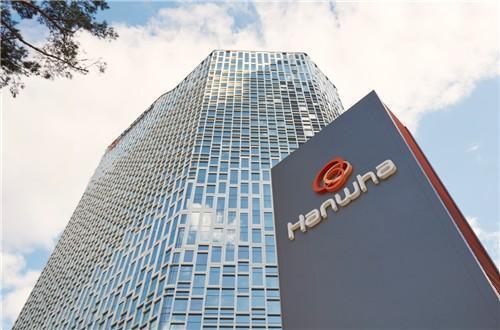 Hanwha Solutions swings to profit in Q1 on solar gains, chemical recovery SEOUL, April 28 (AJP) - Hanwha Solutions posted a sharp earnings recovery in the first quarter of 2026, with operating profit surging more than threefold as its solar and chemical units both returned to the black amid easing U.S. trade headwinds and internal restructuring efforts. The South Korean conglomerate reported Tuesday through regulatory filings consolidated revenue of 3.88 trillion won ($2.63 billion) for the January to March period, up 25.4 percent from a year earlier, while operating profit climbed 205.5% year-on-year to 92.6 billion won — marking its first profitable quarter since the second quarter of 2025. The renewable energy division, operating under the Qcells division, led the charge with revenue of 2.111 trillion won and operating profit of 62.2 billion won. The unit logged its second consecutive quarter above the 2-trillion-won revenue threshold, even during a traditionally slow season, as U.S. factory output normalized following the resolution of a customs clearance backlog on cell shipments that had weighed on output late last year. The chemicals division returned to profit for the first time in about two and a half years, posting revenue of 1.340 trillion won and operating profit of 34.1 billion won. The unit shed loss-making businesses, streamlined production lines, and expanded sales of high-margin products such as ultra-high-voltage cable materials. "We expect performance to improve steadily through year-end, and anticipate that the Cartersville plant's cell line will enter mass production from the third quarter, driving solid earnings momentum in the renewable energy division," co-CEOs Park Seung-deok and Nam Jung-woon said in a statement. Shares of Hanwha Solution ended at 50,800 won per stock, 1.2 percent higher than a day ago. 2026-04-28 18:08:49
 -
 Auto China 2026 Showcases EVs Evolving Into AI-Driven Vehicles "The era of electrification has passed, and the era of intelligence has arrived." Auto China 2026, also known as the Beijing Motor Show, opened in China, the world’s largest electric-vehicle market. This year’s show spotlighted Chinese automakers rolling out new artificial intelligence and autonomous-driving technologies, while global carmakers sought to keep pace. German, South Korean and Japanese brands pushed deeper “In China for China” strategies, tailoring products and operations to the local market. The China Association of Automobile Manufacturers, or CAAM, said in its “2026 China auto market outlook report” that it expects total vehicle sales this year to rise 1.2% from 34.40 million to 34.80 million. New energy vehicles, or NEVs, are projected to account for 19.00 million units, up 15.2% from 16.49 million a year earlier. That would lift NEV penetration to 54.7% from 47.9%, positioning 2026 as a turning point when NEVs become the market standard. As the EV market enters a mature phase, competition is expected to intensify as companies fight to survive. Chinese brands used the show to highlight advances in AI, self-driving systems and battery performance as they aim to move further into the premium segment. Xiaomi drew attention with a marketing display that suspended a cutaway model of its self-developed NEV, exposing the battery and motor structure and the placement of thousands of parts. The display was seen as a way to show how software tightly controls hardware, reinforcing the idea of the car as “AI on wheels,” built on the company’s smartphone software experience. Geely Automobile Group’s premium brand Zeekr unveiled the “8X,” a premium sport utility vehicle with a claimed maximum output of 1,380 horsepower. Xpeng introduced the “GX” with Level 4 autonomous-driving technology. Nio displayed its three brands — Nio, Onvo and Firefly — and showed new models including the Nio ES9 and ET9 equipped with its self-developed smart-driving chip. Established automakers also emphasized technology shifts. Mercedes-Benz showcased its history from horse-drawn carriages to the latest Maybach electric vehicle, while placing the results of its collaboration with China’s Huawei prominently on the stand. BMW and Audi also drew attention for integrating autonomous-driving technologies developed with Chinese partners such as Momenta and Huawei into new models. Battery technology, linked with AI, emerged as a key battleground. CATL, the world’s top battery maker, said its third-generation “Shenxing” battery can charge to 98% in 6 minutes 27 seconds. BYD demonstrated technology that it said boosts energy density and can charge a battery from 10% to 70% in five minutes even in extreme conditions below minus 30 degrees Celsius. An industry official said, “Once the EV market fully enters maturity, only companies with software-defined vehicle technology will survive.” 2026-04-28 18:06:29
 -
 Korea Constitutional Court Picks GC Pharma Vaccine Fine Case as First Trial Appeal The Constitutional Court has selected a vaccine collusion fine case involving GC Pharma as the first case to proceed under the newly introduced trial appeal system. According to legal officials on the 28th, the court had received 525 trial appeal petitions through the previous day and sent only one to the full bench for review. It is the first case to move to a merits review since the system was introduced on March 12. The case sent to the full bench is a petition filed by GC Pharma Co. seeking to overturn a Supreme Court decision. GC Pharma is the petitioner and the Supreme Court is the respondent. Law firm Yulchon represents GC Pharma. The dispute stems from allegations of bid rigging in a Gardasil vaccine procurement tender. The Korea Fair Trade Commission previously issued corrective orders and imposed a fine, saying GC Pharma colluded by using wholesalers as "dummy" bidders during the purchasing process. GC Pharma challenged the sanctions in court, but the Seoul High Court rejected its claim. In February, the Supreme Court also dismissed the company’s appeal without further review, a procedure used to reject appeals when statutory grounds are not met, thereby upholding the lower court ruling. GC Pharma argues that the Supreme Court’s handling of the case violated its constitutional right to a trial. The company said that although a related criminal case ended in an acquittal on the grounds that there was no restriction of competition because there was no substantive competitive relationship, the Supreme Court did not properly examine whether there were legal errors raised in the appeal before dismissing it without review. The court’s decision is expected to draw close attention in legal circles as the first trial appeal case. Since the revised Constitutional Court Act took effect on March 12, 525 petitions seeking to cancel court rulings have been filed. Of those, 37 were dismissed at a preliminary panel stage, and the GC Pharma case is the only one sent to the full bench. The full bench is expected to focus on how far a Supreme Court dismissal without further review can infringe the constitutional right to a trial. The Constitutional Court plans to notify the chief justice of the Supreme Court and request a response, and to seek opinions from the Fair Trade Commission and Justice Minister Jeong Seong-ho.* This article has been translated by AI. 2026-04-28 18:05:26
 -
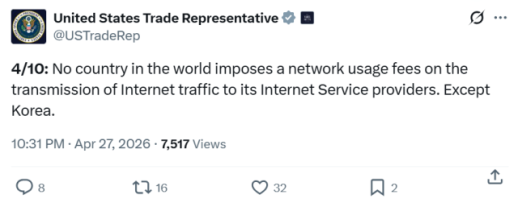 Digital flashpoint: Korea's network fee concept draws renewed U.S. scrutiny SEOUL, April 28 (AJP) - A long-simmering domestic dispute over "network usage fees" has now boiled over into a major diplomatic friction point, as Washington ramps up pressure on Seoul to drop proposed legislation that would force U.S. tech giants to pay for data traffic. The rhetoric from Washington reached a new peak this week. In a blunt post on X, the Office of the U.S. Trade Representative (USTR) labeled South Korea’s mooted network fee policy as one of the "Craziest Foreign Trade Barriers Facing American Exporters." The USTR’s 2026 National Trade Estimate Report, released March 31, categorized the issue as a significant service trade barrier. "No country in the world imposes network usage fees on the transmission of internet traffic... Except Korea," the agency wrote, grouping the fees with other "digital concerns" like platform regulation and location-data export restrictions. As video streaming, cloud computing, and AI drive data consumption to record highs, the fundamental question is: Should the "senders" pay the ISPs? Local giants SK Telecom, KT, and LG Uplus argue that foreign "Big Tech" firms like YouTube and Netflix are free-riders. They claim these platforms profit from South Korea’s world-class infrastructure without contributing to its maintenance. "It is unfair that Korean companies are being discriminated against," says Choi Min-hee, chair of the National Assembly’s Science and ICT Committee. Google, Meta, and Netflix argue that users already pay for internet access. Charging content providers for the same data constitutes "double billing" and violates net neutrality—the principle that ISPs should not discriminate against traffic based on volume or type. While South Korea has not yet passed a direct statutory fee, the National Assembly has seen a flurry of bills since 2021 aimed at mandating these payments. Kim Jeong-won, a former senior digital policy official, notes that while no law exists yet, "Korea is one of the countries closest to legislating such measures." This "closeness" has triggered the USTR’s preemptive strike, as the U.S. fears these fees would benefit Korean competitors and further entrench the local telecom oligopoly. While South Korean experts like Choi Won-mog of Ewha Womans University point out that Europe, Brazil, and India have debated similar "fair contribution" models, the global tide seems to be turning against the fees: The EU recently confirmed it would not adopt mandatory network fees, and Brazil dropped its network fee approach in 2024.This leaves South Korea increasingly isolated in its pursuit of a legislative solution. The timing of the USTR’s pressure is not accidental. The network fee dispute is being folded into a broader trade narrative involving Section 301 investigations and the Trump administration’s focus on the trade deficit. For Washington, digital services are a rare bright spot in the balance sheet. Protecting that surplus is a priority, especially following President Lee Jae Myung’s pledge to invest $350 billion in the United States—a commitment Washington views as a baseline for cooperation, not a free pass for digital regulation. The 2023 resolution of the legal battle between SK Broadband and Netflix—which ended in a "strategic partnership" rather than a court-mandated fee—may offer a blueprint for the future. "A practical solution would be to resolve this issue through agreements between the companies involved," suggests Kim Jeong-won. However, as the rhetoric from both capitals sharpens, the "invisible walls" of the internet may become the next major hurdle in the K-U.S. alliance. 2026-04-28 18:04:24
 -
 Why Healthy Companies Leave the Market: Suspicions of Deliberate Delisting Persist In 2017, a financially sound company with 100 billion won in net assets and 30 billion won in cash and cash equivalents was told by its external auditor that it would receive a “disclaimer of opinion.” The stock price plunged 95%, and the company was ultimately forced out of the market. The auditor said it could not obtain sufficient, appropriate audit evidence. In reality, the company refused to submit materials out of concern that wrongdoing by executives would be exposed. It was a predictable outcome that minority shareholders raised suspicions of a “deliberate delisting.” A similar case emerged in 2023. A blue-chip company with 200 billion won in net assets and steady profits received a “qualified opinion due to a scope limitation.” The company received the same qualified opinion the following year and again the year after, and it was eventually delisted. It was given a one-year improvement period, but the result was another qualified opinion in 2025. The issue was the failure to submit materials related to impairment of a small asset that was not essential to the company’s continued operations. Had the company provided the materials or revised its financial statements, it might have received an unqualified opinion at least once. Instead, it received qualified opinions for three consecutive years on the same grounds, fueling minority shareholders’ suspicion that the delisting was planned to benefit the controlling shareholder. A structure where delisting can be profitable Suspicions persist because the gains and losses are clear. Even after delisting, the company’s main disadvantage is greater difficulty raising funds through the market. For companies with little need for financing, there may be limited benefit in staying listed. For controlling shareholders, delisting can be an opportunity: during the liquidation trading period, they can buy minority shares at bargain prices. After pushing out remaining shareholders and securing 100% ownership, they can sell the company at a higher price or take dividends for themselves. Minority shareholders, by contrast, face a collapsing share price, difficulty trading and a heavier tax burden. In principle, the straightforward way for a controlling shareholder to remove all minority shareholders is a tender offer at a premium to the market price, but that is costly. Delisting can achieve the same goal without that expense. Delisting triggers such as capital impairment or insufficient revenue generally require a company to deteriorate. Failing to provide audit materials does not. While failure to file a business report can bring immediate criminal punishment, a company can exploit the vague boundary of “justifiable reasons” to withhold audit materials, induce a qualified opinion and still avoid criminal liability. Court rulings and continued losses Minority shareholders need meaningful compensation, but that has been difficult. Once delisting becomes likely, the stock price can collapse before the company suffers any direct economic loss. The mere fact that shares may become untradeable can drive prices down. In the 2017 case, minority shareholders sought damages for losses tied to delisting, but the court dismissed the claim. It classified the loss from the stock’s plunge as “indirect damage” stemming from a decline in the company’s assets. Although shareholders suffered from the price drop before any effect of reduced company assets could occur, the court treated the delisting as the result of executives’ management failure and still deemed it indirect damage. The company and executives effectively received a pass. The harm does not end with delisting. If controlling shareholders delisted and simply left minority shareholders in place, there would be little reason to delist. The next step is to force-buy minority stakes at low prices, often through share consolidation or a cash-out comprehensive stock exchange. Under the current Commercial Act and Supreme Court precedents, share consolidations of 1,000-to-1 or 10,000-to-1 are possible, and can be repeated. If a minority shareholder falls short by even one share after consolidation, that shareholder can be pushed out for a low price. A cash-out comprehensive stock exchange can also remove shareholders at the liquidation trading price. Once the company becomes wholly owned, the controlling shareholder can distribute dividends freely. Assets built with minority shareholders’ contributions can end up entirely with the controlling shareholder, whether through liquidation or dividends. Capital-market reform should go beyond revising the Commercial Act This amounts to taking others’ property, yet the law and courts allow it, underscoring why capital-market reform should not stop at revising the Commercial Act. On April 21, the National Assembly held a forum to discuss remaining tasks for protecting minority shareholders after the Commercial Act revision. Society should focus on building practical safeguards for minority shareholders forced out at bargain prices. One option is to create clear rules on liability for damages related to delisting. Share consolidation should be limited in ratio and frequency so it cannot be used to expel minority shareholders. The grounds for cash-out comprehensive stock exchanges should be restricted. And when market prices fail to reach net asset value, share valuation should reflect net asset value.* This article has been translated by AI. 2026-04-28 18:04:12
 -
 Binggrae-Lotte Wellfood Rivalry Heats Up Ahead of Peak Summer Ice Cream Season With the peak summer season approaching, South Korea’s two biggest frozen-dessert makers, Binggrae and Lotte Wellfood, are stepping up a fight for market leadership. Binggrae is betting that a merger with its subsidiary Haitai Ice Cream will deliver scale and help it reclaim the top spot, while Lotte Wellfood is countering with product upgrades and a heavier focus on overseas growth. According to the industry on the 28th, Binggrae completed the merger process with Haitai Ice Cream on April 1, about five years after acquiring it in 2020. Food industry statistics show that in 2024 Binggrae held 27.6% of the domestic frozen-dessert market and Haitai Ice Cream 14.1%. Combined, that totals 41.7%, putting it ahead of market leader Lotte Wellfood at 39.9% and raising expectations of a shift in the competitive landscape. Binggrae plans to integrate sales and logistics networks that had been split across the two companies, reduce overlapping costs and improve operating efficiency. It is also reorganizing its product lineup, consolidating overlapping categories around best-known flagship items and expanding joint purchasing of raw and packaging materials to improve its cost structure. Major brands such as Melona, Together, Bravo Cone and Babamba will be run under a single corporate entity, which the company expects will create synergies. The company is also accelerating its overseas push. Binggrae plans to use its recently established Australian unit as a hub linking Oceania and Europe, adding to its presence in the United States, China and Vietnam. Its U.S. unit posted local sales of 97 billion won last year, helped by Melona’s popularity. In Europe, first-half 2024 sales of plant-based Melona were three times the total for all of 2023, the company said. Products from Haitai Ice Cream, which lacked a dedicated overseas organization, are also expected to expand exports by using Binggrae’s global distribution network. Lotte Wellfood is responding with a two-track product strategy centered on premium branding and an expanded wellness lineup. It is steadily broadening its zero- and low-sugar offerings to match health trends, while strengthening the premium World Cone line and expanding categories using its Pig Bar brand to raise the share of higher-priced products. Overseas, Lotte Wellfood is pursuing growth mainly in India. Its frozen-dessert sales in India rose about 3.3 times, from 58.7 billion won in 2020 to 196.6 billion won last year. With a new plant in Pune recently starting operations, the company aims to stabilize supply and expand its sales network beyond the west into the south, targeting 1 trillion won in sales by 2030. The intensifying rivalry comes as the market environment worsens. With South Korea’s low birthrate shrinking the core consumer base and prices rising for inputs such as raw milk and sugar, companies are finding it harder to grow and protect margins. Binggrae’s operating profit last year fell 32.7% from a year earlier to 88.3 billion won, while Lotte Wellfood’s dropped 30.3% to 109.5 billion won. An industry official said unpredictable weather linked to climate anomalies, a weak domestic economy and issues affecting naphtha supply are among the variables, but expectations for frozen-dessert sales remain high because heat has arrived earlier than usual and rainfall is forecast to be below average this year.* This article has been translated by AI. 2026-04-28 18:00:12