
Journalist

Lee Hugh
=
-
 Lotte Fine Chemical Q1 2026 Operating Profit Jumps 73.9% to 32.7 Billion Won Lotte Fine Chemical reported preliminary first-quarter 2026 results on the 28th, posting revenue of 510.7 billion won and operating profit of 32.7 billion won. Revenue rose 14.6% from a year earlier, while operating profit jumped 73.9%. The company cited stronger earnings from higher sales of TMAC (tetramethylammonium chloride aqueous solution), a raw material used in semiconductor developer solutions, amid a boom in the chip market. It also pointed to higher international prices for ECH (epichlorohydrin), a feedstock for epoxy resins, and increased sales from expanded capacity for Heros, a cellulose-based paint additive. Lotte Fine Chemical said profitability is expected to improve further in the second quarter as it steps up eco-friendly businesses. The company has entered the ammonia marine-fuel supply (bunkering) market and said it succeeded in commercializing the business on April 23, positioning itself as a leading company in clean ammonia. It is also preparing to break ground on a new plant for higher value-added products. Handuck Chemical, a Lotte chemical affiliate that produces TMAH (tetramethylammonium hydroxide) used in semiconductor developer solutions, plans to start construction of a new plant in Pyeongtaek in the second quarter. TMAC is a key raw material for developer solutions used in semiconductor circuit etching processes, and Lotte Fine Chemical said it has the world’s No. 1 TMAC production capacity. Chief Executive Jeong Seung-won said, "In the first quarter, profitability improved sharply due to factors including increased sales of TMAC, a raw material for semiconductor developer solutions, amid a boom in the semiconductor market." He added, "This year will be one in which we deliver visible results in the ammonia marine-fuel business and core semiconductor materials businesses we have been pursuing to strengthen eco-friendly and higher value-added operations."* This article has been translated by AI. 2026-04-28 17:00:21
 -
 Lotte Department Store’s Incheon Branch Completes 3-Year Renovation, Targets 1 Trillion Won in Annual Sales Lotte Department Store’s Incheon branch has completed a sweeping renovation that took about three years, and the retailer said it is aiming to become the first department store in western Seoul metro area to reach 1 trillion won in annual sales. The Incheon store will hold a “grand open” event on May 1, Lotte said Monday, marking the final stage of the renovation that has been carried out in phases since 2023. The overhaul centered on an upscale strategy to match fast-changing local demand. After opening the premium food hall “Food Avenue” in late 2023, the store added a large beauty zone, kids section, and women’s and luxury fashion areas the following year. Despite lengthy construction-related disruptions, the store’s annual sales topped 8.3 trillion won last year, its first time surpassing 8 trillion won. That was up more than 10% from 2022, before the renovation. Sales in the first quarter of this year rose by more than 20%. Lotte also reported a shift in its customer mix. The Incheon branch’s share of its top-tier “Avenuel Black” VIP customers increased, and sales from preferred customers rose about 20% from a year earlier. Food Avenue, built around well-known restaurants to attract younger diners, helped drive new and repeat visits among customers in their 20s and 30s, the company said. Compared with before the renovation, both the number of new customers in that age group and their sales rose about 30%. Total visits to the renovated food hall surpassed 15 million cumulatively through last year. A key addition is the first-floor “Luxury Hall,” completed this month. Starting with Piaget and Bulgari, high-end jewelry brands including Tiffany, Boucheron and Graff have opened in sequence this year. Moncler also reopened in what Lotte said is its largest store in South Korea. With the luxury lineup expanding to more than 50 brands, luxury goods accounted for more than 30% of sales as of the first quarter. Lotte said it is also launching the “Lotte Town Incheon” project to turn the surrounding area into a mixed-use destination combining shopping and culture. With the department store renovation as phase one, the company plans to begin phase two in the second half of this year by modernizing the Incheon Intercity Bus Terminal. The aging terminal, which draws an average of 7,000 visitors a day, will be relocated to a nearby site and rebuilt to improve convenience, Lotte said. The existing site will be redeveloped, with the goal of building a third major “Lotte Town” after Myeongdong and Jamsil. Beginning on the official reopening day, the store will also run a customer appreciation event featuring hands-on programs for families, including a kids art station, a picnic garden and a pop-up liquor shop offering craft beer and traditional Korean alcohol. “Incheon has wrapped up a premium renovation spanning three years and has completed preparations to enter the ‘next 1 trillion-won department store’ tier,” said Jeong Dong-pil, head of Lotte Department Store’s Incheon branch. “Through major innovation in customer experience, we will continue to grow it into a next-generation premium department store with competitiveness that goes beyond the region.”* This article has been translated by AI. 2026-04-28 16:57:26
 -
 Doosan Bobcat Q1 2026 Operating Profit Rises 3.5% to 207 Billion Won Doosan Bobcat said in a regulatory filing on the 28th that it posted first-quarter 2026 revenue of 2.2473 trillion won and operating profit of 207 billion won. Revenue rose 7.1% from a year earlier and operating profit increased 3.5%. Net profit climbed 15.9% to 131.4 billion won, helped by lower financial costs. In dollar terms, revenue and operating profit increased 6.2% and 2.6%, respectively, maintaining an overall growth trend. By region, Europe, the Middle East and Africa grew 18% on a recovery in demand for compact equipment, leading results. North America rose 3% as forklift sales rebounded. Asia, Latin America and Oceania increased 4% on higher sales in South America, China and India. By product, compact equipment revenue rose 7%, and industrial vehicles grew 4% on expanded sales in North America. Portable power revenue fell 18% due to delays in a key customer’s sales schedule. Doosan Bobcat said it is maintaining an annual minimum dividend of 1,600 won per share and a quarterly dividend policy under its corporate value enhancement plan. Its board on the 28th set the first-quarter dividend at 400 won per share.* This article has been translated by AI. 2026-04-28 16:54:18
 -
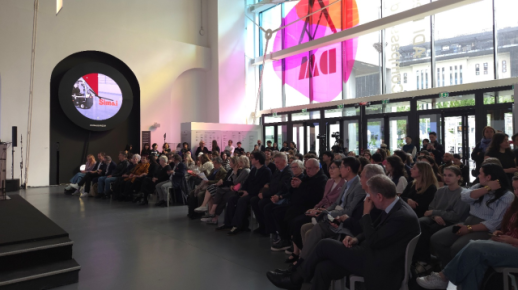 Kookmin University holds inaugural DBEW international design awards in Milan SEOUL, April 28 (AJP) - Kookmin University and the Association for Industrial Design hosted the first Design Beyond East & West Award ceremony at the ADI Design Museum on April 21, coinciding with the opening of Milan Design Week, the prominent South Korean university said Tuesday. The international competition received over 800 entries from 44 countries, focusing on creative design education and outcomes for the future society in the age of artificial intelligence. Unlike traditional design competitions, the Design Beyond East & West (DBEW) Award recognizes both students and their educators for collaborative achievements in fields such as architecture, space design, product design, and visual communication. The event served as an open forum for students, educators, and experts to discuss the future of the industry. The ceremony was attended by prominent figures, including Jury Chair Paola Antonelli, Stefano Giovannoni, and John Thackara. Lorenzo Imbesi, President of Cumulus, and Emilia Gatto, the Italian Ambassador to South Korea, delivered congratulatory remarks emphasizing international solidarity. The Gold Prize was awarded to Baoyi Huang and Professor David Buck from the University of Sheffield for their project, "Ecological Samsara – Soundscape Transformation of Parkwood Springs." Silver prizes were awarded to teams from HTW Berlin University of Applied Sciences, Avantika University, and L'École de design Nantes Atlantique. Andrea Cancellato, Director of the Association for Industrial Design (ADI) Design Museum, noted that the awards grew from a memorandum of understanding signed with Kookmin University last year. "This award is the only model in the world that honors both the educator and the student simultaneously," Cancellato said, adding: "It is an important milestone for the museum in strengthening ties with Asia." Paola Antonelli, who chaired the jury, highlighted that the devotion of teachers is often undervalued and that the DBEW Award brings the necessary attention to the noble value of the educators. Fellow juror John Thackara added that after decades in education, he believes that value lies in the dialogue during the process rather than just the finished result. During a concurrent forum titled "Future-Oriented Redefinition of Design Education," participants discussed the necessity of critical thinking in the AI era. Students at the forum called for curricula that better integrate research with industrial execution and provide a deeper understanding of business mechanisms. The award program is rooted in the work of the Oriental Culture & Design Center (OCDC) at Kookmin University, established by Director Choi Kyung-ran. The center has spent 20 years researching the essential values of design in Asia, providing the foundation for the current international competition. "The DBEW Award is a stage that demonstrates the potential of a global education cluster where universities share technology and philosophy to solve common human problems beyond borders," said Chung Seung-ryul, President of Kookmin University. "It will serve as a practical compass and a new role model for design education in the AI era." The organizers have begun preparations for next year's competition, with schedules for future submissions and forums to be announced on the official DBEW website. 2026-04-28 16:48:20
 -
 South Korea Seeks Central-Local Partnership to Reach 30 Million Foreign Visitors The Ministry of Culture, Sports and Tourism said it met with officials from all 17 provinces and major cities to discuss ways to overhaul inbound tourism, a follow-up to the National Tourism Strategy Council’s elevation to a presidential body. The ministry said it plans to strengthen cooperation between central and local governments, saying revitalizing regional tourism is essential to reaching an era of 30 million foreign visitors. The ministry said it held a meeting of tourism bureau directors from the 17 local governments on the 28th at the Government Complex Sejong, chaired by Kang Jeong-won, director general for tourism policy. The meeting was convened to discuss how to carry out the “inbound tourism transformation and regional tourism leap” measures drawn up at the 11th National Tourism Strategy Council meeting in February. The ministry said it was the first session aimed at strengthening a central-local communication channel since the council, the top decision-making body for tourism policy, was upgraded under revisions to the Tourism Promotion Act. ◆Local governments seen as key to targeting 30 million inbound visitors The ministry and local governments agreed that the decisive factor for the inbound tourism overhaul is a leading role by local governments. They said they will work to identify and develop tourism content tailored to each region in line with the government’s push to foster tourism as a national strategic industry. Officials focused on tasks including making regional airports hubs for inbound tourism, strengthening the lodging industry support system, setting directions for region-specific tourism zones, introducing a performance management system for tourism development projects, developing region-by-region tourism content such as identifying notable destinations in South Korea, and improving visitor readiness by stamping out price gouging. ◆Ministry hears local concerns, pledges “noticeable” tourism gains The ministry said it heard practical difficulties and pending issues local governments face in implementing policies, and that the feedback will be reflected in detailed policy steps going forward. Kang said, “The battleground for an era of 30 million inbound visitors is ultimately the regions, and local governments hold the key to success.” He added, “With the National Tourism Strategy Council elevated to a presidential body, the ministry will communicate more closely with local governments to deliver a tourism leap that both the public and foreign visitors can feel.” 2026-04-28 16:48:19
 -
 Kia Modernizes South Korea’s Military Trucks, Expands Exports Military trucks remain the South Korean military’s workhorse for moving troops and supplies. Many reservists remember riding in the troop carriers commonly known as “Yukgong” or “Dudonban.” As battlefield systems modernize, so do the trucks — now designed for combat use and equipped with features once unthinkable in the field, including navigation. Kia says the vehicles are also finding buyers abroad, including in Europe and the Middle East. ◆Military trucks as infantry transport During battalion-level and larger exercises, 2.5-ton K511 trucks — widely called Yukgong trucks — are a familiar sight filling parade grounds. Troops typically board assigned vehicles after orders are issued. About 10 to 20 soldiers ride in the back, holding their rifles close between their legs. Depending on the mission, they may ride in a “four-direction security” posture, aiming outward. Military trucks are central to infantry movement and logistics, carrying both personnel and the supplies needed for operations. K511 trucks assigned to rapid-response units carry platoon-level troops along with equipment such as ammunition. The trucks long used by troops carry little visible branding, but most are produced by Kia, which also supplies the military with vehicles including the Retona command vehicle, ambulances for medical evacuation and armored reconnaissance vehicles. Kia has produced standard vehicles for the South Korean military since being designated a defense contractor in 1973. After establishing a special-vehicle research center in 1985, it built a standard platform by producing models including the 2.5-ton Yukgong truck and 5-ton trucks. Kia’s special business division said deliveries of military special-purpose vehicles totaled 6,122 units in 2024 and 5,789 in 2025. In the first quarter of this year, deliveries rose to 1,129 units, up 36% from 830 a year earlier. Based on performance proven at home, the vehicles are exported to about 30 countries, including Poland. ◆From familiar trucks to next-generation vehicles Older military trucks were difficult to operate, with no power steering and drivers forced to muscle the wheel. Newer models have changed sharply, adding power steering, navigation and driver-assistance systems to improve operating conditions. The K511 Yukgong truck and the Retona are also being replaced over time. The shift began with the light tactical vehicle, the KLTV (K151). Mass-produced in 2017, the K151 was newly developed on Kia’s Mohave platform and is intended to replace command vehicles such as the Retona and reconnaissance vehicles over the long term. The K151 uses a 3-liter diesel engine rated at 225 horsepower and an eight-speed automatic transmission, allowing speeds up to 130 kph. In 2023, it secured a 400 billion won export contract with Poland, a deal cited as evidence of South Korea’s competitiveness in military vehicles. A next-generation medium standard vehicle, the KMTV, intended to replace the Yukgong truck over the long term, began deliveries to the South Korean military in the second half of last year. Developed on Hyundai Motor Co.’s Pavise truck, it includes navigation, front and rear cameras and an around-view monitor — features comparable to commercial trucks. With a 280-horsepower diesel engine and an eight-speed automatic transmission, it can operate on 60% grades and in water up to 1 meter deep. Kia is also pointing to electrification and unmanned systems as the next step. The company has recently showcased a hydrogen ATV concept vehicle, “Black Veil,” at defense exhibitions in South Korea and overseas. Using a hydrogen fuel cell, it produces less noise and heat and can travel farther than internal-combustion vehicles, Kia says. It has been assessed as suitable for situations requiring rapid movement in high-risk areas. A Kia official said the company is presenting a range of special-purpose vehicles applying its technology, “from medium trucks to pickups,” and added, “We will build customized special-mission vehicles the military needs and present a future vision for military mobility.”* This article has been translated by AI. 2026-04-28 16:45:45
 -
 Minsky moment looming for Korea's financial sector SEOUL, April 28 (AJP) — Loose liquidity binges tend to end in a Minsky moment — the payback for easy gains. For South Korea’s financial sector, that moment may be inching closer, as a domestic slowdown, supply-side inflation and accumulated leverage begin to converge. Delinquency rates are rising with unusual speed. The country’s five largest commercial banks reported an average delinquency rate of 0.4 percent for the first quarter of 2026, up from 0.34 percent in the previous quarter. As of April 7, the figure had already climbed to 0.46 percent — the highest level in about a decade, since the 2015 collapse of STX Group. The first cracks appeared in loans to small and medium-sized enterprises (SMEs). At Hana Bank, SME delinquency rose to 0.61 percent from 0.47 percent a quarter earlier, the highest since its 2015 relaunch. Woori Bank reported a similar jump to 0.61 percent, the highest since the creation of Woori Financial Group in 2019. Large corporates remain relatively insulated, though pockets of risk persist. KB Kookmin Bank stands out for its exposure to troubled real estate project financing. The deterioration is no longer just marginal — it is accumulating in size. Non-performing loans (NPLs) at four major banks, excluding NH, surged 11.6 percent in the first quarter to 5.77 trillion won ($3.92 billion), crossing the 5 trillion won mark for the first time in nearly eight years, since the fallout from the Hanjin Shipping bankruptcy. While industry insiders say most loans are unlikely to be written off, the worsening economic outlook is casting doubt on that view. "Internally, we acknowledge the growing risks and are working to diversify our exposure," said an official from one of the four major banks, speaking on condition of anonymity. Banks plan to secure maximum loan-loss provisions while tightening lending regulations for distressed borrowers. The average NPL coverage ratio fell to 153.8 percent from 172.0 percent at end-2025, even as banks posted robust earnings of nearly 4 trillion won in the first quarter, including a record 1.16 trillion won at Shinhan Bank. Households are showing similar fault lines. Total household debt, already above 1,850 trillion won, expanded by another 3.5 trillion won last month. Mortgage rates — tied to more than 1,000 trillion won of that debt — continue to rise. According to the Bank of Korea, the average rate on new household loans climbed to 4.34 percent in March, the highest in nearly two and a half years. More concerning is the shift in debt quality. High-interest card loans, typically exceeding 10 percent, have ballooned to a record 43 trillion won. Long-term delinquencies of more than six months reached 470 billion won, surpassing 1 percent of total credit — the highest level in 11 years. The macro backdrop offers little relief. Stronger-than-expected first-quarter growth of 1.7 percent has reinforced the central bank’s hawkish stance, keeping the possibility of a rate hike alive. Under Governor Shin Hyun-song, price stability remains the priority — even at the risk of further squeezing already vulnerable borrowers. “Higher rates are boosting bank earnings, but at the cost of rising systemic risk,” said Park Hye-jin, a researcher at Daishin Securities. “It is a paradox where profitability and instability rise together.” While Korean equities remain among the best performers this year, other asset classes are weakening. The won traded at 1,473.6 per dollar on Tuesday, down more than 2 percent from the start of the year. Bond yields have surged, with the three-year Treasury at 3.529 percent and the 10-year at 3.861 percent — both up more than 60 basis points year to date. The signals are not yet a crisis. But the pattern is familiar: leverage builds quietly, stress emerges at the edges, and buffers erode faster than expected. That is typically how a Minsky cycle turns. 2026-04-28 16:43:26
 -
 Korean Bar Association, LAWASIA sign MOU to support 2026 Seoul general meeting The Korean Bar Association and LAWASIA said April 28 they signed a memorandum of understanding to help ensure the successful staging of the 2026 LAWASIA Seoul general meeting. The signing ceremony was held April 27 in the main conference room of the Korean Bar Association building in Seoul’s Seocho District. Attendees included Korean Bar Association President Kim Jeong-uk, LAWASIA President Yap Teong Liang and other officials from both organizations. Under the agreement, the two sides will jointly organize and promote an international conference for legal professionals across the Asia-Pacific region, recruit speakers for each session together, and work to secure sponsors to support the event. The 39th LAWASIA Seoul general meeting is scheduled for Sept. 14, Monday, through Sept. 16, Wednesday, at The Plaza Seoul and the Koreana Hotel under the theme “Global New Order - Challenges and Perspectives.” Organizers said it will be the fourth time the LAWASIA general meeting is held in Seoul and will take place in the year marking LAWASIA’s 60th anniversary. Planned events include an opening ceremony and welcome reception, practice-area sessions, networking programs and a gala dinner at the Four Seasons Hotel. Kim said the Korean Bar Association will “do its best” to prepare the opening ceremony and key events to ensure the meeting is held successfully. He added that the association will work with LAWASIA so that many Korean lawyers can take part and cooperate with legal professionals from the Asia-Pacific region and around the world. The Korean Bar Association said it will use the MOU to further strengthen cooperation with LAWASIA and make thorough preparations so the 2026 Seoul meeting serves as a venue for exchange and collaboration among legal professionals in Korea and abroad. 2026-04-28 16:42:18
 -
 Netflix wins tax battle in Seoul to pay little despite massive revenue in Korea SEOUL, April 28 (AJP) - A South Korean court ruled in favor of Netflix, ordering tax authorities to refund most of the roughly 80 billion won ($58 million) it had imposed on the global streaming giant, in a decision that underscores the limits of taxing cross-border digital services. The Seoul Administrative Court sided with Netflix Services Korea in a lawsuit filed in November 2023 seeking to cancel 76.2 billion won of the total tax assessment following a probe into its income. At issue was whether payments made by the Korean unit to its Netherlands-based affiliate, Netflix International B.V., should be treated as royalty income — subject to domestic taxation — or business income, which is exempt under the South Korea–Netherlands tax treaty if the foreign entity lacks a permanent establishment in Korea. Tax authorities argued the payments were royalties tied to the use of intellectual property. Netflix maintained they were business income derived from services provided overseas. The court ruled that the payments were not compensation for copyrights but service fees related to streaming services, noting that key functions such as content storage and transmission were performed by the overseas entity. It found that the Korean unit mainly handled platform operations, marketing and user management, while operating under a structure in which it retained a fixed margin and remitted the bulk of revenue to its parent — a model consistent with a service arrangement rather than intellectual property licensing. The ruling comes as Netflix continues to expand its presence in Korea’s over-the-top (OTT) market. According to its disclosure last week, Netflix Services Korea posted revenue of 1.05 trillion won last year, up 17 percent from a year earlier, marking its highest level since launching in the country in 2016. Operating profit rose to 20.3 billion won. Netflix’s monthly active users reached 15.6 million in December, up 20 percent on year and nearly double that of second-ranked Coupang Play. Despite strong top-line growth, profitability remains limited. The company’s operating margin has hovered around 2 percent for several years, as more than 80 percent of its local revenue is paid to its headquarters under “membership purchase” costs. Last year, about 8.5 trillion won — roughly 81 percent of domestic revenue — was remitted overseas. As a result, Netflix paid 6.6 billion won in corporate tax in Korea, equivalent to 0.6 percent of revenue, below the 1.1 percent average for foreign firms, according to CEO Score. The tax authority has not yet indicated whether it will appeal the ruling. However, Netflix Korea said "Netflix complies with tax laws and regulations in all countries where it operates and will continue to invest in Korean content and its broader ecosystem while cooperating with local authorities, regardless of the court’s decision." 2026-04-28 16:39:12
 -
 Vance Questions Accuracy of Pentagon’s Iran War Briefings to Trump, The Atlantic Reports With U.S.-Iran talks to end the war stalled, Vice President JD Vance has questioned whether the Pentagon is accurately reporting the state of the war and U.S. weapons stockpiles to President Donald Trump, The Atlantic reported. Citing the magazine’s report dated April 27 (local time), Vance has raised concerns about the accuracy of war-related information coming from the Defense Department led by Defense Secretary Pete Hegseth. He has also directly brought up the availability of certain missile systems, according to the report. The Pentagon has publicly said U.S. weapons stockpiles are sufficient and that eight weeks of fighting inflicted significant damage on Iranian forces. People close to Vance, however, have suggested those assessments may not fully reflect conditions on the ground. Vance is said to have conveyed his concerns as personal views, seeking to limit internal friction rather than openly criticize the Pentagon. Still, some allies believe the department’s assessments have been presented too positively. The report also said Vance delivered ammunition-related concerns directly to Trump in a meeting attended by key national security officials. From the early stages of the war, Vance has been among the more cautious voices within the Trump administration, warning that if the conflict dragged on it could be “a disaster,” the report said. The concerns come as analysts point to shrinking U.S. inventories. The New York Times reported on April 23 that the war has rapidly reduced U.S. stocks of missiles and other precision-guided munitions, weakening readiness in Asia and Europe for potential competitors such as China and Russia. Citing U.S. administration and congressional officials, the Times said the U.S. military has used about 1,100 JASSM-ER long-range stealth cruise missiles since the start of Operation “Grand Fury,” leaving an estimated 1,500 remaining. The Center for Strategic and International Studies said in a report issued March 27, citing The Washington Post, that U.S. forces have used about 850 Tomahawk missiles, with remaining stocks estimated in the low 3,000s. Despite the large-scale missile strikes, assessments say Iran’s military threat remains. According to an internal U.S. intelligence assessment cited in the report, Iran still retains about two-thirds of its air power and key missile-launch capabilities, and has preserved much of its fleet of small fast boats that could be used to lay mines and disrupt maritime operations in the Strait of Hormuz. One source said those forces remain a central threat to resuming maritime trade.* This article has been translated by AI. 2026-04-28 16:36:18