
Journalist

Lee Hugh
=
-
 NH NongHyup Bank Launches First Transition Loan to Back Low-Carbon Upgrades NH NongHyup Bank said Tuesday it has executed its first transition loan, financing environmental improvement investments for companies that need to shift to lower-carbon operations. The bank said the case shows how financial support can help fund equipment investments that improve environmental performance in the real economy. It plans to keep expanding green and transition lending in line with the group’s transition finance strategy. The loan supported funds to install a wastewater treatment facility at a livestock products distribution company in Goseong County, South Gyeongsang Province. The company will use the project to reduce pollution and move to more environmentally friendly facilities. NH NongHyup Bank said the loan was handled as transition lending after a suitability review under Korea’s green taxonomy, known as the K-Taxonomy, aimed at supporting a practical low-carbon shift. The bank has also moved to broaden climate finance, including signing a business agreement Monday with the Korea Technology Finance Corp. on an evaluation project based on the K-Taxonomy. It said it plans to expand support to transition finance and continue strengthening low-carbon transition and ESG-related financial support for companies.* This article has been translated by AI. 2026-04-28 10:09:16
 -
 LG 2026 OLED TVs win Carbon Trust carbon footprint certification for sixth straight year LG Electronics said Tuesday that its 2026 TV lineup has received three ESG-related certifications in areas including carbon reduction, reduced plastic use and the use of recycled materials. The company said its 2026 OLED TVs recently earned a “carbon footprint” certification from the U.K.-based nonprofit Carbon Trust. LG said it has received the certification for six consecutive years since 2021. Carbon Trust evaluates a product’s carbon dioxide emissions and environmental impact across its full life cycle, from production and distribution to use and disposal, before granting the certification. It also awards a separate “carbon reduction” certification to products that cut emissions compared with previous models in the same class. LG said its 2026 OLED TV G6 models in 83-, 77- and 65-inch sizes received the carbon reduction certification. LG said all of its new OLED models released this year — W6, G6, C6 and B6 — also earned Intertek’s “resource efficiency” certification, which the company said supports the products’ sustainability claims. To receive the certification, products must pass strict reviews covering material-use efficiency — including design for recycling, reduced hazardous substances and ease of repair — as well as energy efficiency and the use of recycled materials, LG said. LG said OLED TVs require fewer parts than LCD TVs because they do not use a separate backlight. By applying lightweight composite fiber materials, LG said it reduced plastic use to about 40% of that used in major-brand LCD TVs of the same size. The company estimated that, for an equivalent number of units, plastic used to make the new OLED TVs would be about 15,000 tons less than for LCD TVs. LG said its premium LCD TV, Micro RGB Evo, also received the resource efficiency certification, citing its energy-efficient design. Lee Choong-hwan, head of LG Electronics’ Display Business Unit and a vice president, said, “LG OLED TVs will focus not only on outstanding picture quality and convenient AI features, but also on innovation from an ESG perspective, to build a sustainable future together with customers.”* This article has been translated by AI. 2026-04-28 10:05:07
 -
 South Korea to Issue 200 Billion Won in Retail Treasury Bonds in May The Ministry of Economy and Finance said April 28 it plans to issue 200 billion won ($200 billion won) in retail Treasury bonds in May. By maturity, the ministry will offer 5 billion won each in three-year coupon bonds and three-year compound-interest bonds. It will also supply 50 billion won in five-year bonds, 110 billion won in 10-year bonds and 30 billion won in 20-year bonds. Coupon rates will be based on the winning yields for government bonds of the same maturities sold in April. The three-year bond will carry a 3.450% coupon rate, the five-year 3.530%, the 10-year 3.715% and the 20-year 3.610%. Additional rates will be added to the five-year (0.3 percentage points), 10-year (1.05 percentage points) and 20-year (1.3 percentage points) bonds. No additional rate will be applied to the three-year bond, citing recent rate increases and returns on financial products. If held to maturity, the pretax return is expected to be about 10% for the three-year coupon bond and about 11% for the three-year compound-interest bond, about 21% for the five-year bond, about 59% for the 10-year bond and about 161% for the 20-year bond. Subscriptions will run from May 11 to May 15. Individual investors can apply in person or online through Mirae Asset Securities, the selling agent. The minimum subscription is 100,000 won, and the annual purchase limit is 200 million won per person. If total subscriptions are within the issuance cap, investors will receive full allocations. If subscriptions exceed the cap, up to 3 million won will be allocated equally, with the remaining amount distributed in proportion to subscription size. Allocation results will be provided on the next business day after the subscription period ends. In May, investors will also be able to redeem early retail Treasury bonds issued from June 2024 through April 2025. In that case, they will receive only principal and interest based on the coupon rate applied at purchase, and will not receive compound interest including the additional rate or benefits such as separate taxation on interest income.* This article has been translated by AI. 2026-04-28 10:04:04
 -
 LG Sangrok Foundation to Host Three-Generation Family Walk at Hwadam Forest The LG Sangrok Foundation said April 28 it will host a family invitation event next month, themed “Hwadam Forest Walk for Three Generations,” on May 11 to mark Family Month. The foundation said the program is designed to help families spend time together in nature and talk while walking. “Hwadam” is also the pen name of the late Koo Bon-moo, who created the forest. Hwadam Forest has barrier-free deck paths with gentle slopes across the entire route, allowing access for strollers and wheelchairs, the foundation said. A monorail also operates to help visitors reach areas that are harder to walk. Participating families will be able to visit “Hwadamchae,” a cultural complex featuring exhibits on the forest’s nature and philosophy, take family photos with the forest as a backdrop, and attend an hourly “forest concert,” it said. The event will be free for up to 2,500 people from three-generation families who apply through advance reservations. “Hwadam Forest has aimed to be more than a place to view nature — a place where people stay together and communicate in nature,” an LG Sangrok Foundation official said. The official added the foundation hopes the event will give families “from grandparents to grandchildren” time to walk together and build memories.* This article has been translated by AI. 2026-04-28 10:03:17
 -
 VietJet Moves to Expand Long-Haul Service, Eyes Europe as It Seeks Multinational Group Status Vietnamese low-cost carrier VietJet is stepping up plans to enter European routes and says it aims to grow into a “multinational aviation group,” moving beyond its short-haul budget roots. Vietnamese media including Cheongnyeon Sinmun reported on April 28 (local time) that South Koreans were the second-largest group of foreign visitors to Vietnam in the first quarter, totaling 1,326,425. VietJet, well known to Korean travelers for low fares, has now outlined a shift in strategy: paying shareholders stock dividends instead of cash and raising large sums externally to open long-haul routes to Europe and the Americas. At its annual shareholders meeting in Ho Chi Minh City on April 24, VietJet approved a 30% stock dividend, corporate bond issuance and a plan to issue new shares worth up to $300 million (about 440 billion won). The package signaled a preference to reinvest rather than distribute cash, and shareholders backed the move. The company pointed to strong results last year. Revenue rose about 13% and pretax profit climbed 41%. VietJet carried 28.2 million passengers, added 22 aircraft and expanded its fleet to 101 planes. It logged more than 150,000 flights for the year, averaging more than 400 a day. VietJet said the funds will go to additional wide-body aircraft, new international routes, expanded maintenance facilities and workforce training. It has already drawn attention at the Paris Air Show by ordering 100 Airbus A321neo jets and 20 long-haul A330neo wide-body aircraft. Its Thailand unit plans to expand routes to 53 next year, and its Kazakhstan unit, long in the red, has turned profitable. VietJet said transaction volume on its in-house payment service, Galaxy Pay, has topped 15 trillion dong (about 840 billion won), and membership has surpassed 2 million. Europe is the centerpiece of the expansion plan. Vice President Jay Lingeswara said at an aviation conference this month that “the market we are watching most is Europe,” and that VietJet will launch one-stop service linking Vietnam to Europe via Kazakhstan. “We have always entered markets others avoid first and grown them — that is our formula,” he said. Chairwoman Nguyen Thi Phuong Thao, VietJet’s founder and widely known as Vietnam’s first female billionaire, told the shareholders meeting that VietJet is “not simply a company that carries passengers,” but one that connects “the economy, dreams and the future.” Independent director Philipp Roessler, described in the report as a former German vice chancellor, said VietJet has been preparing for European expansion for a long time. The airline also flagged risks. It said intensified conflict in the Middle East in March pushed jet fuel prices to around $200 a barrel, a major concern for airlines. VietJet said it slightly lowered its targets for this year and will spend only where necessary. For Korean travelers, VietJet Thailand said last year it would gradually expand medium-haul routes toward South Korea, Japan, China and India. That could add options beyond direct flights to Vietnamese resort destinations such as Da Nang and Phu Quoc, including connections via Bangkok. The report noted, however, that frequent delays remain a challenge for VietJet as it expands.* This article has been translated by AI. 2026-04-28 09:58:15
 -
 Han Dong-hoon Criticizes Ha Jung-woo’s Possible Busan By-Election Run as ‘Proxy Fight’ Han Dong-hoon, former leader of the People Power Party, criticized Ha Jung-woo, senior presidential secretary for AI future planning, over Ha’s suggestion that he may run in the Busan Buk-gu Gap parliamentary by-election to be held alongside the June 3 local elections. Speaking on BBS Radio’s “Geum Tae-seop’s Morning Journal” on Monday, Han said Ha appeared to be entering the race not by his own decision but to “fight a proxy battle” for President Lee Jae-myung. Han said Ha had stated that he would need President Lee’s permission to run and would not do so without it. Han also accused Ha of neglecting AI policy while weighing a bid for the by-election. “AI is extremely important and we’re in a golden time,” Han said, adding that Ha spent about a month wavering over whether to run and that “AI was pushed to the back burner.” Han added, “He hasn’t done anything for 10 months.” Han said he would use the election to reflect public sentiment, arguing that the People Power Party’s leadership has damaged the party and failed to effectively check the Lee administration. On criticism from Park Min-sik, a former minister of patriots and veterans affairs who has also signaled interest in running in Busan Buk-gu Gap, Han said Park has not been nominated and that he saw no need to respond. Han added that he understood why Park’s remarks were becoming harsher ahead of the election, describing Park as someone who “hurt” the district and left. Asked about the possibility of unifying conservative candidates in what is expected to be a three-way race, Han said such a move was only a dependent variable compared with the broader push to rebuild conservatism and local hopes for development. He said there was no reason for him to propose unification first and that there was no need to cite political calculations.* This article has been translated by AI. 2026-04-28 09:55:48
 -
 Hyundai Engineering & Construction Ranks No. 1 Globally in S&P Global ESG Construction Review Hyundai Engineering & Construction said April 28 it ranked No. 1 worldwide in the construction sector in S&P Global’s Corporate Sustainability Assessment, part of the Dow Jones Best-in-Class Index (DJ BIC), announced the previous day. DJ BIC is a revamped version of the Dow Jones Sustainability Indices. S&P Global selects the top 10% for sustainability among the world’s 2,500 largest companies by market capitalization. The company said it is the only South Korean builder to be included for 16 consecutive years across all index categories—World, Asia Pacific and Korea. It also said it was named to the “Yearbook 2026” Top 10%, S&P Global’s list of leading companies in the assessment. Hyundai Engineering & Construction attributed the result to steps including a management framework for other indirect emissions (Scope 3), building a companywide ESG IT system, strengthening internal sustainability controls, and disclosing information that includes ESG data from subsidiaries. The company said its ESG performance has also been recognized by major rating organizations at home and abroad. It said it has maintained an integrated A rating for eight straight years from the Korea ESG Standards Institute (KCGS), and earned A ratings from MSCI’s ESG assessment and the Carbon Disclosure Project, receiving strong marks across environmental, social and governance areas. Hyundai Engineering & Construction said it plans to further build trust with global investors and stakeholders by accelerating its shift to renewable energy, developing eco-friendly technologies and strengthening ESG management across its supply chain. A company official said the ranking reflects companywide efforts on climate-change response, safety management and transparent governance, adding that the company will work toward carbon neutrality and creating social value as a global construction leader. * This article has been translated by AI. 2026-04-28 09:55:08
 -
 PPP Floor Leader Song Eon-seok Opposes 'Hasty' Election-Driven Constitutional Revision Song Eon-seok, floor leader of the People Power Party, said April 28 that a constitutional amendment should not be rushed ahead of an election, as the National Assembly prepared to vote on a revision bill jointly introduced by National Assembly Speaker Woo Won-shik and six floor parties. Speaking at a party meeting at the National Assembly, Song said pushing a revision through in a hurry for electoral purposes would set a precedent and fuel “constitutional revision populism” every election season. “Our party is not opposing the substance of constitutional revision,” Song said. “We oppose a hasty, election-driven revision,” as he presented what he called the People Power Party’s five principles for a proper amendment. He argued against a piecemeal approach, saying, “Step-by-step revision is ultimately a patchwork revision,” and warned that repeatedly making small changes would leave the Constitution like “a patchwork garment.” Song said the Constitution’s preamble, which defines its history and spirit, requires careful and rigorous debate rather than a simple yes-or-no decision. He said some have argued the preamble should reflect the constitutional significance of liberal democracy during the Korean War, calling it an issue that should be addressed together. He also said broader public discussion is needed on whether to group the Bu-Ma Democratic Protests and the May 18 Democratization Movement with the April 19 democratic ideal in the current preamble, or treat them as separate principles. Song said revision should not be led by those in power, but should be “the people’s revision,” with the National Assembly, academia and civil society participating. He said all parties should work together under the Assembly’s leadership to gather public opinion and revise the Constitution accordingly. He added that revision should not be pushed through by pro-government parties to isolate the opposition, but should proceed through bipartisan agreement based on political balance. Song said the People Power Party again proposes that after the election, in the second half of the 22nd National Assembly, the parties form a special parliamentary committee on constitutional revision to discuss a comprehensive package, from the preamble to changes in the power structure. Song also expressed regret over Woo’s remarks on the People Power Party’s official stance opposing the revision, after Woo said lawmakers should be able to vote in the plenary session according to their conscience and convictions. Song said a party line is decided by the collective will of all its lawmakers and called Woo’s comments inappropriate, saying they distorted the situation as if party lawmakers were being forced to abandon their conscience. He demanded an apology. * This article has been translated by AI. 2026-04-28 09:54:19
 -
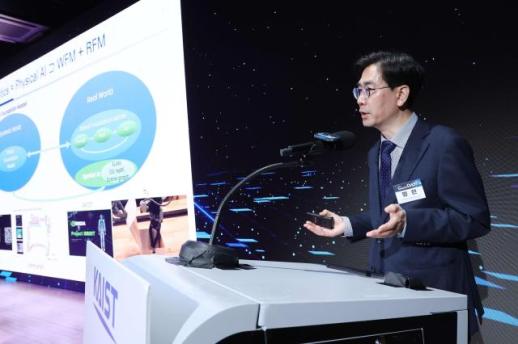 KAIST honors Professor Myung Hyun with Research Grand Prize for spatial AI robotics SEOUL, April 28 (AJP) - The Korea Advanced Institute of Science and Technology held its annual Research Day on Tuesday at its main campus in Daejeon to recognize faculty achievements and share new technical data. The event, which began in 2016, serves as the university's primary forum for highlighting academic breakthroughs and fostering a collaborative research environment, the prominent research institute said April 28. Professor Myung Hyun from the School of Electrical Engineering received the Research Grand Prize, the university's highest research honor. Myung was selected for his work on spatial artificial intelligence (AI) and autonomous robot navigation. Since joining KAIST in 2008, Myung has applied his navigation research to wheeled robots, drones, and walking platforms. His technology has won multiple international competitions and is currently being commercialized through a startup venture. "By focusing on spatial AI and autonomous movement for 17 years, I have been able to contribute to the domestic independence of mobile robot technology," Myung said. He noted that he was grateful for the chance to train the next generation of researchers. To support a more focused research environment, the university expanded its award pool this year. The number of Research Award recipients increased from two to four, and the Special Research Award was expanded to include two winners. Several other faculty members were recognized for their academic contributions. Professor Han Jae-hung, Professor Cho Byung-kwan, Professor Joseph Schiering, and Professor Lee Hyun-joo received the Research Award, while Professor Kim Sun-chang and Professor Jo Woo-young were selected for the Special Research Award. The university also presented the Innovation Award to Professor Kim Jae-kyung and the Convergence Research Award to the team of Professor Cho Him-chan and Professor Lee Jeong-yong. Other honors included the International Joint Research Award for Professor Song Ji-joon and the QAIST Creative Challenge Research Award for Professor Kim Bong-jin. The event showcased 10 representative research achievements from 2025 and 14 future technologies identified for their socioeconomic potential. These projects are aligned with national strategic technology goals in South Korea. President Lee Kwang-hyung said Research Day is an opportunity to share innovative ideas and celebrate the work of faculty. Lee stated the institution plans to continue its efforts to lead global science and technology through its research. 2026-04-28 09:51:53
 -
 Two tankers carrying 4 million barrels of Iranian oil reach Asia after transiting Hormuz; six turn back Despite a U.S. maritime blockade in the Strait of Hormuz, about 4 million barrels of Iranian crude oil transited the waterway in a single day on April 24, according to data cited by Reuters. Reuters, citing TankerTrackers.com satellite-based data, reported April 27 that two tankers bound for Asia carrying roughly 4 million barrels of Iranian crude exited the strait on April 24. By contrast, six other tankers carrying a combined 10.5 million barrels were blocked in recent days and turned back, the data showed. Four additional Iranian tankers returned empty from Asia and were last spotted near Pakistan’s coast. Iran moved to control the Strait of Hormuz immediately after the war began on Feb. 28, and the United States began a maritime blockade against Iran on April 13. Iran briefly reopened the strait April 17-18 before resuming controls, and traffic has fallen sharply from the prewar daily average of 125 to 140 transits. U.S. Central Command said April 25 that since the blockade began it has redirected 37 vessels to alternate routes. Reuters reported the U.S. military appears to have ordered some ships to turn back in the Gulf of Oman while allowing others to pass. As of April 27, at least seven ships transited the strait over the previous day, according to ship-tracking firm Kpler and satellite analytics company SynMax, but none were tankers. Most were bulk carriers; some departed Iraqi ports and one sailed from an Iranian port. Reuters said that because the U.S. military is rerouting Iran-linked ships as far as near the Strait of Malacca, it remains unclear whether the cargoes will reach buyers or be intercepted and sent back to Iran. Reuters also reported that an Abu Dhabi National Oil Co. liquefied natural gas carrier appears to have successfully transited the Strait of Hormuz. If confirmed, it would be the first known case since the war began of an LNG-laden vessel passing through the strait. There had previously been a case of an Omani carrier transiting without LNG on board. According to ICIS LNG Edge and MarineTraffic, the vessel was first detected in Gulf waters on March 30, then went dark for weeks before reappearing recently in waters west of India. In Gulf waters, some ships have also switched off location signals or transmitted false information to avoid tracking.* This article has been translated by AI. 2026-04-28 09:51:19