
Journalist

Lee Hugh
=
-
 National Nakdong River Biological Resources Institute Opens Applications for Teaching Kit Loans, Online Classes The National Nakdong River Biological Resources Institute said on the 27th it is accepting applications from schools and other educational institutions for its “teaching kit loan service” and its “online bio-environment classroom.” The program, which begins that day, is designed to expand hands-on learning by distributing teaching kits and content developed by the institute for use in classrooms and other learning sites. The teaching kit loan service provides free loans of seven types of kits focused on biodiversity and climate change for use in educational settings. The online bio-environment classroom is an integrated online-offline course that combines video content with hands-on activity packages. Applications open that day through the institute’s website reservation system. Registration for the online bio-environment classroom runs through the 31st of next month, with up to 2,000 participants accepted on a first-come, first-served basis for each program; applications will close once capacity is reached. “Through the teaching kits developed by the National Nakdong River Biological Resources Institute, children and teenagers will be able to understand the value and importance of biodiversity in an easy and engaging way,” said Yeo Jin-dong, head of the institute’s Exhibition and Education Division. He added that the institute will continue to expand educational content that can be used in schools and other learning environments.* This article has been translated by AI. 2026-04-27 06:03:06
 -
 South Korea Weighs How to Use Expected Tax Windfall: Debt Paydown, Extra Budget or Reserves South Korea is again expected to post a large tax revenue surplus this year, and the government is weighing how to use it. Options under discussion include early repayment of government bonds, drafting a supplementary budget, or setting the money aside in a fund. Some analysts say the decision should hinge on what is driving the extra revenue. The choice is complicated by competing goals: restoring fiscal soundness while also responding to economic conditions. How policymakers proceed could depend on whether the revenue increase is structural or a temporary swing in the business cycle. ◆ “Use the surplus to cut debt first”: Fiscal discipline argument One view is that the surplus should be used to repay government bonds early to strengthen fiscal health, after national debt rose during the COVID-19 response. Supporters say paying down debt while revenue is strong would preserve medium- to long-term fiscal capacity and improve the government’s ability to respond if another crisis hits. Early repayment could also signal to international credit rating agencies and foreign investors that South Korea is actively managing economic fundamentals. Compared with injecting more money into the economy, debt repayment may help restrain the money supply and contribute, at least in part, to stabilizing high inflation, proponents argue. Some analysts also warn that using surplus revenue to expand spending could amplify economic volatility. The National Assembly Budget Office said surplus revenue stemming from underestimates can lead to higher spending in the same year or the next, potentially weakening fiscal policy’s countercyclical role during an upswing. An official at the office said, “If a supplementary budget is compiled as a tool to make up for underestimated tax revenue regardless of economic conditions, the likelihood of causing economic instability increases.” ◆ “Use fiscal spending to support growth”: Active fiscal policy argument Others argue for more active fiscal intervention to boost the economy. With domestic demand weakened by the effects of high interest rates and high inflation, they say government spending is needed to lift consumption and investment. Some call for cash-type support for vulnerable groups whose real incomes have fallen due to inflation, and for small business owners hit hard by the downturn, to strengthen the social safety net. Another argument gaining traction is preemptive investment in future growth industries such as semiconductors and artificial intelligence to spur private-sector investment. In this view, fiscal spending is a key tool to cushion near-term downside risks when consumption and investment are sluggish. A third camp says the government should build reserves in a fund rather than immediately expand spending or repay debt, as a hedge against volatility. Supporters describe it as a compromise that could serve as a buffer if sharp economic shifts occur or if large resources are needed during structural reforms. Critics note that setting money aside does not reduce debt as directly as early repayment and offers less immediate stimulus than a supplementary budget, making it less attractive politically. With the three approaches competing, the government has not set a clear direction. Park Hong-geun, minister of the Office of Planning and Budget, recently told reporters the government would proceed cautiously. Park said, “If a tax revenue surplus or surplus funds occur, we will execute them in an appropriate manner in accordance with relevant laws and procedures, including the National Finance Act.” Experts advise first determining the nature of the surplus before deciding how to use it. Kim Yu-chan, a professor of business administration at Hongik University, said it is important to distinguish whether the surplus is structural or temporary. He said the current increase appears largely temporary, driven by a strong semiconductor cycle, and that it would be desirable to pair fiscal spending that helps spread growth beyond semiconductors with a reduction in the amount of government bonds originally planned for issuance.* This article has been translated by AI. 2026-04-27 05:05:55
 -
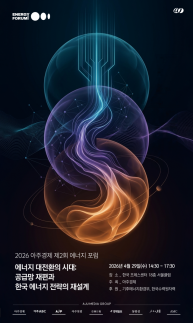 Aju Business Daily to Hold Energy Forum on Korea’s Strategy Amid Supply Chain Shifts Uncertainty is growing in the global energy market as prolonged Middle East-driven geopolitical risks continue to unsettle oil and gas supply chains, prompting countries to refocus energy security as a core national strategy. At the same time, the spread of artificial intelligence and the rise in data centers are sharply increasing electricity demand, accelerating structural change across existing energy systems. South Korea is no exception. With heavy reliance on energy imports and a manufacturing-centered industrial base, the Korean economy is particularly sensitive to shifts in global energy supply chains. That is why securing stable supplies and establishing a practical energy mix strategy spanning renewables, nuclear power and liquefied natural gas (LNG) is increasingly urgent. Aju Business Daily will hold the “2026 Aju Business Daily 2nd Energy Forum” on April 29 at the Korea Press Center in Jung-gu, Seoul. The forum’s theme is “The Era of a Major Energy Transition: Supply Chain Reshaping and Redesigning South Korea’s Energy Strategy.” Kim Hyeong-jun, a chair professor in the Department of AI Futures Studies at KAIST’s Moon Soul Graduate School of Future Strategy, is set to speak on “The Climate Crisis, Energy Security and South Korea,” outlining the importance of energy security and Korea’s response strategy amid a deepening climate crisis and expanding geopolitical risks. Next, Gwak Eun-seop, head of the Grid Planning Office at Korea Electric Power Corp., will present on “Power Demand in the AI Era and New Challenges for the Power Grid,” focusing on surging demand tied to expanding data centers, shortages in transmission networks, and solutions for stable power supply. A panel discussion will bring together experts from government, academia and industry to discuss a Korea-style energy mix strategy and approaches to energy security. ■Theme: The Era of a Major Energy Transition: Supply Chain Reshaping and Redesigning South Korea’s Energy Strategy ■Time: April 29, 2026 (Wed.) 2:30 p.m.–5:30 p.m. ■Venue: Seoul Club, 18th floor, Korea Press Center ■Host: Aju Business Daily ■Sponsors: Ministry of Climate, Energy and Environment; Korea Hydro & Nuclear Power * This article has been translated by AI. 2026-04-27 05:05:06
 -
 South Korea’s Tax Revenue Swings Raise Concerns Over Budget Forecast Accuracy National tax revenue is rising faster than expected this year, fueling expectations that the tax surplus will exceed the government’s initial forecast. Economists and budget analysts, however, warn that repeated forecasting errors could undermine confidence in fiscal management. According to the Ministry of Economy and Finance on the 26th, national tax revenue in January and February totaled 71 trillion won, up 10 trillion won (16.5%) from a year earlier. By category, income tax rose 2.4 trillion won, value-added tax increased 4.1 trillion won, and the securities transaction tax climbed 1.2 trillion won. Revenue is also coming in earlier than usual. As of February, the collection rate versus the annual budget stood at 18.2%, 1.4 percentage points above the five-year average of 16.8%. The government previously projected a tax surplus of about 25.2 trillion won compared with the main budget and used it to fund a supplementary budget. With talk of additional gains in some items, including housing holding taxes, some observers say the surplus could be larger. The concern is that tax revenue volatility has widened sharply in recent years. Surpluses reached 61.3 trillion won in 2021 and 52.6 trillion won in 2022, but were followed by shortfalls of 56.4 trillion won in 2023, 30.8 trillion won in 2024 and 8.5 trillion won in 2025. Such swings are seen as weakening predictability and transparency in fiscal operations, especially when errors run into the tens of trillions of won, reducing the effectiveness of medium- and long-term fiscal plans. Underestimating revenue can increase incentives to draft supplementary budgets, while overestimating can lead to spending cuts or additional bond issuance, potentially hurting fiscal stability. The government has emphasized that the latest supplementary budget is “bond-free” because it uses surplus revenue. Critics note that if the entire surplus is spent, less will remain as a year-end surplus that could have been used to repay government debt, producing an effect similar to issuing additional bonds in terms of fiscal soundness. The National Assembly Budget Office said both under- and over-budgeting revenue causes inefficiency and unnecessary administrative costs. It said the case, in which about 25 trillion won in revenue error emerged just three months after the fiscal year began, calls for a broader review of the tax revenue forecasting system rather than being treated as a simple miscalculation. Analysts attribute the volatility to a tax structure heavily dependent on the business cycle and asset markets. Major taxes such as corporate tax and capital gains tax are sensitive to economic conditions and asset prices, amplifying swings. Limits in forecasting methods — including repeated conservative or overly optimistic errors when incorporating economic outlooks — are also cited. Experts say institutional improvements are needed to better manage volatility, including more sophisticated forecasting models and a framework that improves predictability in medium- and long-term fiscal planning. Kim Jeong-sik, an emeritus professor of economics at Yonsei University, said accurate revenue forecasts require credible growth projections and consideration of policy variables, including tax law changes and real estate-related capital gains and holding taxes. “Because this process is also tied to the National Assembly, there are aspects that make forecasting difficult,” he said.* This article has been translated by AI. 2026-04-27 05:04:11
 -
 South Korea’s Tax Take Seen Surging Past 400T Won This Year, Possibly 500T Next Year South Korea’s government is facing a pivotal choice in fiscal policy as tax revenue is expected to far exceed earlier projections, reversing several years of shortfalls. After an estimated 25 trillion to 35 trillion won in excess revenue this year, some forecasts say national tax revenue could top 500 trillion won next year, well above the government’s initial outlook. As of the 26th, the Finance and Economy Ministry and other officials estimate this year’s national tax revenue will surpass 400 trillion won and reach about 415 trillion won, sharply higher than earlier projections. In its “2025-2029 National Fiscal Management Plan,” the government had forecast about 390 trillion won for this year and about 412 trillion won for next year, based on a conservative assumption of 4.6% average annual growth. Changing conditions are now forcing a revision. Revenue conditions have improved quickly this year, helped by a semiconductor boom, a strong stock market and a recovery in employment. When the government drafted its first supplementary budget this year, it made a 22.6 trillion won revenue adjustment, a procedure used to revise the budget when tax receipts come in higher or lower than expected. By category, corporate tax revenue was projected to rise by 14.8 trillion won, while the securities transaction tax and the rural special tax were expected to increase by 10.3 trillion won. Earned income tax was also projected to rise by 4.8 trillion won, reflecting broader gains in the tax base. With growth across major tax items now expected to be steeper than previously assumed, some observers say excess revenue this year could exceed the 25 trillion won used to finance the first supplementary budget and reach as much as 35 trillion won. Next year’s increase could be even larger. Using operating profit forecasts that reflect a “semiconductor supercycle” for major companies such as Samsung Electronics (300 trillion won) and SK hynix (198 trillion won), a simple calculation suggests corporate tax revenue from those two firms alone could generate more than 130 trillion won in additional revenue. That has fueled speculation that next year’s national tax revenue could far exceed the 412 trillion won forecast and climb well past 500 trillion won. If the unexpected surge materializes, debate is expected to intensify over how to use the windfall. Some argue it should be used to repay government bonds and strengthen fiscal soundness, saying rapid growth in national debt during years of revenue shortfalls makes this a chance to rebuild fiscal room. Others say the government should play a more active fiscal role during a period of low growth. The government has also stressed the need for spending to strengthen the growth foundation. Park Hong-geun, minister of the Planning and Budget Office, said at a news briefing on the 21st, “To raise the growth rate, the role of fiscal policy is needed,” signaling support for an expansionary stance. With the decline in potential growth becoming entrenched, the government sees fiscal spending as unavoidable for investment in new industries and structural reform. Questions remain about sustainability, however, because the revenue boom may be temporary and tied to a specific industry cycle rather than structural change. Critics note that external uncertainty remains high, including high oil prices and a weak won, and that tax receipts could still swing sharply with corporate earnings. The broad direction of fiscal management is expected to take shape at a National Fiscal Strategy Meeting in June after local elections. Chaired by the president, the meeting sets medium- and long-term fiscal policy and the basic principles for drafting next year’s budget, effectively serving as the government’s fiscal control tower. Officials are also expected to outline a more concrete plan there for how to use excess revenue.* This article has been translated by AI. 2026-04-27 05:03:19
 -
 LBS Professor Alex Edmans: Curiosity and Constant Questions Help Defeat Fake News "We need a culture where saying, 'I was wrong — I see it differently now,' is accepted and even encouraged." Alex Edmans, a professor of finance at London Business School, says resisting misinformation starts with curiosity and the habit of asking questions rather than leaning on conventional wisdom or authority. In his book <May Contain Lies> (Wisdom House), Edmans puts a wide range of sources under scrutiny — government-approved reports, papers published in scientific journals and even books endorsed by Nobel laureates. He also points to what he calls errors and exaggerations in global bestsellers, including <Outliers>. In an interview with this news organization, Edmans said Korea’s polarization and a confirmation-bias environment — where people seek out only what supports what they already believe — can be addressed by encouraging curiosity and questioning. He also said a harsh attitude toward failure can make people cling to a view once they adopt it, instead of changing their minds. "If people become more discerning, things can improve," he said. "Just being curious and asking questions can do it. In an environment that is strict about failure, once you hold a particular view, you become focused on defending it and you don’t want to change your mind." Edmans said books should not be treated as automatically trustworthy and that popularity is not proof of accuracy. "People say something is 'textbook' when they mean it’s correct, or they defer to authority by saying, 'He wrote the book on it,'" he said. "But a book isn’t that different from a long blog post. What matters is who wrote it and whether that person has expertise. Popularity is not evidence that the content is accurate — just as viral videos can be misleading." He said people should avoid settling for the most obvious explanation and instead look for alternatives by asking questions. He described confirmation bias as a tendency to accept what feels comfortable and said people should practice tolerating discomfort and challenging what they want to be true. He wrote in the Korean edition’s preface that “democracy dies when citizens stop asking questions.” "As an economist, I believe both supply and demand matter," he said. "If the public wants fake news — if citizens don’t ask questions and accept as fact only what they want to believe — then politicians, influencers and journalists will keep supplying it. The key point is that this isn’t because they are bad people. They are human, and they may lack the time or expertise to think critically and fact-check. Even busy citizens can understand the world better and make better decisions just by asking simple questions." Edmans also answered questions in writing about fact-checking and how people can avoid being misled by false information and incitement. ▷ People can be influenced more by values and ideology than by facts. How can people balance the pursuit of objective facts with value judgments? "It starts with recognizing the difference," he wrote. "Some issues have an objective truth — whether smoking causes cancer, or whether investing in a net-zero portfolio lowers financial returns. But what decision to make in a given situation is often a value judgment. Even if a net-zero portfolio doesn’t maximize returns, you might invest because you worry about climate change. Separating the two is important. If someone says, 'Net-zero investing sacrifices financial returns,' social media may try to brand that person a climate-change denier or immoral. But it’s simply a fact, without a value judgment. Acknowledging that net-zero investing has costs, while deciding you are willing to pay them because of concern about climate change, is not logically inconsistent." ▷ Your book emphasizes diversity and inclusion. Is dialogue that reaches mutual agreement really possible? "If people are open-minded, and if culture supports changing one’s view rather than saving face by refusing to admit mistakes, then agreement through dialogue is certainly possible," he wrote. ▷ Korea’s education system tends to focus on finding the right answer. As a parent, what matters most in building a child’s critical thinking? "Encourage children to ask questions," he wrote. "There are two ways. First, explicitly praise the act of asking. I often tell my son, 'That’s a good question.' Second, answer carefully even if the question is simple. Sometimes you may need paper and a pen to draw a picture, or show a real object, to answer properly." ▷ The word “common sense” is often used in politics and can change by era and context. Is it a reliable standard? "Appealing to common sense is dangerous," he wrote. "It often means personal intuition or a hunch, which can lead people to reject evidence that contradicts their instincts. For example, it may seem like giving water to a child with diarrhea will just pass through, so you shouldn’t. But experts say you must give water to prevent dehydration. Also, the 'common' in common sense can mean what everyone else thinks — a shared belief. But the wisdom of crowds is often wrong." ▷ Will advances in technology, including AI, worsen information distortion or improve it? "The internet has made it very easy for people to search for information that supports their views, regardless of whether it is true," he wrote. "Social media bears some responsibility for misleading people with posts or short videos, but the problem is that this has expanded into blogs and newspaper articles. AI is a double-edged sword. Like other tools, it depends on how it is used. Some will use AI to check or verify the other side of an argument, while others will use it to find information that reinforces existing biases." ▷ A message for Korean readers? "Fake news is a serious problem, but it is not unsolvable," he wrote. "If you keep an open mind, don’t lose curiosity, and keep asking questions, you can get a little better every day." 2026-04-27 00:04:38
 -
 Xdinary Heroes on chasing mainstream appeal: 'We have to make people listen to our music' "We’ve thought a lot about mainstream appeal. But we concluded that something is called mainstream because many people like it," Jooyeon said. "If more people come to like the music we make, that becomes the mainstream appeal of our music — and at the same time, it becomes our own color." As others talk about reaching a broader audience, the band Xdinary Heroes has kept writing its own songs and building its stage experience. Over time, that push for the sound the group wants has become a distinct discography — and, the members say, it is increasingly connecting with fans. "It’s hard to say only bright, upbeat, easy-listening songs count as mainstream," Jun Han said. "If you look back at the ’80s and ’90s, there were times when the sound itself was the center. For us, mainstream appeal means making it so people can naturally listen to the music we do." The group’s new mini-album, "DEAD AND," centers on the keyword "farewell" and asks, in its own way, what an ending means. The band said it aimed to cross genre lines while sharpening its identity. "This album includes a lot of interesting musical experiments," Gaon said. "Because the key word is ‘farewell,’ we thought hard about how to express a heavier theme in different ways than the last album. There are seven tracks, and we tried to capture different meanings of farewell in each one." Gaon said the sound also shifts, with synthesizers more prominent than before. "In the past, we expressed a heavy, rock sound mainly through guitar and drums," he said. "This time, there was a clear sensation we got through synths. That’s a difference from the previous work and a strength unique to this album." The title track, "Voyager," compares the will to continue an endless journey to the space probe Voyager 1. The band took part in writing the lyrics and composing the song. "While working on ‘Voyager,’ I had this image of a star dying while holding another star, bursting with light and giving birth to another star," Jungsu said. "Thinking about that brought back my own experience of farewell. I once went through a farewell with a friend — I can never see them again — but I wrote the lyrics thinking maybe they became another star and remain somewhere." The track pairs a sharp synth riff with powerful drums and driving guitar. Asked about his role with the synth-forward arrangement, O.de laughed and said he has been "having a hard time." "It’s a song where the synth comes out in a flashy way, and my part was just as challenging," he said. "I even gave up the holiday break to practice. Thankfully, my hands and wrists are moving well now, and if I don’t lose focus, I think I’ll be fine." The members described "DEAD AND" as a turning point, saying they expanded their musical range by participating in work across the mini-album’s eighth release. They are also set to hold a special live run in Europe and the U.K. in May and June titled "The New X Scene Special Live in Europe and UK." "If the last album talked about the beginning of love, we wondered what story could come next," Gunil said. "If there’s a beginning, there’s an end, so we thought we should tell a story around ‘farewell.’" He said the group did not choose the theme to force a "turning point" narrative. "To be honest, I never imagined we’d receive this much more attention this year," Gunil said. "It’s not something that happens just because you want it badly. I think it’s a flow we’re grateful for. So we prepared this album the way we always have. We didn’t set out from the start to make it a turning point — but looking back after finishing it, we thought ‘farewell’ could resonate with many people, and that it fit this moment." The band also emphasized how each instrument’s role is defined while still locking into a cohesive group sound. "As the bassist, I often share a wide range in the low and mid frequencies with Gaon," Jooyeon said. "This time, to organize that, I tried to implement a lower-range sound, while Seungmin took on the more piercing tones. It felt like our division of roles became more solid than before." "When O.de plays something flashy, we arranged our parts in a way that actually strips back that flashiness as much as possible," Gaon said. "We supported it from a lower range and tried to match the overall tone together." Members said the band’s sound is built on trust — believing in one another’s parts and supporting them. "While preparing the album, I looked up a lot of old performance videos — from when we were trainees rehearsing together to clips of us appearing on broadcasts," Gunil said. "Watching them, I could see each member gradually growing. If you look at performances from a few years ago, there are parts that feel lacking now, but all that time piled up into what we are today." "For me, the members are something I’m truly proud of," he said. "If even one person wasn’t in this team, I don’t think today’s Xdinary Heroes would exist." Gaon said the group’s biggest strength is its distinct musical identity and the way six different ideas come together. "The biggest appeal is that music can move people," he said. "What I’m most proud of these days is our own musical color. When I’m with these guys, I feel that all six of us have different thoughts and ideas. Six different heads come together to make one album and a comeback, and we can keep showing growth through that process." Now in their fourth year since debut, the members also pointed to each other’s progress. "Jun Han’s guitar parts keep getting harder, but he keeps pulling them off," Gunil said. "This album has a lot of difficult songs, too. Every time we rehearse together, I feel like he’s improving with every album." O.de singled out Gunil’s drumming. "When you talk about ‘growth,’ the other five of us have a process you can clearly see, but Gunil is already at such a high level that it might be harder to notice," O.de said. "But if you think about how important drums are in a band live set, his presence is huge. At the Muse opening show or at festival stages, when he starts playing, you can feel the atmosphere change." Despite different ways of putting it, the members agreed the band’s core comes down to "fun" and "sincerity." "Our goal is to perform fun music," Gaon said. "So I think ‘fun’ is the key word that runs through us." "Personally, what we’ve kept from debut until now is sincerity," Gunil said. "If you ask what we’re sincere about, it’s music. Just as we were healed, grew and found comfort through the music we listened to when we were young, our 마음 hasn’t changed: We hope our music can have that kind of positive impact on the people who listen to it." * This article has been translated by AI. 2026-04-27 00:03:23
 -
 Korea’s Q1 Surprise Growth Lifts Forecasts, but Potential Growth Seen Sliding to 1% Range Q1 surprise growth lifts forecasts, but warning signs on potential growth Global investment banks are raising their outlooks for South Korea’s growth after a surprise first-quarter expansion. Economists, however, are warning that the rebound may be short-lived as the economy’s underlying capacity continues to weaken, with potential growth projected to slip into the mid-1% range next year. Analysts said the strong reading could reflect a temporary bounce. They pointed to base effects from last year’s unusually weak growth, combined with a semiconductor upturn and currency-related factors. The longer-term trend remains softer. The Organization for Economic Cooperation and Development projects South Korea’s potential growth rate will fall to 1.71% this year from 1.92% last year, a decline of 0.21 percentage points, and ease further to 1.57% next year. China pushes smart cars at Auto China 2026 to counter weak domestic demand “Auto China 2026,” running through May 3, highlighted Chinese brands rolling out AI-heavy smart cars as they seek to offset a sharp domestic slowdown. Held under the theme “Future of Intelligence,” the show drew global automakers including Hyundai Motor, Mercedes-Benz, BMW and Volkswagen Group, along with more than 100 local companies such as BYD, Geely, Chery, Xiaomi, Xpeng and Nio. A Li Auto official said the government’s new energy vehicle strategy is shifting from rapid expansion to higher-quality growth, intensifying competition among local firms. With AI integrated into vehicles, the official said, autonomous driving and infotainment features have advanced, and charging and operating systems have improved. “A 1,500-kilometer driving range has become the standard, and the 2,500-kilometer era will open soon,” the official said. Against China’s fast-rising automakers, Hyundai Motor is betting on its electric “Ioniq V.” The model is the production version of the previously unveiled “Venus” concept car and the first China-focused strategic model under Hyundai’s Ioniq brand. Hyundai Motor Group Vice Chairman Jang Jae-hoon said, “We will learn a lot and grow in China,” adding, “It is the toughest market, but we will rise again in China and create success.” Top five financial groups post record Q1 profit; nonbank units drive gaps South Korea’s five major financial holding companies — KB, Shinhan, Hana, Woori and NH NongHyup — posted a combined net profit of more than 6 trillion won in the first quarter, a record, as performance differences widened in noninterest income and nonbank businesses. A strong stock market lifted trading value, and results varied depending on each group’s securities unit. The financial industry said the five groups’ combined first-quarter net profit totaled 6.1976 trillion won, up 9.8% from 5.6430 trillion won a year earlier. It was the first time their combined first-quarter profit exceeded 6 trillion won. Nonbank units, especially brokerages, were the biggest swing factor as securities firms emerged as a key earnings pillar during the market rally. KB Securities posted 3,478 billion won in first-quarter net profit, up 93.3% from a year earlier, as stock trading fees and proprietary trading both grew. Shinhan Investment Corp. reported 2,884 billion won, up 167.4%. NH Investment & Securities posted 4,757 billion won, up 128.5%. KOSPI surge lifts minors’ stock assets near 3 trillion won despite fewer holdings A historic stock rally, including a 70% jump in the KOSPI last year, sharply increased the value of shares held by underage investors, even as the number of shareholders and shares owned declined. The total value of minors’ holdings approached 3 trillion won on rising prices. The Korea Securities Depository said that as of the end of last year, 728,344 minors (under age 20) held shares in 88 companies among the top 200 listed firms by market capitalization that disclose shareholder data by age. The value of their holdings was about 2.9761 trillion won. Average minors per company fell to 8,277 from 8,466, and average shares held declined to about 370,000 from about 400,000. But average holding value jumped more than 72% to 33.8 billion won from 19.6 billion won, reflecting higher stock prices. By company, Samsung Electronics drew the largest number of minor shareholders. Trump says shooting suspect likely acted alone; doubts Iran link U.S. President Donald Trump said on April 25 local time that a suspect in a shooting at the White House Correspondents’ Association dinner likely acted alone and that he did not believe the incident was connected to Iran. According to AP and other outlets, Trump told a White House news conference that he initially thought the sound was “a tray falling.” “It was quite loud, and it was heard from quite far away,” he said. Referring to suspect Cole Thomas Allen, 31, Trump said, “They (investigators) seem to think it was a lone act. I think so, too.” He added, “He is someone with very serious mental problems,” and said authorities searched the suspect’s apartment. On a possible Iran link, Trump said, “I don’t think so,” while adding, “But you never know. We will learn a lot” through the investigation. Seoul jeonse demand index hits highest since June 2021 as moves stall Seoul’s apartment jeonse supply-demand index, which tracks the balance between demand and supply for the lump-sum deposit lease system, rose to its highest level since June 2021. A reading above 100 indicates demand exceeds supply, nearing levels seen during the 2021 surge in jeonse prices. The Korea Real Estate Board said the index for the third week of April (as of April 20) came in at 108.4, up 3.2 points from 105.2 the previous week. The increase was larger than the prior week’s 0.7-point rise. It was the highest since the fourth week of June 2021 (as of June 28), when the index stood at 110.6. The index scores demand and supply around a baseline of 100; readings closer to 200 indicate far more renters seeking jeonse than landlords offering it, while readings closer to 0 indicate the opposite. In September 2021, the index rose as high as 109.1 during what was widely described as a jeonse crunch. The Seoul index moved above 100 starting in the third week of May last year (100.2) and has continued rising since the spring moving season began in March. * This article has been translated by AI. 2026-04-26 22:03:28
 -
 Buckingham Palace to Review Impact of U.S. Shooting on King Charles III Visit Buckingham Palace said it is reviewing whether a shooting in the United States could affect King Charles III’s upcoming visit. A palace spokesperson, referring to the shooting during the White House Correspondents’ Association dinner on April 26 (local time), said officials will discuss with U.S. counterparts “the extent to which this incident will affect the schedule for this visit,” Yonhap News Agency reported. The spokesperson said Charles expressed relief after hearing that President Donald Trump and his wife, along with other attendees, were safe. Charles is scheduled to make a four-day state visit to the United States starting April 27 at Trump’s invitation, tied to events marking the 250th anniversary of U.S. independence. * This article has been translated by AI. 2026-04-26 21:42:14
 -
 South Korea’s ruling, opposition parties condemn White House dinner shooting, offer sympathy to Trump A shooting at a dinner event for the White House press corps drew condemnation from South Korea’s ruling and opposition parties, which said violence and terrorism cannot be tolerated under any circumstances. Kang Jun-hyeon, senior spokesperson for the Democratic Party, said in a written briefing on the 26th that it was fortunate the situation ended without escalating into a serious bloodshed. He offered sympathy to President Donald Trump and White House officials who may have felt anxious. Kang said peace cannot be assured when people try to resolve conflict through violence, and urged overcoming differences through rational dialogue and democratic compromise. He said he hoped the incident would help end attempts to express views through terror, adding that the Democratic Party would also use it as an opportunity to reflect on and practice the political principles of peace and democracy. Cho Yong-sul, spokesperson for the People Power Party, called the shooting a serious crime that should be strongly condemned regardless of political stance. He expressed deep sympathy to U.S. citizens and President Donald Trump, saying they would have been deeply shocked. Cho said the incident was not limited to a specific individual but a shared threat everyone must guard against. “Violence can never defeat democracy,” he added, again strongly condemning what he called a violent act of terror.* This article has been translated by AI. 2026-04-26 21:18:14