
Journalist

Lee Hugh
=
-
 Choi Chan Wins First KPGA Title at Woori Financial Championship 최찬이 한국프로골프(KPGA) 투어 우리금융 챔피언십(총상금 15억원)에서 생애 첫 우승의 감격을 안았다. Choi closed Sunday with a 4-under 67, making five birdies and one bogey in the final round at Seowon Valley Country Club’s Valley-Seowon course (par 71) in Paju, Gyeonggi Province. He finished at 13-under 271, beating Jang Yu-bin and Jung Tae-yang, who tied for second at 10-under 274, by three strokes. It was Choi’s first win in 32 starts on the regular tour. His previous best was a tie for fourth at the season-ending Championship in November last year. Choi earned 300 million won in prize money and secured a two-year tour exemption. The payout was nearly double his cumulative earnings of 175.14 million won from his previous 31 events. Last week, Choi shared the first-round lead at the season-opening DB Insurance Promy Open but faded to a tie for 34th. This week, he moved into contention from the second round and held on for the title. “I never even dreamed I could win. It still doesn’t feel real,” Choi said in a postround TV interview. “It was difficult at first. I’m grateful to my parents for waiting and supporting me.” Jang, who returned after playing LIV Golf, settled for second at 10-under 274. Defending champion Lee Tae-hoon of Canada finished tied for fourth with Kim Baek-jun and others at 9-under 275. Im Sung-jae, the 2023 and 2024 champion who entered the event while visiting South Korea during the PGA Tour season, tied for 39th at 2-under 282.* This article has been translated by AI. 2026-04-26 17:24:16
 -
 Kim Jong Un Watches Mortar Drill on Anti-Japanese Guerrilla Founding Anniversary Kim Jong Un, North Korea’s state affairs commission chairman, watched a mortar live-fire competition marking April 25, the anniversary of the founding of the Korean People’s Revolutionary Army, which Pyongyang portrays as an anti-Japanese guerrilla force and the roots of today’s military. The Korean Central News Agency said Sunday that Kim on April 25 visited a combined unit under a mechanized infantry division in the western region, congratulated service members and offered encouragement on the 94th anniversary of the force’s founding. KCNA said Kim laid a bouquet at a monument commemorating the achievements of state founder Kim Il Sung, observed a moment of silence and toured a revolutionary history museum. Kim said the party’s “unchanging” concept for building a strong military is that “the ideological elite-ization of soldiers is the invincible, sure-victory sword,” and said only an ideologically firm force that is constantly aware of its “lineage and roots” can “resolutely subdue and crush” any enemy. He said the unit should set an example for the entire military in political-ideological work and in completing combat readiness, in line with its characteristics and status, KCNA reported. Kim then observed the mortar competition by light infantry units under combined formations at multiple levels. KCNA said he was accompanied by Defense Minister No Kwang Chol, Ri Yong Gil, chief of the General Staff of the Korean People’s Army, and Kim Song Gi, director of the General Political Bureau, among other military leaders. Satisfied with the results, Kim said combat training should be organized to fully implement the party’s military strategic thinking and “Juche tactics,” focusing on building combat power capable of “completely annihilating” the enemy. He called for more intensive training competitions across the military by unit level and specialty, KCNA said. North Korea says the Korean People’s Revolutionary Army was organized by Kim Il Sung during anti-Japanese activities in Manchuria. Since 1978, it has designated April 25, 1932, as the founding anniversary of its armed forces and holds commemorative events. * This article has been translated by AI. 2026-04-26 17:15:16
 -
 Democratic Party Faces Growing Calls to Nominate Kim Yong as Leader Chung Cheong-rae Stays Quiet Calls inside the Democratic Party to nominate Kim Yong, former deputy head of the Democratic Research Institute, for a parliamentary by-election being held alongside the June 3 local elections are growing, but party leader Chung Cheong-rae has maintained a cautious stance, citing “public standards.” Chung visited Daegu on Saturday and attended the opening of the campaign office for Daegu mayoral candidate Kim Boo-kyum, continuing election-related field events. He did not address Kim Yong’s nomination. At a party leadership meeting on April 22, Chung said, in remarks seen as aimed at Kim, “The core strategy of every election is the public’s standards and the perspective of winning.” On the same day, Secretary-General Cho Seung-rae told CBS Radio’s “Park Sung-tae’s News Show” that the party was “reviewing it comprehensively,” while indicating there were many negative views within the party. Cho said there were competing arguments: that political consideration was needed for what some describe as a victim of a “fabricated indictment” by “political prosecutors,” and that the nomination would not be appropriate in the eyes of the public. Since then, party leaders have largely avoided commenting on the issue. As the leadership stays cautious, more lawmakers have publicly urged Kim’s nomination. Rep. Ahn Ho-young wrote on Facebook on Saturday that “Kim must run” to secure victory in the by-election. Kim, described as a close aide to President Lee Jae-myung, has openly sought the party’s nomination in Gyeonggi Province’s Ansan Gap district. He posted on Facebook a day earlier, “I’ve had a run of luck with TV appearances lately, so maybe nomination luck will come, too.” Kim’s side claims about 60 Democratic Party lawmakers want him to run. Supreme Council members including Reps. Lee Eon-ju, Kang Deuk-gu and Hwang Myung-sun, as well as senior lawmakers including Reps. Cho Jung-sik, Kim Tae-nyeon and Park Jie-won, are said to agree on the need to nominate him. The party leadership, which has remained silent, is expected to decide by late this month or early next month. The party plans to finalize strategic nominations for by-elections, including Ansan Gap, by early next month. 2026-04-26 16:57:17
 -
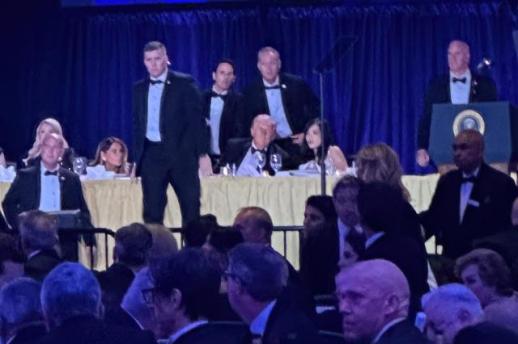 Trump Survives Gunfire at Washington Dinner as U.S. Political Violence Grows "No one told me this job was this dangerous." Trump said it that night at a news conference, wearing a tuxedo. It was less than two hours after gunfire erupted at a dinner. It sounded like a joke, but it was not. He has faced gunfire three times. This time, the shots came without warning at the Washington Hilton Hotel ballroom. Amid tuxedos and evening gowns at a "Washington night," an unfamiliar sound cut through the room. Trump said he first thought a tray had fallen. Melania noticed first. "That's a bad sound." She was right. Agents secured the stage. Cabinet members ducked under tables. In one corner, a waitress screamed in Spanish: "I don't want to die here." On the floor were half-eaten salad, crumpled napkins and a single high heel. Trump survived again. But survival is no longer the ending. In 2024, a bullet grazed his ear at a campaign stop in Pennsylvania. Later that year, a sniper hid in bushes at a Florida golf course. This time, an armed man sprinted toward a security checkpoint at the dinner venue. Trump said, "The more influence you have, the more you get attacked." That may be true, but it does not capture what has changed. In the United States, it is not only a leader at risk; politics itself has become more dangerous. A sitting member of Congress was shot. A conservative commentator died at a lecture hall. The husband of a former House speaker was attacked with a hammer. A Democratic governor's home was set on fire. Sorting out which side is threatened is increasingly beside the point. The irony is stark: The president of the world's most powerful military was attacked at a dinner in his own country. Trump said the incident showed the need for a new White House banquet hall: bulletproof glass, drone defenses and a fully controlled space. The plan carries a $400 million price tag and is in litigation. Security is necessary. But when a space meant to symbolize openness turns into a fortress, questions follow about how open the system can remain. It is a paradox of a democracy closing itself to protect itself. The strain did not arise in a vacuum. Immigration enforcement, alliance realignments and clashes with the media have drawn sharp reactions at home and abroad to Trump administration policies. Policy disputes do not justify violence. But as politics runs on extreme language, the threshold for action drops. What once seemed unthinkable becomes imaginable, and sometimes becomes real. The war with Iran is now in its second month. In joint U.S.-Israeli operations, about 1,200 Iranians and six U.S. troops have been killed. Trump canceled a negotiating delegation's trip to Pakistan just before takeoff, saying, "We have all the cards." Iran said it would not sit at the table as long as the blockade continues. The structure is simple: Neither side yields, and each waits out the other. Iran's foreign minister, leaving Pakistan, said, "We'll have to see whether the United States is truly serious about diplomacy." Trump said later that night Iran's proposal was "much better but still not enough." The talks appear to continue, but in practice remain stuck. Investigators believe the suspect, Cole Thomas Allen, 31, acted alone. Trump said he agreed and drew a line under any likely Iran connection. "He has very serious mental problems," Trump said. One agent was shot but survived because of a bulletproof vest. The suspect's apartment is being searched. The motive remains unclear. Like the gunfire at the dinner, like the stalemate with Iran, the moment was loud but the outcome is uncertain, and nothing is resolved. Trump joked that no one told him the job was this dangerous. What no one can say yet is where this war and this tension end. Washington and Tehran do not have that answer. 2026-04-26 16:54:19
 -
 KGC Highlights Red Ginseng Benefits at Global Science Meeting, Boosting Overseas Push Korean red ginseng, a leading health supplement, is gaining momentum overseas as research presented on the international academic stage points to a range of potential benefits. KGC said the growing body of scientific evidence is helping build credibility in foreign markets. KGC, which operates the red ginseng brand CheongKwanJang, said it recently held an academic seminar on the latest red ginseng research at the International Society for Natural Product Sciences (ICSB) meeting in Mississippi. About 400 researchers attended, including officials from the U.S. Food and Drug Administration and the U.S. National Institutes of Health, the company said. Presentations covered findings on key functions of red ginseng, including neuroprotection, anti-aging and blood sugar regulation. Researchers also outlined a proposed mechanism in which ginsenosides cross the blood-brain barrier and contribute to protecting nerve cells. In clinical research on metabolic health, the red ginseng group showed a tendency toward lower post-meal and fasting blood glucose levels, and indicators of insulin secretion were also analyzed as improved, KGC said. The company said the results suggest potential use in blood sugar management, an area of strong global demand. Human application tests also indicated reduced oxidative stress and improved sleep quality. Industry observers say such findings could broaden red ginseng beyond immunity-focused products into anti-aging, metabolic and brain health categories. KGC said it is also expanding distribution. Red ginseng products are sold through major North American channels including Amazon, Costco and Sprouts. The company cited alignment with health trends such as gluten-free and caffeine-free products as a growth factor. “Red ginseng is an ingredient whose functionality has been verified through numerous studies,” a KGC official said. “Based on overseas research cooperation, we will strengthen credibility and expand locally tailored products to increase market share.”* This article has been translated by AI. 2026-04-26 16:50:17
 -
 Lotte Mart Targets Golden Week Travelers; Gmarket Extends Midnight Cutoff for Fast Delivery Lotte Mart steps up promotions for foreign shoppers ahead of Golden Week holidays Lotte Mart said April 26 it will strengthen promotions for foreign customers to coincide with major holiday periods, including Japan’s Golden Week (April 29 to May 6) and China’s Labor Day break (May 1-5). The retailer will work with Japan-based online travel platform Konest to offer Lotte Mart discount coupons. It will also provide hotel-guest-only discount vouchers through Lotte City Hotel Gimpo Airport, where Japanese guests account for a large share of stays, the company said. Lotte Mart will also issue special coupons through Taiwan’s Line Pay through May 15. On WeChat Pay, it will run a random discount event offering immediate discounts of up to 88 yuan. At its foreign-visitor hub stores — Zettaplex Seoul Station and the Gwangbok branch — customers who spend above a set amount will receive gifts such as luggage tags and travel shopping bags. “As a shopping landmark representing Korea, we will build stores global customers want to return to, based on differentiated products, tailored benefits and outstanding shopping convenience,” said Yoon Yeo-ryeong, who oversees promotional marketing for Lotte Mart and Super. Gmarket extends ‘Star Delivery’ order cutoff to midnight Gmarket said April 26 it will extend the order cutoff time for its fast-shipping service to midnight as it seeks to strengthen delivery competitiveness. Starting April 28, the cutoff for “Star Delivery” will move from 11 p.m. to 12 a.m., the company said. Star Delivery is a guaranteed-arrival service that delivers items on the promised date. It includes “Fulfillment Star Delivery,” operated from the Dongtan Mega Center, and “Seller Star Delivery,” run directly by merchants. The midnight cutoff will apply first to fulfillment items. During this year’s Lunar New Year holiday period, Gmarket extended the cutoff from 8 p.m. to 11 p.m. After sales between 8 p.m. and 11 p.m. rose 56% from the prior year’s holiday period, it kept the 11 p.m. deadline in place, the company said. Gmarket said the change will allow consumers to place late-night orders while still receiving next-day delivery benefits, and it expects sellers to gain additional sales opportunities. The company said it plans to improve logistics infrastructure and operating efficiency and gradually expand Star Delivery coverage. Hyundai Department Store begins Seoul Forest eco-garden project with customers Hyundai Department Store has launched an environmental donation project to create green space in the city with customers. The company said April 26 that it held the first planting for its “Grow My Garden” project on April 25 at Seoul Forest in Seongsu-dong, Seongdong-gu, Seoul. Under the program, customers donate by selecting one of eight garden areas, and Hyundai Department Store covers half the cost. Participants included donating customers, about 50 company employees and family members, and officials from the Seoul Metropolitan Government and the nonprofit Forest for Life. They planted about 2,000 trees and flowering plants. Hyundai Department Store said it plans to plant an additional 2,000 perennials and seasonal flowers through April 28. The roughly 800-square-meter “Green Friends Garden” created through the project will be unveiled at the 2026 Seoul International Garden Show, which opens May 1, the company said. Hyundai Department Store said it will install amenities such as benches and lighting so the public can use the space freely, and it plans to run customer-participation gardening programs. CJ OnStyle says KBO scarves and key rings are driving demand for team goods South Korea’s professional baseball league, the KBO, is drawing strong interest, and related goods are expanding beyond food and beverages into fashion and lifestyle items. CJ OnStyle said April 26 that an analysis of sales data from April 9 to 25 — after it launched KBO goods — found fashion accessories such as bandana scarves, lightweight folding umbrellas and stadium-bag key rings ranked among top sellers. In the first 10 days after launch, cumulative sales reached 35,000 items, the company said. Fashion accounted for 52.8% of total sales volume. CJ OnStyle said it expanded sales channels to external platforms including Naver and 29CM starting April 20, citing early momentum. “KBO league fans increasingly see goods not as simple souvenirs but as a way to express personal taste and style,” a CJ OnStyle official said. “We will identify fandom trends early and connect them to product planning to broaden the base for fandom commerce.”* This article has been translated by AI. 2026-04-26 16:49:05
 -
 South Korea's potential growth rate to hit record low next year, OECD forecasts SEOUL, April 26 (AJP) - South Korea's potential growth rate is projected to fall to a record low next year, continuing a downwred trend for over a decade, according to a report released by the Organisation for Economic Co-operation and Development (OECD) on Sunday. The country's potential growth rate is projected to slip to 1.71 percent this year from 1.92 percent last year, falling further to 1.57 percent next year before dipping to 1.52 percent in the fourth quarter. The rate gauges an economy's growth capacity, measured by the maximum level of output it can sustain by fully utilizing labor, capital, and other resources without triggering inflation. South Korea's potential growth rate has been falling steadily since 2012, when it was 3.63 percent. If this trend continues through next year, it will mark 15 straight years of decline. The Paris-based agency also projected that South Korea will rank 20th among OECD member economies by potential growth rate this year, down one notch from last year, overtaken by Slovakia, whose GDP per capita, estimated by the International Monetary Fund (IMF), remains more than US$6,000 below South Korea's $37,412. The IMF also earlier predicted that Taiwan's per capita GDP would reach $42,103 this year, surpassing the $40,000 mark ahead of South Korea. Taiwan's per capita GDP stood at $39,489 last year. 2026-04-26 16:47:49
 -
 Kim Jong Un Meets Visiting Russian Duma Speaker as Defense Minister Arrives in Pyongyang Kim Jong Un met with Vyacheslav Volodin, speaker of Russia’s lower house, the State Duma, during Volodin’s visit to North Korea for a ceremony marking the completion of a memorial honoring troops deployed to Kursk. The Russian Embassy in North Korea said on Telegram, and Russia’s state-run TASS news agency reported, that Kim met Volodin in Pyongyang on Saturday. Volodin delivered greetings from Russian President Vladimir Putin and a message congratulating Kim on his reappointment as chairman of the State Affairs Commission. Volodin expressed gratitude for the deployment of North Korean troops, saying they fought alongside Russian forces and “liberated Russian territory from Ukrainian Nazis.” “The Russian people will never forget the dedication of the North Korean soldiers who gave their lives for the freedom of their homeland,” he said, calling it “the true image of comrades-in-arms.” Volodin also said the close bond between Kim and Putin became “the decisive key to building the future in the most difficult time.” The embassy said Volodin arrived Friday, on Putin’s instructions, to attend the opening of a combat merit memorial tied to the first anniversary of the end of the “Kursk liberation operation.” North Korea and Russia appear to be using the ceremony to highlight military cooperation through a series of high-level exchanges. Separately, the embassy said Russian Defense Minister Andrei Belousov arrived in North Korea on Saturday for a working visit. North Korean Defense Minister No Kwang Chol met him at the airport. Belousov is expected to hold talks with North Korean leaders in Pyongyang and attend commemorative events. * This article has been translated by AI. 2026-04-26 16:45:59
 -
 Lee Ye-won wins KLPGA Deoksin EPC Championship for 10th career title Lee Ye-won, known as the "queen of spring," reached the 10-win mark on the Korea Ladies Professional Golf Association Tour. Lee won the Deoksin EPC Championship on Saturday at Kingsdale Golf Club in Chungju, North Chungcheong province, shooting a 4-under 68 in the final round with six birdies and two bogeys. The tournament carried a total purse of 1 billion won. She finished at 12-under 204, beating Park Hyun-kyung (9-under 207) by three strokes for her first title of the season. With the 180 million won winner’s check, Lee moved to No. 1 in the season money list at 353.07 million won and also climbed to No. 1 in player-of-the-year points. It was her first victory in 11 months, since winning the Doosan Match Play in May last year, and made her the 16th player in KLPGA Tour history to reach 10 career wins. The win again underscored Lee’s reputation as a strong spring performer. Seven of her first nine tour titles came between March and May. Lee earned her first tour win at the Lotte Rent-a-Car Women’s Open in April 2023, then won the Doosan Construction We’ve Championship in August and the HiteJinro Championship in October. That season she swept the tour’s top honors for player of the year, money leader and scoring average. In 2024, she won three of the first nine events, and last year she won three of the first seven, finishing as co-leader in wins for two straight years. This year, she was runner-up at the season opener in March and tied for sixth at the iM Financial Open, which ended April 12. With this victory, she has been in contention three times in five spring events. In a postround TV interview, Lee said, “I’m happy to reach 10 wins faster than I expected. I like spring because I play well in spring, but this year I want to win in the fall, too. My goal this season is three wins, including a major.” Park, who had not posted a top-10 finish in the first four events, recorded the day’s best score with a 6-under 66 and secured her best result of the season. Han Jin-seon, Yoo Hyun-jo, Kim Si-hyun, Yoo Seo-yeon and Kim Jae-hee tied for third at 8-under 208. Defending champion Kim Min-sun, who was seeking a second straight title after winning the Nexen Saint Nine Masters on April 19, tied for 17th at 5-under 211. 2026-04-26 16:36:19
 -
 Rebuilding Korea Party launches 'Blue Pinwheel' election committee ahead of June 3 local vote The Rebuilding Korea Party said it has launched its central election committee, dubbed “Blue Pinwheel,” ahead of the June 3 local elections and National Assembly by-elections. The committee is campaigning on three pledges: “zero insurrection forces,” zero corruption and the realization of an “advanced nation of social rights.” Lee Hae-min, the party’s central campaign chief, told reporters at the National Assembly on April 26 that the name “Blue Pinwheel” was shortened to “Blue Pin.” He said it reflects a promise to “use the public’s desire to change outdated politics as the driving force for reform” and to pursue clean politics. Lee said the party set three goals aligned with its ballot number, 3, for the local elections. “Blue Pinwheel turns on the people’s wishes,” he said, adding that the party would embrace the concerns of young people, farmers, the self-employed and future generations. Lee also addressed the Pyeongtaek B by-election in Gyeonggi Province, where party leader Cho Kuk has declared his candidacy and former lawmaker Yoo Eui-dong was named the People Power Party’s sole recommended candidate. Lee said the matchup fits the party’s goal of eliminating what it calls “insurrection forces,” and argued Pyeongtaek could become a place where the party’s election aims are achieved. Asked about the possibility of cooperation among progressive forces in Pyeongtaek, Lee said the reform camp shares awareness on issues such as political reform, but election alliances are not formed on those issues alone. He added that the key actors in any alliance are Pyeongtaek residents, not the leaders of five parties. On possible coordination outside Pyeongtaek, including in the Honam region, Lee said he met Democratic Party Secretary-General Cho Seung-rae for about two hours for a serious discussion and that the two parties have maintained frequent behind-the-scenes contact. He said more time is needed before details can be made public, and that they plan to meet again soon. The Blue Pinwheel committee is scheduled to hold its first meeting on April 27. Cho is expected to serve as committee chair. 2026-04-26 16:24:16