
Journalist

Lee Hugh
=
-
 China’s Beijing Auto Show spotlights AI-powered new energy vehicles amid weak domestic demand “We’re the ‘king of the alleyways.’ Our next throne will be in humanoid robots and flying cars,” said He Xiaopeng, chairman of XPeng Motors. At the 2026 Beijing International Motor Show (Auto China 2026) on April 24 at the Capital International Exhibition Center in Beijing’s Shunyi district, crowds of more than 200 reporters packed the booth of XPeng, often called China’s Tesla, to see the world debut of its new SUV, the GX. XPeng said the GX uses four in-house AI chips and a second-generation VLA (Vision-Language-Action) system to deliver Level 4 autonomous driving that can recognize and judge situations on its own. “Autonomous driving is no longer just for early adopters,” He said. “We’re moving into everyday life, from apartment underground parking lots to crowded shopping centers.” When He played video of the second-generation VLA system, the audience reacted loudly as the vehicle navigated a chaotic night market and narrow alleys clogged with illegally parked cars. The video also showed the car reading building signs and “entrance/exit” markings to make decisions. In one scene, a kitten lay in the road; the vehicle hesitated, then edged into the next lane to avoid it. He said advanced autonomous driving is becoming a must-have feature that drives purchases. He said XPeng aims to create new demand and “break through” weak domestic consumption by emphasizing safety, including for mothers in their 60s and older. He added that a second version of the second-generation VLA system, which learns by recognizing voice across the full driving route rather than relying on memory-based approaches, will be unveiled in May, opening an era of “mass-market autonomous driving.” At Auto China 2026, which runs through May 3, Chinese automakers rolled out a wave of AI-enabled new energy vehicles, presenting them as a way to counter a sharp domestic slowdown. The show, themed “Future of Intelligence,” drew global brands including Hyundai Motor as well as Mercedes-Benz, BMW and Volkswagen Group, alongside local players such as BYD Group, Geely Auto Group, Chery Automobile Group, Xiaomi, XPeng and Nio. Organizers said more than 100 automakers and more than 1,000 parts suppliers took part. A representative of Li Auto said China’s NEV strategy is shifting from rapid expansion to higher-quality growth, intensifying competition among local companies. With AI integrated into vehicles, the person said, autonomous driving and infotainment are improving, along with charging and operating systems. The representative said a 1,500-kilometer driving range has become standard and that a 2,500-kilometer era is approaching. According to the China Association of Automobile Manufacturers, China’s auto sales in the first quarter totaled 6.3 million vehicles, down 6% from a year earlier. Exports rose 50%, but domestic sales fell 16%, after China ended NEV tax incentives late last year. As a result, local brands are rapidly shifting from a low-priced, domestic-focused EV market to an export-driven NEV market, a trend also reflected in their more aggressive push into South Korea. Geely Auto Group, which plans to enter the South Korean market in the first half of this year, built one of the show’s largest booths. Under the concept of “embodied intelligence,” it presented NEV strategy models from Zeekr, Lynk & Co and Galaxy, along with a bipedal robot called “Eva,” smart city initiatives and a methanol ecosystem strategy. A key attraction was the “EVA Cab,” described as China’s first robotaxi-only prototype. Geely said the vehicle applies a “quantum-level” AI architecture and is the industry’s first Level 4 robotaxi prototype to complete mass-production preparation. After a year of pilot operations in cities including Hangzhou and Suzhou, it is set for a full launch starting in 2027. On the show floor, the EVA Cab featured a wide-opening sliding door and a cabin layout with facing seats. Zeekr and Lynk & Co also introduced models they said use AI to improve range, charging time, fuel efficiency and driver safety. Zeekr strengthened its luxury lineup with the new 009, 8X and 9X. The 8X uses a 900-volt high-voltage system and a three-motor electric drivetrain, delivering a peak output of 1,030 kW and a 0-100 kph time in the 2.96-second range, which the company billed as the world’s fastest hybrid SUV. Lynk & Co’s electric sport sedans 10+ and 10, set for release in May, use a 900-volt system and a 95 kWh “golden battery,” which the company said enables ultra-fast charging equivalent to 2 kilometers of driving per second. A Geely Auto Group official said the AI ecosystem technologies unveiled at the show will help the company evolve from an automaker into a global intelligent mobility company. BYD, along with its sub-brands and Denza, Yangwang and Formula Bao, highlighted its ambition to lead China’s NEV strategy. BYD drew attention with a display that placed the Denza Z9 GT and Formula Bao’s Tai 3 inside a freezer so visitors could gauge charging performance in extreme cold. The freezer dropped to minus 35 degrees Celsius, leaving frost on the vehicles, but BYD said its second-generation Blade Battery still charged from 10% to 70% in under five minutes, underscoring its focus on energy efficiency as well as high specifications and stronger autonomous-driving features. Amid the surge by Chinese brands, Hyundai Motor showcased its electric vehicle, the Ioniq V. The Ioniq V is the production model of the previously unveiled concept car “Venus” and the first China-focused model under Hyundai’s Ioniq brand. Hyundai said it will add an SUV model around the first half of next year and introduce 20 new models by 2030. Jang Jae-hoon, vice chairman of Hyundai Motor Group, told reporters at the company’s booth, “We will learn and grow a lot in China,” adding, “It is the toughest market, but we will rise again in China and create success.” 2026-04-26 11:45:24
 -
 Lee Kang-in scores and assists as PSG beats Angers 3-0 to stay atop Ligue 1 Lee Kang-in scored and set up another goal as Paris Saint-Germain beat Angers 3-0 away and stayed top of France's Ligue 1 despite finishing with 10 men. PSG won at Stade Raymond Kopa in Angers on April 26 (Korean time) in the 2025-2026 season's Round 31. The victory was PSG's second straight. With four matches left, PSG moved closer to the title. It remained first with 69 points (22 wins, three draws, five losses), keeping a six-point cushion over second-place Lens on 63 (20 wins, three draws, seven losses). PSG struck early. In the seventh minute, Achraf Hakimi's shot rebounded off the goalkeeper, and Lee raced in, rounded the keeper and slotted a right-footed finish. It was Lee's third league goal of the season and his fourth in all competitions (three in the league, one in the UEFA Super Cup), his first since the Round 21 match against Marseille in February. Against Angers, he has three goals and two assists in four career appearances. PSG doubled the lead in the 39th minute through Senny Mayulu. Lee then delivered the assist for the third goal in the seventh minute of the second half, curling a precise right-side corner into the box for Lucas Beraldo to head home. PSG went down a man in the 29th minute of the second half when Goncalo Ramos was sent off, but it held on for the clean sheet and a 3-0 win. Lee played the full match and received a 8.1 rating from statistics site SofaScore, the second-highest on the team behind Beraldo (8.8).* This article has been translated by AI. 2026-04-26 11:31:01
 -
 Woori Bank Takes FX Risk Seminars to Regional Importers and Exporters Amid a Middle East-driven geopolitical crisis and heightened exchange-rate volatility, Woori Bank is expanding support for regional small and midsize import-export companies to help them manage foreign-exchange risk. Woori Bank said April 26 it is running a “visiting exchange-rate seminar” program for regional small and midsize exporters and importers. The program is designed to strengthen companies’ practical ability to manage currency risk in areas where access to specialized foreign-exchange and derivatives services is limited. The bank visits worksites first and provides tailored consulting without requiring companies to apply separately. Woori Bank held on-site seminars April 14 at Seongwoo Hitech and Taekwang Fujikin in the Busan area. On April 22, it continued the sessions with visits to MNC Solution, GPC and Woorim PTS in South Gyeongsang Province. Topics include Middle East risks and global commodity market trends, major currency movements and outlooks, and hedging strategies such as forward contracts and currency options, with company-specific response plans. Woori Bank plans to expand the seminars to major industrial hubs including Ulsan and Gwangyang, aiming to help regional companies maintain stable operations amid global uncertainty. “The exchange-rate risks felt by regional import-export companies are significant, but access to information to manage them is relatively limited,” a Woori Bank official said. “We are focusing on providing on-site, company-specific measures to respond to foreign-exchange risk.” 2026-04-26 11:30:18
 -
 Five Firms Vie for South Korea’s $2 Billion GPU Project as Next-Gen Platform Looms Competition is intensifying among major companies for the government’s 2.08 trillion won project to secure advanced graphics processing units, with the ability to build large clusters, whether to adopt Nvidia’s next-generation “Vera Rubin” platform, and how much of the GPUs bidders plan to use themselves emerging as key factors. Yonhap News reported on Saturday that the National IT Industry Promotion Agency (NIPA) plans to select operators next month for the “GPU procurement, buildout and operations support” project. Led by the Ministry of Science and ICT, the initiative aims to quickly secure large-scale GPUs through public-private cooperation and supply them to domestic industry, universities and research institutes. The project centers on using government funds to secure about 15,000 of the latest GPUs and choosing private cloud providers to build and run them reliably. Five companies submitted bids: Naver Cloud, KT Cloud, Samsung SDS, Coupang and Elice Group. Industry officials expect multiple operators could be chosen again, as in last year’s 1.4 trillion won program, which selected Naver Cloud, Kakao and NHN Cloud. A central issue this time is how the GPU volume will be allocated. Last year, based on proposed scale and build capability, NHN Cloud received about 8,000 units, Naver Cloud about 3,000 and Kakao about 2,400, with NHN Cloud winning the largest share after its large-cluster plan scored highly. Cluster size remains a major evaluation item. The government requires at least one cluster of 256 nodes, or 2,048 GPUs, or more, because larger clusters significantly improve processing speed and efficiency. Another new variable is whether bidders will adopt Nvidia’s “Vera Rubin” platform. The government plans to award extra points to proposals that include it. Naver Cloud and Elice Group are reported to be reviewing adoption, while some companies are said to have excluded it. Vera Rubin’s high power density and facility load requirements could limit where it can be deployed, raising concerns that adoption will depend heavily on each company’s data-center infrastructure. Strategies also differ, with some proposing to use existing data centers for large GPU clusters and others promoting new approaches such as modular data centers. How much of the GPUs companies plan to use themselves is also seen as decisive. The government will purchase and retain ownership of the GPUs, but participating companies may use the remainder after meeting public supply requirements. Because the government gives extra points to bidders offering a higher share for public supply, companies must balance profitability against evaluation scores. Industry sources said last year’s participants set self-use at about 20%, limiting profitability. “Once you factor in adopting a next-generation platform, the investment burden rises sharply,” an industry official said. “It’s not an environment where it’s easy to make aggressive large-scale proposals.”* This article has been translated by AI. 2026-04-26 11:27:09
 -
 South Korea’s top court rejects trust firm liability limits not explained to buyers South Korea’s Supreme Court has ruled that a trust company cannot rely on a contract clause limiting its liability if it did not explain the clause to the buyer. The decision means the trust company may still be responsible for penalties tied to delayed occupancy. According to the legal community on the 26th, the Supreme Court’s Third Division, with Justice Lee Sook-yeon as presiding justice, recently upheld a lower court ruling that partly favored the plaintiff in a lawsuit filed by a person identified as A against K Trust Co. seeking a refund of the purchase price. The dispute arose over the sale of a unit in a knowledge industry center building in Seoul’s Geumcheon District. K Trust, which had signed a managed land trust agreement with the project developer, was the seller that directly executed the sales contract. A became a party to the contract in March 2022 after buying the sales rights from the original buyer. Construction was not completed by the promised move-in date of July 2022. After the delay exceeded four months, A filed suit in November that year seeking to cancel the contract and obtain a penalty payment. The contract stated that if occupancy did not occur within three months of the scheduled move-in date, the buyer could cancel and receive 10% of the sale price as a penalty. During the litigation, K Trust argued it was shielded by a “liability-limitation clause.” The clause said the trust company, as seller, would bear responsibility only within the scope of the trust property and trust agreement, while the developer, as settlor, would be responsible for all obligations including returning cancellation payments. K Trust argued that any refund obligation belonged to the developer, not the trust company. The trial and appellate courts rejected that argument and ruled for A, finding the trust company had to fulfill its obligations as a contracting party. The Supreme Court agreed. The court said the clause “limits or exempts the trustee’s liability to perform obligations to the buyer to the extent of the trust property,” and that it is a matter that “can directly affect” a buyer’s decision on whether to enter the contract. It added that even if such clauses are common in the trust industry, buyers generally have limited transaction experience and lack specialized knowledge of managed land trusts, making it difficult to assume they could anticipate the clause’s existence and content without a separate explanation.* This article has been translated by AI. 2026-04-26 11:24:09
 -
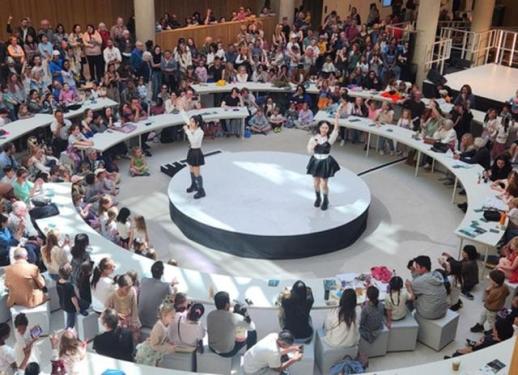 K-pop takes Oxford University by storm as Korean culture gains global spotlight SEOUL, April 26 (AJP) - K-pop has taken center stage at one of the world's most prestigious academic institutions, highlighting the growing influence of Korean popular culture in reshaping global education and cultural landscapes. A K-pop performance was held at the University of Oxford's Stephen A. Schwarzman Centre for the Humanities last Saturday, drawing hundreds of visitors including students and local residents, who gathered around a circular stage to watch the unusual, lively event in a traditionally conservative academic space. The performance featured a string of K-pop songs including Rosé's catchy song "APT." and several tracks from Netflix' hit animated series "KPop Demon Hunters" such as "Golden," "Soda Pop" and "Your Idol." The atmosphere soon resembled a pop concert, with the audience cheering and responding enthusiastically. Saturday's event was part of an event marking the opening of the centre, named after Blackstone co-founder Stephen A. Schwarzman, who donated 185 million pounds (about US$370 million). The centre brings together humanities departments, libraries, and performance spaces under one roof, with the aim of bridging the humanities and contemporary culture, reflecting the university's broader efforts to make academic spaces more accessible to the public. Many see this as a pivotal moment for traditionally scholarly disciplines to engage wider audiences through K-pop, suggesting that global popular culture now plays a key role in shaping the modern humanities. The event was organized in collaboration with the university's Korean studies programs, supported by South Korean energy company Samchully, which has provided 2.5 billion won (about $1.7 million) in funding since last year. The university is also slated to open a centre dedicated to Korean studies this fall, with plans to hold a week-long event to promote Korean culture early next year. 2026-04-26 11:23:49
 -
 Mandatory Spending Nears 55% of South Korea Budget as Basic Pension, Education Grants Top 100T Won More than half of the government’s total spending next year is set to be locked in as legally mandated outlays, rapidly narrowing fiscal flexibility. The basic pension and education grants to local governments are emerging as key drivers of the burden as they approach a combined 100 trillion won a year. According to the government’s 2025-2029 National Fiscal Management Plan submitted to the National Assembly last year, total spending next year is projected at 764.4 trillion won, with mandatory spending at 415.1 trillion won, or 54.3%. With mandatory spending rising faster on average (6.3% a year) than total spending (5.5%), its share is expected to climb to 55.0% in 2028 and 55.8% in 2029. Most mandatory spending is statutory welfare outlays, including basic livelihood support, health insurance, the four major public pension programs and the basic pension. As South Korea enters a super-aged society, both the number of recipients and benefit payments are increasing. Related spending is estimated to exceed 200 trillion won next year and expand to 237 trillion won by 2029. Beyond welfare, the cost of transfers to local governments is also rising quickly. Local allocation tax and education grants, which are linked to domestic tax revenue, are expected to top 150 trillion won next year and reach the 170 trillion won range by 2029. The basic pension and education grants are cited as variables that could reshape the fiscal structure. As the government has set a goal of cutting mandatory spending by 10% during the process of drafting next year’s budget, observers expect reform talks around the two programs to accelerate. The basic pension is seen as a leading item with room to adjust eligibility and payment methods. President Lee Jae-myung has proposed differentiated payments based on the principle of “the higher, the lower,” increasing the likelihood of changes. Education grants, meanwhile, automatically rise because they are tied to domestic tax revenue even as the school-age population declines. That structure has fueled recurring debate over surplus funds, and critics warn the fiscal burden could grow further if tax revenue increases, such as from strong semiconductor exports. Under the fiscal plan, basic pension spending is projected to rise from 25 trillion won next year to 28.2 trillion won in 2029, while education grants increase from 77.1 trillion won to 85.9 trillion won. Combined, the two items are expected to total about 100 trillion won and account for roughly one-quarter of mandatory spending. Academics have already outlined potential savings under reform scenarios. A research report commissioned by the Ministry of Economy and Finance, now the Ministry of Planning and Budget, found that gradually raising the eligibility age for the basic pension could save up to 603.4 trillion won through 2065. Analysts have also said revising the formula that links education grants to domestic tax revenue could significantly reduce the burden. Kim Hak-su, a senior research fellow at the Korea Development Institute, estimated in a report that savings could reach up to 1,046.8 trillion won from 2021 to 2060.* This article has been translated by AI. 2026-04-26 11:19:08
 -
 Seoul to Run 'Seoul Welcome Week' for Foreign Tourists May 1-8 Seoul is rolling out a broad welcome campaign for foreign visitors, aiming to provide tightly linked services from airports to major downtown areas during the spring peak travel season. The Seoul Metropolitan Government said Sunday it will run “2026 Seoul Welcome Week (Seoul Welcome Week 2026)” from May 1 to 8 with the Seoul Tourism Association. The city is targeting a Northeast Asia travel rush as Japan’s Golden Week overlaps with China’s Labor Day holiday, as demand to visit Korea rises amid events such as K-pop concerts. The main hubs will be Myeongdong and Yeouido. The city will set up a “welcome center” near Myeongdong Station and a “welcome booth” at Yeouido Hangang Park, operating them intensively from May 1 to 5. It will extend the campaign through May 8 via major tourist information centers and local tourism “antenna shops.” At the Myeongdong welcome center, the city will run a “Seoul styling spot” and an “AI smart travel guide consultation desk” to provide tailored information. Interactive offerings will include an art-drawing guestbook and K-pop cover dance performances. A K-beauty experience zone will also be offered for visitors to try current Seoul trends. At Yeouido Hangang Park, the city will operate tourist information programs tied to the Seoul Spring Festival. Along with multilingual assistance, the site will offer a “daenggi meori” traditional hair-ribbon styling experience and souvenir-giveaway events. The city said the week is also designed to expand travel routes “from Seoul to the rest of the country.” Working with local tourism antenna shops, it plans to introduce region-specific content and provide discount coupons to encourage foreign visitors to travel outside Seoul. Seoul also highlighted a “welcome from departure” strategy. In cooperation with China Eastern Airlines, it will place welcome leaflets at departure airports on major routes including Shanghai, Qingdao and Nanjing. The city also plans to spread welcome messages across Seoul through outdoor digital billboards, mobility advertising and hotel media platforms. Kim Myeong-ju, director general of Seoul’s Tourism and Sports Bureau, said foreign tourist arrivals to Korea in the first quarter rose about 23% from a year earlier, showing a rapid recovery in demand. “Through a welcome system that runs from the airport to the city center, we will further enhance Seoul’s appeal as a destination,” he said. 2026-04-26 11:18:17
 -
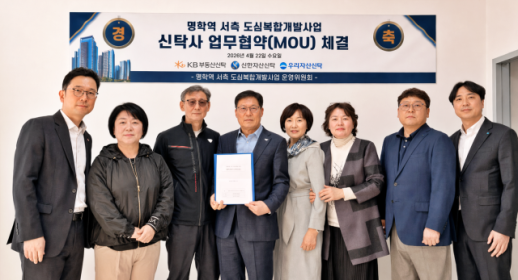 Woori, KB and Shinhan Asset Trusts Sign MOU for Anyang Mixed-Use Redevelopment Anyang’s Manan district area west of Myeonghak Station is set to be redeveloped into a mixed-use space combining housing and commercial functions. Woori Asset Trust, KB Real Estate Trust and Shinhan Asset Trust said April 26 they signed a memorandum of understanding to advance the urban mixed-use redevelopment project west of Myeonghak Station in Anyang. The project aims to revitalize an aging residential neighborhood and underused land near the station on Seoul Subway Line 1. The site is close to the station and offers convenient transportation, with access to nearby commercial and everyday amenities. Under the agreement, the consortium will provide overall advice and project management support, including reviewing the project structure, preparing financing plans and helping coordinate among stakeholders. The companies said they will draw on their experience in redevelopment, development capabilities and fund-management expertise to help keep the project stable from its early stages. A consortium official said the project will improve housing conditions in central Anyang and reorganize urban functions more efficiently, adding that the group will do its best to ensure the project moves forward smoothly.* This article has been translated by AI. 2026-04-26 11:15:41
 -
 Trump Evacuated After Gunfire at WHCA Dinner; Same Hotel as 1981 Reagan Shooting Gunfire broke out at the White House Correspondents' Association dinner, prompting an emergency evacuation of President Donald Trump and drawing renewed attention to a past presidential shooting at the same hotel. CNN reported that the shooting on April 25 (local time) occurred at the same location where President Ronald Reagan was targeted in an assassination attempt while in office. The Washington Hilton Hotel was the site of the March 30, 1981, attack in which Reagan was shot by John Hinckley Jr. as he was leaving the hotel. Reagan suffered a serious injury, including a gunshot wound that pierced a lung and caused severe internal bleeding. During the dinner, Trump was rushed out under U.S. Secret Service protection. He later wrote on his social media platform, Truth Social, that a suspect had been arrested and that all attendees were safe. He also said he planned to hold a news conference in the White House briefing room 30 minutes later to explain the situation.* This article has been translated by AI. 2026-04-26 11:15:14