
Journalist

Lee Hugh
=
-
 Pope Leo XIV Says He Can’t Support War, Urges U.S. and Iran to Return to Talks Pope Leo XIV urged the United States and Iran to return to dialogue over the Iran war, saying preventing the deaths of innocent civilians must come before questions of regime change. According to AP, Reuters and Vatican News, Leo spoke to reporters aboard the papal plane on the 23rd local time as he flew back to Rome from Malabo, Equatorial Guinea. “As a pastor, I cannot support war,” he said, calling on all sides to seek solutions rooted in “a culture of peace,” not “hatred and division.” Asked whether he supports regime change in Iran, the pope avoided a direct answer. “The issue is not whether there is regime change or not, but how we can promote the values we believe in without the deaths of so many innocent people,” he said. He added that since the first day of Israeli and U.S. attacks, “it is not even clear what regime exists now.” Leo described the situation in Iran as “very complex.” On U.S.-Iran negotiations, he said one day Iran says yes and the United States says no, and the next day the reverse happens. “We don’t know where it is headed,” he said. He said the war is causing direct suffering for Iranian civilians. “There is an entire innocent people of Iran suffering because of this war,” he said, urging all parties to promote peace, remove the threat of war and respect international law. Protecting innocent people is crucial, he said, but “in many places that has not happened.” Reuters reported that Leo also condemned the killing of protesters in Iran and questions about recent executions. “I condemn every unjust act,” he said. “I condemn taking human life.” He added that if a regime or a state unjustly decides to take others’ lives, it should be condemned. The pope also cited the death of a child on the Lebanon front. He said he keeps a photo of a Muslim child who welcomed him during a visit to Lebanon, and that the child recently died amid the war. AP reported the child was killed during the recent war between Israel and Hezbollah. “We must be able to think about these human situations,” Leo said, again urging a dialogue-based solution and calling on countries to remove the threat of war and respect international law.* This article has been translated by AI. 2026-04-24 08:54:15
 -
 Trump Orders U.S. Forces to Sink Iranian Boats Laying Mines, Extends Israel-Hezbollah Truce U.S. President Donald Trump is managing two Middle East fronts in different ways, tightening military pressure on Iran while pressing for a longer ceasefire between Israel and Hezbollah in Lebanon. The Associated Press reported that on April 23 (local time), Trump ordered U.S. forces to sink small Iranian boats trying to lay mines in the Strait of Hormuz. He also said the United States would expand mine-clearing operations. The strait is a vital route for global energy trade, with about 20% of the world’s seaborne oil and natural gas passing through it. The U.S. is also keeping up maritime pressure. AP said U.S. forces in the Indian Ocean additionally detained a tanker suspected of carrying Iranian crude. The United States is maintaining its blockade of Iranian ports. Iran has said it will not enter further talks until the blockade is lifted. Negotiations remain stalled. Iran, referring to possible follow-up talks in Islamabad, Pakistan, said it would not negotiate “under threat” and made lifting the blockade a precondition. While Trump has mentioned a ceasefire and negotiations, Iran views the continued maritime pressure as military coercion even after any ceasefire. Tensions in the Strait of Hormuz have also spilled into ship seizures. Reuters reported that Iran’s Revolutionary Guard detained two vessels passing through the strait on April 22 and was reported to have fired on the two detained ships and another vessel. Iran has underscored its leverage over passage through the strait, while the United States is pairing mine-clearing efforts with the port blockade. On the Lebanon-Israel front, Trump has pointed to a ceasefire extension as a result. AP reported that after White House talks, Trump said Israel and Lebanon agreed to extend the Israel-Hezbollah ceasefire by three weeks. The sides had previously entered a 10-day truce under U.S. mediation, and the new agreement lengthens that period. The two fronts are linked. Iran and Hezbollah are both aligned with the pro-Iran camp, and rising tension in the Strait of Hormuz could shake the Lebanon ceasefire, a factor behind Trump’s effort to manage both at once. A key variable is the possibility of further Israeli strikes. Israeli Defense Minister Israel Katz said he is “ready to resume the war with Iran” and is “waiting for a ‘green light’ from the United States.” Israel signaled it could again target Iran’s energy and economic base and its leadership. The Lebanon front also remains unsettled. While the ceasefire was extended by three weeks, reports said Hezbollah rocket launches and Israeli responses continued. Israel views Hezbollah’s disarmament as a condition for lasting peace. Lebanon wants negotiations to include an Israeli troop withdrawal, prisoner releases and reconstruction. Analysts say the region could become unstable again depending on the level of U.S. pressure and whether Israel takes additional action. Michael Young, a senior editor at the Carnegie Middle East Center, told Reuters that the Israel-Lebanon ceasefire “is very fragile for now.”* This article has been translated by AI. 2026-04-24 08:45:19
 -
 South Korea Debates Security Risks After Unification Minister Mentions Suspected North Korea Enrichment Site South Korean politics has been pulled back into a national security dispute after Unification Minister Jeong Dong-young publicly mentioned a suspected uranium enrichment facility in North Korea’s Kusong. Opposition parties accused him of leaking secrets and triggering a diplomatic setback, with some calling for his dismissal. The government and ruling camp countered that the opposition was mounting a political attack over information already in the public domain. A central question is whether the place name “Kusong” was revealed to the world for the first time by Jeong. The answer appears to be no. Kusong in North Korea’s North Pyongan province and nearby areas — including the Panghyon aircraft plant and the Panghyon base — have long been cited by international security researchers and U.S. think tanks as possible sites linked to uranium enrichment. In 2016, the U.S.-based Institute for Science and International Security (ISIS) suggested the Panghyon aircraft plant area could have been an early, small-scale centrifuge research and development site, and assessed it may have housed about 200 to 300 centrifuges. International media, including Reuters, later treated the area as a potential hub for North Korea’s nuclear development. In 2024, RAND Corp. researcher Bruce Bennett said in a Radio Free Asia interview that a large underground facility in the Yongdok-dong area of Kusong could be linked to uranium enrichment. In 2025 and 2026, the Center for Strategic and International Studies (CSIS) and related researchers continued to raise the possibility of expansion at undeclared North Korean nuclear facilities based on satellite imagery analysis. That record makes it difficult to argue the name “Kusong” was entirely new secret intelligence. On that point, Jeong’s defense has some factual grounding. His argument — that the location had been mentioned for a decade in U.S. research institutes, congressional reports and the media — is not wholly off base. President Lee Jae-myung also defended the minister in similar terms, saying the matter had already been discussed in reports and news coverage. But the issue is not only whether information exists publicly. It also matters who said it, from what position and in what context. There is a major diplomatic and security difference between a private research group describing a “suspected facility” based on satellite images, defector testimony and open sources, and a sitting unification minister naming a specific location in the National Assembly or another public setting. The fact that something appears in open sources does not automatically make every public remark safe. At the same time, the presence of public references does not by itself justify branding the episode as a “leak of U.S. secrets.” South Korea’s military intelligence authorities have offered a different view. The Defense Intelligence Agency has said the specific location names of North Korean uranium enrichment facilities are classified as a joint South Korea-U.S. secret. That suggests open-source discussion and alliance-level classification can diverge, and that official confirmation by a government figure carries different weight. As a result, Jeong’s remarks are difficult to label either an unprecedented breach or a completely harmless public statement. The dispute has also highlighted how security issues can become partisan weapons. Conservatives often frame progressive governments’ North Korea policy as a security risk, while progressives dismiss conservative criticism as Cold War-style politics. In that back-and-forth, key questions can be sidelined: how far North Korea’s nuclear capabilities have advanced, how to sustain South Korea-U.S. intelligence cooperation, and what strategy should balance deterrence and dialogue. Jeong’s metaphor that “the moon is the urgency of the North Korean nuclear issue, and the finger is the place-name controversy” reflects that concern. North Korea’s uranium enrichment capability is not limited to Yongbyon. The article cites multiple suspected axes — including Kangson, Yongbyon, Panghyon and Kusong — where nuclear material production capacity is believed to be steadily advancing. The International Atomic Energy Agency has repeatedly raised concerns about undeclared enrichment facilities at Yongbyon and Kangson, and U.S. satellite imagery analysts have continued tracking expansion at new suspected sites. The core threat, the article argues, is not the mention of a location name but the reality of North Korea’s growing nuclear capabilities. Similar clashes over the boundary between open and classified information have played out elsewhere. The article points to the 2003 U.S. controversy over Iraq’s alleged weapons of mass destruction, where satellite images, intelligence reports and defector accounts were used to justify war, but no WMD stockpiles were found afterward. It also cites Britain’s Tony Blair government, which argued Iraq could deploy WMD within 45 minutes — a claim later found to be exaggerated or inaccurate. The article says politicizing intelligence may bring short-term political gains but can erode national credibility over time. It also notes that in Israel, leaks and public disputes over assessments of Iran’s nuclear facilities have repeatedly fueled clashes between prime ministers and opposition parties, turning security threats into political strategy. Japan, it says, strictly separates what can be disclosed publicly from alliance-level nonpublic information on North Korean missiles and nuclear sites. Germany, the article adds, strengthened parliamentary oversight and multilayered verification after the Cold War to prevent intelligence judgments from being used as political propaganda. The article calls for South Korea to draw lessons from those cases. It urges stronger pre-review procedures for public remarks by senior officials, including coordination with the Defense Ministry, Foreign Ministry and intelligence agencies when open-source material may overlap with joint South Korea-U.S. secrets. It also calls on the National Assembly to apply basic verification to distinguish open information from classified material, and on the government to explain calmly what is public and what cannot be confirmed rather than simply dismissing criticism as political maneuvering. The media, it adds, should prioritize layers of fact over partisan framing. The article concludes that Jeong’s Kusong remarks have become a test of South Korea’s political maturity, warning that internal division and careless language can pose risks alongside external threats. 2026-04-24 08:42:23
 -
 BLACKPINK’s Jisoo’s Sister Kim Ji-yoon to Make TV Debut on tvN Survival Show BLACKPINK member Jisoo’s older sister will make her broadcast debut on a survival variety show set to air in May. The official social media account for tvN’s “Kill It: Style Creator War” recently announced that influencer Kim Ji-yoon, Jisoo’s sister, will appear on the program. A teaser video released with the post shows Kim, who has 550,000 followers and is known by the nickname “Gunpo Han Hyo-joo.” Kim’s casting comes as attention has focused on a separate controversy involving Jisoo’s older brother. He has faced allegations including illegal filming of sexual activity, an attempted sexual assault case involving a Gangnam-area BJ, and domestic violence. In the attempted sexual assault case, a court rejected a request for an arrest warrant, citing insufficient grounds to support the allegations. As the controversy grew, attorney Eun Hyun-ho of Kim & Chang, legal representative for Jisoo’s one-person agency Blissoo, said the matter “has absolutely nothing to do with the artist or Blissoo.” He said the artist received only limited advice from family members during preparations to establish the agency, adding that no family member has been paid by Blissoo or taken part in decision-making, and that the company “has since been run completely independently.” Some online commenters have questioned that statement, noting that the older brother’s name appears in the production credits for Netflix’s “Monthly Boyfriend,” in which Jisoo appeared. They also pointed to last year’s “Newtopia,” where his name was listed as “Jisoo manager,” keeping the dispute alive. 2026-04-24 08:39:20
 -
 Bitcoin Holds Near $78,000 as Oil Jumps on Renewed U.S.-Iran Tensions Bitcoin held above $78,000 as military tensions between the United States and Iran flared again and global oil prices extended a four-day surge. According to CoinMarketCap, bitcoin was trading at $78,266 as of 8 a.m. on the 24th, down 0.43% from a day earlier. Major altcoins also weakened. Solana fell 1.37% to $86.20, and ether slid 2.72% to $2,333.09. XRP edged up 0.03% to $1.43. Market participants said the standoff around the Strait of Hormuz capped gains. President Donald Trump wrote on Truth Social on the 23rd that he had ordered any vessel laying mines in the strait to be sunk without hesitation. Oil prices jumped 3.1% from the previous day, and the broader geopolitical risk weighed on sentiment, limiting bitcoin’s upside, the report said. Still, bitcoin stayed near the $78,000 level after Strategy, the publicly listed company that holds the most bitcoin, bought about $2.5 billion worth from the 12th to the 19th, local time. In South Korea, bitcoin was trading at about 116.30 million won ($78,395) on Bithumb at the same time, up 0.19% from a day earlier. The so-called kimchi premium, when domestic prices exceed overseas prices, stood at 0.304%. * This article has been translated by AI. 2026-04-24 08:33:20
 -
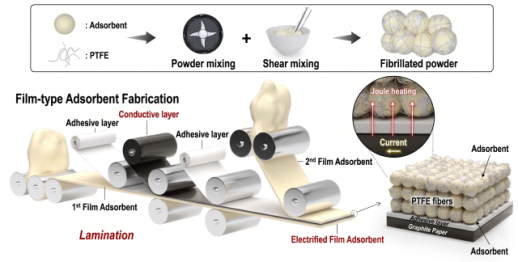 KAIST researchers develop high-efficiency carbon capture technology SEOUL, April 24 (AJP) - A research team at the Korea Advanced Institute of Science and Technology has developed a high-efficiency Direct Air Capture (DAC) technology inspired by electric vehicle battery manufacturing processes, placing them among the top four finalists in a global carbon removal competition. The development addresses the high costs and low efficiency currently hindering the commercialization of technologies that remove carbon dioxide directly from the atmosphere, the research institute said Friday. The research team, led by Professor Koh Dong-yeon of the Department of Chemical and Biomolecular Engineering, was selected as one of four finalists in the 2026 Carbon Removal Challenge. The competition is hosted by OpenAir, a global non-profit organization dedicated to advancing carbon removal solutions. Out of approximately 40 teams from 30 universities worldwide, KAIST was chosen alongside the University of Michigan, Rutgers University, and a joint team from Cornell, Princeton, and Columbia. To overcome the limitations of existing DAC methods, the researchers applied a dry fabrication process typically used for battery electrodes. This solvent-free method involves pressing powders into solid films, allowing carbon-absorbing materials to be packed more densely. The process increased the adsorbent content to 97 weight percent, significantly improving the volume of carbon dioxide captured compared to traditional methods that use liquid-based coatings. The team also improved the regeneration process, which involves releasing the captured carbon for storage or use. By implementing Joule heating—a method that generates heat instantly by passing electricity through a conductor—the system can reach required temperatures within one minute. Additionally, by integrating a water-cooling system inspired by electric vehicle thermal management, the team reduced cooling times by approximately 60 percent, increasing overall productivity. "This achievement recognizes both the innovativeness and the practical applicability of our carbon capture technology," Professor Koh Dong-yeon said. "We plan to actively pursue the commercialization and expansion of this technology through global cooperation in the future." The South Korean team has been invited to present their technology to experts and investors at the Carbon Unbound 2026 conference in New York on May 20, 2026. The research was led by doctoral student Park In-jun, with contributions from a team of students and researchers, including Park In-hwan, Lee Min-hyung, and Karoline L. Hebisch. 2026-04-24 08:29:23
 -
 Wall Street slips as U.S.-Iran talks stall and oil surges for fourth day U.S. stocks fell as additional talks between the United States and Iran remained stalled, reviving fears of wider military tension around the Strait of Hormuz. Oil prices jumped again, and the S&P 500 and Nasdaq Composite, which set record highs a day earlier, turned lower. On April 23 (local time), the Dow Jones Industrial Average closed down 180.70 points, or 0.37%, at 49,309.33. The S&P 500 fell 29.60 points, or 0.41%, to 7,108.30, and the Nasdaq dropped 219.06 points, or 0.89%, to 24,438.50. The S&P 500 and Nasdaq briefly hit fresh intraday records early in the session, then reversed as Iran-related tensions intensified. Profit-taking after the prior day’s highs combined with renewed geopolitical risk. The Strait of Hormuz was at the center of the market’s unease. The Associated Press reported that U.S. President Donald Trump ordered the U.S. military to sink small Iranian boats attempting to lay mines in the strait. The U.S. military also detained another tanker in the Indian Ocean tied to Iranian crude oil. Iran maintained it would not enter talks until the U.S. blockade is lifted. Military pressure also increased. AP reported that the arrival of the George H.W. Bush in the Indian Ocean brought the number of U.S. aircraft carriers deployed in waters near the Middle East to three. Reuters reported that Iran’s Revolutionary Guard on April 22 detained two container ships trying to leave the Strait of Hormuz and was also reported to have fired on those vessels and another ship during the incident. Oil prices extended their rally. Reuters reported U.S. benchmark West Texas Intermediate rose 3.11% to settle at $95.85 a barrel, while Brent gained 3.10% to $105.07. Reports that Iran’s air defenses were activated over Tehran added to anxiety in the oil market. As investors sought safety, the dollar and Treasury yields rose. The dollar index was up 0.19% at 98.80. The 10-year U.S. Treasury yield rose 3 basis points to 4.33%, and the 2-year yield climbed 4 basis points to 3.83%. Technology shares led the decline. ServiceNow slid after saying some large contracts were being delayed due to the fallout from the Middle East war, sparking broader selling in software stocks. IBM also fell sharply despite results topping expectations, as investors focused on slower software growth and concerns about its outlook. Microsoft, Palantir and other large tech names also weakened, leaving the Nasdaq with the biggest drop among the major indexes. Still, earnings helped limit losses. Reuters said that among 123 S&P 500 companies that have reported first-quarter results, 82.1% beat market expectations. After the close, Intel jumped in after-hours trading after issuing a second-quarter revenue forecast above expectations, offering some support to tech sentiment.* This article has been translated by AI. 2026-04-24 08:12:18
 -
 South Korea’s Q1 Surprise Growth Faces Q2 Test From High Oil Prices and Weak Won South Korea posted a surprise expansion in the first quarter, but attention is shifting to cost shocks expected from the second quarter as high oil prices and a weak won threaten to squeeze manufacturers and households. The first-quarter gain also underscored the economy’s heavy reliance on semiconductors, while external risks tied to the Middle East war have yet to fully show up in the data. Growth’s shadow behind a semiconductor-led surge 23일 the Bank of Korea said manufacturing GDP rose 3.9%, led by computers, electronics and optical equipment, including semiconductors. Lee Dong-won, director general of the BOK’s Economic Statistics Department 2, said semiconductors accounted for “a little over half,” about 55%, of the contribution. Excluding semiconductor manufacturing, the first-quarter growth rate could have fallen by more than half from 1.7%, he said. Demand for high value-added products fueled by the artificial intelligence boom helped semiconductors stay resilient even as the Middle East war pushed up global oil prices. Domestic chipmakers posted record results. Samsung Electronics’ first-quarter operating profit was 57.2 trillion won, exceeding its operating profit for all of last year, 43.6011 trillion won. SK hynix posted 37.6103 trillion won in first-quarter operating profit, nearing its full-year profit of 47.2063 trillion won in a single quarter. Outside semiconductors, other manufacturers and domestic demand remain exposed to external variables. With South Korea heavily dependent on energy imports, rising oil prices and the exchange rate could start to compress margins across manufacturing, limiting how far semiconductors alone can carry growth. From the second quarter, the fallout from the Middle East war is expected to be reflected more clearly. Citi has estimated that if Brent crude stays in the $82-a-barrel range, South Korea’s GDP growth this year could fall by 0.45 percentage points. Higher energy prices raise import costs for raw materials, which can feed into corporate cost pressures and consumer inflation. The won’s weakness — near 1,500 per U.S. dollar — adds to import-price burdens and could also curb corporate investment. The second-quarter outlook, analysts say, will hinge on whether strong exports can offset higher energy and currency costs — and how widely those costs spread from manufacturing to domestic demand. Consumer sentiment turns pessimistic Income conditions have improved in the data, but it remains unclear whether gains tied to better terms of trade will translate into stronger domestic demand. Improved corporate earnings could lift wages and household income, but higher oil prices could erode margins and weaken wage momentum. Private consumption, which accounts for about half of the economy, held up, but weakening sentiment is raising concern. Consumer sentiment turned “pessimistic” for the first time in a year amid the Middle East war. The April Consumer Sentiment Index (CCSI) fell 7.8 points from the previous month to 99.2. It was the first reading below 100 since April last year, when it was 93.6. The drop was the steepest since December 2024, when the index fell 12.7 points during an emergency martial law incident. The government and the central bank said the war’s spillover effects are likely to intensify from the second quarter. Lee said, “No one can know” the impact of the war, adding that credit card monitoring shows private consumption has not yet been hit, “but it is clear that the negative impact has grown because of the war.” A Finance Ministry official said second-quarter quarter-on-quarter growth is likely to be revised down as base effects from the strong first quarter combine with construction material supply difficulties and the war-driven rise in oil prices. The official said a strong semiconductor cycle and government policies may provide some cushioning, but uncertainty remains high.* This article has been translated by AI. 2026-04-24 07:53:35
 -
 KOSPI Rally Lifts ‘Million-Won’ Shares to Nine; ESG AGM Concerns and Key Filings ◆Aju Economy Top News ▷‘Million-won’ shares jump from four to nine as stock rally accelerates -Amid a KOSPI rally, the number of so-called “emperor stocks” priced at 1 million won or more surged from four to nine in five months. -The KOSPI closed at 6,475.81, extending its record run to three straight sessions, and briefly topped 6,500 intraday. -Buying focused on sectors expected to benefit from the postwar period, including semiconductors and defense, helped drive gains. -Shares and target prices for major high-priced stocks, including Hyosung Heavy Industries, rose together, boosting market expectations. -Some analysts cautioned about the so-called “emperor stock curse,” saying the next move will depend on earnings and order momentum. ◆Key Report ▷ESG Snapshot: What we saw at annual shareholder meetings -The 2026 March annual general meeting season again highlighted limits on participation by minority shareholders as meetings clustered in a short period. -Despite mandatory cumulative voting, many proposals to amend corporate bylaws were voted down, leaving adoption sluggish. -The report attributed this in part to low direct participation and limited proxy submissions, which weakened the exercise of voting rights. -It also cited a structural problem: packed schedules make it difficult for shareholders to review agenda items thoroughly. -Experts urged stronger education on using electronic voting and proxy systems to expand minority shareholders’ ability to exercise their rights. ◆Major disclosures after the close (23rd) ▷BF Labs to be delisted after auditors refuse to issue an opinion; trading to be suspended for liquidation from the 27th ▷Hansol Iones: Q1 operating profit 7.1 billion won, down 40.2% from a year earlier ▷Multicampus: Q1 operating profit 600 million won, down 86.4% from a year earlier ▷Organic Cosmetic: largest shareholder changed from Im Guk-gang to SUN YANE ▷Haesung Industrial fined 49 billion won by the Fair Trade Commission ▷East Asia Holdings changes company name to ‘Deep Commerce’ ◆Fund flows (as of the 22nd, excluding ETFs) ▷Domestic equity funds: -1.0 billion won ▷Overseas equity funds: -2.4 billion won ◆Key events today (24th) ▷Japan: Consumer Price Index (March) ▷U.K.: Retail sales (March) ▷Germany: Ifo business climate index ▷U.S.: Consumer sentiment index (April, final)* This article has been translated by AI. 2026-04-24 07:52:21
 -
 2PM’s Ok Taec-yeon Marries Non-Celebrity Partner; Hwang Chan-sung to Host 2PM member Ok Taec-yeon is getting married today. According to the entertainment industry on the 23rd, Ok will hold a wedding ceremony at a location in Seoul with his non-celebrity girlfriend, who is four years younger. The wedding will be private. Fellow 2PM member Hwang Chan-sung is expected to serve as host, and the group’s members are reported to sing the congratulatory song. Ok previously announced his marriage plans in a handwritten letter in November last year. At the time, he said, “I promised to spend my life with someone who has understood and believed in me for a long time,” adding, “We will be a steady support for each other as we walk through life together.” In December last year, after winning the Excellence Award for Actor in a Miniseries at the KBS Drama Awards for “I Took the Male Lead’s First Night,” Ok drew attention when he mentioned a name believed to be his bride’s, saying, “I love you, Jihye.” Ok debuted with 2PM in 2008 and began acting in 2010 with the KBS2 drama “Cinderella’s Sister.” He later appeared in “Dream High” and “Vincenzo,” among other works. * This article has been translated by AI. 2026-04-24 07:51:19