
Journalist

Lee Hugh
=
-
 OPINION: What goes up must pay - a warning on Korea's chip windfall A profit windfall is taking shape in South Korea’s chip sector. Samsung Electronics is projected to post 320 trillion won in operating profit this year, while SK hynix could reach 230 trillion won — a combined 550 trillion won. On that estimate, the two Korean chipmakers would edge past Microsoft and Google to rank among the world’s four most profitable tech companies. The temptation is to read this as a triumph of strategy and execution. It is not — at least not entirely. As one industry observer bluntly put it, the surge is “70 percent luck and 30 percent skill.” Over the past year, South Korea has not dramatically expanded capacity or unveiled game-changing technologies. Instead, the rally has been propelled by forces largely beyond its control: Washington’s restrictions on China’s semiconductor sector, the memory-intensive architecture of Nvidia’s AI chips, China’s workaround using large volumes of lower-performance chips, and supply disruptions tied to the industry’s shift from DDR4 to DDR5. Prices for commodity memory have soared as much as 120 percent. In other words, this is less a story of newfound dominance than of favorable winds. And windfalls, by nature, are fleeting. As the column’s metaphor suggests, a strong gust can lift even a pig — but when it dies down, gravity returns. Talk of a prolonged semiconductor “supercycle” lasting through 2028 is gaining traction. History advises caution. Booms invite competition, and competition erodes margins. Already, expansion plans are accelerating. Global players — from Micron to Chinese memory firms — are moving to build new fabs, compressing timelines as profits swell. At the same time, technological responses are emerging: Google’s “TurboQuant,” designed to reduce memory usage, could cut demand by as much as 30 to 40 percent. Policy risks also loom. A potential easing of U.S.-China tensions could unleash a wave of Chinese DDR4 supply into global markets. New entrants and new architectures are also taking shape. From Intel and SoftBank-backed initiatives to Taiwan’s push into memory foundry services, the competitive landscape is broadening. Even Tesla has entered the fray with its Terafab concept. The current shortage, then, is “fragile as glass.” Just a year ago, the narrative centered on crisis and decline. The swing from despair to boom took less than 12 months — a reminder that reversals can be just as swift. The more important question is not how much South Korea earns in this cycle, but what it does with it. The real prize lies not in 550 trillion won, but in building the foundations for ten times that value. That requires a shift from passive beneficiary to active architect — across technology, capacity, policy and business models. First, capacity. Market control in semiconductors ultimately hinges on supply. Expanding DRAM market share from roughly 70 percent to 85 percent by 2030 would consolidate dominance. In a market defined by cyclical scarcity, having more to sell is itself a strategic advantage. Second, technology. The next battleground is already visible: HBM5, HBM6 and CXL-based memory systems. The gap here will determine pricing power. Rivals face constraints — capital shortages in the U.S., technological gaps in China — but those advantages are perishable. Third, policy. For companies generating tens of trillions of won per quarter, subsidies are no longer the binding constraint. Infrastructure is. Faster permitting, dedicated energy supply such as small modular reactors, and national-scale ultrapure water systems matter more than tax breaks. Semiconductors must be treated as strategic infrastructure, not merely a revenue source. Fourth, market structure. The idea of an “OPEC for memory” — a consultative body among South Korea, Japan and Taiwan — may sound ambitious, but it reflects a deeper truth: price-setting power defines hegemony. Establishing a global memory futures exchange in Seoul would be a step toward that goal. Finally, business models. Selling chips alone will not deliver exponential gains. The future lies in packaging memory as part of AI systems — potentially through subscription-based models. If memory firms evolve into platform companies, valuation multiples could expand dramatically, transforming not just profits but market capitalization. South Korea stands at a rare inflection point — one that echoes how resource-rich nations built enduring wealth from temporary booms. Yet the domestic debate risks missing the moment. Political instincts lean toward redistributing gains through taxation, while labor tensions threaten disruptions in an industry that runs continuously, where even a single day of stoppage can cost hundreds of billions of won. The lesson of cycles is simple: good times do not last. The current boom offers a narrow window to design the next one. There is no time to get drunk on 550 trillion won. The difference between a windfall and a legacy — between 550 trillion and 5,500 trillion — will be determined by decisions made now. *The author is the head of the China Economy and Finance Research Institute About the author ▷Master’s degree from Tsinghua University; doctorate from Fudan University ▷Senior research fellow at Daewoo Economic Research Institute ▷Semiconductor and IT analyst ▷Adjunct professor at Sungkyunkwan University Graduate School of China ▷Head of the China Economy and Finance Research Institute 2026-04-24 07:32:58
 -
 Musinsa Opens Seongsu Mega Store With First Permanent Beauty Shop, Taking On Olive Young In Seoul’s Seongsu-dong neighborhood, where CJ Olive Young stores are clustered, fashion platform Musinsa has opened a supersized complex anchored by its first permanent offline beauty shop. The new Musinsa Mega Store Seongsu is a seven-minute walk from Olive Young N Seongsu, billed as the chain’s largest store nationwide. Musinsa is bundling beauty, food and hands-on experiences as it seeks a bigger presence in the offline beauty market. The store, shown during a media tour on April 23, a day before its opening, spans five levels from basement 1 to the fourth floor. Each floor is organized by concept — including Musinsa Girls, Musinsa Young and Musinsa Work & Formal — with separate zones for the shoe specialty area Musinsa KICKS and the bags-and-hats section Musinsa Bag & Cap Club. The layout is designed so shoppers can outfit themselves head to toe within the store. The basement includes a coin karaoke area branded “Musingsa,” built as a large glass capsule that can fit four adults at once. A camera inside allows visitors to record themselves singing. Musinsa applied for the “Musingsa” trademark in July last year and has now brought it into a physical space. The unusual addition reflects Seongsu-dong’s experience-driven retail scene. The most prominent addition is the second-floor beauty zone, a 483-square-meter (about 146-pyeong) space that serves as Musinsa’s first permanent offline beauty store. About 700 beauty brands are carried. Shelves are packed with skin care and hair products, and a dedicated mask-pack display fills an entire section. The merchandising appears to reflect rising foreign tourism in Seongsu-dong and demand for Korean mask packs among visitors. With three Olive Young stores nearby, Musinsa is also emphasizing differentiation. A section called the “Only Musinsa Beauty Zone” groups products sold exclusively through Musinsa Beauty. A Musinsa official said shoppers can find brands recently added to Musinsa Beauty, including the Chinese color cosmetics brand Flower Knows. The area is also designed in red, contrasting with Olive Young’s signature green. The top floor is a new food-and-beverage area called “Food Garden.” Past the entrance, visitors pass Norway’s coffee brand Fuglen, then find a lineup that includes a garaetteok tteokbokki specialty shop, pizza and dessert brands. The setup resembles food halls in large malls or department stores, aimed at keeping shoppers on site longer after they finish shopping. Musinsa’s mega store opening is expected to accelerate its beauty expansion and intensify competition with Olive Young in the Seongsu area. Musinsa created a beauty purchasing organization in the first quarter of this year and hired specialized staff. A Musinsa official said the company plans to continue hiring in the second quarter and expand the beauty team, adding that it aims to “cement its position as an unprecedented fashion-and-beauty hub in Seongsu.” * This article has been translated by AI. 2026-04-24 06:06:31
 -
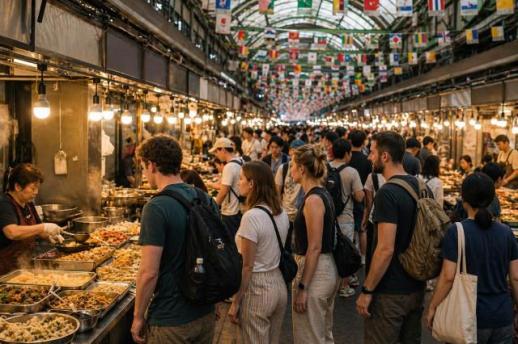 Gwangjang Market Overcharging Dispute Raises Concerns About Korea’s Image Traditional markets popular with foreign visitors are often a condensed view of South Korea — its food, people, atmosphere and prices. Against that backdrop, the overcharging dispute at Seoul’s Gwangjang Market has become more than a complaint about cost, raising questions about how the country is seen by tourists. A Myanmar-born YouTuber who has lived in South Korea for 13 years recently said he visited Gwangjang Market with a Russian friend and was asked to pay 2,000 won for a bottle of water at a street stall. The vendor first replied, “Because there are a lot of foreigners,” then changed course after being told, “We’re Korean, too,” saying, “I sell it like that to Koreans, too.” The price — higher than at convenience stores — and the response drew criticism, especially since restaurants in South Korea do not commonly charge separately for water. The issue has resurfaced repeatedly. Past controversies have included cases in which vendors raised the price of soondae without notice and demanded extra payment, and behavior that pressured customers who did not order more. Each time, explanations followed that it was “a deviation by some merchants,” but repeated incidents point to a structural problem and a broader loss of trust in the market. With Gwangjang Market widely seen as a must-visit stop for foreign tourists, the impact can be amplified. Travel experiences are quickly shared on YouTube and social media and consumed as content. Videos by travel creators describing overcharging in places such as Egypt have helped spread negative impressions of entire countries, and South Korea is not immune. A single unpleasant encounter can overshadow positive experiences tied to K-culture, K-pop and K-dramas. Government and local authorities have acknowledged the problem. The Ministry of SMEs and Startups, the Seoul Metropolitan Government and Jongno District have carried out joint inspections and provided merchant training and guidance when disputes flare. But the pattern has persisted: conditions improve briefly during crackdowns, then slide back. The problem, the column argues, is not the direction of policy but a lack of sustained enforcement. The column calls for a more fundamental approach, including institutionalizing full price transparency by clearly posting all menu items and prices and requiring advance notice of any additional charges. It also urges mandatory multilingual guidance so foreign visitors can easily understand pricing. It also calls for stronger self-policing led by merchant associations. While associations may have helped internal cohesion, the column says they have fallen short in protecting public trust. It argues that a system should allow meaningful penalties — including real limits on business operations — for merchants who repeatedly cause problems, describing such steps as a minimum safeguard to keep the market viable. The column adds that merchants need to view traditional markets as a tourism asset. Inflating prices for short-term gain can lead to long-term losses, it says, because disappointed visitors do not return. By contrast, tourists who experience reasonable prices and warm service can become informal promoters. The priority, it argues, is not more sales but a better experience. A market that loses trust will eventually be avoided, and the damage will fall on the many merchants who do business honestly. The Gwangjang Market dispute, the column concludes, is not a minor episode but a test of what path South Korea’s traditional markets will choose — and that basic fairness remains the strongest competitive advantage for bringing visitors back.* This article has been translated by AI. 2026-04-24 06:04:02
 -
 Trump Says He Has No Intention of Using Nuclear Weapons Against Iran U.S. President Donald Trump said Thursday that he has no intention of using nuclear weapons against Iran, which he said the United States is at war with. According to Yonhap News Agency, Trump made the remarks at a White House event on lowering medical costs when asked whether he would use nuclear weapons on Iran. “No,” he said. “We’ve already completely devastated them with conventional means, without nuclear weapons, so why would I use nuclear weapons?” Trump said. “I will not use nuclear weapons. No one should ever use nuclear weapons.” He also rebuked the reporter who asked the question, saying, “Why would you ask such a stupid question?” On April 7, Trump wrote on social media platform Truth Social, referring to Iran, “Tonight an entire civilization will disappear and it will never be reversible.”* This article has been translated by AI. 2026-04-24 06:03:16
 -
 Why Central Asia Should Be a Strategic Market for Korea’s Export Diversification Last November, the leaders of Central Asia’s five countries met with President Donald Trump in Washington to discuss securing critical minerals, the Trump Peace Route (TRIPP) and cooperation on artificial intelligence. A platform that began as a ministerial meeting in 2015 was elevated to a leaders’ summit within 10 years, signaling the start of supply-chain and trade shifts in a region long dominated by Russian and Chinese influence. The United States is not alone. China and Japan are also strengthening C5+1 (Central Asia 5+1) cooperation with the five countries. The United States, in particular, is using the B5+1 (Business 5+1) forum to explore cooperation in agriculture, banking and finance, critical minerals, e-commerce and IT, telecommunications and logistics, and tourism. For South Korea, which is seeking both supply-chain stability and export diversification, the trend carries clear implications. Central Asia has historically served as a conduit for technology and culture among major powers such as China, Russia, Britain and Turkey. With about 130 ethnic groups maintaining distinct identities, the region also shows diverse consumer demand. Exports to Central Asia rose about 42% last year, far outpacing South Korea’s overall export growth rate of 3.8% and exceeding gains seen in many other Global South markets, including Southeast Asia, the Middle East and Latin America. While competition is intensifying in those markets, Central Asia is seeing new supply chains form due to the Russia-Ukraine situation. The region also has strong awareness of Korean consumer goods, steady economic growth and a high average birthrate close to three children, factors that point to significant growth potential. Central Asia should be viewed not as a stopgap market but as a strategic buffer as Korean companies adapt to a changing trade order. The more dependence rises on any single market, the more vulnerable firms become to external shocks. Building an early foothold in emerging markets where competition is less overheated can help spread medium- and long-term trade risks. That requires a shift in mindset from seeking a short-term export outlet to making a proactive investment in resilience. Three keywords can serve as a practical map for using Central Asia as a strategic market for export diversification: Market Test, Area Expansion and Pilot Sandbox. First, Market Test: Central Asia can be used to test export suitability across a range of products. As supply chains are reshaped, companies should use access to major local distribution channels while accounting for clearly segmented demand by income level in industries such as autos, cosmetics, food, and medical and biotech products. In Uzbekistan, the IT Park has set up overseas offices in South Korea, the United States and China to expand startup cooperation and is pursuing projects such as building green data centers. Second, Area Expansion: The region can be linked to entry into nearby large markets. In Kazakhstan, CU convenience stores and Artbox have entered for the first time in the former Soviet bloc, and BBQ Chicken is expected to enter soon. Companies should use a start in Central Asia as a bridge to Russia, where language and business conditions are similar and many Western firms have withdrawn. Kaspi, Central Asia’s largest e-commerce company, is expanding into Azerbaijan and Ukraine. Freedom Holding, a U.S.-based fintech company, is also expanding beyond Kazakhstan into Uzbekistan and Kyrgyzstan. Third, Pilot Sandbox: Central Asia has strong interest in advanced-industry cooperation, offering Korean companies opportunities to build technical data in areas such as sovereign AI, cryptocurrency, autonomous driving and drones (UAM). Kazakhstan’s Alatau new city, now under construction, is promoting regulatory sandboxes in fields including blockchain, AI and drones to attract foreign companies. Uzbekistan has also moved to improve the business environment by deciding to pilot stablecoin payments. In a fast-changing global market, Korean companies should aim to use Central Asia to succeed in diversifying exports. 2026-04-24 05:04:11
 -
 POSCO Expands Tactile Exhibits Using Steel-Based 'PosArt' for Visitors With Visual Impairments POSCO Group is combining steel technology with art and giving to expand access for visitors, including people with visual impairments. Industry officials said April 23 that the group is producing tactile exhibits using PosArt to help people with disabilities and other underserved visitors experience museum displays. PosArt is POSCO Group's premium color steel sheet made by applying high-resolution inkjet printing to specialized steel. Using 3D layering that builds ink in stacked layers, it delivers image quality more than four times sharper than conventional color steel sheets, the company said. In February, the POSCO 1% Sharing Foundation produced tactile exhibits using PosArt and donated them to the National Museum of Korea. The foundation said applying PosArt to artworks allows delicate raised textures, enabling visitors with visual impairments to feel details by hand. POSCO Humans, a POSCO Group social enterprise and a standard workplace for people with disabilities, handled production to help link steel technology with art and support a broader culture of giving. The donated items fall into three categories: a large feature wall at the entrance to the calligraphy and painting gallery; a tactile table that lets visitors explore representative calligraphy and paintings with their fingertips; and four showcases designed to store artifacts safely. Separately, POSCO Art Museum is running exhibitions where visitors can experience PosArt. The shows, titled 'Spirits of Water' and 'Recorders of Nature,' examine the value of the Korean Peninsula's disappearing natural ecosystems as artistic records and run through May 3. The exhibitions include a hands-on area featuring PosArt works made with POSCO Group's steel technology, allowing visitors with visual limitations to explore the shapes of fish, insects and plants through touch.* This article has been translated by AI. 2026-04-24 05:03:21
 -
 Actor Jung Woo Revisits ‘Jjanggu’ Character in New Film, Drawing on His Own Youth Actor Jung Woo is bringing back the face of youth with the film 'Jjanggu,' returning to a character now nearing the end of his 20s and confronting reality while chasing an acting dream in Seoul. By reviving the name Jjanggu from the film 'The Wind,' Jung Woo said he aimed to portray endurance and a youthfulness that does not break easily, with an autobiographical undercurrent. "If you ask why now, I didn’t start this thinking I had to do it at this exact time," he said. "It flowed naturally and felt more like a project I met by fate. That made me even more grateful — and I was thankful to work with good staff and actors." For 'Jjanggu,' Jung Woo went beyond acting, taking part in the screenplay and serving as a co-director. He said being involved throughout the process gave him a closer look at how a film is completed. "Actors sometimes don’t realize how much energy and care goes into postproduction," he said. "Experiencing it myself was fun, but it also reminded me how much effort it takes to finish a film." Jung Woo said he does not consider 'Jjanggu' a sequel to 'The Wind,' even though the character returns. "Strictly speaking, I don’t think it’s 'The Wind 2,'" he said. "It’s hard to call it that. If anything, since that character comes back, it can feel like a spinoff or a character movie. But it’s different from the kind of series people usually think of — it’s definitely not like 'The Roundup' 1 and 2, where it continues in that way." In the film, Jjanggu’s friends — including Jang-jae (played by Shin Seung-ho) and Kkangnaengi (played by Jo Beom-gyu) — are grounded characters with a lifelike feel. Jung Woo said they were not created from pure fiction but grew out of people he has known and observed. "Like with 'The Wind,' because I wrote this myself, I kept thinking of unusual friends I’d seen in real life," he said. "Jang-jae and Kkangnaengi look ordinary on the surface, but if you look closely, they’re not. I thought that sense of real life would be fun. I have even more unusual friends around me, and I’m a little disappointed I couldn’t fit them all into this film." Jung Woo also recalled how 'The Wind' built a reputation beyond its theatrical run. He said it achieved meaningful results as an independent film and later gained wider, longer-lasting attention through IPTV and VOD, earning the label of an "unofficial 10 million" film. "Back then, I didn’t even know what the break-even point was — how many people it was," he said. "To us, it was just a meaningful step. Once we went to Jeju for stage greetings and there were only four people sitting there. There were fewer audience members than us, so theater staff even filled seats. We still went around doing those greetings." He said the routine was exhausting at the time, including taking selfies and signing for each audience member after screenings. "Honestly, it was hard," he said. "I didn’t really know the idea of fan service, and I didn’t know how to enjoy that time. But now it’s different. This time in Busan, taking photos and making memories with people felt really fun and I was grateful. I can’t control the numbers, so I see it as a process of thanking each person." If 'The Wind' was based on Jung Woo’s story and turned into a screenplay by director Lee Seong-han, Jung Woo said 'Jjanggu' was a more direct effort to write out his own time. He said it began from the same autobiographical starting point, but this time he revised and refined the story more as a writer. "Putting my story into writing isn’t easy," he said. "'The Wind' had the autobiographical label, but I felt it was closer to a series of episodes. Still, because my real experiences — including my father’s story — were in it, I think it had its own arc. This film also started from my story, but I adapted it more. I rewrote it five or six times, and as many as seven, getting help from people around me as I polished it." Asked what changed most through the rewrites, Jung Woo said the process ultimately brought him back to the original direction. "It’s not that it changed a lot from the first draft — in the end, I went back to the beginning," he said. "Even after about six rounds of adaptation, I returned to that first draft. The production company heads said, 'We knew this would happen.' But you can’t just do nothing and jump in. Going through the process made what was rough at first feel smoother." Though he is credited as a co-director, Jung Woo said he is not treating directing as a firm plan or goal. "I don’t have a specific plan for directing," he said. "I just keep writing scripts. I don’t know which script will become a film, but I write when I can and enjoy it. I really enjoyed being on set. It was tough and I could have gotten hurt, but thankfully I didn’t." He said filming stayed within set hours, noting the importance of both cast and crew condition, and added that shooting in his hometown of Busan gave him more time with staff and actors. "So I think we filmed with a grateful heart," he said. 2026-04-24 00:05:44
 -
 South Korea Moves to Overhaul Decades-Old Tourism Laws as Industry Pushes Reform In the first quarter of 2026, inbound tourism to South Korea topped 4.76 million visitors, setting a record, as the government, academics and the private sector moved to modernize tourism laws written decades ago. The Ministry of Culture, Sports and Tourism held a policy forum on the afternoon of April 23 in central Seoul to discuss a broad overhaul of the Tourism Framework Act and the Tourism Promotion Act. The forum followed up on the 10th National Tourism Strategy Meeting held in September. Officials said the goal is to move beyond laws enacted in the 1970s and 1980s that no longer reflect rapid changes, and to present a concrete roadmap for what the ministry called a major shift in the legal framework. ◆ Patchwork revisions hit limits; full overhaul urged South Korea’s tourism legal framework consists of six laws, four enforcement decrees and three enforcement rules. The Tourism Promotion Development Fund Act and the Tourism Framework Act were enacted in the 1970s, and the Tourism Promotion Act and the Korea Tourism Organization Act were enacted in the 1980s and 1990s. Because the system has been revised only in parts, it has grown sprawling and unclear, critics have said, limiting long-term responses needed to develop the tourism industry. The ministry said it has prepared a systematic reform plan — including a full revision of the Tourism Framework Act and a full revision and possible split of the Tourism Promotion Act — based on research conducted with the Korea Culture and Tourism Institute. ◆ From declarations to execution: Framework Act to spell out responsibilities Jeong Gwang-min, a research fellow at the institute, said the Tourism Framework Act is being fully revised for the first time since it was enacted in 1975. “If the existing framework act remained largely declarative — ‘what we will do’ — the new law’s core is to clearly define who will execute policy, how, and on what legal basis,” Jeong said. He said inbound tourism hit a record about 18.7 million visitors last year and reached 4.76 million in the first quarter of this year, but 78.4% of inbound visitors remain concentrated in Seoul. “With the capital-area concentration, there are limits to the extent that regions as a whole can feel the benefits of growth,” he said. He called for the revised law to firmly establish local governments’ legal authority and administrative and financial support so they can plan and carry out region-specific tourism policies. Under the proposal, the current 16-article law would expand to five chapters and 27 articles. The four main directions are strengthening tourism’s guiding principles and core values; defining the roles and responsibilities of the central government, local governments and businesses; reorganizing the policy implementation system; and specifying legal grounds to promote tourism and build an industry base. A key element is reorganizing the “policy formulation and implementation system” that serves as a control tower. Jeong said the proposal would elevate the existing five-year plan to a 10-year “National Tourism Master Plan” and reinforce the legal basis for the National Tourism Strategy Meeting, which was elevated in March to a presidential body, to strengthen policy execution. The proposal also adds new sections on “promotion and facilitation of tourism” and “building the foundation for the tourism industry,” and spells out legal grounds for policies that lacked clear support. It would include provisions to guarantee the public’s right to enjoy tourism and support tourism welfare for vulnerable groups; ensure tourism safety in disasters and other emergencies; protect tourists’ rights; and establish fair trade practices. In the discussion, Cho Gwang-ik, senior vice president of the Korea Tourism Sciences Society, said it could be the biggest comprehensive overhaul since 1986, but warned that universal values such as inclusive tourism and the public’s right to enjoy tourism should not be diminished as the law is made more detailed. Kim Jin, a senior expert adviser at Shin & Kim, said the framework act should reflect a shift from central-government-led tourism policy to a model in which local governments take the lead and the central government supports them. ◆ Proposal would split Tourism Promotion Act into industry and regional tracks The second session focused on splitting the expanded Tourism Promotion Act by function to increase specialization. Ryu Gwang-hun, a senior research fellow at the institute, proposed dividing it into a tentatively named “Tourism Industry Promotion Act,” focused on industry development, and a tentatively named “Regional Tourism Development Act,” aligned with a stronger local-government era. On the industry law, Ryu said the system should move beyond the traditional classification centered on seven major sectors and adopt a “service-attribute-based” structure that actively accommodates digital transformation such as AI and platforms. He cited support to expand an AI-based industry ecosystem; promotion of tourism data collection and use; building broader support for startups, investment and finance; and stronger consumer protections suited to changing transaction environments. He said a separate, stand-alone law for the casino and lodging sectors was also discussed, given their institutional characteristics. On the regional law, Ryu said the approach should shift from development-centered policy to regional community growth and sustainability. He said legal grounds are needed for dedicated local tourism organizations and that legal options should be reviewed to secure local finances, such as a tourism lodging tax or room tax. He also proposed bold regulatory exemptions for small-scale, dispersed development and a one-stop system for handling related agendas. In the second-session discussion, Lee Hoon, a professor at Hanyang University, said that if the law is divided into industry and regional parts, a tight linkage system is needed so overlapping areas — such as festivals that are both industry activity and local events — are not neglected. Jeong Ji-ha, CEO of Tripbtoz, said tourism’s share of South Korea’s gross domestic product has long been stuck in the 3% range. “To raise it to 10%, we can’t remain an analog industry. We urgently need a legal framework centered on the next generation that fosters innovative companies able to compete head-on with global services in the digital world,” he said. In an open discussion, participants also raised a shortage of tourist interpreters and guides for less common languages; the need for clear legal status and certification standards for small and midsize tourism venture companies; a regulatory fast track for new services to keep up with rapidly changing trends; and support measures for local creators to energize regional tourism. Kang Jeong-won, the ministry’s director general for tourism policy, said the overhaul is not simply revising a thick statute book but “a difficult task of designing a new framework that opens an era of 30 million tourists and properly reflects the wide range of industries today.” He pledged to incorporate feedback from the forum and push for legislation through a National Assembly bill in the second half of the year. * This article has been translated by AI. 2026-04-24 00:03:49
 -
 Blue House policy chief says Samsung strike talks not at breaking point Kim Yong-bum, the Blue House policy chief, said April 23 (local time) that he hoped talks would resolve the possibility of a strike by Samsung Electronics’ labor union. Speaking at a press center briefing in Hanoi, Kim was asked whether the government could step in to mediate if Samsung workers strike. “I hope it will be resolved wisely through dialogue,” he said. Kim added that he did not yet see it as a special problem, saying labor and management were “not at the stage of heading to extremes” and that he expected the issue to be settled. Asked whether President Lee had been briefed, Kim said he had reviewed what was reported at a meeting, but that the president did not separately comment on it. Earlier, the Samsung Electronics union held a rally of about 40,000 people demanding the abolition of a cap on performance bonuses and warned of a general strike. Kim also addressed the recent death of a union member at a rally by the Cargo Truckers Solidarity, saying he was concerned and was looking into it. He said it was “a great relief” that the Labor Ministry was communicating with the site.* This article has been translated by AI. 2026-04-23 22:36:21
 -
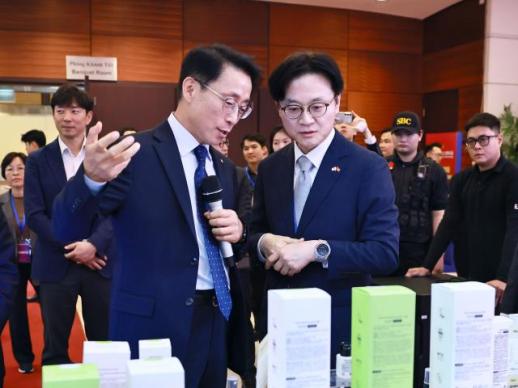 South Korea-Vietnam Forum Spurs Deals on Nuclear Power, AI and Energy Infrastructure South Korean and Vietnamese business leaders gathered in Hanoi to expand economic cooperation, with talks and agreements spanning artificial intelligence, energy and other future industries. The Korea Chamber of Commerce and Industry said it sent an economic delegation to Vietnam and held a South Korea-Vietnam business forum on April 23 (local time), timed to President Lee Jae-myung’s state visit. About 500 government and business figures from both countries attended. Lee and Vietnamese Prime Minister Le Minh Hung appeared together, underscoring their commitment to closer economic ties. Attendees included Chey Tae-won, chairman of SK Group and the chamber; Samsung Electronics Chairman Lee Jae-yong; LG Group Chairman Koo Kwang-mo; Lotte Group Chairman Shin Dong-bin; POSCO Holdings Chairman Chang In-hwa; HD Hyundai Group Vice Chairman Chung Ki-sun; GS Group Chairman Huh Tae-soo; Doosan Enerbility Chairman Park Jie-won; Hyosung Group Chairman Cho Hyun-joon; Daewoo Engineering & Construction Chairman Jung Won-ju; Hyundai Motor President Sung Kim; and Naver CEO Choi Soo-yeon, along with other business group leaders. The delegation, involving 109 companies, sought to move beyond manufacturing-centered cooperation toward AI, advanced technology and energy, the chamber said. In welcoming remarks, Chey called Vietnam “Korean companies’ most important global partner,” and said cooperation should go beyond expanding trade to higher value-added areas such as advanced manufacturing, services and digital industries. “Through cooperation in AI and advanced technology, Korea’s technology and Vietnam’s young, dynamic talent can create tremendous synergy,” Chey said, adding that Vietnam is “no longer just a land of opportunity,” but a partner in building the future. The forum, held under the theme of advancing industrial, investment and science-and-technology partnerships, discussed concrete tasks in four areas: training advanced talent, energy, AI transformation and science and technology. Na Ki-hong, head of Samsung Electronics’ Vietnam strategic cooperation office, introduced manufacturing innovation consulting and smart factory support cases and outlined plans to expand “youth future technology education” to develop next-generation talent. SK Innovation CEO Choo Hyung-wook highlighted the importance of power infrastructure for building an AI ecosystem and shared a roadmap for ongoing cooperation projects, including the Quynh Lap LNG power project. KIST President Oh Sang-rok presented a vision linking talent, technology and industry and proposed a cooperation strategy combining Korea’s maturity with Vietnam’s dynamism. Vietnamese presenter Nguyen Trung Chinh, chairman of CMC, shared strategies for advanced-industry innovation based on AI and science and technology, calling for stronger technology partnerships. The chamber said the forum produced about 70 MOUs and contracts. Key areas included AI data centers and digital infrastructure; energy projects such as nuclear power and power-grid construction; production bases for secondary batteries and advanced materials; smart cities and infrastructure development; and finance and investment. SK Innovation and SK Telecom signed MOUs with Vietnam’s National Innovation Center on building AI data centers and an ecosystem, and with Nghe An province on AI infrastructure, expanding cooperation on future infrastructure, the chamber said. Daewoo Engineering & Construction signed an MOU with Vietnam’s SaigonTel to jointly develop a data center business and participate in construction. POSCO Future M said it completed approval procedures with Thai Nguyen province to build a plant for artificial graphite anode materials, a key secondary-battery material, and began building a supply chain for battery materials. Doosan Enerbility signed MOUs with Vietnamese companies PTSC and PETROCONs on cooperation including Vietnam’s new nuclear power projects. Taihan Cable & Solution signed an MOU with Vietnam’s Newtecons on power-grid upgrades and extra-high-voltage cable business cooperation, moving to expand technology partnerships for local energy infrastructure.* This article has been translated by AI. 2026-04-23 22:30:15