
Journalist

Lee Hugh
=
-
 South Korea Requests Police Probe Into Illegal Vehicle Software Changes South Korea’s Ministry of Land, Infrastructure and Transport has asked police to investigate cases in which vehicle software was altered without authorization. In a press note released on the 23rd, the ministry said unauthorized software changes have continued to occur and it has requested a probe by the National Police Agency. The police agency plans to begin an investigation after receiving related materials from automakers, the ministry said. The ministry said it had already warned last month that illegally modifying software that affects safe vehicle operation is prohibited, and it has been monitoring for violations. Automakers are also responding under the vehicle cybersecurity certification system, known as CSMS, and are taking steps to immediately disable vehicles remotely if users alter software without authorization, the ministry said. As vehicles shift to connected cars and software-defined vehicles, safety oversight of automotive software is being strengthened internationally, the ministry said. It added that under Article 35 of the Automobile Management Act, unauthorized changes to software that affects safe operation are strictly restricted. * This article has been translated by AI. 2026-04-23 18:09:19
 -
 Retail Trading in Single-Stock Futures and Options in South Korea Triples Amid Rally As South Korea’s stock market rally continues, retail investors are increasing high-risk leveraged bets, with trading in derivatives tied to individual stocks surging more than threefold from a year earlier. The rise in debt-funded investing has also accelerated, prompting warnings that household investor risk is approaching dangerous levels. According to the Korea Exchange, retail investors traded 276.605 trillion won ($276,605,000,000,000) in domestic single-stock futures from January through April 21. That was about 3.44 times the 80.3073 trillion won ($80,307,300,000,000) recorded in the same period last year. Retail trading in stock options totaled 230 billion won ($230,000,000,000), up 5.85 times from 39.3 billion won ($39,300,000,000) a year earlier. Derivatives linked to individual stocks are generally considered riskier than index-based products because they tend to be more volatile. The jump reflects both expectations for further gains and increased volatility, analysts said. Derivatives allow investors to bet on either rising or falling prices and can be used for hedging, but they also attract money seeking profits when price swings widen. With relatively small margin requirements, investors can take large positions. Margin rates vary, but current conditions allow leverage of roughly three to 10 times, a range that can expand or shrink with market conditions. The concern is that heavier use of leverage can amplify losses. With 10-times leverage in futures, a 10% drop in the underlying asset can wipe out the entire investment. Options positions can also generate rapidly growing losses if the trade moves the wrong way, and some structures can produce losses exceeding the initial principal. Leverage is also rising through margin borrowing. The Korea Financial Investment Association said outstanding margin loans stood at about 34.4694 trillion won ($34,469,400,000,000) as of April 21, repeatedly setting record highs as more individuals borrow to invest amid the market’s climb. Such debt-backed investing can support prices in a rising market, but it can deepen shocks when sentiment turns. If share prices fall, collateral values drop, and positions can be forced into liquidation, including broker-initiated sell-offs, potentially accelerating declines. Retail investors, the report said, posted losses every year over the five-year period from 2020 to 2024. Experts urged individuals to focus less on short-term gains and better understand the risks embedded in leveraged products. “If leveraged investing surges during a period of rising volatility, losses can spread quickly even from a small shock,” a financial investment industry official said. “In a rising market, repeated profit-taking can make it easy to underestimate risk. When the market’s direction changes, losses can expand sharply, so investors should be cautious about excessive leverage.”* This article has been translated by AI. 2026-04-23 18:07:12
 -
 Samsung heiress' ex-husband serving jail term in bizarre case involving shaman girlfriend SEOUL, April 23 (AJP) - Im Woo-jae, the ex-husband of Samsung heiress Lee Boo-jin and former adviser at the conglomerate's minor subsidiary Samsung Electro-Mechanics, has been serving a one-year prison sentence, it was belatedly revealed on Thursday. Lee was found guilty of obstruction of official duties after getting caught up in a bizarre case involving his girlfriend, who is a shaman, according legal sources. He apparently deceived officials while attempting to shield his girlfriend who was involved in the confinement and assault of a woman in her 80s last year. The shaman, who had a dispute with the elderly woman's son, allegedly arranged for the victim to be kidnapped and beaten by her own grandson on the outskirts of Seoul. But the elderly woman managed to escape and went to the police, and Im's girlfriend allegedly staged a fake suicide attempt to conceal her crime, only for the truth to be revealed later. The shaman was sentenced to six years in prison. Although Im did not carry out the violence himself, a judge ruled that he knew about the assault and convicted him of obstructing justice for helping to cover up his girlfriend's crime. Im, who was previously married to Lee, the eldest daughter of the late Samsung chairman Lee Kun-hee, divorced in 2020 after a lengthy legal battle over substantial alimony and custody of their son. 2026-04-23 18:06:59
 -
 Hyundai Motor posts record first-quarter revenue as profit drops on tariffs, higher costs Hyundai Motor Co. said geopolitical uncertainty and rising costs weighed on its first-quarter results, even as sales in its biggest export market, the United States, held up. The automaker pointed to tariffs, higher raw material prices and currency moves as key drags, and said it plans to lean more on hybrids and other eco-friendly models to regain momentum. In a preliminary earnings filing on Wednesday, Hyundai said first-quarter operating profit on a consolidated basis fell 30.8% from a year earlier to 2.5147 trillion won. Revenue rose 3.4% to 45.9389 trillion won, the highest ever for a first quarter. While sales grew, profitability weakened. Hyundai said the continued burden of a 15% tariff, along with a weaker exchange rate tied to geopolitical risks and higher raw material prices, hit operating profit. With multiple cost pressures at once, operating profit fell by more than 1 trillion won from a year earlier. Lee Seung-jo, head of Hyundai’s planning and finance division, said raw material prices have surged since late last year, creating about a 200 billion won burden on first-quarter results. He said similar cost pressure could continue in the second quarter and that the company is preparing cost-cutting measures. Hyundai sold 976,219 vehicles worldwide in the first quarter, down 2.5% from a year earlier. The company attributed the decline to heightened geopolitical uncertainty that it said drove global auto demand down 7.2%. In the United States, Hyundai sold 243,572 vehicles, up 0.3% from a year earlier. Total overseas sales fell 2.1% to 817,153 vehicles. Domestic sales dropped 4.4% to 159,066 vehicles, which Hyundai said reflected demand tied to waiting lists for new models and production disruptions after a fire at its parts plant in Daejeon affected some lines. Hyundai said sales of electric and hybrid models were strong. The share of eco-friendly vehicles and hybrids in global sales rose to quarterly highs of 24.9% and 17.8%, respectively, as consumer demand shifted toward hybrids amid a slowdown in electric-vehicle growth. Looking ahead, Hyundai said it will continue to improve its product mix by focusing on higher value-added models such as hybrids. It plans to expand its lineup, including a refreshed Grandeur, and to diversify sales channels by strengthening its push in China and other emerging markets. Hyundai also said it will keep expanding its electrified lineup, including new Ioniq models, range-extended electric vehicles and sedans. It plans to deploy its software-defined vehicle (SDV) “face car,” a test vehicle, on some roads starting in the second half of this year.* This article has been translated by AI. 2026-04-23 18:06:05
 -
 SK hynix Profit Surge Fuels Bonus Pressure as Big Chip Investments Loom SK hynix has posted a record first-quarter operating profit of more than 37 trillion won, prompting talk that it could climb into the world’s No. 4 spot on an annual basis. But as earnings surge, management faces rising pressure from the labor union over performance bonuses, adding to the company’s burden. According to securities-industry consensus estimates released on April 23, SK hynix is projected to post 358.037 trillion won in revenue this year, with operating profit as high as 277.7 trillion won. If those forecasts are realized, SK hynix would rank around fourth globally, ahead of Microsoft (245 trillion won) and Alphabet (240 trillion won). Even with record results, executives are increasingly concerned as bonuses of “hundreds of millions of won per employee” come into view, potentially squeezing management flexibility. Under a labor-management agreement to allocate 10% of operating profit to profit-sharing bonuses, the company would already need to set aside about 3.76 trillion won based on first-quarter operating profit of 37.6103 trillion won. Divided among about 35,000 employees, that works out to an average bonus of about 100 million won per person based on first-quarter results alone. If annual operating profit exceeds 270 trillion won, the average payout would be about 650 million won per employee. That level would surpass the cost of building a single advanced production base. SK hynix on the previous day officially broke ground on its advanced packaging plant, P&T7, in Cheongju, North Chungcheong Province, with a total budget of 19 trillion won. The projected annual bonus pool would exceed the cost of constructing a next-generation flagship production site. The gap is also large compared with spending meant to secure the company’s future. SK hynix’s R&D investment last year totaled 6.7325 trillion won. The projected bonus pool would also exceed by more than 10 times the company’s total dividends of 2.1 trillion won for more than 1.19 million shareholders. SK hynix has major projects awaiting funding, including its new M15X fab in Cheongju and the Yongin semiconductor cluster, both requiring investments in the trillions of won. The company also needs sustained funding to develop and mass-produce next-generation high-bandwidth memory, or HBM, to meet demands from global customers including Nvidia. Industry experts say the semiconductor sector’s volatility means the company should focus on capital allocation for long-term survival rather than becoming complacent amid record earnings, prioritizing preparation for future downturns and investment in next-generation processes. Ahn Ki-hyeon, executive director of the Korea Semiconductor Industry Association, said, “Since semiconductors are a national security asset, the union also needs cooperation at a broader level for the company’s sustainable growth, rather than focusing on short-term gains in performance bonuses.”* This article has been translated by AI. 2026-04-23 18:05:12
 -
 SK hynix posts record Q1 operating profit as Hyundai Motor margin slides SK hynix posted its best quarterly results on record on surging demand for artificial intelligence chips, while Hyundai Motor saw profitability weaken despite higher sales, raising fresh concerns about Korea’s growing reliance on semiconductors. On the 23rd, SK hynix said first-quarter revenue rose to 52.5763 trillion won and operating profit to 37.6103 trillion won. That was up 198.1% and 405.5% from a year earlier, respectively, and marked a record for any quarter. Its operating margin reached 72%, the company said. The results were unusual for a seasonally slow period, helped by expanding AI infrastructure investment and a shift toward higher-value products. The boom could continue as AI demand broadens from training to real-time inference, strengthening the base for memory demand. Some in the securities industry have forecast SK hynix’s annual operating profit could exceed 200 trillion won, which would place it fourth globally. Hyundai Motor and Kia, however, showed weaker profitability even as sales grew. Hyundai Motor’s first-quarter revenue rose 3.4% from a year earlier to 45.9389 trillion won, but operating profit fell 30.8% to 2.5147 trillion won. Kia, which is set to report on the 24th, is expected to post operating profit of 2.2986 trillion won, down about 24%, according to the consensus estimate cited in the report. The two automakers posted record sales in the U.S. market, but tariff costs weighed heavily on earnings, the report said. Hyundai Motor said it spent 860 billion won on tariff costs in the first quarter. Kia’s tariff costs are estimated at 500 billion to 700 billion won. Other headwinds included higher oil prices tied to the Middle East war, rising raw material prices and a weaker currency. The report said a fire at a parts supplier in Daejeon caused production disruptions of about 30,000 vehicles, while Middle East risks added pressure to both logistics costs and the sales environment. With autos, a key export industry, also hit by worsening external conditions, the profit structure of Korean industry is becoming more concentrated in semiconductors, the report said. In an AI-driven industrial reshuffle, semiconductors have moved into an outsized-profit phase, while autos remain highly exposed to policy and cost variables, it added. Kim Pil-su, a professor in the Department of Future Automotive Engineering at Daelim University, said reliance on Samsung Electronics and SK hynix for AI semiconductors such as high-bandwidth memory, or HBM, means the semiconductor tilt is likely to persist for now. He added that uncertainty over auto tariffs continues and geopolitical risks in the Middle East are growing. 2026-04-23 18:04:17
 -
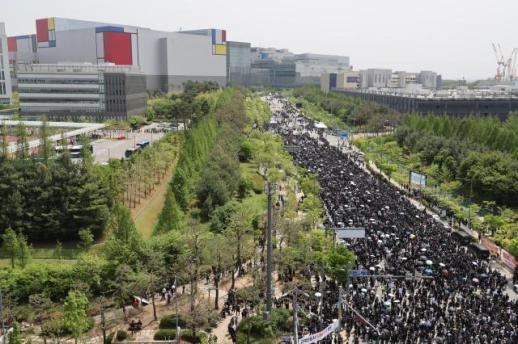 Samsung Elec's Pyeongtaek campus - protest instead of celebration of chip boom PYEONGTAEK, April 23 (AJP) -The usual soundtrack of the Samsung Electronics Pyeongtaek Campus—the low, constant hum of fabrication lines—was drowned out Thursday by a different cadence: tens of thousands of workers chanting in lockstep, their placards snapping in the wind as a bonus fight spilled into the open. At 2 p.m., the newly ascendant Samsung Electronics Enterprise Union—now the company’s first majority union—filled the forecourt with an estimated 40,000 members, a sea of dark jackets punctuated by white placards: “Change it transparently” and “Abolish the cap.” The slogans rose and fell in waves, each chant snapping into unison under the emcee’s cadence. From atop a crane, union chairman Choi Seung-ho delivered a speech overlooking the tightly packed crowd, underscoring the union’s sharpened leverage after securing legal worker representative status on April 15 with around 74,000 members. The union warned it would launch a general strike from May 21 to June 7 if negotiations fail. Earlier in the day, a small counter-protest by the Korea Shareholder Movement Headquarters drew just four participants, who argued that shareholders oppose what they called excessive bonus demands and potential risks to the semiconductor operation. 2026-04-23 18:03:37
 -
 SK hynix posts 72% operating margin in Q1 on HBM boom and surging memory prices SK hynix’s first-quarter earnings beat pushed its operating margin into the 70% range, outpacing Taiwan Semiconductor Manufacturing Co. as well as Nvidia and Apple, the company said. The strong growth cycle is likely to continue for now. SK hynix reported an operating profit margin of 72% for the first quarter, it disclosed on April 23. That topped its previous record of 58% in the fourth quarter of last year. The figure implies more than 7,000 won in operating profit for every 10,000 won in sales, an unusually high level for a manufacturer. Among semiconductor companies, it ranked first by a wide margin. Samsung Electronics posted a 43% operating margin in the first quarter; its memory business alone is estimated to be in the 60% range. The gap with TSMC, the world’s top foundry, also widened. Based on last year’s fourth quarter, SK hynix led TSMC (54%) by 4 percentage points, but the difference has since grown to 14 points. Nvidia’s operating margin is 65%, and Apple’s is about 48%, the report said. Profitability rose as sales of high-value high-bandwidth memory, or HBM, expanded and prices for other memory chips such as commodity DRAM and NAND flash surged. HBM accounts for 30% of SK hynix’s total DRAM shipments, with the rest in commodity products. By revenue, DRAM made up 78% and NAND flash 21%. With semiconductor demand jumping, first-quarter DRAM selling prices rose more than 60% from the previous quarter, while NAND flash average selling prices increased in the mid-70% range. The earnings strength also improved the balance sheet. Cash and cash equivalents at the end of the first quarter rose 19.4 trillion won from the end of the previous quarter to 54.3 trillion won. Borrowings fell 2.9 trillion won to 19.3 trillion won, lifting net cash to 35 trillion won. The company aims to build net cash of more than 100 trillion won, with most of it to be used to raise utilization at its M15X facility, build infrastructure for the Yongin cluster, and secure key equipment such as extreme ultraviolet, or EUV, tools. The first-quarter beat, despite a seasonally weak period, has also raised expectations for the second half. If mass production of sixth-generation HBM4 ramps up in the second half, the company’s annual results and profitability metrics could climb further, the report said. Some brokerages forecast annual revenue of 300 trillion won and operating profit exceeding 230 trillion won. Kim Woo-hyun, SK hynix chief financial officer, said on the company’s first-quarter earnings conference call that memory demand from major customers has expanded to HBM, server DRAM and enterprise SSDs, but manufacturers cannot quickly increase supply. “As this supply shortage continues, there is a high possibility that the memory price upcycle will be prolonged,” he said. The company said the current rise in memory prices reflects structural changes such as a broad AI shift, suggesting the supply-demand imbalance could persist and prices could keep rising. 2026-04-23 18:03:21
 -
 Korean Brokerages Ramp Up Marketing for Domestic Derivatives as Retail Trading Grows A bull market is drawing more retail investors into derivatives, intensifying marketing competition among brokerages. Firms are cutting fees and offering gift-card promotions. Experts warn that if the rally fades, losses from leveraged derivatives trading could fall squarely on individuals. According to the securities industry on the 23rd, brokerages are stepping up campaigns tied to domestic derivatives. Brokerage A said it will offer up to three months of discounted fees for domestic futures and options customers and provide gift cards to clients who meet trading requirements. Brokerage B is targeting new and inactive customers with gas gift cards, cash and fee coupons to spur first trades. Brokerage C is offering cash for completing education and additional rewards based on trading volume. The industry is broadly competing on incentives to expand domestic derivatives trading. The shift is also seen as a response to tighter oversight that has made aggressive marketing harder for overseas stocks and overseas derivatives, pushing firms to focus on domestic derivatives, which face relatively fewer restrictions. Brokerage results from last year underscore the trend. As of the end of last year, brokerages’ fee income from domestic derivatives (excluding overseas) totaled 508.9 billion won, up 13.8% from 447.1 billion won a year earlier. Over the same period, interest income from credit provision rose 8.5% to 3.1073 trillion won from 2.8626 trillion won. The structure rewards higher trading volumes with more fees, and expanding debt-funded investing boosts interest income. Still, responsibility for investment decisions and losses rests with individuals, prompting calls for caution. Futures and options are typical leveraged products that allow large positions with small margin deposits, meaning losses can multiply if investors bet the wrong way. Margin trading carries similar risks. Data from the office of Rep. Heo Young, a member of the National Assembly’s Political Affairs Committee, show individual investors posted cumulative losses of about 3.667 trillion won in domestic derivatives from 2020 to 2024. Losses were recorded each year over the five-year period, though the first half of 2025 saw a profit of 326.3 billion won. Heo said investors who meet eligibility requirements may mistakenly believe they are fully prepared for high-risk trading and take on excessive speculation, adding that brokerages’ sales practices that stoke get-rich-quick sentiment through promotions should be examined. Financial authorities, meanwhile, have not issued specific warnings on exchange-traded domestic derivatives. They highlighted risks in leveraged ETFs and overseas derivatives trading late last year and early this year, but have provided no separate guidance for domestic exchange-traded derivatives. A Financial Supervisory Service official said there are no plans yet to respond regarding domestic derivatives, adding that exchange-traded derivatives are handled by investors who have completed education, making them different from products such as ETFs traded by the general public.* This article has been translated by AI. 2026-04-23 18:00:55
 -
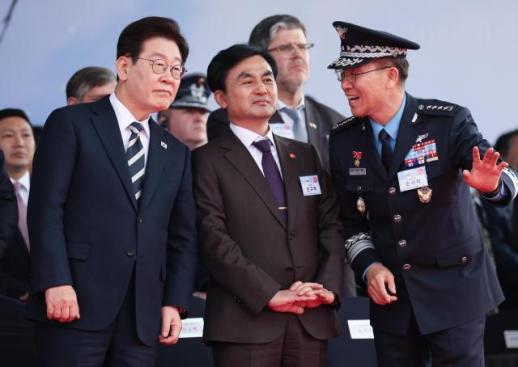 Seoul pushes for wartime command transfer as U.S. urges caution on timeline SEOUL, April 23 (AJP) - A long-simmering question at the heart of the U.S.–South Korea alliance is once again coming into sharper focus: when — and under what conditions — should Seoul take full wartime command of its own and U.S. military forces on the peninsula? Behind the scenes, officials in Seoul and Washington are quietly diverging over the timeline for transferring wartime operational control, or OPCON, with South Korea favoring an earlier date and U.S. military leaders urging a slower, conditions-based approach. Timeline divides the allies South Korean officials have been working toward completing the transition before 2028, aligning with President Lee Jae Myung’s term in office. But recent comments by Gen. Xavier Brunson, commander of U.S. Forces Korea, suggest Washington may be working on a different timeline. “Political expediency must not outpace the conditions,” Gen. Brunson said in congressional testimony on Tuesday (local time), cautioning against setting deadlines that could compromise readiness. According to defense officials familiar with the discussions, the U.S. military has been working internally toward a target closer to early 2029 — a timeline not fully coordinated with Seoul. A South Korean government official, speaking on condition of anonymity, acknowledged the gap. “We are not fundamentally apart on the goal,” the official said. “But there is clearly a difference in how fast we believe we can get there.” Political pressure vs. military conditions Operational control of South Korean troops was handed over to the U.S.-led U.N. Command during the 1950–53 Korean War and later transferred to the Combined Forces Command in 1978. Peacetime operational control reverted to Seoul in 1994. The OPCON transition would place combined Korea–U.S. forces under the command of a four-star South Korean general in wartime, with a four-star U.S. general serving in a supporting role. At the center of the timing debate is a tension between political preference and military preparedness. Rep. Yoo Yong-won, a senior opposition People Power Party lawmaker on the National Assembly’s Defense Committee, criticized what he described as the prioritization of political considerations. “The government is pushing this too hard because it wants to achieve it within its term,” he said. “That is not desirable. The conditions must come first.” Experts with military and intelligence backgrounds also stressed that the OPCON transfer is fundamentally a structural security issue. Chae Sung-jun, a former National Intelligence Service (NIS) official and now head of the Department of Military Studies at Seokyeong University, said the transition must be approached with caution. “This is not simply about reclaiming authority,” he said. “It is about maintaining deterrence under a new command structure — and that is far more complex.” He added that the issue should be understood in its historical and strategic context. “The debate is not about whether to regain control, but how to integrate wartime command into an alliance structure without weakening deterrence,” he said. Lingering dependence Despite improvements in South Korea’s military capabilities, reliance on U.S. assets remains significant. Yoon Sang-yong, a military studies professor at Seokyeong University, pointed to persistent gaps in intelligence and operational integration. “We are still heavily dependent on U.S. intelligence, surveillance and reconnaissance assets,” he said. “These are not capabilities that can be replaced quickly.” He also raised concerns about alliance dynamics after the transfer. “If the command structure changes, there is a legitimate question as to whether the United States will respond with the same level of immediacy and scale in a crisis,” he said. Alliance in transition For Washington, the issue is shaped by long-standing institutional norms. The U.S. military has historically been reluctant to place its personnel under full foreign command — a practice sometimes referred to as the “Pershing Principle.” However, it has granted operational control to foreign commanders in joint-force arrangements during combat. At the same time, American strategy is shifting toward encouraging allies to assume greater responsibility for regional security. This creates a delicate balance: supporting South Korea’s autonomy while ensuring that the alliance’s deterrence posture remains intact. The risk of miscalculation Security experts warn that how the transition is handled could influence North Korea’s strategic calculations. “Command structures send signals,” Chae said. “If the transition is not backed by sufficient capability, it could invite miscalculation.” Others argue that further delays could undermine South Korea’s credibility as a self-reliant military power. A narrow window The coming months will be critical, with working-level consultations expected to intensify ahead of the annual Security Consultative Meeting in Washington later this year. A senior South Korean defense official, speaking anonymously, emphasized the stakes. “This is ultimately both a military and political decision,” the official said. “But if the balance is wrong, the consequences will be strategic.” 2026-04-23 18:00:39