
Journalist

Lee Hugh
=
-
 Prosecutors Indict 4 Corn Syrup Makers, 25 Employees in $10B Price-Fixing Case Prosecutors said they uncovered long-running price-fixing in South Korea’s corn syrup industry, a market they said generates sales in the tens of trillions of won, and indicted dozens of company officials. Investigators said the alleged collusion extended beyond the main product to byproducts, forming what they described as an organized scheme. The Seoul Central District Prosecutors Office Fair Trade Investigation Division, led by Chief Prosecutor Na Hui-seok, said on the 23rd it indicted four manufacturers and 25 executives and employees without detention for alleged violations of the Fair Trade Act. Prosecutors said the defendants are accused of agreeing in advance on when and how much to raise prices for corn syrup and related byproducts from July 2017 through October last year, restricting competition. The suspected collusion involved about 10.152 trillion won in transactions, prosecutors said. The case is notable, prosecutors said, because the companies allegedly aligned prices not only for corn syrup but also for byproducts. They said they view it as “structural collusion,” alleging that firms shared information and reached prior agreements across the process, from buying corn to setting product prices. Prosecutors said the companies moved quickly to raise prices when raw material costs rose, but limited price cuts when costs fell, repeatedly coordinating the timing and level of increases in advance. They said consumers bore higher costs: During the alleged collusion period, prices of major corn syrup items rose by as much as 73.4% compared with before the scheme, exceeding the consumer inflation rate. Prosecutors also said the four companies’ sales increased by an average of about 24.5% during the period, indicating that the price hikes were reflected in business results. Investigators said they identified how the alleged scheme operated: Sales departments shared pricing information, coordinated responses by customer, and effectively ran a joint pricing policy. They added that byproduct prices generated during corn syrup production also appeared to have been fixed in tandem with corn syrup prices, limiting price competition across the market for years. “Through this investigation, we identified the reality of collusion across the corn syrup industry,” prosecutors said, adding they will continue to respond strictly to price-fixing in everyday goods that affect household finances.* This article has been translated by AI. 2026-04-23 14:30:27
 -
 Callaway Golf Korea Launches Odyssey S2S Tri Hot SB Zero-Torque Heel-Shaft Putter Callaway Golf Korea said Wednesday it is officially launching the Odyssey “S2S (Square 2 Square) Tri Hot SB (Single Bend)” putter in South Korea, combining a heel-shaft structure with zero-torque technology. The company said the model targets golfers who feel uncomfortable with center-shaft, zero-torque putters. By using a familiar heel-shaft setup, it aims to keep a comfortable look at address while delivering the stability and consistency associated with zero-torque designs. The putter pairs a single-bend shaft with Odyssey’s Tri Hot multi-material construction. The shaft is positioned toward the heel to support intuitive alignment. The head uses aluminum and steel, along with more than 140 grams of tungsten placed strategically. Callaway said more than 80% of the overall weight is concentrated below the topline to create an ideal center of gravity and reduce unwanted head movement during the stroke. The face features an AI-designed “Ai-DUAL insert,” with a firm inner core and a softer outer layer intended to produce consistent ball speed and a softer feel. It also uses new “FRD (Forward Roll Design)” grooves tilted at 19 degrees to improve straight-line roll immediately after impact. Callaway said it incorporated feedback from tour players, fitting a black PVD-finished SL120 shaft to add weight compared with previous versions and applying a newly designed Pistol Plus grip for a more natural fit in the hands. The lineup includes four mallet models: Rossie, #7, Jailbird and #7 Cruiser. Standard lengths run from 33 to 35 inches, with a 38-inch Cruiser option. The Cruiser model comes with an SL140 shaft and an oversized grip, aimed at golfers who prefer a heavier, more stable putting feel. A Callaway Golf Korea official said the S2S Tri Hot SB “delivers both the comfort of a heel-shaft putter and the stability of a zero-torque putter,” adding that it offers an alternative for golfers uneasy with center-shaft models and is designed to provide more consistent putting performance.* This article has been translated by AI. 2026-04-23 14:29:41
 -
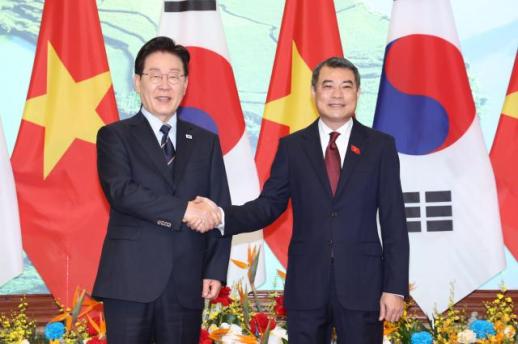 President Lee pitches S. Korean growth model as Viet Nam pursues infrastructure surge SEOUL, April 23 (AJP) - South Korean President Lee Jae Myung committed to deepening strategic cooperation in nuclear energy, transportation, and finance during a meeting with Vietnamese Prime Minister Le Minh Hung in Hanoi on Thursday. Lee framed the partnership as a catalyst for a new "Red River Miracle," drawing direct parallels between South Korea's rapid post-war industrialization and the current development trajectory of Viet Nam. The diplomatic push comes as Seoul seeks to export its foundational economic model to one of the world's fastest-growing economies, positioning South Korean infrastructure and technology as the primary drivers for Viet Nam to become a high-income nation by 2045. For the Lee administration, securing these high-stakes projects is essential for maintaining South Korea's regional influence and finding new growth engines for its own domestic industry. During the meeting at the Prime Minister's Office, the president said the South Korean government will strengthen strategic cooperation with Viet Nam in nuclear power, transport infrastructure, and energy to create a new "Red River Miracle" together. He detailed how South Korea previously invested intensively in three core infrastructures: energy independence through nuclear power, logistics innovation through highways and railroads, and transparent payment systems. Lee noted that "the combination of these physical and institutional foundations was the decisive engine" that allowed his country to achieve an economic leap in a short period of time. The president further emphasized that stable energy and logistics flows sustain industry, while efficient financial infrastructure accelerates capital movement. He suggested that Hung, a former central bank governor, is uniquely positioned to lead this economic transition. "The success of Viet Nam, the driver of regional economic growth, is the success of us all," Lee said, according to officials present at the meeting. Hung responded by expressing confidence that the state visit would provide "new momentum" for the development of bilateral relations. He noted that Viet Nam is currently focused on strategic tasks to become a modernized, high-income developing nation by 2030 and a high-income advanced nation by 2045. The Vietnamese leader requested South Korea's continued support and technical cooperation to meet these milestones. In a move to further solidify executive ties, Hung extended an official invitation for South Korean Prime Minister Kim Min-seok to visit Viet Nam. Lee accepted the invitation on behalf of the prime minister, stating he would relay the message immediately upon his return to Seoul to ensure the visit takes place at the earliest possible date. The two leaders concluded their discussion with a commitment to maintaining open channels for ministerial-level coordination on upcoming infrastructure projects. 2026-04-23 14:29:33
 -
 South Korea Land Prices Rise 0.58% in Q1; Seoul Up 1.10% Land prices nationwide rose 0.58% in the first quarter, extending their upward trend, though the pace eased slightly from the previous quarter. The Ministry of Land, Infrastructure and Transport and the Korea Real Estate Board said on the 23rd that nationwide land prices have risen for 37 straight months since turning upward in March 2023. The first-quarter increase was 0.03 percentage points lower than the 0.61% gain in the fourth quarter of last year, but 0.08 points higher than the 0.50% rise a year earlier. By month, the nationwide land-price change rate in March was 0.20%, up 0.01 points from 0.19% in February and 0.02 points higher than March last year (0.18%). While the quarterly gain slowed slightly overall, the increase picked up again in March. By region, land prices in the Seoul metropolitan area rose 0.81%, far outpacing the 0.19% increase in non-metropolitan areas. By province-level jurisdiction, Seoul climbed 1.10%, the only 1%-plus gain among the country’s 17 cities and provinces. Gyeonggi rose 0.55%, followed by Sejong at 0.45% and Daejeon at 0.42%. Jeju fell 0.22%, the only region to post a decline. At the local-government level, 41 of the nation’s 255 cities, counties and districts exceeded the national average. The biggest increases were in Seoul’s Gangnam District (1.50%), Yongsan District (1.31%) and Seocho District (1.26%), reflecting continued strength in key Seoul neighborhoods. In 89 areas designated as experiencing population decline, land prices rose 0.15%, 0.47 points lower than the 0.62% increase in other areas. Land transactions declined. Total land deals in the first quarter, including land attached to buildings, totaled 462,000 parcels covering 265.4 square kilometers, down 3.6% from the fourth quarter. Transactions for land excluding building-attached plots totaled 150,964 parcels covering 239.4 square kilometers, down 0.1% from the previous quarter. Compared with a year earlier, however, total transactions rose 6.7% and land-only transactions increased 0.6%. By city and province, compared with the fourth quarter, total and land-only transactions increased in five regions and fell in 12. Sejong posted the largest gains, with total transactions up 41.7% and land-only transactions up 33.6%. On a land-only basis, Seoul also recorded a 17.6% increase.* This article has been translated by AI. 2026-04-23 14:28:40
 -
 McDonald’s Korea Doubles Happy Meal Donations for Family Month Campaign McDonald’s Korea is expanding donations linked to its children’s Happy Meal menu item to mark Family Month. The company said Wednesday it will double the amount set aside from Happy Meal sales for about a month, from April 30 through the end of May. The donation per set will rise to 100 won from 50 won. During the campaign, the company will provide donation certificates and stickers to help children better understand and take part in the giving process. On May 24, McDonald’s Korea will hold its walking fundraiser, the “2026 McDonald’s Happy Walk.” This year, it will expand participation to 6,000 people from about 5,000 previously. “Happy Meal is a meaningful menu item that lets customers join in giving simply by making a purchase,” a McDonald’s Korea official said. The official added that the company will continue to increase everyday opportunities for families to share and give through programs such as the Family Campaign and Happy Walk. McDonald’s Korea said it is RMHC Korea’s largest sponsor and has continued support efforts for sick children and their families.* This article has been translated by AI. 2026-04-23 14:27:57
 -
 Korea Transportation Safety Authority wins Interior Ministry award for 'Accident-Free Today' campaign The Korea Transportation Safety Authority, known as TS, said April 23 it won the Minister of the Interior and Safety Award in the safety management category at the Korea Creative Management 2026 awards ceremony held at The Plaza Hotel in Seoul. TS said it received the honor for helping spread a traffic safety culture through its governmentwide “Accident-Free Today” campaign. The agency said it has been running the campaign at major transportation hubs nationwide. Since last year, it has held on-site events at key locations including Seoul Station, Incheon International Airport, Daejeon Complex Terminal and Gimpo Airport, drawing about 20,000 visitors and securing safety pledges from about 10,000 participants. Working with its 14 regional headquarters, TS said it conducted the campaign 548 times, targeting pedestrians as well as motorcycle and bus drivers. TS also said it designated Gimcheon as “Accident-Free Today City No. 1” and promoted six safety rules at high-traffic facilities such as Gimcheon-Gumi Station, other public facilities, and cultural and sports venues. This year, TS said it again held an on-site campaign tied to the Mercedes-Benz Social Contribution Committee’s 13th GIVE ’N RACE marathon event on April 5 in the area around Gwangalli Beach in Busan, with about 20,000 people taking part. TS President Jeong Yong-sik said the award recognized employees’ efforts to expand traffic safety culture and create a safer, more convenient transportation environment. “TS will continue to pursue its management vision as a safe mobility partner that protects everyone’s daily lives, and do its best to prevent traffic accidents and ensure public traffic safety,” Jeong said. * This article has been translated by AI. 2026-04-23 14:27:15
 -
 Lotte Speeds Turnaround as Jamsil Hub Tops 5 Trillion Won and Southeast Asia Grows Lotte Group’s food, retail and hotel affiliates are leading a recovery in results, the company said. In South Korea, “Lotte Town Jamsil” posted a record by topping 5 trillion won in annual sales for the first time. Overseas, growth has continued mainly in food and retail operations in India, Vietnam and Indonesia. The chemicals business, which has faced a prolonged slump, is accelerating restructuring to protect profitability. Lotte said Thursday that its retail affiliates are continuing to expand in Southeast Asia. A key example is Lotte Mall West Lake Hanoi, which opened in 2023. Since opening, it has maintained double-digit sales growth and has surpassed 600 billion won in cumulative sales. Lotte Mart is also stepping up its push in Southeast Asia. It operates 63 stores in the region, including 15 in Vietnam and 48 in Indonesia. The company said it has stabilized its hypermarket business locally and is continuing to grow by focusing on groceries and daily necessities. Food affiliates are adding momentum. Lotte Wellfood has stood out in India, with the effect of launching the merged Lotte India entity reflected in results. Sales last year rose 10% from a year earlier, and the company expects growth to continue this year. Lotte Chilsung Beverage is also strengthening its push in key overseas markets to support an improving earnings trend. At home, growth at Lotte Town Jamsil has been notable. The complex, which includes Lotte Department Store, Lotte Hotel and Lotte World, exceeded 5 trillion won in annual sales last year for the first time. Lotte said seasonal large-scale events and differentiated content helped draw more than 60 million visitors over the year. A central driver has been Lotte Department Store’s Jamsil branch. The store posted more than 3 trillion won in sales last year, matching 2024 and marking a second straight year above 3 trillion won. From 2021 through last year, its average annual growth rate was about 15%. The hotel and duty-free businesses have also shown signs of recovery. Lotte Hotel said sales and operating profit improved across all regions last year, helped by a rebound in global travel demand and an increase in foreign tourists. Lotte Duty Free recorded profits for four consecutive quarters last year and returned to profitability on a full-year basis. It recently reopened its store in the DF1 zone at Incheon International Airport and expects an annual sales boost of more than 600 billion won. The chemicals business is moving faster on restructuring to improve its fundamentals. Lotte Chemical is participating in petrochemical restructuring, including integrating naphtha cracking centers at Daesan and Yeosu. It is also pursuing a spinoff of business divisions at its Daesan plant and a merger with HD Hyundai Chemical. A company official said, “We will also work to improve profitability by shifting the business toward high value-added areas.” * This article has been translated by AI. 2026-04-23 14:23:56
 -
 Hyundai Motor posts record Q1 revenue of 45.9 trillion won; operating profit falls to 2.51 trillion Hyundai Motor posted weak first-quarter results as U.S. auto tariffs in its largest export market and rising raw material costs weighed on earnings. Hyundai Motor said in a regulatory filing on the 23rd that its first-quarter operating profit on a consolidated basis was provisionally tallied at 2.5147 trillion won, down 30.8% from a year earlier. Revenue rose 3.4% to 45.9389 trillion won, the highest ever for a first quarter. Net profit fell 23.6% to 2.5849 trillion won. Operating margin was 5.5%. The company said operating profit fell by more than 1 trillion won from the same period last year due to U.S. auto tariffs, higher warranty provisions tied to a weaker exchange rate, and softer global demand linked to the Iran war, among other factors. “Amid a global industrial environment with growing uncertainty, difficult market conditions are continuing, including a 7.2% year-on-year decline in demand for the global auto industry,” a Hyundai Motor official said. “However, Hyundai Motor is maintaining a steady sales trend compared with the decline in overall demand by expanding sales of high value-added models such as hybrids.” Hyundai Motor sold 976,219 vehicles worldwide in the January-March 2026 period, down 2.5% from a year earlier. Domestic sales fell 4.4% to 159,066 vehicles, which the company attributed to demand tied to waiting lists for new models. Hyundai Motor said it plans to roll out a large number of new vehicles this year, starting with a facelifted Grandeur. Overseas sales slipped 2.1% to 817,153 vehicles, despite a 0.3% rise in the key U.S. market to 243,572, as overall market conditions deteriorated. Global sales of eco-friendly vehicles, including commercial models, rose 14.2% to 242,612 units in the first quarter, driven by higher EV sales and a strengthened hybrid lineup. EV sales totaled 58,788 units and hybrid sales 173,977. Hyundai Motor said it expects an increasingly hard-to-forecast business environment to persist due to greater macroeconomic uncertainty, rising geopolitical risks and deepening trade conflicts between countries. To navigate those conditions, the company said it will seek new growth momentum centered on major new models launching this year. It plans to pursue both higher sales and improved profitability through key new-model lineups and upgraded versions that bolster brand competitiveness, while also advancing electrification, expanding high value-added models and pursuing region-specific strategies. Under the value-up program announced last year, Hyundai Motor said it will pay a quarterly dividend of 2,500 won, the same as the dividend paid in the year-earlier quarter. “Despite changes in the macro business environment, Hyundai Motor will continue striving to faithfully implement the shareholder return policy it has promised in order to maximize shareholder value,” the official said. * This article has been translated by AI. 2026-04-23 14:23:05
 -
 Google Unveils 8th-Gen TPU Chips, Challenging Nvidia as AI Accelerator Market Shifts Google has unveiled what it called its highest-performing AI-only chips yet at its annual tech conference, taking direct aim at Nvidia’s dominance. Analysts say that as the AI accelerator market diversifies beyond Nvidia, Samsung Electronics and SK hynix stand to gain because they supply the key memory used in those chips. According to the IT industry on the 23rd, Google Cloud on April 22 (local time) introduced two eighth-generation Tensor Processing Units at “Google Cloud Next 2026” in Las Vegas: the training-focused TPU 8t and the inference-focused TPU 8i. Both are scheduled for official release within the year. TPUs are AI-specific application chips (ASICs) that Google co-designed with Broadcom. Unlike general-purpose graphics processing units, they are optimized for AI workloads and are widely viewed as more power-efficient. The key change in the eighth-generation TPU is a design that separates training and inference for the first time. It is the first major architectural shift since Google first launched the TPU in 2015. The TPU 8t uses a “superpod” design that can link up to 9,600 chips in a single system. Google said each pod delivers 121 exaflops of performance and trains models three times faster than the previous generation, with double the power efficiency. Through its Pathways platform, Google said more than 1 million TPUs can be pooled to operate like a single cluster, cutting development time for very large AI models from months to weeks. The TPU 8i targets demand tied to agentic AI. Google said it delivers 9.8 times the performance of the seventh generation and includes 384MB of on-chip SRAM — more than triple the prior generation — along with 288GB of high-bandwidth memory (HBM). Market share remains heavily tilted toward Nvidia. Google’s TPUs account for about 5% of the AI accelerator market, while Nvidia’s GPUs hold about 92%, according to the report. Nvidia’s next-generation “Vera Rubin” platform has already entered mass production and is set for commercial release in the second half of this year. Still, conditions are shifting in Google’s favor as a prolonged shortage of Nvidia GPUs pushes customers to seek more cost-effective alternatives. Amazon Web Services is also pursuing a strategy to reduce reliance on Nvidia by promoting its own AI accelerators, including Trainium for training and Inferentia for inference. Hedge fund Citadel has built quantitative research software using Google TPUs, and 17 U.S. national laboratories under the Department of Energy are operating TPU-based “AI co-scientist” software, the report said. The trend is drawing attention to South Korean chipmakers. Each TPU carries six to eight HBM stacks, and supply of HBM for Google’s TPUs has effectively consolidated around Samsung Electronics and SK hynix. In Nvidia’s GPU supply chain, Samsung, SK hynix and Micron compete, but Micron has effectively fallen out of the TPU camp due to limited production capacity, the report said. The industry expects the eighth-generation TPU to use HBM4, a sixth-generation HBM standard, and forecasts Samsung’s HBM shipments to Google will more than double from this year. SK hynix, described as Google’s preferred supplier, is currently supplying HBM3E and is also reported to be the exclusive supplier of 12-high HBM3E for the power-efficiency-improved TPU 7e. * This article has been translated by AI. 2026-04-23 14:22:22
 -
 A Bio Materials Launches Plant-Derived Exosome Inner-Beauty Brand in Vietnam The global beauty industry is increasingly expanding beyond topical cosmetics into “inner beauty,” a category often described as ingestible beauty products. Industry observers say the inner-beauty market is being reshaped quickly around functional ingredients and biotechnology. Against that backdrop, South Korean biomaterials company A Bio Materials is moving into Southeast Asia. The company partnered with food brand NOWLAB and Vietnamese distributor OMB GROUP to introduce the inner-beauty brand “EXO QUEEN” in Vietnam. The three companies held a seminar for influencers in Hanoi on April 14 to present the products and underlying technology. Discussions also covered how to use content and coordinate marketing partnerships, according to the companies. The newly unveiled products apply plant-derived exosome ingredients. Exosomes are known for their role in cell-to-cell signaling, and their potential use is being studied not only in cosmetics but also as food ingredients. A Bio Materials said it used its in-house technology to formulate the ingredient in a food format. The key ingredient is derived from Centella asiatica, and related research has suggested potential links to anti-inflammatory effects and skin improvement. However, the use of exosomes in foods remains at an early stage, making national regulations and safety verification critical. In the health functional food market, whether an ingredient is recognized for functionality and supported by clinical evidence is a major factor in competitiveness. The project is structured as a division of roles across materials, branding and distribution. A Bio Materials supplies the ingredient, NOWLAB handles product planning and brand operations, and OMB GROUP manages local distribution and marketing. Vietnam has been seeing growing consumption of K-beauty products, with rising interest among younger consumers in health functional foods and skin-care items. Influencer marketing on social media has become a key sales channel. OMB GROUP, which is handling local distribution, is known for experience distributing K-beauty brands. The companies said the product’s ability to gain a foothold will depend on local consumer response. Industry watchers say collaboration models between biomaterials firms and brand and distribution companies are increasing as the inner-beauty market expands around functional ingredients. Southeast Asia is widely viewed as a high-growth region, drawing continued entries by global companies. A Bio Materials said it plans to broaden its lineup using a range of plant-derived ingredients. Industry sources said the project is being watched as one test of how South Korean biotechnology can be applied overseas.* This article has been translated by AI. 2026-04-23 14:18:16