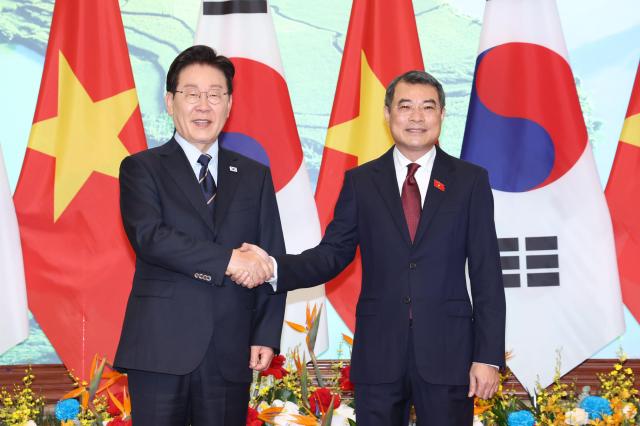
SEOUL, April 23 (AJP) - South Korean President Lee Jae Myung committed to deepening strategic cooperation in nuclear energy, transportation, and finance during a meeting with Vietnamese Prime Minister Le Minh Hung in Hanoi on Thursday. Lee framed the partnership as a catalyst for a new "Red River Miracle," drawing direct parallels between South Korea's rapid post-war industrialization and the current development trajectory of Viet Nam.
The diplomatic push comes as Seoul seeks to export its foundational economic model to one of the world's fastest-growing economies, positioning South Korean infrastructure and technology as the primary drivers for Viet Nam to become a high-income nation by 2045. For the Lee administration, securing these high-stakes projects is essential for maintaining South Korea's regional influence and finding new growth engines for its own domestic industry.
During the meeting at the Prime Minister's Office, the president said the South Korean government will strengthen strategic cooperation with Viet Nam in nuclear power, transport infrastructure, and energy to create a new "Red River Miracle" together. He detailed how South Korea previously invested intensively in three core infrastructures: energy independence through nuclear power, logistics innovation through highways and railroads, and transparent payment systems. Lee noted that "the combination of these physical and institutional foundations was the decisive engine" that allowed his country to achieve an economic leap in a short period of time.
The president further emphasized that stable energy and logistics flows sustain industry, while efficient financial infrastructure accelerates capital movement. He suggested that Hung, a former central bank governor, is uniquely positioned to lead this economic transition. "The success of Viet Nam, the driver of regional economic growth, is the success of us all," Lee said, according to officials present at the meeting.
Hung responded by expressing confidence that the state visit would provide "new momentum" for the development of bilateral relations. He noted that Viet Nam is currently focused on strategic tasks to become a modernized, high-income developing nation by 2030 and a high-income advanced nation by 2045. The Vietnamese leader requested South Korea's continued support and technical cooperation to meet these milestones.
In a move to further solidify executive ties, Hung extended an official invitation for South Korean Prime Minister Kim Min-seok to visit Viet Nam. Lee accepted the invitation on behalf of the prime minister, stating he would relay the message immediately upon his return to Seoul to ensure the visit takes place at the earliest possible date. The two leaders concluded their discussion with a commitment to maintaining open channels for ministerial-level coordination on upcoming infrastructure projects.
Copyright ⓒ Aju Press All rights reserved.