
Journalist

Lee Hugh
=
-
 Survey: 34% of South Korean travelers say food is a main reason to travel; searches rise for spring destinations Food is increasingly a primary reason for travel, and South Korea ranked third in a survey of Asian travelers on “food trips.” Demand is also rising at home this spring for travel tied to seasonal ingredients. Agoda, a digital travel platform, said Tuesday that its “2026 Travel Outlook Report” survey across eight Asian markets found Taiwan had the highest share of respondents citing food as a main travel purpose, at 47%. Vietnam followed at 35% and South Korea at 34%. Malaysia was at 33%, Japan 32%, Indonesia 31%, Thailand 20% and India 8%. South Korea’s figure was above the Asia average of 31%. Korean travelers are also seeking regional seasonal specialties. Agoda said its analysis of domestic lodging searches from January through March showed year-on-year increases across major spring ingredient-producing areas. Changwon, which accounts for about 70% of Korea’s production of sea squirt, saw lodging searches rise 34%. Seocheon, known for webfoot octopus, and Gwangyang, known for corbicula clams, rose 30% and 28%, respectively. Jindo, a spring blue crab producing area, increased 23%, and searches by domestic travelers surged 357% amid anticipation for the Jindo Blue Crab Festival, scheduled for May 1-3. Nonsan, the country’s largest strawberry-producing area, posted an 18% increase. The Nonsan Strawberry Festival, held March 26-29, drew about 670,000 visitors and sold a total of 150 tons of strawberries. “Among travelers recently, the trend of wanting to experience local food culture is becoming clear,” said Lee Jun-hwan, Agoda’s Northeast Asia head. “South Korea offers distinctive seasonal foods by region, from Changwon’s sea squirt to Nonsan’s strawberry desserts.” He said Agoda will continue supporting travelers with competitively priced flights, lodging and activities so they can experience local cuisine in each area.* This article has been translated by AI. 2026-04-21 14:34:07
 -
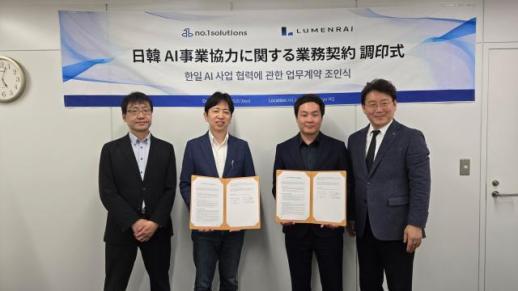 Lumenrai Targets South Korea’s On-Premises Local LLM Market South Korean on-premises AI company Lumenrai, led by CEO Ahn Tae-min, is moving to target the country’s local large language model market. Lumenrai supplies on-premises AI platforms tailored to Korean corporate environments. The company said it has proprietary technology to fine-tune and deploy retrieval-augmented generation (RAG) systems using vetted open-source LLMs, including Meta Llama, OpenAI GPT-OSS, Microsoft Phi, Qwen, Mistral, DeepSeek and EXAONE. The company’s core capability, it said, is selecting and tuning the best model for a customer’s industry, data and security requirements, then deploying it in a fully offline environment. Lumenrai said it has co-developed a local LLM deployment platform with Japan’s Number One Solution since 2024 and, through that partnership, confirmed the product’s prospects in Japan. Lumenrai plans to formally launch a Korea-optimized on-premises AI platform in the first half of 2026. Its flagship product will be a Korean version of “Microcosm,” an on-premises AI platform built on a 100% air-gapped architecture. The platform runs fully offline so corporate data is not sent to external servers, the company said. Lumenrai said the system meets requirements tied to the AI Basic Act set to take effect in January 2026, the National Network Security Framework (N2SF) differentiated security at Level 3, a medical law ban on sending patient data outside, financial network separation and defense-industry security standards. “The open-source LLM ecosystem is already mature,” Ahn said. “What the market needs now is the technology to precisely tune top-tier global open-source models for each customer and operate them reliably. We have focused on building that capability over the past two years, and we are launching it through Lumenrai, newly established in Korea.” Ahn said Lumenrai aims to take responsibility for the full process, from choosing open-source models to automating operations, and to supply local LLMs that can be used immediately in the workplace at competitive prices with stable systems. As more companies weigh adopting generative AI, on-premises deployments are emerging as a key strategy, particularly in industries where data security and regulatory compliance are critical. In those sectors, the trend of running open LLMs on in-house servers is accelerating. * This article has been translated by AI. 2026-04-21 14:33:18
 -
 Korea Fair Trade Commission Probes Olive Young, Daiso Over Supplier Dealings South Korea’s Fair Trade Commission has sent investigators to the headquarters of CJ Olive Young and Asung Daiso, which operates Daiso, to secure transaction records with suppliers. The on-site inspection is aimed at determining whether the companies violated the law governing large retailers. While the probe appears to be separate checks on two firms, it also reflects a broader effort to set clearer rules for fast-growing retail powerhouses. Familiar consumer brands should not be exempt from scrutiny. Olive Young and Daiso have moved beyond being simple storefronts. Olive Young has become a leading distribution channel for the K-beauty industry, and Daiso has emerged as a key sales network in the household goods market. For small manufacturers and suppliers, whether their products are carried can directly affect sales and growth. In an environment where placement on a retailer’s shelves can influence production, hiring and follow-on investment, fair dealing becomes more important as retailers’ influence expands. According to an FTC fact-finding survey, Olive Young’s effective commission rate was 23.52% for its online business and 27.0% for its offline specialty stores. At Daiso, the average payment period for direct-purchase transactions was 59.1 days, close to the legal limit of 60 days. These figures alone do not establish illegality, given factors such as industry practices, contract structures and inventory turnover. But if suppliers have little practical ability to refuse terms, the impact changes: higher commissions can squeeze small firms’ margins, and slower settlements can strain companies with weak cash flow. For companies with significant market power, meeting only the minimum legal standard does not end their responsibility. Fair trade depends not just on formal legality but on whether bargaining power is balanced in practice. A signed contract does not necessarily mean negotiations were equal. If one side accepts terms without real alternatives, the market is already tilted. If such conditions persist, the broader industry can lose momentum. Small manufacturers may devote more resources to meeting listing costs and conditions than to product innovation. When money that should go to research, development and quality improvements is diverted to commissions and promotional burdens, competitiveness can erode. Consumers may benefit from low prices in the short term, but over time could face less product variety and higher prices. The FTC’s investigation should be calm and precise. It should avoid both showy punishment because the companies are well-known and leniency because they are popular brands. Authorities should closely examine the facts — including contract terms, return responsibilities, how promotional costs are shared, settlement timing and other demands on suppliers — and decide based on law and principle. What the market needs is not emotional retribution but predictable rules. Companies, too, need to adjust their approach. As they grow, their responsibilities grow with them. Without building supply chains that grow alongside suppliers, today’s success may not last. Consumers’ choices are not determined by price alone; trust that a company trades fairly can strengthen brand value. Olive Young and Daiso are widely seen as success stories that reshaped Korea’s retail market. The remaining question is not how much bigger they become, but how fairly they grow. A retail leader’s real strength lies not only in sales, but in building trading practices that all market participants can accept.* This article has been translated by AI. 2026-04-21 14:32:06
 -
 Hyundai CEO Munoz Signals Push to Expand U.S. Production to Counter Tariffs Hyundai Motor CEO Jose Munoz suggested the automaker could expand production in the United States to respond to tariffs. According to Bloomberg News, Munoz told reporters on April 20 in Milan that tariffs are weighing on the company and that the short-term outlook is “really difficult.” Munoz said producing more vehicles in the United States could help the company avoid added costs. Hyundai makes about half of the vehicles it sells in the U.S. locally, while the rest are imported and subject to a 15% tariff, he said. “We need to make efforts to minimize costs,” Munoz said, adding that one of the easiest and most direct ways is to speed up localization. He said Hyundai will aggressively cut costs and adjust prices to offset the immediate financial impact. Munoz also said the Iran war is causing significant disruption in the Middle East, Hyundai’s most profitable market, affecting both demand and logistics. 2026-04-21 14:31:15
 -
 Choi Won-yong Wins Democratic Nomination for Pyeongtaek Mayor, Eyes June 3 Race The local political scene is closely watching whether Choi Won-yong can win his first bid for Pyeongtaek mayor, with attention rising after he secured the Democratic Party of Korea nomination for the June 3 local elections by winning a runoff on April 20. The campaign is also moving to form a “one team” with participation from candidates he faced in the primary. Choi formally declared his run for Pyeongtaek’s ninth popularly elected mayor on Feb. 24 at the National Assembly’s press briefing room. He advanced through the primary and clinched the nomination after an all-out final push. (Aju Economy report dated April 20, 2026) With the People Power Party’s candidate not yet decided, observers cautioned against early predictions, but many said Choi has at least laid groundwork for a competitive race. Choi, born in 1967, is from Poseung in Pyeongtaek and is known to have deep local ties. He earned a degree in public administration from Chung-Ang University and a master’s degree from Seoul National University’s Graduate School of Public Administration, then began his government career after passing the first local senior civil service exam in Gyeonggi Province. He later served as a council secretariat chief, head of the provincial planning and coordination office, and in 2022 as Pyeongtaek’s deputy mayor. He has been described as a pragmatic, field-oriented official with strong planning and execution skills. The article cites his work during the COVID-19 pandemic, when he oversaw disaster relief income tasks and helped design a system to deliver payments in 15 days, easing concerns that distribution by the promised date would be impossible. An anecdote about then-Gyeonggi Gov. Lee Jae-myung — described in the article as President Lee Jae-myung — praising him as a “great civil servant” is still widely repeated. Choi later was promoted to head the Gyeonggi Free Economic Zone Authority and ended a 30-year public service career. During the 21st presidential election, he joined the Democratic Party and became vice chair of Lee’s local decentralization innovation committee and co-chair of campaign committees for Pyeongtaek’s Eul and Byeong districts, working to support Lee’s election. Though some speculation circulated that he could join the Cabinet, he instead entered the Pyeongtaek mayoral race. In his February announcement, Choi said, “For more than 30 years, I have directly taken responsibility for planning, budgeting and policy implementation at the center of administration in Gyeonggi Province and Pyeongtaek.” He added that as head of Gyeonggi’s “Pyeongtaek Development Support Group,” he handled practical work to lay the groundwork for the Godeok International New Town and Samsung Electronics’ Pyeongtaek campus, and emphasized that as Pyeongtaek deputy mayor he practiced on-the-ground administration while communicating with residents. He presented three visions: an economy centered on K-semiconductors, an AI future city, and transportation built around a “Pyeongtaek 30-minute living zone” linking the city, along with an education system “completed within Pyeongtaek.” His campaign has continued releasing detailed pledges, saying its core philosophy is that change begins by solving small inconveniences in residents’ daily lives. Choi is also described as someone who steadily honed his administrative skills over more than three decades in public service. Voters are watching whether he can translate that experience into what he calls a Pyeongtaek renaissance in the ninth popularly elected administration.* This article has been translated by AI. 2026-04-21 14:27:05
 -
 South Korea Defense Ministry Denies U.S. Forces Commander Protested Minister Over Jung Dong-young Remarks South Korea’s Defense Ministry on Monday denied a claim that the commander of U.S. Forces Korea protested to Defense Minister Ahn Gyu-back over a controversy involving Unification Minister Jung Dong-young’s remarks about a North Korean nuclear facility. In a statement issued Monday afternoon, the ministry said it was “not appropriate in terms of South Korea-U.S. military diplomacy” and “not true at all” that the U.S. commander lodged a protest with the defense minister. The ministry added that South Korea and the United States communicate frequently on major issues and strictly comply with their military information protection agreement. Sung Il-jong, a lawmaker from the ruling People Power Party and chair of the National Assembly Defense Committee, said at a news conference Monday morning that, based on information he had obtained as committee chair, the U.S. Forces Korea commander “urgently” visited Ahn to strongly protest Jung’s mention of Guseong as the location of a third North Korean nuclear facility. Sung also claimed that the U.S. Embassy’s intelligence chief strongly protested the matter to South Korea’s National Intelligence Service. Jung said Sunday, “I explained the policy to describe the seriousness of the North Korean nuclear issue, and it is deeply regrettable to frame this as an information leak.”* This article has been translated by AI. 2026-04-21 14:26:18
 -
 Actor Lee Hoon Says Projects Have Collapsed for Three Years, Will Cut Fee to Audition Actor Lee Hoon said several of his recent projects have repeatedly fallen through. Lee appeared on the KBS Joy variety show "Ask Anything" on the 20th. He said projects he prepared from 2024 to 2025, as well as one he was preparing this year, were postponed indefinitely because of budget problems. "If acting really doesn’t work out, I could boldly give it up," Lee said. "The problem is that offers do come in. But when production gets canceled or delayed, it feels like false hope." Lee also said he recently traveled to Germany as part of an effort to break into Hollywood. He said he auditioned in 2022 and appeared in a project about representative killers from different countries gathering to assassinate the main character, with Lee playing the killer representing South Korea. He said some people misunderstand his situation as "complaining because of my looks," but added, "I’m about to starve," and said he is ready to audition even if it means taking a pay cut. Seo Jang-hoon advised Lee, saying Lee has strong pride and stubbornness, and that he should now set that aside, rebuild his image as an "actor who tells life stories" and promote himself more actively. Lee debuted in the 1994 SBS series "Cheongnyeon Naegak" and rose to popularity through "Seoului Dal."* This article has been translated by AI. 2026-04-21 14:25:29
 -
 Utransfer US Cuts U.S.-to-Korea Remittance Processing Time to Under 6 Hours Global financial IT company Adenasoft said its subsidiary UFintechHub has sped up remittances from the United States to South Korea on its foreign-exchange fintech platform, Utransfer US. The company said system upgrades cut average processing time to within six hours from about 12 hours. A key change was full automation so transfers can be processed automatically at night, on weekends and on holidays in Korea, rather than being constrained by bank business hours. The company also said it improved real-time tracking of each step, allowing users to check progress from submission through completion and more easily identify delays. Industry observers view the move as part of intensifying competition in cross-border remittances, as global fintech firms expand real-time or near-real-time services and emphasize faster processing and higher levels of automation. Adenasoft CEO Jeong Seung-woo said the company focused on speed and ease of use, adding that it is developing a second-phase system aimed at paying out within 10 minutes of an application by June. The company said some transactions may still take about one additional business day if extra checks are required under anti-money laundering rules. Those cases include transfers above certain amounts or meeting specific conditions, reflecting compliance procedures required for international remittances. UFintechHub operates segmented services including Utransfer for individuals, Utransfer Biz for companies and Utransfer US for U.S.-to-Korea remittances. The company said usage has been rising as demand grows for simpler transfers among overseas Koreans and international students, as well as foreign residents in Korea. The company said it plans further upgrades across the system, including stronger stability and improved detection of suspicious transactions.* This article has been translated by AI. 2026-04-21 14:25:02
 -
 Adobe, Nvidia CEOs say AI race is shifting from generative tools to execution Adobe is shifting its artificial intelligence push from generating content to executing real business tasks, unveiling an enterprise system designed to bring together brand assets, customer data and marketing channels. Adobe CEO Shantanu Narayen and Nvidia CEO Jensen Huang said in an Adobe Summit keynote that the next battleground in AI will be execution and control, not just creation. At the opening-day keynote of Adobe Summit in Las Vegas on April 20 (local time), Adobe introduced “Adobe CX Enterprise.” The system is designed to let companies manage personalization and execution by linking customer data, brand assets and multiple customer touchpoints. Adobe also said more than 20,000 brands worldwide run their businesses on its platform. The company’s pitch is that AI is moving from providing “answers” to taking “actions.” Adobe’s “CX Enterprise Coworker” is built to coordinate AI functions and tools around goals set by a company, create plans, support execution after approval, and monitor results. Adobe said the process operates under human oversight and control. Narayen said corporate competitiveness will depend less on how quickly a company adopts general-purpose large language models than on how precisely it reflects its own data, content and brand standards in AI. Adobe said it is offering features that apply brand guidelines while also helping tailor experiences based on customer responses, signaling a shift beyond creative tools toward broader brand operations and customer experience management. Huang said generative AI is the stage where systems produce sentences and images, while agent-based AI is the stage where systems receive goals and carry out actual work. He said enterprise software interfaces and usage will increasingly shift toward AI agents, aligning with Adobe’s execution-focused strategy. Adobe also outlined its partnership with Nvidia, saying it plans to connect its system to Nvidia’s AI development tools, runtime environment and open models. Nvidia said it is building an agent-based marketing foundation through cooperation with Adobe and advertising company WPP. 2026-04-21 14:22:07
 -
 HYBE Shares Turn Lower After Report of Arrest Warrant Request for Bang Si-hyuk HYBE shares turned lower during trading after news that police requested an arrest warrant for Chairman Bang Si-hyuk, weighing on investor sentiment and erasing most early gains. As of 2:10 p.m., HYBE was down 2.16% from the previous session at 249,500 won, according to the Korea Exchange. The stock opened up 1.18% at 258,000 won from the prior close and rose early before reversing into negative territory. Earlier in the day, the Seoul Metropolitan Police Agency’s Financial Crime Investigation Division said it had requested an arrest warrant for Bang on allegations of fraudulent unfair trading. The request came about five months after Bang was first questioned in mid-November last year. Police allege Bang misled HYBE investors in 2019 by saying there were no plans for an initial public offering, prompting them to sell stakes to a specific private equity fund, and then proceeded with a listing. Police also said they believe Bang received about 30% of post-IPO sale profits under a nonpublic contract with the private equity side, generating gains of about 200 billion won. Under South Korea’s Capital Markets Act, it is illegal to obtain financial gains through false statements or improper schemes involving financial investment products, including unlisted shares. If the violation results in profits of 5 billion won or more, the penalty is life imprisonment or at least five years in prison. 2026-04-21 14:21:24