
Journalist

Lee Hugh
=
-
 New Books: An American Zen Monk’s Korea Journey and Lee Seok-yeon on Constitutional Principles An American Zen Monk’s Journey in Korea=Written by Hyeonan, Mo Gwa Namu. For readers who turn to spicy food or stimulating content to cope with stress, this new book offers a different approach. The author, who once enjoyed salsa dancing and driving sports cars, says he changed course after immersing himself in what he calls “American Zen meditation,” becoming a “Korean American monk.” For him, the sports car has been replaced by the lotus position. Following his teacher’s wishes, he moved to South Korea and opened his first meditation center in a building marked by a large sign advertising “unlimited meat refills.” The space later became a youth magnet — a kind of “meditation hot spot.” Guided by teachings from his mentor, Ven. Yeonghwa — “Don’t try to teach before you ask,” “There are no stupid questions,” and “In a temple, you must see the person” — the author shares meals and conversations with young people and draws them into meditation in an unforced way. The book lays out brief, clear steps for beginners: practicing attention on the lower abdomen (around the navel), sitting every day, adding two minutes a day, and meditating without expectations. He writes that simply gathering attention around the navel can lead to calm. The author says Zen meditation builds not only the ability to stop thinking when needed, but also the capacity to observe thoughts in daily life without being swept away. As the mind clears, he argues, judgment becomes sharper. “Meditation is not knowledge but a process learned through the body,” he writes, adding, “Buddhism is not philosophy; it is a performing art.” He also presents examples of ordinary office workers to suggest readers can find the courage to face themselves through practice. “When you start meditating, thoughts keep coming up. That is natural. You should set a time, sit every day, and gradually increase the time. Having many thoughts during meditation never means you are not suited for meditation. Rather, that process is a very important stage of practice. If you repeatedly experience not being pulled by thoughts and returning again, thoughts gradually decrease. All practice bears fruit only with time and consistency. Keeping your mind on the lower abdomen is not as easy as it sounds. That is why chanting during seated meditation can help. If your religion is Buddhism, repeating names such as ‘Amitabha, Amitabha’ or ‘Bhaisajyaguru, Bhaisajyaguru,’ or using mantra practices such as the Surangama Mantra or the Great Compassion Mantra, can also be helpful.” (pp. 87-88) Conviction=Written by Lee Seok-yeon, Saebit Publishing. In a book that revisits major turning points in South Korea’s modern political history, Lee Seok-yeon — now chair of the National Integration Committee — urges a steady approach even amid fierce ideological conflict. He describes himself as a “constitutional liberal” and argues that attitude should matter more than rhetoric, principles more than faction, and the Constitution more than power. Citing major cases such as rulings striking down the military bonus-points system and the Special Act on the New Administrative Capital, Lee says his standard has been simple: “The only yardstick for judgment is the Constitution.” That stance, he writes, drew criticism from both sides — branded a hard-line conservative by progressives and a disguised conservative by conservatives. The book includes his diagnosis of the 2024 Dec. 3 martial law crisis and the impeachment standoff that followed, structural problems in the presidential system, and the need for constitutional revision. Lee points to an “imperial presidency,” factional logic and distortions of the rule of law as reasons Korean politics repeatedly fails. He argues that civic awareness and the force of the Constitution sustain the state, and asks why “constitutional thinking” is needed again. He also calls for a society that can hold differing views and circumstances, like the sea holding both calm and rough waves — insisting that both heated debate and quiet daily life are part of democracy. “Waves never stop rolling into the sea, but the sea does not reject them; it embraces them all. Some waves are gentle, and some are rough. At times a typhoon throws up enormous swells, but the sea ultimately takes them in and expands itself. I believe our society’s conflict and division are the same. Different thoughts, emotions and values keep surging like waves, but only when we can hold them rather than push them away does integration begin. Living as a public official, lawyer and civic activist, I have seen countless waves, and at times I was swept up in them. But as I stand in a new position this time, I feel an urgent need to hold different voices, as the sea holds waves.” (p. 252)" * This article has been translated by AI. 2026-04-01 16:24:24
 -
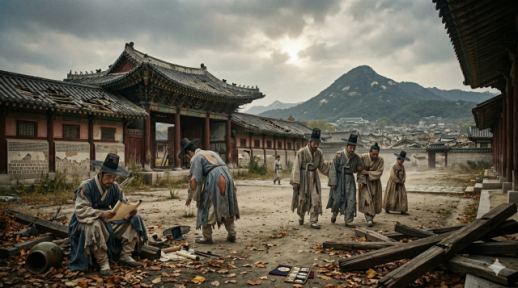 Data science reveals how a 500-year Joseon Dynasty was brought to knees by own elites SEOUL, April 01 (AJP) - After surviving five centuries of invasions and internal coups, the Joseon Dynasty’s ultimate undoing was a systemic collapse of fairness that data scientists have now mapped for the first time. By analyzing 14,600 officials across the "Lee" regime's 500-year history, a joint research team from the Korea Advanced Institute of Science and Technology (KAIST) and Hong Kong universities has pinpointed exactly how power hoarding by a few elite families broke the state's back. The study, led by Professor Park Ju-yong of the KAIST Graduate School of Culture Technology, used complex systems science to track the Total Success Index (TSI). This metric measured an official’s achievement by combining their rank with their length of service. The data shows that for 400 years, the dynasty remained remarkably resilient because its civil service system maintained a level of merit-based social mobility. Even the bloody 1453 Gyeyu Jeongnan coup—which saw Grand Prince Su-yang seize the throne from his nephew, King Dan-jong—appears in the data as a localized shock rather than a systemic failure. The researchers' network analysis shows power shifting between royal factions, such as those surrounding Prince An-pyeong, but the broader bureaucratic machinery remained functional. The secret to the dynasty's final collapse was found in the data from the 19th century. The maps show a sudden, sharp stratification where a handful of clans, such as the Andong Kim and Pungyang Cho, effectively hijacked the state. By monopolizing the civil service exams and high-ranking offices through influence rather than talent, these families destroyed the meritocracy that had sustained the Lee family's rule for half a millennium. "The data proves that the fall of Joseon wasn't just a series of unfortunate events, but a structural death spiral," said Professor Park Ju-yong. "When the mechanism for fair recruitment broke, the foundation of the entire nation gave way." The research team, which included first author Dr. Choi Dong-hyuk, plans to use these digital humanities tools to compare South Korea's historical bureaucracy with other global empires to see if similar patterns of elite capture predicted their downfall as well. (Reference Information) Journal/Source: Physica A: Statistical Mechanics and Its Applications Title: Total Success Index and the Longitudinal Dynamics of Bureaucratic Stratification in Joseon Korea Link/DOI: https://doi.org/10.1016/j.physa.2026.131353 2026-04-01 16:22:44
 -
 The mix of populist element in Korea's "war" budget raises eyebrows SEOUL, April 01 (AJP) - President Lee Jae Myung is set to pitch for a 26.2 trillion won ($17.4 billion) "war" extra budget Thursday before the ruling-dominant National Assembly as a "preemptive" defense against fallouts on the energy-dependent economy as the conflicts in the Middle East enters a second month. Determined to fend off bigger damage, Lee indicated during a cabinet meeting on Tuesday approving a supplementary budget — just the third month into the year — that he could bypass legislative approval, if necessary, by invoking rarely used emergency executive fiscal powers to press ahead with proactive budgeting. The emergency fiscal authority, stipulated under Article 76 of the Constitution, allows the president to issue measures with the force of law in times of severe economic or national crisis when legislative delays are untenable. It has been used only once in modern history — in 1993, when then-president Kim Young-sam enforced the financial real-name system. According to the National Assembly Budget Office (NABO), total expenditure in the 2026 budget stands at 727.9 trillion won. If the supplementary budget bill is passed, this year’s total government spending is expected to rise to 754.1 trillion won. The government maintains it can keep the managed fiscal deficit at 3.8 percent of GDP, as the extra budget could be financed through excess tax revenue from strong chip sales in the first quarter rather than additional debt issuance. The urgency reflects the scale of the shock. Oil prices have surged amid tensions around the Strait of Hormuz — a chokepoint for roughly one-fifth of global oil and LNG trade — exposing South Korea’s deep reliance on imported energy. The economic toll is already feeding through. The OECD has cut Korea’s growth outlook to 1.7 percent, while oil at around $100 per barrel could shave about 0.5 percentage point off annual growth, economists estimate. With the risk of the economy falling into a technical recession after contracting in the fourth quarter, international economists broadly see proactive fiscal policy as the right direction. “This is not just an energy problem; it is an inflation, exchange-rate, and confidence problem at the same time,” said Sumit Agarwal, a professor of finance and economics at the National University of Singapore (NUS). While fiscal intervention is justified, he advised it be “temporary, targeted, and explicitly linked to the shock.” Donghai Zhang, an economist at NUS, described the oil shock as effectively a “negative income shock” for an importing country like South Korea. “Temporary and targeted support can help cushion this,” he said, noting that lower- and middle-income households are more likely to spend additional income quickly, stabilizing demand in the short term. But Zhang also warned of a more insidious risk: inflation expectations. “Higher energy costs raise firms’ production costs and can spread beyond fuel and transportation. If expectations become unanchored, inflation becomes more persistent and more costly to reverse.” Under the “war” label, the budget package is explicitly designed to counter the energy shock. Of the total package, 10.1 trillion won is allocated to offset high oil prices, including compensation for refiners under a fuel price cap system and expanded public transport subsidies. Another 5 trillion won has been earmarked to cap fuel costs and ease transport expenses, including support for a temporary oil price ceiling and expanded public transport rebates. Additional measures target energy-vulnerable households and fuel-intensive sectors such as agriculture and fisheries. More controversial is the 4.8 trillion won set aside for direct cash transfers to roughly 35.8 million people — about 70 percent of the population — ranging from 100,000 to 600,000 won per person. The populist element ahead of the June 4 local elections has ignited heated debate even before reaching parliament. Rep. Kim Sang-wook, a lawmaker from the ruling Democratic Party of Korea and its candidate for mayor of Ulsan, framed the package as an urgent social safety measure. “High oil prices inevitably lead to high inflation, and that hits ordinary people hardest,” he said. “This is a ‘social disaster.’ The most vulnerable — low-income households and small businesses — must be protected, and speed is critical.” The opposition, however, sees something more cynical. Rep. Park Soo-young, the People Power Party’s ranking member on the National Assembly’s Strategy and Finance Committee, criticized the cash transfers as both inefficient and politically motivated. “If you subsidize fuel for 70 percent of the population, other prices — rice, meat, vegetables — will rise,” he argued. “Why not simply cut fuel taxes? Instead, this looks like vote-buying ahead of local elections.” The fiscal easing could also complicate monetary policy, as the inflationary effects of high oil prices are expected to seep through the economy in the coming months. David E. Cook of Hong Kong University of Science and Technology warned that broad price controls can backfire. “Capping consumer energy prices prevents efficient adjustment and makes the transition more costly overall,” he said. Massimo Filippini, professor of public and energy economics at ETH Zurich, urged a more forward-looking approach. “High energy prices, while painful, encourage households and firms to reduce consumption, improve efficiency, and adjust behavior,” he said, adding that such dynamics can ultimately support investment in cleaner and more efficient technologies. Korea’s vulnerability underscores its structural dependence on imported fossil fuels and reinforces the need to view the energy transition not only as a climate objective, but also as a strategy for economic resilience and security. “Overall, the most economically sound approach is a balanced mix: targeted support for households, conditional aid for firms, and policies that preserve incentives to reduce energy use,” he said. He added that the current crisis could serve as a turning point in how the energy transition is framed — less as an environmental imperative alone, and more as an issue of security, independence and quality of life. Agarwal suggested policymakers think in three layers: stabilize the short run, protect financial and external systems, and use the crisis to accelerate structural change. “The right policy is to protect households from an oil shock without pretending that the state can permanently shield the economy from global prices,” he said. Temporary measures — cash transfers, transport subsidies and targeted industry support — are relatively easy to enact. Rolling them back once the crisis subsides, however, will be far more difficult, he warned. 2026-04-01 16:18:22
 -
 Grand homecoming for award-winning K-pop Demon Hunters team SEOUL, April 01 (AJP) - Singer-songwriter EJAE still lives in the surreal “Golden” moment of the Oscars night she stole by winning Best Original Song for the Netflix animation K-pop Demon Hunters and performing the famously high-pitched “up, up, up” at the 98th Academy Awards. “I used to be teased in the United States, but standing on the Oscars stage and seeing the audience wave light sticks, I felt a deep sense of pride,” she said, her voice breaking as she received a warm welcome back home. EJAE joined fellow Oscar winners at a joint press conference at CGV Yongsan I’Park Mall in Seoul, alongside key figures behind the film, including co-directors Maggie Kang and Chris Appelhans, and producers from The Black Label’s IDO — Lee You-han, Kwak Jung-gyu and Nam Hee-dong. The event marked the film’s recent triumph at the 98th Academy Awards, where it secured both Best Animated Feature and Best Original Song — a rare double win that underscores the growing global influence of Korean content. Singer also recalled the emotional buildup to her performance, saying she became overwhelmed during rehearsals. “I cried a lot during rehearsal,” she said, adding that incorporating traditional Korean elements such as pansori and gugak made the performance especially meaningful. That emotional intensity carried onto the stage, where the performance drew strong reactions — including Hollywood actors seen waving light sticks, a signature element of K-pop fandom. Co-director Appelhans said Korean cultural identity would remain central to the sequel. “The Koreanness is the soul of the film,” he said, adding that the next installment will continue to draw on Korean cultural elements while expanding the story beyond the first film. The event highlighted a broader shift, as distinctly Korean cultural elements are increasingly being translated into content with global appeal rather than remaining confined to local narratives. Participants also pointed to the role of audiences in the film’s success, noting that global fans were instrumental in discovering and amplifying the film. While specific details of the sequel were not disclosed, Kang said the team aims to deliver a larger-scale project building on the success of the original. Released in June 2025, K-pop Demon Hunters follows a fictional K-pop girl group battling supernatural forces, blending music, fantasy and Korean mythology. The film has since garnered major international accolades, including the Golden Globes and the Grammys, culminating in its Oscar wins last month. 2026-04-01 16:15:52
 -
 South Korea’s Big Five Banks See Household Loans Fall in March on Tighter Rules, High Rates Major commercial banks’ household loan balances fell last month for the first time in two months, as stricter lending rules and high interest rates drove a sharp decline in mortgage lending. According to the financial sector on Tuesday, the combined household loan balance at the five largest banks — KB Kookmin, Shinhan, Hana, Woori and NH NongHyup — stood at 765.729 trillion won at the end of last month, down 136.4 billion won from a month earlier. After falling in December and January, the total edged up in February but slipped again. Mortgage loan balances fell to 610.3339 trillion won, down 387.2 billion won from the end of February. Mortgages turned lower in January for the first time in 1 year and 10 months, rebounded in February, but failed to sustain the rise. Unsecured credit loans, however, returned to growth. Personal credit loan balances totaled 104.6595 trillion won at the end of last month, up 347.5 billion won from the previous month, reversing a decline that had continued since December. Time deposits fell 9.4332 trillion won in a month to 937.4565 trillion won, and installment savings deposits slipped by 251.2 billion won. Demand deposits rose 15.0477 trillion won to 699.9081 trillion won. The downtrend in household lending is expected to persist for the time being. Financial authorities on Tuesday announced a “household loan management plan,” lowering this year’s target growth rate for household lending to 1.5% and introducing a total-volume cap that separately manages mortgage lending.* This article has been translated by AI. 2026-04-01 16:09:00
 -
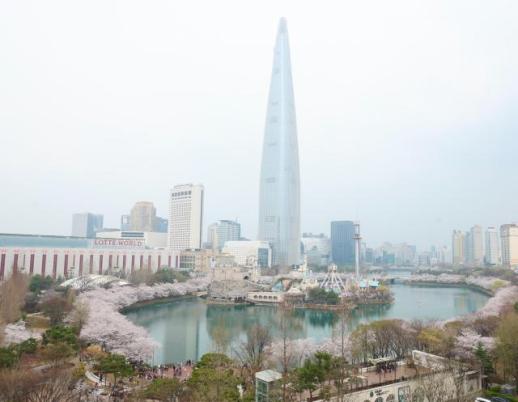 Seoul turns pink earlier than usual SEOUL, April 01 (AJP) -Full bloom suddenly arrived after heavy rain earlier this week. Cherry blossoms burst into full bloom around Seokchon Lake, soaking the lakeside in soft waves of pink and marking an early arrival of spring in the city. Petals clung to rain-darkened paths and shimmered on the lake’s surface, while the skyline — anchored by Lotte World Tower — stood framed by a fleeting canopy of blossoms. The city will formally welcome the season with the 2026 Lake Cherry Blossom Festival, set to run for nine days from April 3 through April 11. The '2026 Lake Cherry Blossom Festival' will be held around Seokchon Lake for nine days from April 3 through April 11. The festival has been extended by five days compared to last year. Landscape lighting has been installed along the entire 2.5km lakeside promenade, allowing visitors to enjoy the cherry blossom tunnel even at night. During the festival period, various exhibitions including installation art and media art will be presented. Programs for families, including Fashion Week, bubble shows, circus performances, and magic shows, will also take place. 2026-04-01 16:04:16
 -
 Toss CEO floats April Fools’ pledge to sell his home to cover rent for 100 staff Lee Seung-geon, CEO of Viva Republica, operator of the finance app Toss, said he plans to sell the home he lives in under his own name and use the profit to cover the full rent and loan interest for 100 Toss employees for life. With Lee known for making bold April Fools’ Day pledges in the past, attention is focused on whether he will follow through this time. According to the industry on Tuesday, Lee wrote on an internal messenger that he would "sell the home I currently live in that I own in my personal name, and with the capital gain created through that, I want to support the full rent and interest for 100 Toss team members for life." Lee said he has long seen it as a serious problem that some people make large profits from real estate while others struggle to get by because of housing costs. He said employees who pay rent or loan interest can enter their personal information by 9 p.m. Tuesday, and winners will be selected by lottery. He added that starting this month, selected employees who submit a copy of their lease contract or loan agreement would receive full support for rent or loan interest until they own a home. Based on past cases, however, it is considered likely that the pledge may not be carried out as stated. Lee has made eye-catching April Fools’ Day promises to employees before, but some were later reduced in scale or changed in how they were implemented. In 2022, he said he would give Teslas to 20 employees, but it was changed to a plan to lend the cars to 10 employees for free for one year. Last year, he handed out hundreds of invitations for a trip to Okinawa, Japan, but support ultimately went to 100 people. A Toss official said Lee posts messages around this time each year, but it is not clear whether this is an April Fools’ Day event. The official added that, based on past examples, Lee has often used April Fools’ Day to express gratitude to colleagues.* This article has been translated by AI. 2026-04-01 16:03:00
 -
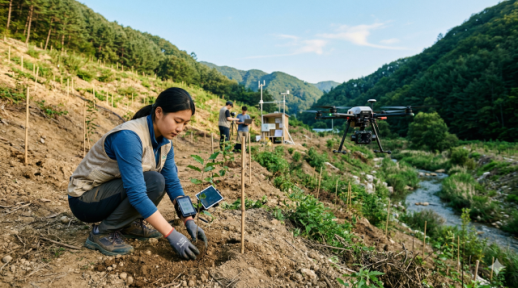 Kookmin University researchers to develop carbon absorption ecosystem restoration technology SEOUL, April 01 (AJP) - Researchers at Kookmin University have launched a new project to develop ecosystem restoration and management technologies designed to mitigate climate change and increase carbon sinks, the university said Monday. The new project is part of South Korea's government initiative designed to strengthen the country's natural environment restoration capability. The research team, led by Professor Im Chol-hee and Professor Lee Chang-bae from the Department of Forest Environmental Systems, was selected for a new initiative under the South Korean Ministry of Environment’s environmental technology development program. KMU will specifically focus on the carbon sink enhancement category of the project. Following recent amendments to the Natural Environment Conservation Act, South Korea has introduced new systems for the natural environment restoration industry. The government plans to invest in the development of restoration technologies over the next five years to help the industry expand and stabilize. KMU will receive approximately 3.5 billion won in funding over the five-year period. The research team aims to integrate artificial intelligence, drones, and advanced sensing technologies with soil and biotechnology. The project will move through several stages, from initial technical development to practical on-site demonstrations. The Korea Adaptation Center for Climate Change, various universities, registered restoration companies, and AI specialists will collaborate on the study to ensure the practical application of the new technologies. "It is highly significant that we are developing ecosystem restoration technology centered on carbon sinks, which is one of our university's primary strengths," said Professor Im Chol-hee. "We intend to take the lead in developing world-class technology by cooperating with both domestic industries and leading global institutions." The initiative aligns with the university's KMU VISION 2035: EDGE strategy, which focuses on environmental, social, and governance (ESG) values. Kookmin University is currently home to approximately 23,000 students across its undergraduate and graduate programs (Source: Kookmin University official website). 2026-04-01 15:57:12
 -
 SK Biopharmaceuticals Files FDA Application for Cenobamate Oral Suspension for Epilepsy SK Biopharmaceuticals said April 1 it has submitted a new drug application to the U.S. Food and Drug Administration for an oral suspension formulation of its epilepsy drug cenobamate. The filing seeks approval of an additional formulation following the existing tablet version, for adults with partial-onset seizures. The company said the liquid oral suspension is expected to improve convenience for patients who have difficulty swallowing tablets and allow more flexible dosing depending on a patient’s condition and treatment setting. SK Biopharmaceuticals said it has been expanding the drug’s use in clinical practice and is also conducting pediatric clinical development of cenobamate. Based on the adult NDA and pediatric trial results, the company said it plans to gradually expand the eligible age group to include pediatric and adolescent patients. At the 2025 annual meeting of the American Epilepsy Society, the company presented poster data from a pharmacokinetic study comparing the tablet and oral suspension formulations. The two formulations showed generally similar absorption and drug exposure, indicating pharmacokinetic equivalence. Lee Dong-hoon, CEO of SK Biopharmaceuticals, said the oral suspension reflects the treatment needs of patients who struggle to take tablets. He said the company will continue to broaden patient-centered treatment options and address unmet medical needs across different patient groups to expand its prescribing base. * This article has been translated by AI. 2026-04-01 15:15:00
 -
 Pearl Abyss' latest RPG sells 4 million copies worldwide in less than two weeks SEOUL, April 1 (AJP) - Pearl Abyss' latest role-playing video game "Crimson Desert" has sold a cumulative 4 million copies worldwide, the game developer said on Wednesday. Over 2 million copies of the fantasy adventure game were sold immediately upon its release on March 19, surpassing 3 million just a few days later and reaching 4 million in less than two weeks. The game's success reflects its widespread popularity, achieving an unprecedented milestone for a South Korean game in the global console market. As a testament to its global appeal, more than half of its reviews on Steam, the world’s largest PC gaming platform, were written in English. As of 2024, North America and Europe are estimated to account for 74 percent of the global console market, which is valued at approximately US$53.7 billion. Crimson Desert is a single-player, open-world action-adventure RPG set on the fictional continent of Pywel, following the epic journey of a mercenary leader and his companions. The game is available on PlayStation 5, Xbox Series consoles and other platforms. 2026-04-01 15:07:17