
Journalist

Kim Yoon-seop
angks678@ajunews.com
-
 South Korea to Ease Mutual Finance Rules, Offer Incentives for Inclusive Lending Interior view of the Financial Services Commission building in Jongno-gu, Seoul. South Korea’s financial authorities are moving to ease regulations on the mutual finance sector to expand inclusive lending, including incentives for cooperatives that increase loans to local communities and working-class borrowers. The Financial Services Commission said it held a kickoff meeting on April 29 for a task force on institutional improvements for mutual finance and discussed measures to strengthen inclusive finance. The meeting was aimed at helping mutual finance institutions reinforce their role as community- and working-class-focused lenders. The government is pursuing reforms after concluding that lending by mutual finance institutions has increasingly shifted away from their founding purpose and toward real estate and loans to nonmembers. According to the FSC, the share of loans by mutual finance cooperatives — including credit unions, agricultural cooperatives, fisheries cooperatives and forestry cooperatives — tied to real estate and construction rose to 23.7% in 2025 from 4.9% in 2015. Over the same period, the share of loans to nonmembers increased to 40.7% from 32.0%. To encourage more inclusive lending, the FSC said it will review incentives such as adjusting the weighting of loans to local residents and working-class borrowers when calculating regulatory ratios, including the nonmember-loan ratio and the loan-to-deposit ratio. It is also considering additional regulatory relief for cooperatives that actively provide inclusive finance. To promote social solidarity finance, the FSC said it will also review legal and institutional changes, including amending the Credit Union Act to allow credit unions to invest in other corporations. The commission said it plans to set up a structure in which central federations support “inclusive cooperatives,” including by offering preferential interest rates, to prevent risks from rising as inclusive lending expands alongside regulatory easing. It also said it will examine steps to strengthen credit assessment, including upgrading internal credit scoring systems, and to reflect inclusive finance performance in management evaluations. Starting with the kickoff meeting, the task force plans to draft a tentative plan in June and, after consultations with relevant agencies, announce a final package in July. Kim Jin-hong, director general of the FSC’s Financial Industry Bureau, said, “Along with soundness, inclusiveness is a key pillar that will drive the mutual finance sector’s restoration of trust,” and urged cooperatives to take an active role in expanding inclusive finance by leveraging their strength in member ties. * This article has been translated by AI. 2026-04-30 08:18:25
 -
 South Korea Variable-Rate Mortgages Near 40% as Borrowers Chase Lower Rates Variable-rate mortgages at South Korean banks climbed to nearly 40% last month, a shift that could leave more borrowers exposed as market rates rise. The jump is widely attributed to a widening gap between fixed and variable mortgage rates after market rates spiked in the short term amid tensions in the Middle East. With mortgage rates rising quickly, the growing share of variable-rate loans is also fueling concerns about a chain of financial stress among vulnerable borrowers and heavily leveraged households. According to the Bank of Korea on Tuesday, variable-rate loans accounted for 39.2% of deposit-taking banks’ mortgage balances as of the end of March, up 10.3 percentage points from 28.9% a month earlier. The share has risen sharply this year, from 13.4% at the end of last year to 24.4% at the end of January, then 28.9% in February, and higher again in March. Variable-rate loans reset periodically in line with market rates. Typically, when rates are rising, borrowers prefer fixed-rate loans because they lock in interest costs and make budgeting more predictable. Even so, borrowers have been gravitating toward variable rates because they are cheaper upfront. The view is that many are choosing to cut near-term interest costs even if they face higher payments later, as the rate gap is close to 1 percentage point. As of Tuesday, fixed-rate mortgages at the five major banks — KB Kookmin, Shinhan, Hana, Woori and NH Nonghyup — were quoted at 4.28% to 6.88% annually for products that reset every five years. Variable-rate mortgages that reset every six months were 3.65% to 6.05%. Fixed rates were higher by 0.83 percentage points at the top end and 0.63 points at the bottom end. The concern is that the shift toward variable-rate borrowing could translate into heavier repayment burdens. Because variable rates reflect market moves at set intervals, borrowers’ interest costs tend to rise in a tightening cycle. Mortgage rates have already been climbing. The Bank of Korea said the average rate on newly issued bank mortgages in March was 4.34% annually, up 0.02 percentage point from February, extending gains for a sixth straight month since October. The outlook remains uncertain, with Middle East tensions still unsettled and war-driven oil price spikes potentially feeding into inflation and higher interest rates. Korea Investment & Securities said in a report Monday that it expects the central bank to raise its policy rate twice in the second half of this year, in August and November. A financial industry official said variable-rate loans are structured to increase borrowers’ interest burdens if rates keep rising. If higher rates coincide with a weakening economy, the official said, repayment capacity could deteriorate among self-employed people and low-income, vulnerable borrowers, pushing delinquency rates sharply higher. 2026-04-29 15:18:47
 -
 IBK Industrial Bank of Korea to Cut Online Loan Rates for SME Workers by Up to 0.6 Points IBK Industrial Bank of Korea said Tuesday it has launched a new online loan interest-rate reduction program for employees working at small and midsize enterprises, ahead of Labor Day on May 1. Eligible borrowers are workers employed at SMEs as of the application date. The bank will offer a basic rate cut of up to 0.4 percentage points depending on length of employment. It will provide an additional 0.1 percentage point discount for workers at companies outside the Seoul area and another 0.1 percentage point for young workers age 34 or younger, for a maximum reduction of 0.6 percentage points. The discounts apply to the bank’s online loan products: i-ONE mortgage loans, i-ONE jeonse loans and i-ONE interest-subsidized credit loans for workers’ living stability. With the maximum discount, the bank said that as of Tuesday its mortgage loan rate would be about 3.36% a year and its jeonse loan rate about 3.09%. The program will run through Dec. 31. Details are available at branches and on the bank’s website. A bank official said the program is intended to provide practical financial support for SME workers and that the bank will continue to introduce preferential support measures to help ease SMEs’ labor shortages.* This article has been translated by AI. 2026-04-29 10:54:19
 -
 NH NongHyup Bank to Provide 500 Billion Won in Financial Support to OCI NH NongHyup Bank said it is moving to provide 500 billion won ($500 million) in financial support to OCI as part of efforts to foster future strategic industries. The bank said April 29 that it signed a financial cooperation agreement with OCI aimed at expanding “productive finance” and supporting future strategic industries. Under the agreement, NH NongHyup Bank plans to provide a total of 500 billion won in productive financing over the next three years. The bank said the support will go beyond simple funding to meet company needs, including technology development, facility investment and overseas exports. “We will do our best to serve as a reliable financial partner for OCI’s growth,” bank President Kang Tae-young said. “We will continue to contribute to national economic growth through productive financial support.” OCI is a chemical materials company that produces basic chemicals and advanced semiconductor materials, including polysilicon for semiconductors and hydrogen peroxide.* This article has been translated by AI. 2026-04-29 08:40:42
 -
 Korean Banks Face Rising Delinquencies as Government Pushes More Corporate Lending Banks are growing increasingly concerned about asset quality as government efforts to curb household lending and expand so-called productive finance push more credit toward companies. With the economy slowing, a rapid expansion of lending to weaker firms could become a threat to banks’ balance sheets, the industry says. According to the financial sector on the 28th, the average overall delinquency rate for the four major banks — KB Kookmin, Shinhan, Hana and Woori — rose to 0.36% in the first quarter, covering both household and corporate loans. That was up 0.06 percentage points from 0.30% at the end of last year. The delinquency rate refers to the share of loans with both principal and interest overdue by more than one month. Delinquencies at regional banks, which have a higher share of lending to local small and midsize businesses, have crossed the 1% level seen as a psychological threshold. As of the fourth quarter of last year, the average delinquency rate at four regional bank affiliates under BNK Financial Group and JB Financial Group was 1.07%, up 0.29 percentage points from 0.78% a year earlier. With regional downturns persisting, analysts said the upward trend could continue this year. The challenge, bankers say, is that delinquencies are rising just as policy-driven expansion of productive finance makes loan growth hard to avoid. As corporate lending increases quickly and delinquencies climb, banks face pressure to expand credit while also tightening risk management. Unlike collateral-heavy household loans, corporate loans are more exposed to spillover defaults when the economy weakens. The industry also points to growing numbers of higher-risk borrowers as downside pressure on the economy has increased since the Middle East war, signaling weaker capacity for companies to repay debt on time. In the Bank of Korea’s survey on financial institutions’ lending attitudes, the corporate credit risk index for the second quarter rose from the previous quarter to 25 for large companies and 36 for small and midsize firms. The index measures the risk of delinquency or default, with higher figures indicating greater risk. If rising credit risk leads to more troubled borrowers and keeps delinquencies climbing, banks’ asset-quality burden could intensify. Warning signs are already showing in key indicators. The four major banks’ average nonperforming loan coverage ratio fell to 153.8% in the first quarter from 172% at the end of last year, down 18.2 percentage points. The ratio compares loan-loss reserves with substandard loans that are more than three months overdue and is a major gauge of banks’ ability to absorb losses. A lower ratio indicates weaker loss-absorbing capacity. The balance of nonperforming loans rose about 12% from the end of last year to 5.0773 trillion won. Banks also warn that aggressive corporate lending could hurt profitability. Policy projects require interest rates to be set below certain levels, and commercial banks with relatively higher funding costs can see margins shrink. In some large projects, loan rates have been set about 0.5 to 6 percentage points below the market average, making negative margins unavoidable once funding costs are considered, according to the industry. Banks also cited added burdens from expanding inclusive finance for vulnerable groups and support tied to prolonged Middle East-related risks. A financial industry official said expanding productive finance is necessary, but warned that running it at a fast pace with a focus on performance could bring side effects such as bad loans. The official added that banks face a difficult task of meeting government policy direction and social expectations while also raising shareholder returns under value-up initiatives. * This article has been translated by AI. 2026-04-28 17:07:56
 -
 Dollar Deposits at South Korea’s Top Banks Jump as Won Strengthens Below 1,500 Geopolitical risks in the Middle East pushed the won-dollar exchange rate sharply higher, and dollar deposit balances that had fallen are now rising again, banking officials said. While the won has strengthened recently, demand has also picked up on fears the rate could jump back above 1,500 won per dollar, drawing bargain buyers. As of April 24, dollar deposits at South Korea’s five major banks — KB Kookmin, Shinhan, Hana, Woori and NH NongHyup — totaled about $64.118 billion, the financial sector said Monday. That was up $5.28532 billion, or 8.8%, from $59.272 billion at the end of March. Dollar deposits are foreign-currency accounts that convert won into dollars at the exchange rate at the time of deposit. Balances have moved with the exchange rate. Deposits at the five banks surged from $56.33355 billion in October last year to $65.68157 billion in December as the average won-dollar rate climbed from 1,423 won in October to 1,467 won in December, reflecting stronger demand to buy dollars on expectations of further won weakness. This year, deposits edged up from $65.667 billion at the end of January to $65.842 billion at the end of February as uncertainty persisted with the exchange rate fluctuating in the mid-1,400s. But after the U.S.-Iran war broke out at the end of February and the exchange rate spiked, the trend reversed. Dollar deposits fell to $59.272 billion at the end of March, down about 10% from the previous month, as individuals and companies sold dollars amid a sustained high exchange rate. The won-dollar rate ended weekly trading in the 1,500s on March 19 for the first time in 17 years. The Bank of Korea said the average won-dollar rate in March was 1,486 won, close to 1,500. Banks said the rebound this month reflects both a temporary pullback in the exchange rate and growing expectations that elevated levels could persist, prompting customers to buy dollars in advance. With swings widening, both households and companies have reacted quickly. “Since the war, the exchange rate has moved in and out of the 1,500s, and there’s a sense that 1,470 to 1,480 won is a bargain-buying opportunity,” a commercial bank official said. “A pattern is forming where people sell when the rate rises and waiting demand comes in when it falls.” Some analysts cautioned it is too early to view the rebound as a lasting shift, citing the risk of renewed volatility if the war drags on, including after a second ceasefire negotiation between the United States and Iran fell through. “Since the start of the year, dollar deposit balances have moved very quickly depending on exchange-rate changes,” another commercial bank official said. “With uncertainty still high, volatility is likely to continue in the near term.”* This article has been translated by AI. 2026-04-28 16:04:12
 -
 iM Financial posts 154.5 billion won Q1 net profit as nonbank units lift results iM Financial Group said in a regulatory filing on the 28th that it posted 154.5 billion won ($) in net profit for the first quarter, up 0.1% from a year earlier. Net interest income rose 4.6% from last year. Noninterest income increased 8.3% as fee income grew despite heightened market volatility tied to external uncertainty. Return on equity attributable to controlling shareholders was 9.94% in the quarter, and return on assets was 0.60%, both slightly lower than a year earlier. The group’s preliminary common equity Tier 1 ratio was 11.99%. An iM Financial official said the group actively expanded its loan portfolio from the start of the year in line with its transition to a nationwide bank and the government’s push for “productive finance.” The official said the group’s profit-generating capacity improved as fee income rose even amid greater volatility. By subsidiary, iM Bank posted 120.6 billion won in first-quarter net profit. Corporate loans and household loans grew 3.6% and 1.2%, respectively, lifting total won-denominated loans by 2.7%. The delinquency ratio was 0.86%, and the nonperforming loan ratio was 0.83%. Over the same period, iM Securities, iM Life and iM Capital posted net profit of 21.7 billion won, 16.5 billion won and 19.3 billion won, respectively, helping drive results. Nonbank affiliates’ share of group profit rose to 34.0% from 30.3% in the first quarter of 2025. Separately, iM Financial announced shareholder return measures including a capital-reduction dividend (tax-free dividend) and share buybacks and cancellations. In February, it announced a 40 billion won share buyback and cancellation plan, and in March it secured 290 billion won in funding for tax-free dividends through a shareholders meeting resolution. Cheon Byeong-gyu, the group’s chief financial officer and executive vice president, said that with funding secured at the March shareholders meeting, the company expects a tangible increase in dividend income in 2026. He said the group will continue to review and carry out measures to boost shareholder value, including expanding share buybacks and cancellations. 2026-04-28 16:00:07
 -
 FSS chief urges outside directors to step up oversight at regional financial groups Lee Chan-jin, head of South Korea’s Financial Supervisory Service, told newly appointed outside directors in the financial sector that they should “fairly and objectively represent shareholders’ interests” and actively check and monitor management. Lee spoke on April 28 at the Korea Banking Institute in central Seoul, appearing as the first lecturer in a new outside-director training program run by the Korea Banking Institute. He said the role of outside directors is “more important than ever” if financial companies are to carry out their core functions. “Transparent governance helps minimize principal-agent problems between shareholders and management, raising shareholder value and ultimately building trust in the financial industry,” Lee said, calling outside directors central to transparent and fair governance. He also cited repeated cases of consumer harm, including misselling, and the concentration of financial resources in real estate, saying the low-growth trend underscores the need to shift toward more productive finance. Lee said the FSS would provide institutional support, including reflecting board-level feedback on sound governance in its supervision and inspections. After the lecture, the FSS signed a memorandum of understanding with three regional financial holding companies — iM, BNK and JB — to train and strengthen outside directors. The move follows a February agreement last year with five major financial holding companies: KB, Shinhan, Hana, Woori and NH NongHyup. Attendees included BNK Financial Group Chairman Bin Dae-in, who won a second term last month, along with iM Financial Group Chairman Hwang Byung-woo and JB Financial Group Chairman Kim Ki-hong. Under the agreement, the Korea Banking Institute will add topics tailored to regional holding companies to its outside-director curriculum and introduce remote learning to improve access for directors living outside Seoul. The FSS and the Korea Federation of Banks said they plan to encourage active participation across the financial sector. 2026-04-28 13:43:12
 -
 KB Kookmin Bank Expands KB Hope Finance Centers Nationwide KB Kookmin Bank said on the 28th it has expanded its “KB Hope Finance Center,” which supports financially vulnerable customers seeking to get back on their feet, to major hubs nationwide. Following openings in Seoul and Incheon in February, the bank has launched additional centers in Daegu, Daejeon and Busan. To mark the expansion, an event was held on the 27th at the Seoul center on the second floor of KB Kookmin Bank’s Sangdo-dong Comprehensive Financial Center, attended by Financial Services Commission Chairman Kim Byoung-hwan, Lee Chang-kwon, head of the Future Strategy Division at KB Financial Group, and Song Yong-hoon, executive vice president of KB Kookmin Bank’s Credit Management Group, among others. The KB Hope Finance Center is positioned as a leading banking model for inclusive finance, offering debt restructuring and credit counseling services, including guidance on debt relief programs and support schemes for low-income borrowers. The bank said it has introduced an in-house “post-loan management AI agent” developed by KB Financial Group to improve efficiency. The bank also operates a “mind care counseling service” funded by KB Kookmin Bank donations in partnership with the Korea EAP Association. Through 943 affiliated counseling centers nationwide, the program provides professional psychological counseling to customers who receive debt adjustment counseling from the Credit Counseling & Recovery Service, aiming to support emotional stability and a return to daily life. The Korea EAP Association is a nonprofit incorporated association established in 2005 and described as the country’s first specialized EAP (employee assistance program) organization. A KB Kookmin Bank official said the bank hopes customers struggling with debt will receive practical help through the centers, adding that it will continue to fulfill its social responsibility through inclusive finance initiatives.* This article has been translated by AI. 2026-04-28 09:27:15
 -
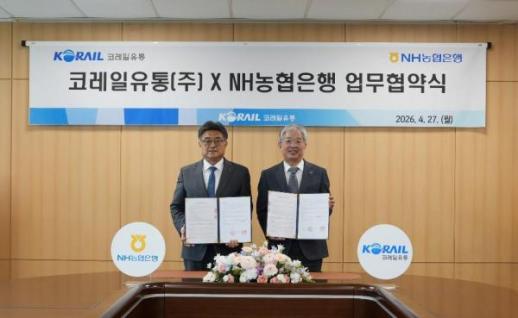 NH NongHyup Bank Named Korail Retail’s Main Bank Through March 2031 NH NongHyup Bank said April 28 it was selected as the main bank for Korail Retail, a public institution under the Ministry of Land, Infrastructure and Transport, after winning an open bidding process. The main-bank agreement ceremony was held the previous day at Korail Retail’s headquarters in Seoul’s Yeongdeungpo district. Attendees included Lee Young-woo, executive vice president and head of NH NongHyup Bank’s Agriculture · Public Finance Division, and Park Jeong-hyeon, Korail Retail’s CEO, along with other officials. Under the agreement, NH NongHyup Bank will handle key financial services for Korail Retail through the end of March 2031, including managing operating funds, supporting corporate card operations and providing financial services for employees. Lee said the bank will provide stable and efficient financial services through cooperation with Korail Retail and will continue strengthening its financial support capabilities for public institutions.* This article has been translated by AI. 2026-04-28 08:24:15