
Journalist

Candice Kim
candicekim1121@ajupress.com
-
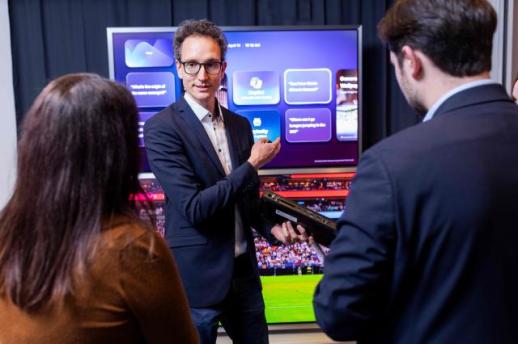 Samsung Electronics unveils 2026 AI TV lineup at European tech seminar SEOUL, April 16 (AJP) - Samsung Electronics held its '2026 Europe Tech Seminar' in Frankfurt, Germany, from Wednesday to Thurdsay, showcasing its 2026 artificial intelligence (AI) TV and audio product lineups to European media and industry professionals. During the event, Samsung demonstrated its 'Vision AI Companion,' an integrated TV platform that functions as a smart home hub. The platform provides real-time information on viewed content and supports tasks such as trip planning and recipe recommendations. The company also detailed its latest AI-driven picture and sound features, including 'AI Upscaling Pro' for enhancing low-resolution video, 'AI Football Mode,' and 'AI Sound Controller Pro.' On the hardware front, Samsung highlighted its new 'Micro RGB' TV, emphasizing that it meets 100 percent of the BT.2020 color gamut standard established by the International Telecommunication Union (ITU). The 2026 OLED TV models feature 'Glare Free' technology to reduce light reflection, along with Pantone's 'ArtfulColor' certification. Additionally, Samsung introduced an OLED gaming monitor (FG600S) with a 500Hz refresh rate, a 6K resolution monitor (G80HS), and the 'Music Studio' Wi-Fi speaker series, which supports 3D surround sound. "By applying advanced AI technology across our entire lineup, from premium to entry-level models, we will usher in an era of AI TV popularization for everyone," said Lee Heon, Executive Vice President of Samsung Electronics' Visual Display Business. Samsung has hosted tech seminars annually since 2012 to present its latest technologies to global video and audio experts. 2026-04-16 16:25:08
 -
 SK hynix to test Samsung's shock earnings as AI memory boom deepens SEOUL, April 16 (AJP) - After Samsung Electronics’ mind-blowing first-quarter numbers, its memory-focused rival SK hynix will be closely watched to see whether its three-month earnings can match — or even eclipse — expectations when it reports January–March results next week. According to financial data tracker FnGuide, the consensus among domestic brokerages estimates SK hynix’s operating profit for the period at 34.9 trillion won ($24.8 billion), with quarterly revenue projected to reach a record 50.13 trillion won. The heightened expectations follow Samsung Electronics’ preliminary estimate of 57.2 trillion won in first-quarter operating profit — a figure that surpassed its full-year 2025 earnings of 43.6 trillion won and reset the bar for the sector. Investors are now watching whether SK hynix can deliver a similar upside surprise, particularly given its heavier exposure to memory chips. Its full-year income for 2025 was record 47.2 trillion won. For the fourth quarter, it reported quarterly high of 19.17 trillion won in operating profit on revenue of 32.83 trillion won. SK hynix has emerged as a dominant player in high bandwidth memory (HBM), commanding nearly 57 percent of the market as of the fourth quarter of 2025. HBM, a critical component for AI accelerators such as Nvidia chips, has seen explosive demand from hyperscale data centers. That surge has strained cleanroom capacity, as HBM production requires roughly three times the resources of standard DRAM. The resulting supply constraints, combined with aggressive stockpiling, have pushed memory prices sharply higher — rising an estimated 90 to 95 percent in the first quarter from the previous quarter. Brokerages have been quick to revise target prices and earnings forecasts upward, citing tighter-than-expected supply of conventional memory and SK hynix’s pricing power in HBM. Mirae Asset Securities maintained its target price at 1.54 million won, projecting a higher first-quarter operating profit of 36.7 trillion won. “Elevated price levels are expected to persist due to irreversible specification upgrades in smartphones, polarized supply-demand conditions, and structural limits to capacity expansion,” said Kim Young-gun, an analyst at Mirae Asset Securities. “This should support sustained high returns on equity.” Analysts say the AI boom is now lifting the broader memory portfolio, not just premium HBM products. Pak Yu-ak of Kiwoom Securities raised his target price to 1.3 million won, noting that strong AI-driven demand is spilling over into mobile memory, including LPDDR5X and UFS. Still, he cautioned that the cycle may be entering a new phase. “As the memory semiconductor cycle shifts from price increases to shipment growth, the stock’s trajectory over the next six months could differ from the past half-year,” Pak said. Shares of SK hynix closed Thursday up 1.7 percent at 1,155,000 won. Some analysts argue the current rally reflects more than a typical cyclical upswing, pointing instead to a structural shift in the industry. “Robust growth is highly likely to continue amid limited supply increases,” said Ryu Young-ho of NH Investment & Securities. He added that SK hynix’s partnership with TSMC would be key to developing next-generation, high-efficiency memory solutions. With earnings projections reaching unprecedented levels, internal expectations are also rising. Under SK hynix’s profit-sharing structure — which allocates roughly 10 percent of operating profit to bonuses — employees are bracing for potentially record payouts if the current upcycle holds. SK hynix will release its first-quarter earnings and hold a conference call on April 23. 2026-04-16 16:02:51
 -
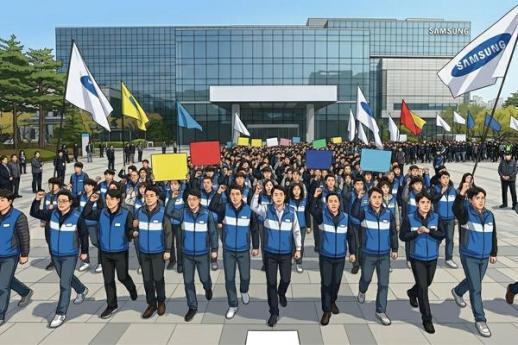 Samsung Electronics faces April walkout as bonus dispute escalates SEOUL, April 15 (AJP) - Samsung Electronics is heading toward a partial walkout next week, with its largest labor union pushing ahead with industrial action over a profit-linked bonus system despite stalled negotiations. The union plans a rally and walkout on April 23, with a full-scale strike scheduled from May 21 if talks fail to produce a compromise. “We are open to negotiations if management puts the 15 percent operating profit payout and the removal of the bonus cap on the table,” a union official said. The official added that a cleanroom walkout will proceed if management continues to offer one-off compensation instead of institutionalizing a bonus framework. At the center of the dispute is the union’s demand that 15 percent of operating profit be allocated to employee bonuses and that the current cap be scrapped. Based on the company’s record first-quarter operating profit of 57.2 trillion won, the proposed formula would translate into a bonus pool of up to 45 trillion won ($32 billion). That would be roughly four times last year’s dividend payout of 11.1 trillion won and exceed the company’s planned annual research and development spending of 37.7 trillion won, raising concerns among management and investors. The union, however, said the demand is aimed at creating a transparent and sustainable compensation system rather than securing a one-time payout. “Our core demand is to establish a system that union members can accept in the long term, rather than just asking for more money because the company is making good money,” another union official said. Samsung has warned that linking a large portion of operating profit to bonuses could constrain future investment in a capital-intensive and cyclical semiconductor industry. A company official also flagged potential risks to client confidence if production is disrupted. “In the long run, it is a tremendous loss for our company if it causes anxiety to clients or if clients show movements to change contract conditions,” the official said. The controversy is further amplified by the contrasting situation at SK Hynix. Having abolished its bonus cap last year and agreeing to distribute 10 percent of its operating profit, SK Hynix employees are projected to receive significantly larger payouts. Driven by the artificial intelligence boom and robust High-Bandwidth Memory (HBM) sales, securities firms estimate that SK Hynix’s upcoming bonuses could average around 700 million won per employee. The union walkout is set to coincide with SK Hynix’s earnings release on April 23, which is widely expected to reflect similarly strong performance. 2026-04-15 17:57:14
 -
 Korean chipmakers push long-term deals as AI demand overrides cycle SEOUL, April 09 (AJP) - The memory chip market is behaving less like a cycle and more like a contract. South Korea’s Samsung Electronics and SK hynix are moving to lock in multi-year supply agreements as artificial intelligence demand strengthens their leverage over pricing and terms. Memory has long been one of the most volatile segments of the semiconductor industry, with Random Access Memory (RAM) prices prone to sharp swings. But the rapid expansion of AI infrastructure is altering that dynamic, shifting bargaining power toward suppliers. Upstream chip designers and major technology firms — including Nvidia and Tesla — are increasingly seeking contracts lasting up to five years, a departure from the industry’s traditional short-term agreements, to secure both high-end and legacy chips. Industry sources said Samsung Electronics and SK hynix are gaining greater control not only over pricing but also over contract structures, as supply constraints persist. Unlike foundry businesses, where long-term agreements are standard, memory chip supply deals have typically been negotiated over periods ranging from several weeks to a few months, reflecting fluid market conditions. The shift comes as the semiconductor industry enters what many describe as a prolonged “super-cycle,” with demand outpacing supply for an extended period. Unlike previous upcycles driven by consumer electronics, the current surge is anchored in the rapid buildout of AI and data center infrastructure, creating sustained demand that the industry’s rigid supply chain struggles to match. Building new semiconductor fabrication plants requires years and substantial capital investment, limiting the ability of suppliers to respond quickly and reinforcing tight market conditions. Samsung Electronics has reportedly begun applying a minimum three-year long-term agreement (LTA) framework for new contracts with major clients this year. The move follows comments by Jun Young-hyun, vice chairman of Samsung’s Device Solutions division, who said the company is pushing to shift supply contracts from annual or quarterly terms to multi-year agreements of three to five years. An industry official said customers are increasingly anxious about securing supply, adding that longer contract formats are becoming inevitable in a seller-driven market. SK hynix is taking a similar — and in some cases more aggressive — approach. The company is reportedly in discussions with Google over a long-term DRAM supply deal that could extend up to five years. Sources said initial talks centered on a three-year agreement but were extended to enhance supply stability during the AI-driven demand surge. The push toward multi-year contracts reflects a broader effort to reduce exposure to the industry’s long-standing boom-bust cycle, which has historically led to sharp earnings swings and large losses during downturns. By securing volumes and pricing over longer periods, memory makers can introduce greater earnings stability even if demand from consumer electronics weakens. At the same time, memory chips are increasingly seen as strategic infrastructure for AI workloads. Products such as High Bandwidth Memory (HBM) are elevating suppliers’ roles beyond commodity producers to essential partners for global technology firms. Investor sentiment reflects expectations that the current earnings cycle could outlast the typical two-year upturn seen in previous memory markets. Samsung Electronics on Tuesday reported an operating profit of 57.2 trillion won ($38 billion) for the first quarter, surpassing its full-year 2025 earnings and placing it among the world’s top technology companies by profit, alongside Apple, Nvidia and Microsoft. 2026-04-09 17:42:40
 -
 Samsung Elec turns up 'warmth' in design as gadget prices turn cold SEOUL, April 09 (AJP) - Samsung Electronics is painstakingly dialing up “warmth” in product design for its latest Galaxy lineup, seeking to soften consumer resistance as rising component costs push device prices higher and colder Unveiling the Galaxy S26 and Buds4 series on Thursday, the company’s design leadership emphasized a shift toward more intuitive, tactile and emotionally resonant products — a deliberate counterpoint to what executives acknowledged as increasingly “cold” price tags. “Our goal was to make advanced technology feel warm and approachable,” said Hubert H. Lee, executive vice president and head of MX Design. “We wanted to create products that feel closer to users, not more distant.” The shift is most evident in the flagship Galaxy S26 Ultra, which abandons its signature sharp corners for a rounded “7R” curvature. The 7-millimeter radius was mathematically calibrated to balance a modern silhouette with a more comfortable grip. Samsung also introduced an “Ambient Island” camera design, using integrated materials and light-refracting contours to visually soften the bulk of high-performance lenses and create a more seamless flow across the device’s back. Lee Ji-young, vice president of MX Design, said the team aimed to ensure that “while the technology is powerful, the impression it leaves is soft,” describing the result as a culmination of the company’s evolving design philosophy. For the Galaxy Buds4, Samsung pivoted to a stemmed “Blade” form factor, grounded in ergonomic data as much as aesthetics. The company said it analyzed more than 100 million ear shape data points — in collaboration with the University of Michigan — and conducted 10,000 wear simulations to refine fit and usability. The redesigned stem improves grip and enables more precise touch controls, including pinch-and-slide gestures. A transparent charging case reflects a broader push toward intuitive hardware, allowing users to instantly confirm whether the earbuds are properly docked. Samsung is also tapping into customization trends among younger consumers. The company highlighted the rise of “Bud-gu,” a decorating culture around earbuds, with the Buds4 designed to accommodate stickers and accessories on its metal finish. The design pivot comes as prices for consumer electronics climb, driven in part by rising memory chip costs. The expansion of high-bandwidth memory (HBM) production has tightened supply for general-purpose DRAM, pushing up overall component prices and feeding into retail pricing. By emphasizing warmth, Samsung appears to be reframing the premium experience — not only as a function of performance, but as one of emotional connection and everyday usability. “Our focus on warmth represents the peak of our design evolution,” said Song Jun-yong, head of the MX Buds Design Group. “We wanted to create products that gain value the more they are used.” 2026-04-09 14:39:04
 -
 Chipflation accelerates, Samsung device makers bump up price tags SEOUL, April 8 (AJP)-Samsung Electronics and other South Korean device makers are raising prices across smartphones, laptops and tablets as a sharp surge in memory costs — driven by artificial intelligence demand — squeezes margins and reshapes the consumer electronics market. Samsung this week lifted prices for key products including laptops and tablets, with some models rising by as much as 900,000 won ($600). The company also raised official prices of several smartphones months after launch — an unusual move that underscores the severity of component cost pressures. The top-end Galaxy Book6 Ultra with RTX 5070 rose from 4.93 million won to 5.83 million won, while the RTX 5060 model climbed from 4.63 million won to 5.53 million won — both up by 900,000 won. The models had already launched in January at prices significantly higher than their Galaxy Book5 predecessors, but were raised again as memory costs accelerated. Samsung also increased prices for the base Galaxy Book6 just a week after its release, lifting launch prices — originally set between 1.6 million won and 2.51 million won depending on specifications — by between 170,000 won and 880,000 won. Tablet prices were also adjusted upward. The Galaxy Tab S11 Ultra, along with mid-range and budget models in the FE and A series, saw increases ranging from 30,000 won to 150,000 won. The price bump-up came after the company which also produces memory along with devices estimated a record-breaking operating profit of 57 trillion won ($39 billion) for the first quarter due to the spike in chip value. The retail price hikes reflect a broader shift in the global memory market, where supply is increasingly being diverted away from consumer devices toward AI infrastructure. Samsung’s decision to raise prices on existing smartphone models highlights the scale of the pressure. Such post-launch price hikes are rare in the industry, where prices typically decline over time. The move suggests manufacturers are no longer able to absorb rising component costs. Other Korean electronics and appliance makers are also expected to follow, as memory inflation feeds into broader hardware pricing. Market tracker TrendForce expects conventional DRAM contract prices to rise 58 to 63 percent quarter on quarter in the second quarter, while NAND Flash prices are projected to jump 70 to 75 percent. “DRAM suppliers are reallocating capacity toward HBM and server applications, while overall supply remains tight,” TrendForce said. The price surge is being driven by an aggressive buildout of AI data centers, particularly in North America, where cloud providers are securing memory supply through long-term agreements. TrendForce noted that suppliers are prioritizing server-grade memory due to higher profitability, leaving less capacity for consumer-grade products. “Suppliers continue prioritizing server DRAM… while near-term supply remains tight,” it said, adding that meaningful capacity expansion is unlikely before late 2027. The shift is hitting Korean manufacturers directly. Memory accounts for roughly 20 percent of smartphone production costs, making devices highly sensitive to DRAM and NAND price swings. As supply tightens — particularly for lower-capacity chips used in consumer products — manufacturers are increasingly forced to pass costs on to consumers. TrendForce said major suppliers are gradually pulling back from the consumer DRAM segment, worsening shortages. Worse, the outlook points to continued upward pressure. In NAND, demand from AI servers and enterprise storage remains strong, while consumer demand is weakening under higher prices — a dynamic that reinforces supply tightness. TrendForce said enterprise SSD demand tied to generative AI is accelerating, with cloud providers willing to pay premiums to secure supply. The impact is expected to extend into upcoming product cycles. New flagship smartphones and foldables set for release later this year as result are likely to carry higher price tags. 2026-04-09 08:05:05
 -
 Samsung vaults into global top tier as AI-driven memory boom turbocharges profits SEOUL, April 07 (AJP) - Its record-smashing first-quarter earnings that nearly matched the full-year income of its previous peak in 2018 place Samsung Electronics among the world’s top five big tech firms and suggest it could even challenge Nvidia in operating profit if the memory supercycle extends into next year. The company on Tuesday estimated its first-quarter operating profit at 57.2 trillion won ($38.0 billion), nearly tripling its previous quarterly high in the October–December period and surpassing its full-year 2025 income of 43.6 trillion won. Revenue reached 133 trillion won. The latest figures place Samsung alongside the world’s most dominant tech firms. Based on recent quarterly results, Apple leads with operating profit of $50.9 billion, followed by Nvidia with $44.3 billion and Microsoft with $38.3 billion. At current exchange rates, Samsung outperforms Google’s parent Alphabet, which reported quarterly operating profit of $35.93 billion. "Samsung is enjoying a dual effect in the memory market," said Lee Jong-hwan, a professor of system semiconductor engineering at Sangmyung University. "As the company shifted its production capacity toward High Bandwidth Memory (HBM), the supply of legacy DRAM naturally decreased, driving up prices significantly amid strong demand." Analysts projected that the bulk of first-quarter profit would come from semiconductors, or the Device Solutions (DS) division, even before the results overwhelmingly beat expectations. Daishin Securities had projected DS operating profit at 41.8 trillion won, out of a total estimated company profit of 45.2 trillion won. Kiwoom Securities offered a similar outlook, estimating the chip division’s profit at 41.3 trillion won. Meritz Securities presented the most bullish domestic forecast, expecting the DS unit to generate 48.9 trillion won in profit—driven by 50.3 trillion won from the memory sector alone—out of a total projected profit of 53.9 trillion won. Citi projected Samsung’s total operating profit to reach 51 trillion won in early April, a sharp increase from Goldman Sachs’ earlier estimate of 40.3 trillion won in March. The rush into high-bandwidth memory (HBM) to train AI systems and run hyperscale data centers has fueled demand across both premium and legacy chips, sending prices sharply higher and giving suppliers stronger pricing power in long-term contracts. DRAM contract prices soared 90 to 95 percent quarter-on-quarter in the first quarter, while NAND prices rose around 60 percent, according to TrendForce, which estimates 58 to 63 percent on-quarter gains in the second quarter and 70 to 75 percent for NAND flash. Samsung is the dominant supplier of both DRAM and NAND flash. "As global big tech companies seek to develop their own custom AI chips, TSMC’s limited capacity will inevitably lead to spillover orders for Samsung," Lee said. "As the only tech giant handling both memory and foundry businesses, Samsung is entering a phase where both sectors can expand simultaneously." Analysts emphasize that this surge is a direct result of explosive growth in AI infrastructure. "We assume that the year-on-year growth rate of capital expenditure by big tech companies will be revised upward to 92 percent, in which case DRAM demand growth this year will reach 20.3 percent," said Song Myung-sup, an analyst at iM Securities. This immense profitability provides a critical buffer for Samsung’s aggressive investment strategy, with capital expenditure projected to reach 114.3 trillion won by 2026. Even amid geopolitical tensions, the structural stability of the company’s core projects remains intact. "Considering the stability of payment collection for group captive projects, the actual risk of bad debt is limited," said Ryu Tae-hwan, an analyst at Eugene Investment & Securities. According to market consensus data from FnGuide, Samsung’s total annual operating profit for 2026 is projected to reach 227.3 trillion won. Some estimates have been revised upward following the first-quarter results. KB Securities projected Samsung’s operating profit at 327 trillion won this year and 488 trillion won in 2027, closely chasing Nvidia’s 357 trillion won and 485 trillion won, respectively, in the brokerage's estimate. Paled in comparison, Korea’s home appliance rival LG Electronics also reported stronger-than-expected first-quarter results, highlighting the resilience of the country’s tech sector. The company estimated operating profit at 1.67 trillion won ($1.24 billion), up 32.9 percent on-year and well above market consensus. Revenue rose 4.4 percent to a quarterly record of 23.73 trillion won, supported by demand for premium home appliances and steady growth in its vehicle components division. Both Samsung and LG will release finalized results later this month. Shares of Samsung Electronics closed Tuesday up 1.45 percent at 195,900 won on Tuesday. Cross-town memory rival SK hynix also saw strong gains, jumping 3.16 percent to finish at 914,000 won. 2026-04-07 17:31:09
 -
 LG Electronics Q1 OP beats expectations, sales hit quarterly high SEOUL, April 07 (AJP) - LG Electronics on Tuesday estimated stronger-than-expected operating profit and record three-month sales in the quarter ended March thanks to its premium lineup and steady growth in business-to-business segments despite tariff pressure in the U.S. and weak Korean won. In its preliminary earnings guidance, the company reported an operating profit at 1.67 trillion won ($1.24 billion) for the January–March period, up 32.9 percent from a year earlier and well above the 1.38 trillion won market consensus compiled by FnGuide. Revenue rose 4.4 percent on year to a quarterly record of 23.73 trillion won. The performance contrasts with the volatility seen in the broader tech components sector, as LG’s earnings were underpinned by resilient demand in its home appliance division. The unit benefited from expanded subscription-based services and stronger online sales, reinforcing stable cash flow generation. Its vehicle component solutions (VS) division also sustained growth, supported by a solid order backlog, while ongoing cost structure improvements helped cushion the impact of higher raw material prices and currency pressure from a sharply weakened won. Shares of LG Electronics were up 0.5 percent at 109,900 won as of 11:40 a.m. The company is scheduled to release its full earnings report toward the end of this month. 2026-04-07 11:51:46
 -
 Samsung Electronics Q1 income eclipses full 2025, nears full 2018 peak SEOUL, April 07 (AJP) - Samsung Electronics on Tuesday estimated its operating profit reached a whopping 57.2 trillion won ($42.3 billion) in the January–March period on a surge in memory prices from legacy to AI-supporting high-performance chips, beating not just full-year 2025 earnings but nearing the annual income of the last chip boom year in 2018. In its first-quarter earnings guidance, the South Korean tech giant — spanning chips, smartphones and home appliances — said operating profit jumped 755.0 percent from 6.6 trillion won a year earlier and nearly tripled from 20.1 trillion won in the previous quarter. The figure far exceeded the market consensus of 40.5 trillion won compiled by FnGuide, as investors had been closely watching whether the company could surpass the 50 trillion won milestone. The result also came close to its record annual profit of 58.9 trillion won in 2018. The second straight record-setting quarter was fueled by a sharp rebound in memory prices, with DRAM contract prices surging 90–95 percent on-quarter in the first quarter and NAND prices rising about 60 percent, according to TrendForce. Revenue jumped 41.73 percent on quarter and 68.06 percent on year to 133 trillion won, the first quarterly milestone above 100 trillion won. Samsung will release its detailed earnings report later this month. 2026-04-07 08:13:37
 -
 Samsung Q1 profit set to rival full-year earnings on AI chip boom SEOUL, April 06 (AJP) - Samsung Electronics is poised to deliver its strongest quarterly reports to date with January-March operating profit expected to approach or exceed full-year earnings for 2025, underscoring the sheer scale of the ongoing memory super-cycle driven by artificial intelligence demand. According to market consensus compiled by FnGuide, the South Korean tech giant is projected to post an average operating profit of 40.5 trillion won ($29.9 billion) for the January–March period. The estimate comes just shy of last year’s full-year operating profit of 43.6 trillion won, though some institutions have recently raised their forecasts as high as 53.9 trillion won. The figures would mark a more than sixfold jump from 6.6 trillion won recorded a year earlier, and roughly double the previous quarterly high of 20.1 trillion won logged in the fourth quarter. Samsung, the world’s largest memory chipmaker with businesses spanning semiconductors, smartphones and consumer electronics, is set to release its earnings guidance before the market opens on Tuesday. Shares have jumped nearly 4 percent as of midday, outperforming KOSPI gain of 1.7 percent. Analysts say the surge reflects an unprecedented “super-cycle” in memory chips, as explosive demand for AI infrastructure spills over into broader segments of the market amid tight supply. “We assume that the year-on-year growth rate of facility investment by big tech companies will be revised upward to 92 percent, in which case DRAM demand growth this year will reach 20.3 percent,” said Song Myung-sup, an analyst at iM Securities, who projected operating profit of 45.3 trillion won. Song added that Samsung’s return on equity for 2026 is expected to reach 39 percent, surpassing the previous 30-year peak of 34 percent set in 2004. At the core of the rally is high-bandwidth memory (HBM), a critical component for AI servers, where Samsung Electronics and SK hynix effectively hold a duopoly — placing them in what industry observers describe as a rare “super-supplier” position. Even if U.S. big tech firms slow capital spending, securing HBM — a core component in the AI arms race — remains non-negotiable. The current HBM4 and next-generation memory market is effectively dominated by the two Korean firms, ensuring structurally firm demand. The balance of power has also shifted decisively toward suppliers. Memory makers are increasingly signing two- to three-year supply contracts with major tech firms — a departure from the industry’s traditionally short-term cycles — creating a structural buffer that prevents short-term market volatility from immediately translating into earnings deterioration. The broader upcycle remains intact. Analysts expect average DRAM prices to rise more than 60 percent this year, driven by exponential increases in memory capacity per AI server and compounded by tight supply in conventional DRAM. Unlike past cycles marked by aggressive capacity expansion and subsequent price collapses, Korean chipmakers have maintained disciplined production strategies, prioritizing profitability and sustaining pricing power. Despite concerns over potential supply disruptions stemming from the Middle East conflict, industry observers say Korean memory makers are likely to maintain strong earnings momentum for several years, with demand structurally underpinned and sellers firmly in control of pricing. Growth, however, is expected to be uneven across Samsung’s businesses. While the semiconductor (DS) division continues to drive earnings, the mobile (MX) and display (SDC) units are likely to face margin pressure from rising component costs. Even so, Samsung is expected to press ahead with aggressive investment. Capital expenditure is projected to reach 114.3 trillion won in 2026, reflecting continued bets on AI-driven demand. Macroeconomic uncertainties remain a variable, but their direct impact on production is expected to be limited. “While geopolitical risks in the Middle East and North Africa persist, the stability of Samsung’s captive projects, such as the P4 and NRD-K facilities in Pyeongtaek, remains high,” said Ryu Tae-hwan, an analyst at Eugene Investment & Securities. 2026-04-06 12:09:53