
Journalist

Lee Jung-woo, Kim Yeon-jae
cannes2030@ajupress.com, duswogmlwo77@ajupress.com,
-
 North Korea, Belarus seal closer axis in Pyongyang summit SEOUL, March 26 (AJP) -North Korea has drawn Belarus further into its orbit, formalizing ties along a likeminded axis of sanctioned states aligned with Russia. Belarusian President Alexander Lukashenko received an enthusiastic welcome from North Korean leader Kim Jong-un during his first two-day visit to Pyongyang, according to state media from both countries, as the two leaders moved to upgrade relations into what they called a “new stage.” The two strongmen — both long isolated from the West — are bound by their support for Russia’s war in Ukraine and shared pariah status under international sanctions and human rights scrutiny. “The friendly relations between our states, born during the era of the Soviet Union, have never been interrupted,” Lukashenko said, according to Belarusian state news agency Belta. “Today, thanks to comprehensive and steady development, we are entering a fundamentally new phase.” He added that “independent countries must cooperate more closely” to safeguard sovereignty — language widely seen as a rebuke to Western pressure. The Korean Central News Agency (KCNA) reported that Lukashenko arrived in Pyongyang on Wednesday aboard a special aircraft and paid tribute at the Kumsusan Palace of the Sun, laying bouquets for North Korea’s former leaders, including one on behalf of Russian President Vladimir Putin — underscoring the triangular alignment among Pyongyang, Minsk and Moscow. The visit follows growing engagement between the two countries, with Lukashenko turning more openly toward North Korea after Pyongyang dispatched troops to support Russia Kim and Lukashenko first met in September in Beijing on the sidelines of a military parade, where the North Korean leader extended an invitation for the visit. In a letter earlier this month, Kim said he was “willing to expand and develop” bilateral ties “to a new, higher stage in line with the demands of the new era,” KCNA said. Lukashenko was accompanied by a senior delegation including Deputy Prime Minister Yuri Shuleiko and ministers overseeing foreign affairs, health, education and industry, signaling broad-based cooperation. North Korean Premier Kim Tok-hun and Vice Foreign Minister Kim Jong-gyu were among officials who greeted him at the airport. The two sides signed a friendship and cooperation treaty, marking what they described as a “fundamental” shift in relations — a move that cements an emerging axis among U.S.-sanctioned states as geopolitical divisions deepen. 2026-03-26 17:46:16
 -
 South Korea Supreme Court overturns 2021 ruling dismissing forced labor claims SEOUL, March 26 (AJP) - South Korea’s Supreme Court belatedly confirmed Thursday that it has dismissed and ordered a retrial of a lower court decision that rejected a collective damages suit against Japanese companies filed by victims of wartime forced labor during World War Two. The Supreme Court said that on Feb. 12 that it upheld an appellate court decision overturning the Seoul Central District Court’s dismissal of the case. The proceedings date back to 2015 when 85 alleged victims and their bereaved families took the action against 16 Japanese companies, including Mitsubishi Heavy Industries, Nippon Steel, Nissan Chemical and Hokkaido Colliery & Steamship Co., seeking unpaid wages and compensation for damages. While exact figures are unavailable, it is estimated that about 1.5 million Koreans, then subjects of Japan, were mobilized to Japan, Manchuria, and other areas, and about 2 million were forcibly mobilized within the Korean Peninsula. The Seoul Central District Court’s initial dismissal of the case in June 2021 cited the 1965 Korea-Japan Claims Agreement when the two countries normalized their relations, saying it effectively ended individual claims. This decision ran counter to a Supreme Court October 2018 ruling which upheld an earlier decision ordering Nippon Steel to compensate Korean victims of forced labor. The Seoul High Court overturned the lower court ruling on appeal in February 2024, saying the Supreme Court’s 2018 ruling recognized Japanese companies’ liability. Mitsubishi Heavy Industries and Hokkaido Colliery & Steamship Co. appealed, but the Supreme Court dismissed both, finding no error in the lower court’s judgment, including on legal principles concerning international jurisdiction, treaties, or the scope and effect of the Claims Agreement. With the latest ruling by the Supreme Court, the case is to be retried at the Seoul Central District Court. Hokkaido Colliery & Steamship Co. argued it had been discharged from liability under Japan’s former Corporate Reorganization Law and that any lawsuit based on discharged claims was inadmissible, but the Supreme Court rejected the argument, noting that under South Korea’s former Corporate Reorganization Act — which follows the principle of territoriality — such discharge does not extend to the plaintiffs’ claims. Many of those conscripted endured brutal working conditions, with numerous deaths resulting from accidents or suicide. In 1942, for instance, 136 Koreans were killed in a mass drowning incident at the Chosei coal mine in Yamaguchi Prefecture. After liberation, the South Korean government showed limited interest in compensating individual victims, but rather focused on national-level compensation. The 1965 Korea-Japan Basic Treaty and its supplementary Agreement on Claims and Economic Cooperation stipulated that Japan would provide $500 million — $300 million in grants and $200 million in loans — and that “the problems concerning property, rights and interests of the two countries and their nationals have been settled completely and finally.” 2026-03-26 17:18:00
 -
 Seoul deploys "wartime" policy arsenal to fight Gulf shockwaves SEOUL, March 26 (AJP) -South Korea is deploying “all possible” fiscal and policy tools — including a supplementary budget of around 25 trillion won ($18.7 billion), expanded fuel tax cuts and market stabilization measures — as it moves into what the government described as a “wartime” economic response to the prolonged Middle East conflict. “In the face of a grave wartime situation, we will mobilize all policy means and the optimal mix to ensure the hard-won recovery momentum is not derailed,” Deputy Prime Minister for Economy Koo Yun-cheol said in a televised briefing Thursday after an emergency cabinet meeting. The emergency package comes as the conflict enters its fourth week, driving sharp volatility in global oil prices and financial markets, with South Korea particularly exposed due to its heavy dependence on Middle Eastern energy imports. Under the plan, the government will expand temporary fuel tax cuts to 15 percent for gasoline and 25 percent for diesel through May 31, nearly doubled from current reductions, in a bid to cushion rising energy costs. The measures are part of a broader push to stabilize prices and supply chains, while preventing spillovers into vulnerable sectors such as small businesses, farmers and low-income households. To contain inflation and energy price shocks, authorities will maintain a ceiling price system on petroleum products, strengthen market surveillance against collusion and expand subsidies for freight and public transport operators. On the supply side, the government will secure alternative crude and liquefied natural gas sources, including increased imports from the United Arab Emirates and swap arrangements with Japan, while preparing to release strategic reserves in coordination with the International Energy Agency if needed. A crisis-level supply chain task force has also been launched to monitor key items such as naphtha and urea on a daily basis, with emergency financial support and import diversification measures to mitigate disruptions. To support affected businesses, policymakers will expand policy financing by more than 4 trillion won, provide low-interest loans and extend maturities for firms facing liquidity stress, while fast-tracking approvals for emergency funding. Additional targeted support will be directed at small merchants, farmers and transport operators, including energy subsidies, logistics cost assistance and temporary toll exemptions. In financial markets, authorities pledged “timely” intervention to curb excessive volatility in the won and bond markets, including liquidity injections, bond buybacks and activation of a 100 trillion won-plus market stabilization program if necessary. The finance ministry separately announced 5 trillion-won buyback program to bolster the bond market, with government bonds yielding more than 100 basis points over the base rate. The government will conduct stress tests across the financial sector and maintain 24-hour monitoring of foreign exchange and capital markets to guard against systemic risks. The U.S. dollar hit 1,506.90 won as of 3:00 p.m. Thursday, unshaken by the Seoul government response. The markets instead pay heed to the government warning. “The longer the situation persists, the greater the downside risks to the economy, including slower growth, higher inflation, supply chain disruptions and financial market volatility,” the government said in its assessment. 2026-03-26 15:18:42
 -
 Korea's consumer confidence at 10-mo low March, sharpest drop since martial law shock SEOUL, March 25 (AJP) -South Korea’s consumer confidence fell to a near one-year low in March, posting its steepest monthly decline since the brief martial law episode in late 2024, as prolonged disruptions in the Strait of Hormuz fuel concerns over a stagflationary shock in the import-dependent economy, central bank data showed Wednesday. The composite consumer sentiment index (CCSI) stood at 107.0 in March, down 5.1 points from the previous month, according to the Bank of Korea. The reading marked the lowest level since 101 recorded in May 2025 and the sharpest drop since December 2024, when a short-lived martial law declaration rattled markets and public sentiment. The CCSI is a composite gauge of consumer perceptions, combining six sub-indices that track current living standards, household income and spending outlook, and broader economic conditions. A reading above 100 indicates optimism relative to the long-term average from 2003 to 2024, while a reading below 100 signals pessimism. The latest decline reflects mounting anxiety over energy supply disruptions stemming from the ongoing conflict in the Middle East. Since late February, joint U.S.-Israel strikes on Iran have disrupted the Strait of Hormuz — a critical chokepoint through which roughly one-fifth of global energy shipments pass — while also forcing a suspension of some Qatari gas flows. The shock is particularly acute for South Korea, which relies heavily on the region for energy imports. According to the Korea International Trade Association, 68.8 percent of Korea’s crude oil imports and 19.7 percent of its natural gas imports came from the Middle East in 2025. Sub-indices showed a broad-based deterioration in sentiment. The index measuring current economic conditions plunged 9 points to 86, while the outlook for the economy over the next six months dropped a steeper 14 points to 89, underscoring growing concerns over the war’s spillover effects. Income-related indicators also weakened. The index for current household income fell 3 points to 97, slipping into pessimistic territory, while the outlook for future income edged down 2 points to 101. Inflation expectations ticked higher. The perceived current inflation rate was at 2.9 percent, while expected inflation for the next 12 months increased by 0.1 percentage point to 2.7 percent, marking the first uptick in five months. The housing price outlook index dropped 12 points to 96, falling below the neutral 100 mark for the first time in 13 months since February 2025, extending a sharp 16-point decline in the previous month amid tightening property regulations. The index suggests that more respondents now expect home prices to decline over the next year than to rise, adding to signs of a broader cooling in domestic demand expectations. 2026-03-25 11:13:35
 -
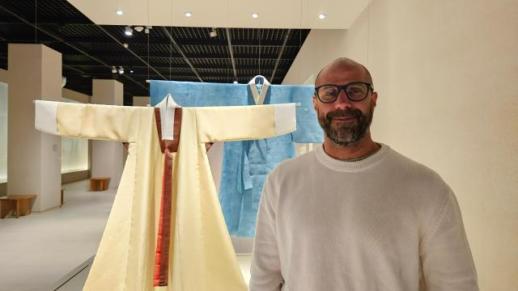 Folk Museum anchors Gwanghwamun beyond BTS spotlight SEOUL, March 24 (AJP) - Gwanghwamun, the historic gateway to Gyeongbokgung Palace, briefly became the center of the world last Saturday as BTS turned it into a global livestream stage. But just steps away, another kind of crowd continues to gather — one drawn not by spectacle, but by story. On ordinary days, that stop is the National Folk Museum of Korea. Museums have been enjoying a surge in popularity, fueled in part by last year’s “K-pop Demon Hunters” hype and a broader global appetite for cultural immersion. The National Museum of Korea drew more than 6.5 million visitors last year, placing it alongside institutions like the Louvre and the Vatican Museums among the world’s most visited. The Folk Museum alone welcomed 2.28 million visitors, and nearly 60 percent of them foreigners. The appeal begins the moment visitors step inside. The entrance hall hums with motion. A group of French tourists leans into a digital display animating a traditional Korean village. Nearby, American college students mirror the gestures of a projected folk dance, their laughter echoing under the high ceiling. “I liked the interactive dance exhibit the most,” said Will, a 28-year-old visitor from Washington, still tracing the choreography with his hands. “It felt very interactive,” his friend added. “You could really immerse yourself in the experience.” Unlike traditional museums that rely on dense timelines and academic explanations, the Folk Museum organizes its exhibits around life itself — birth, childhood, marriage, aging and death — woven through the rhythm of seasons. The approach is deliberate. “If we just display objects by era, it can be difficult for foreigners to connect,” a museum official said. “But when we show how people lived — what they celebrated, how they raised children — those are experiences everyone can understand.” That philosophy is perhaps most vividly expressed in a special exhibition titled “Happy Birthday.” The gallery explores childbirth as both a personal and communal milestone. Among more than 300 artifacts are a delicate baek-il jeogori, worn by infants on their 100th day, and a father’s handwritten parenting diary, its careful script conveying quiet devotion. At the center stands the Cheonin Cheonjamun, a book of a thousand Chinese characters, each written by a different person — a symbol that a child is raised not by parents alone, but by an entire community. For some visitors, the resonance is immediate. “Everything here is beautiful,” said Tiago, a 42-year-old architect from Portugal now living in Angola, pausing before a display of traditional wooden furniture. “There’s a simplicity, but also a deep sense of purpose. Others point to something more subtle: accessibility. The museum’s layout is intuitive, its signage clear, and its exhibits cohesive — qualities that make it easy to navigate even for first-time visitors unfamiliar with Korean history. That accessibility has helped position the museum as part of a broader cultural circuit. Tourists often visit it alongside nearby landmarks such as Gyeongbokgung Palace, the National Museum of Korea and the National Museum of Modern and Contemporary Art, creating a curated day-long journey through Korean heritage. Lee Yourim, who has run a café near the museum for a decade, sees this pattern daily. “A lot of people visit several places in one course,” she said. “They go to the palace, then the museum, then somewhere else nearby.” She added that foreign visitors frequently praise the museum’s family-oriented programs, especially those designed for children. Steve Lebwohl, a 76-year-old businessman from Portland, Oregon, the museum’s strength lies in its storytelling. “The architecture is simple but functional,” he said. “What stands out is the content — the way it covers seasons, birth, dance. It gives you background and context on things that foreigners are curious about.” “It’s a rounded exhibit for a national museum,” he added. His son-in-law, Oh Hanbin, a Korean American, offers a more personal perspective. He has brought his children to the museum not just as tourists but as participants in a kind of cultural inheritance. “We wanted to show them how their halmeoni and harabeoji grew up,” he says, using the Korean words for grandparents. “There aren’t many places in Portland where you can experience Korean culture like this.” As Gwanghwamun shifts from global stage back to everyday crossroads, that quieter draw remains — a place where visitors move not just through exhibits, but through the lived rhythms of a culture. 2026-03-24 17:45:56
 -
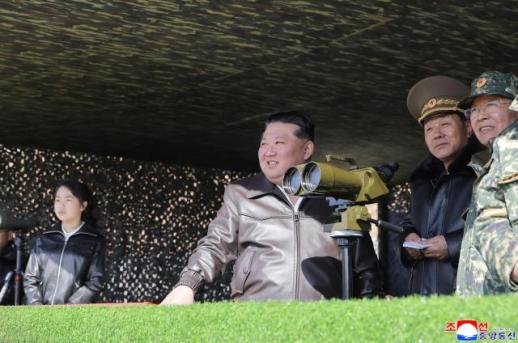 About 1 in 4 NK defectors show chromosomal anomalies; no proven radiation link SEOUL, March 23 (AJP) - Roughly one in four North Korean defectors who lived near the country’s main nuclear test site has shown signs of chromosomal abnormalities potentially consistent with radiation exposure, the Unification Ministry said Monday, while stressing that no causal link has been established. The findings are based on 2024 tests conducted by the National Radiation Emergency Medical Center under the Korea Institute of Radiological and Medical Sciences. The study examined 35 defectors from eight cities and counties surrounding the Punggye-ri nuclear test site, where North Korea carried out all six of its nuclear tests. Of those tested, 12 individuals — about 34 percent — showed chromosomal changes in a “stable chromosome aberration test,” a biological dosimetry method used to estimate cumulative lifetime radiation exposure. All 12 recorded levels above the minimum detection threshold of 0.25 gray. By contrast, an “unstable chromosome aberration test,” which detects more recent exposure within the past three to six months, found no values above the detection limit in any subject, suggesting that any potential exposure occurred earlier. Officials cautioned that the results do not establish a direct connection to nuclear testing. Chromosomal abnormalities may arise from other sources, including medical radiation such as CT scans or exposure to harmful chemicals, including smoking. North Korea conducted nuclear tests at Punggye-ri between 2006 and 2017, releasing radioactive isotopes such as iodine-131, cesium-137, strontium-90 and plutonium-239, which can enter the body through contaminated air, water or food and potentially cause genetic damage. Despite the findings, none of the 12 individuals identified with possible abnormalities has been diagnosed with cancers typically associated with radiation exposure, according to the ministry. The latest results build on earlier screenings. In 2023, 15 out of 59 defectors showed similar signs, bringing the three-year total to 44 out of 174 individuals — about 25 percent of those tested who had lived near Punggye-ri since North Korea’s first nuclear test in October 2006. The ministry said establishing a definitive link would require environmental sampling of soil and water near the test site — currently impossible without cooperation from Pyongyang. Comparative analysis with the general South Korean population could also help clarify any correlation. About 800 defectors in South Korea are believed to have originated from the eight regions surrounding the test site. The Unification Ministry said it will continue testing, aiming to examine 50 additional individuals this year, though the program has slowed, with only 94 people tested over the past two years and no new results publicly released since 2024. 2026-03-23 17:53:03
 -
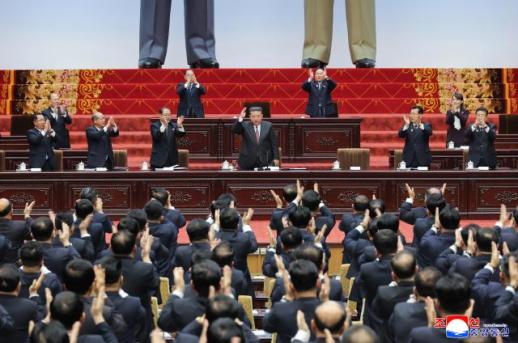 NK assembly reaffirms Kim Jong-un as head of state, watched for Iran response SEOUL, March 23 (AJP) - North Korean leader Kim Jong-un was reappointed as head of state at the opening session of the new Supreme People’s Assembly, closely watched for Pyongyang's rhetoric on inter-Korean relationship, U.S., and nuclear amid U.S.-led attacks on Iran over Tehran's nuclear ambitions. The Korean Central News Agency said the first session of the 15th Supreme People’s Assembly opened in Pyongyang and “again highly elevated Comrade Kim Jong-un to the post of president of the State Affairs.” Under North Korea’s constitution, the State Affairs Commission is the country’s highest state policy body, and its president serves as the supreme leader and head of state. Kim has held the post since the commission was created in 2016, and his latest reappointment – third - formalizes the continuation of his rule under the new parliamentary term. The SPA, North Korea’s rubber-stamp legislature, typically meets to approve personnel changes and codify decisions already made by the ruling Workers’ Party. The session was accompanied by a notable reshuffle in the upper ranks of the regime. Choe Ryong Hae, long regarded as one of the North’s most powerful officials and formerly chairman of the SPA Standing Committee, appears to have stepped down after being left off the list of delegates to the new assembly, according to reports preceding and following the session. He was succeeded by Jo Yong Won, a senior party secretary and one of Kim’s closest aides, who was also named first vice chairman of the State Affairs Commission, further underscoring his rise in the leadership hierarchy. In a rare move for North Korea’s tightly controlled political system, KCNA said Choe delivered a farewell message in which he declared that the country had “permanently secured its status as a nuclear weapons state” and further strengthened its socialist system. Public remarks from departing senior officials are unusual in Pyongyang, where leadership transitions are normally handled without open acknowledgment. Other appointments included Ri Son Gwon, a former inter-Korean affairs official, and Kim Hyong Sik, a party legal official, as vice chairmen of the State Affairs Commission. Premier Pak Thae Song retained his post, while former premier Kim Tok Hun was appointed to the newly created role of first vice premier, according to KCNA. KCNA also said the Second Economic Committee, which oversees munitions production and defense industry planning, would be placed under the Cabinet, though it did not disclose who would lead the body. Kim Yo Jong, the leader’s influential sister, was removed from the State Affairs Commission, while Foreign Minister Choe Son Hui and External Economic Relations Minister Yun Jong Ho retained their posts. In another notable sign of institutional change, Rodong Sinmun referred to Ri Chang Dae, previously known as minister of state security, as head of a “State Intelligence Bureau,” suggesting a possible renaming or restructuring of the internal security apparatus. The SPA session also took up amendments to the socialist constitution, implementation of the country’s new five-year national policy plan and state budget issues for 2025 and 2026, though state media gave no details. Analysts are watching closely to see whether the regime will formally write Kim’s “two hostile states” doctrine into the constitution, a move that could erase longstanding references to peaceful reunification and shared national identity with South Korea. KCNA’s description of the meeting as the “first session” suggests further meetings could follow, with constitutional revision likely to remain at the center of attention. 2026-03-23 11:02:48
 -
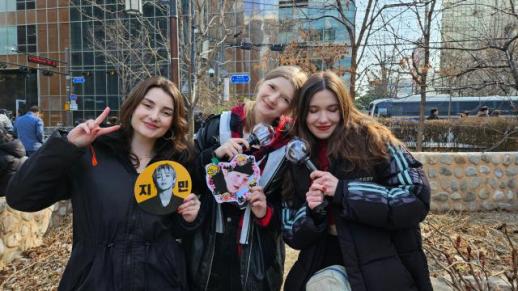 BTS Live: How purple are you? Inside every ARMY's story SEOUL, March 21 (AJP)-Many had crossed the Pacific and the Atlantic. On the day of the concert, they arrived dressed for the scene — in purple. Scarves, dresses, glow sticks and dyed hair turned central Seoul into a moving spectrum of the group’s signature color, as fans circled the barricaded perimeter of Gwanghwamun Square ahead of BTS’s comeback concert. From the open-air stage, rehearsal tracks from the new album carried across the plaza — loud, metallic and unmistakable. Each burst of sound sent phones upward and briefly stilled the crowd. For many, that was enough. They had already come too far not to feel it. Distance and money, at that point, had ceased to matter. Jessie, 35, who works in the film industry in Mexico, had been in South Korea for a week before the show. She traveled to Busan, visited Bukchon Hanok Village and Namsan Tower, and spent days shopping in Myeong-dong. “I’ve already done a lot,” she said. “Now I’m just enjoying cafés, food, taking it slow.” The concert was the anchor of the trip, but not its entirety. For others, the scale of the experience was still settling in. For the Vibe - and Simply to be There Agnieszka, 26, and Paula, 23, flew in from Poland, adding stops in Jeju and Seoul in the days leading up to the event. “Myeong-dong was very overwhelming,” Agnieszka said. They had watched the drone show the night before and planned to stay several more days, venturing beyond the capital to Nami Island and Sokcho. A visit to Gyeongbokgung in hanbok was also on their list. “Korea is all about giving instructions,” she said, pointing to the dense signage across streets and stations. “There’s always something telling you what to do.” She paused, then added with a laugh: “And the roads are dangerous.” Anh Nguyen, 22 and a fan since 2015, flew in from Germany, spending about 5,000 euros ($5,400) on the trip to see their comeback. “Why go this far?” she repeated, before answering her own question. “The older songs — that’s what made me stay. They were my first K-pop boy band. New, interesting… and very humble.” She paused, searching for the right phrase. “There’s always a meaning. A story behind each album. That ‘wow effect.’” In Germany, she said, BTS has long moved beyond niche fandom. “Everyone knows BTS and Blackpink. Even my boyfriend — he doesn’t like K-pop — but he knows them,” she said. “ ‘Dynamite’ and ‘Butter’ are the most famous.” For ARMY, the chance to connect and share the vibe of this milestone comeback is priceless. Australian fans Kim Suda, 42, and Emily Monro, 27, were brought together far from Down Under by a shared fandom. “We literally just met,” one of them said. “There’s a BTS fan page for Australians, and now we’re just hanging out.” Neither had secured tickets for the day, but that hardly seemed to matter. They had already come prepared — light sticks packed before departure — and were now roaming the area, searching for the best vantage point ahead of the 8 p.m. show. Every fan seemed to carry a history with BTS — one that explained how they had come this far, and why simply being close to the moment was enough. “I tried my best to get a ticket, but I failed,” said Christina, 30, who flew 14 hours from Germany. “Still, it’s about being at the scene — vibing with ARMY.” For others, the connection ran deeper, shaped over years. “It reminds me of my teenage years,” said Iman Lee, 23, who traveled 17 hours from Morocco. “I used to watch them with my friends — those are really special memories.” “They gave me strength during a difficult time,” said Alise Tarbuna, who has followed BTS since returning to K-pop in 2016. And for many, the draw extended beyond music into something broader. “Through BTS, I learned about Korea — the people, the culture,” said Dilara Dogan, 25, from Germany. “I’m really thankful.” . Pilgrims from home For Kim Eun-ji, 39, from Cheongju, South Korea, getting inside had been uncertain until the last moment. “I couldn’t get a ticket at first,” she said. “Then I managed to buy a canceled one. When it worked, I couldn’t even scream.” Even on the day of the show, the reality had not fully registered. “It still doesn’t feel real,” she said. “I buy every album,” she added, showing off her 130,000 ($86) won worth purchase on Friday alone. The concert had yet to begin. But for many, the journey — measured in miles, money and time — had already reached its point. 2026-03-21 16:41:19
 -
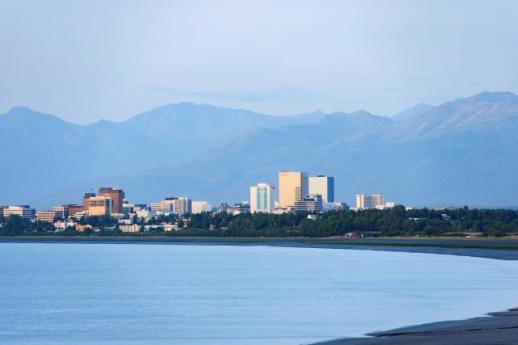 US pitches Alaska to South Korea and Japan as Gulf substitute for energy import SEOUL, March 20 (AJP) -While pressuring allies to help reopen the Strait of Hormuz, Washington is also selling them an alternative — Alaska. The pitch is becoming increasingly explicit: if South Korea and Japan are unwilling or unable to shoulder more of the military burden in the Gulf, they can instead buy into a U.S.-controlled energy system that bypasses it. That strategy gained a timely boost on Wednesday, when the United States showcased investor appetite for its Arctic resources. A federal oil and gas lease sale in the National Petroleum Reserve–Alaska (NPR-A) drew a record $163.7 million in bids, with 11 companies competing for more than 1.3 million acres. Major bidders included ConocoPhillips, ExxonMobil and a joint effort involving Repsol and Shell. The result — the strongest in the reserve’s history — is already being framed by U.S. officials as proof that Alaska can anchor a new energy order. “This is the strongest sale we have ever had,” said Kevin Pendergast of the Bureau of Land Management, while Interior Secretary Doug Burgum called it central to “America’s energy security.” But the timing also raises a more pointed question: whether Washington is leveraging a geopolitical crisis to accelerate a commercial realignment in its favor. A meeting between U.S. President Donald Trump and Japanese Prime Minister Sanae Takaichi on Thursday, expected to reinforce alliance coordination, instead turned strained. Trump openly pressed Japan to do more in securing Gulf shipping routes, while mocking references to Pearl Harbor underscored the asymmetry in expectations. Japan, constrained by its pacifist constitution and still nearly 90 percent dependent on Middle Eastern energy, is responding less with warships than with checkbooks. Tokyo is finalizing investments in Alaska oil, U.S. natural gas and small modular reactors as part of a broader $550 billion package pledged last year. An initial $36 billion tranche is already in motion. South Korea is likely to face a similar proposition. Seoul has pledged up to $350 billion in U.S. investments, with $150 billion set aside for shipbuilding, and energy is emerging as a central channel through which that capital can be directed. In that context, Alaska begins to look less like an option and more like a curated solution. South Korean firms have already been on the move. POSCO International has taken a stake in Glenfarne Alaska Partners, the lead developer of a $44 billion LNG project designed to ship gas directly across the Pacific. If completed, it would lock in long-term supply relationships centered on U.S. infrastructure. Nearly all of South Korea’s and Japan’s energy imports pass through the Strait of Hormuz, a chokepoint now exposed to prolonged disruption. The recent shock has already pushed currencies and markets toward crisis territory. Alaska, by contrast, offers a route that is politically aligned, geographically direct and — crucially — under U.S. control. “Energy security isn’t just about price. It’s about reliability,” Alaska Governor Mike Dunleavy wrote, framing the state as a supplier “from one stable democracy to another.” By steering allies toward U.S.-based supply, Washington is effectively internalizing parts of their energy security — converting geopolitical risk into investment inflows and long-term commercial ties. For Japan, this aligns with its traditional model of securing stable procurement. For South Korea, whose firms are deeply embedded in trading, infrastructure and industrial ecosystems, the implications are broader. Participation in projects like Alaska LNG is not just about supply — it is about being integrated into a U.S.-led energy architecture. That creates both opportunity and constraint. “In practice, that could mean competition as well as cooperation,” said Marc Muendler of UC San Diego, noting that U.S. policy is likely to favor allied capital — on its own terms. Investment in U.S. oil, gas and critical minerals is increasingly tied to trade discussions, tariff relief and broader supply-chain alignment. A parallel U.S.-Japan initiative on rare earths and lithium is expected, with South Korea likely to be drawn in. What emerges is a pattern: allies are being asked not only to share security burdens, but to reallocate capital into U.S. strategic sectors. Washington’s message is no longer limited to securing sea lanes. It is also selling an alternative system — one that reduces exposure to Middle Eastern risk while deepening reliance on U.S. energy. 2026-03-20 14:10:39
 -
 AI war jolts Seoul into bipartisan push for defense chips SEOUL, March 19 (AJP) - The U.S.-Israel war on Iran — increasingly described as the world’s first “AI war” — is forcing South Korea to confront a critical vulnerability: its heavy reliance on foreign semiconductors in defense systems. Both Washington and Tel Aviv have confirmed deploying a “variety” of artificial intelligence tools in combat, from targeting systems to leadership strikes. The conflict has underscored how modern warfare is rapidly evolving into a data- and chip-driven domain — and how exposed countries can be without secure supply chains. The reality check has trigged an unusually bipartisan flurry among lawmakers. Lawmakers from both the ruling and opposition parties are reviving long-delayed efforts to foster a domestic defense semiconductor industry, aiming to reduce reliance on imports and build self-reliant military capabilities. Microchips already sit at the core of modern weapons systems — from fighter jets and naval vessels to missiles, radar and satellites. Yet South Korea sources nearly all of them from abroad. Internal estimates show that about 98.9 percent of semiconductors used in Korean defense systems are imported, leaving the country acutely vulnerable to external disruptions. That dependency stands in stark contrast to South Korea’s global leadership in memory chips, led by Samsung Electronics and SK hynix. The gap lies in system semiconductors — the logic chips essential for defense applications, where Korea still lags global leaders. Rep. Lee Un-ju, a Supreme Council member of the ruling Democratic Party, on Wednesday introduced a sweeping bill aimed at fostering a domestic defense semiconductor industry and stabilizing supply chains increasingly strained by geopolitical rivalry. Her proposal, titled the Special Act on the Promotion of the Defense Semiconductor Industry and Supply Chain Stabilization, frames semiconductors not merely as industrial goods but as strategic security assets. The bill calls for the creation of a Defense Semiconductor Promotion Committee under the Ministry of National Defense to assess industrial competitiveness and supply chain vulnerabilities, while building a centralized information management system. It also outlines state-backed support across the semiconductor value chain — from materials and fabrication to packaging and design — along with preferential procurement policies for domestically produced defense chips. A key focus is strengthening system semiconductors, which require far higher levels of reliability and resilience than commercial chips and underpin communications systems, radar, satellites and missile platforms. “By building a stable supply chain and fostering a domestic ecosystem, we can strengthen the foundation of self-reliant defense and contribute to economic growth,” Lee said, calling for bipartisan cooperation. A similar effort had already been underway. Rep. Sung Il-jong of the ruling People Power Party, who chairs the National Assembly’s Defense Committee, introduced related legislation in February 2025, reflecting a growing sense of urgency. “Nearly 99 percent of defense semiconductors used in South Korean weapons systems are imported,” Sung told AJP. “Our sovereign weapons systems, including missiles, depend on semiconductor sovereignty.” His proposal emphasizes building a full domestic ecosystem — from design and fabrication to packaging and maintenance — while prioritizing locally developed chips in defense procurement and strengthening safeguards against technology leakage. The push is also shaped by shifting U.S. policy. The U.S. Department of Defense is moving to phase out Chinese components from its weapons systems, with plans to exclude them from general-purpose semiconductors by 2027 and eliminate them entirely from existing programs by 2031. The effort spans the entire defense industrial base, from critical minerals to communications and navigation systems. For allies such as South Korea and Japan, the implications are immediate. Washington is increasingly urging partners to align their supply chains, effectively redrawing the boundaries of acceptable sourcing. The private sector is beginning to respond. The Defense Acquisition Program Administration has been pursuing defense semiconductor initiatives since 2023, including efforts to cultivate AI-specialized personnel. Hanwha Systems has launched joint research programs with Seoul National University and Sungkyunkwan University to localize key technologies. The company aims to develop high-frequency communication chips by 2031 and is working on domestically produced high-power, wideband semiconductors for radar systems. Still, the economics remain a major hurdle. Unlike commercial semiconductors, which benefit from massive economies of scale, defense chips are typically produced in small volumes with highly specialized specifications. That makes them less attractive to private firms without sustained government support — a gap the proposed legislation seeks to address through subsidies, workforce development and measures to prevent technology leakage. 2026-03-19 16:26:15