
Journalist

Jungwoo Lee
cannes2030@ajupress.com
-
 FTC recasts Coupang under founder control, testing Korea-US fault lines SEOUL, April 29 (AJP) -South Korea’s antitrust watchdog on Wednesday designated Bom Kim as the legal head of Coupang, placing the U.S.-listed e-commerce giant under the country’s full conglomerate regulatory regime after a data breach scandal and despite U.S. pressure. The decision by the Korea Fair Trade Commission (FTC) reclassifies the group’s “same person” — a legal term denoting ultimate control — from the corporate entity Coupang Inc. to Kim himself. The shift expands disclosure obligations, broadens the scope of affiliates and tightens oversight of intra-group transactions under Korea’s antitrust framework. It marks the first time in nearly four decades that a head of a U.S.-incorporated company is treated as a controlling individual behind a business entity in operation in Korea. “Under current law, a corporate entity can be designated as the ‘same person’ only when there is no risk of private interest, including where relatives of the controlling individual do not participate in the management of domestic affiliates. The government determined that this condition has been breached," observed Kim Hong-yu, a business professor of Kyung Hee University. "Kim’s brother, Kim Yoo-seok, served at a vice president level and exercised influence over key business decisions through involvement in logistics and delivery policy. This was judged to constitute managerial participation rather than passive employment, invalidating the basis for corporate designation,” he added. The company thus far had operated as a regulatory outlier since being classified as a large business group in 2021 after surpassing the 5 trillion won ($3.4 billion) asset threshold, maintaining that its governance — a single ownership chain with no family stakes in domestic affiliates — did not fit the traditional chaebol model. The FTC’s decision effectively rejects that distinction, applying a framework designed for family-controlled conglomerates to a platform company with dispersed global ownership. The FTC said Coupang no longer met the conditions for corporate designation, citing findings that Kim’s younger brother, a senior executive, exercised substantive influence over key operations, including logistics and delivery policy — effectively participating in management. Under Korean law, once a natural person is designated as the same person, regulatory oversight extends beyond formal ownership to include relatives and related entities. Kim must now submit annual filings detailing family shareholdings and governance structures, while transactions involving related parties will face closer scrutiny under rules aimed at preventing private benefit and unfair intra-group support. For Coupang, the immediate impact is compliance. The broader implication is structural. Coupang said it will file an administrative suit, arguing the designation amounts to duplicative oversight for a firm already subject to strict disclosure rules as a U.S.-listed company. “As a U.S.-listed company, we are under stringent oversight obligations,” the company said, adding that neither Kim nor his relatives hold equity in Korean affiliates and that its structure leaves “no concern about improper private interest.” The legal dispute is expected to hinge on whether operational influence — absent ownership — constitutes control under Korean law. The latest FTC ruling comes against a backdrop of intensifying scrutiny of Coupang’s business practices and political reach. A major personal data breach last year triggered regulatory investigations and public backlash in South Korea, sharpening concerns over platform accountability as the company has become embedded in daily life for millions of users. Coupang, incorporated in Delaware and listed on the New York Stock Exchange, occupies a hybrid position: legally American, financially global, but operationally Korean, with more than 90 percent of its revenue generated in South Korea. Coupang reported revenue of about 45.5 trillion won last year, with operating profit rising to 2.28 trillion won and net profit to 1.58 trillion won. It also transferred roughly 1.46 trillion won to its U.S. parent, a move the company described as capital allocation rather than profit extraction, but which drew criticism in South Korea as most earnings are generated domestically. The Coupang issue has loomed largely over Korea-U.S. relations, partly as the result of aggressive lobbying. Coupang significantly expanded its lobbying efforts in Washington. Disclosures show the company nearly doubled its U.S. lobbying spending in early 2026 to about $1.8 million, widening engagement beyond trade agencies to include senior government offices such as the White House and National Security Council as regulatory pressure mounted in Korea. U.S. policymakers have already raised concerns over Seoul’s treatment of the company, viewing investigations — including those tied to the data breach — as potentially unfavorable to American firms. In recent weeks, U.S. lawmakers have urged the Korean government to avoid what they described as discriminatory regulatory actions. 2026-04-29 14:05:06
 -
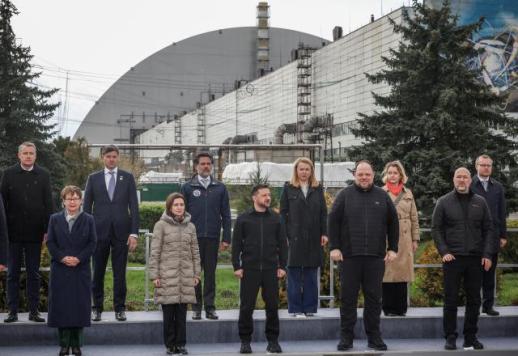 Chernobyl at 40: Nuclear Power Recast as a Strategic Asset Amid Energy and AI Demand On April 26, 1986, the explosion of Unit 4 at the Soviet-era Chernobyl nuclear plant was more than an environmental disaster. The radioactive cloud darkened not only Europe’s soil but also public trust in nuclear power for a generation. In 2026, as the disaster reaches its 40th anniversary, the world is paradoxically turning back toward nuclear energy. Geopolitical instability in the Middle East continues to rattle energy markets, and Russia’s invasion of Ukraine has exposed Europe’s energy-security vulnerabilities. At the same time, surging electricity demand tied to the artificial intelligence boom and the urgency of the climate crisis are driving a reassessment of nuclear power — from a symbol of fear to a strategic asset. “Chernobyl was an outlier” — engineers weigh what has changed For decades, Chernobyl served as the ultimate warning for opponents of nuclear power. More recently, expert debate has shifted from broad claims that “nuclear is dangerous” to closer analysis of which reactor designs are risky and under what conditions. Jacopo Buongiorno, a professor of nuclear engineering at MIT, described Chernobyl as “an outlier” caused by a flawed RBMK design without a containment structure and reckless actions. Sarah A. Pozzi, a University of Michigan professor and president of the IEEE Nuclear and Plasma Sciences Society, said no modern reactor approved under Western regulatory systems includes all of the defects present at the time. Some experts also point to changes in reactor physics. Steven Lyman, a University of Michigan professor, cited the Soviet graphite-moderated RBMK design as central to the Chernobyl disaster. He said modern water-moderated reactors cannot experience a Chernobyl-style meltdown, describing a physical safety mechanism in which overheating causes water coolant to boil off and naturally slows the nuclear reaction. Lyman added that, as the Fukushima accident showed, the principle does not eliminate risk but can reduce the severity of an accident. He said nuclear power matters as “scalable clean baseload power,” but high upfront costs remain the biggest obstacle. If small modular reactors, or SMRs, can bring initial costs down to a manageable level, he said, that barrier could be overcome. Nuclear’s return in numbers: “An answer for energy security” Nuclear power currently supplies about 10% of global electricity and about 25% of low-carbon power. More than 400 reactors are operating in 31 countries, and about 70 more are under construction. The United States, the world’s largest nuclear-power nation, operates 94 reactors and plans to quadruple capacity by 2050. Thomas DiNanno, a U.S. State Department deputy assistant secretary, recently said, “The world cannot power industry, meet AI demand, or secure its energy future without nuclear power.” China is building about 40 reactors, signaling it could surpass the United States. Even Germany, long a symbol of anti-nuclear sentiment, is showing signs of reconsideration. European Commission President Ursula von der Leyen, referring to the past rise in reliance on fossil fuels, acknowledged that turning away from nuclear power was a “strategic mistake.” Warnings remain: “System complexity and human error” Not all experts share the optimism. R. Scott Kemp, director of MIT’s Nuclear Security and Policy Program, urged caution, noting that nuclear safety is based in large part on simulation models. “In a complex system like a reactor, it is difficult to fully predict every interaction,” he said. Kemp emphasized that human misjudgment has played a role in major accidents and warned that “a Chernobyl-type accident is absolutely possible even today.” Even if modern plants are safer, he said, unexpected accidents cannot be ruled out if human understanding of the system is incomplete. A new front: SMRs and South Korea’s challenge The next battleground in the nuclear market is SMRs. The factory-built, on-site “plug-and-play” approach promises lower costs and faster deployment. But the BBC and other foreign media have cautioned that SMRs’ commercial viability has not yet been fully proven. That is where South Korea is drawing attention. The country has a top-tier supply chain capable of building standardized reactors such as the APR-1400 on budget and on schedule. But domestic conditions are complicated, with lingering fears after Fukushima, local opposition known as NIMBY sentiment, and policy uncertainty still weighing on the sector. Experts including Lee Jeong-ik, a professor at KAIST, have said South Korea’s 12th Basic Plan for Long-term Electricity Supply and Demand still falls short of delivering a full revival of the nuclear industry. Forty years after Chernobyl, the international order around nuclear power has shifted. Nuclear energy is increasingly framed not as an automatic object of fear, but as a practical option tied to survival. With climate pressures, energy security and AI-driven electricity demand converging in 2026, the question being asked is no longer whether societies can afford to live with nuclear power, but whether they can afford to live without it. 2026-04-29 11:37:29
 -
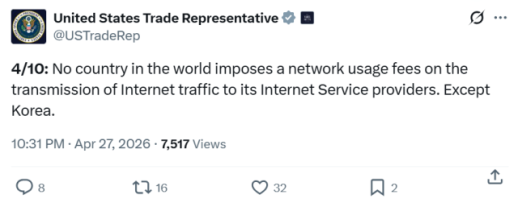 Digital flashpoint: Korea's network fee concept draws renewed U.S. scrutiny SEOUL, April 28 (AJP) - A long-simmering domestic dispute over "network usage fees" has now boiled over into a major diplomatic friction point, as Washington ramps up pressure on Seoul to drop proposed legislation that would force U.S. tech giants to pay for data traffic. The rhetoric from Washington reached a new peak this week. In a blunt post on X, the Office of the U.S. Trade Representative (USTR) labeled South Korea’s mooted network fee policy as one of the "Craziest Foreign Trade Barriers Facing American Exporters." The USTR’s 2026 National Trade Estimate Report, released March 31, categorized the issue as a significant service trade barrier. "No country in the world imposes network usage fees on the transmission of internet traffic... Except Korea," the agency wrote, grouping the fees with other "digital concerns" like platform regulation and location-data export restrictions. As video streaming, cloud computing, and AI drive data consumption to record highs, the fundamental question is: Should the "senders" pay the ISPs? Local giants SK Telecom, KT, and LG Uplus argue that foreign "Big Tech" firms like YouTube and Netflix are free-riders. They claim these platforms profit from South Korea’s world-class infrastructure without contributing to its maintenance. "It is unfair that Korean companies are being discriminated against," says Choi Min-hee, chair of the National Assembly’s Science and ICT Committee. Google, Meta, and Netflix argue that users already pay for internet access. Charging content providers for the same data constitutes "double billing" and violates net neutrality—the principle that ISPs should not discriminate against traffic based on volume or type. While South Korea has not yet passed a direct statutory fee, the National Assembly has seen a flurry of bills since 2021 aimed at mandating these payments. Kim Jeong-won, a former senior digital policy official, notes that while no law exists yet, "Korea is one of the countries closest to legislating such measures." This "closeness" has triggered the USTR’s preemptive strike, as the U.S. fears these fees would benefit Korean competitors and further entrench the local telecom oligopoly. While South Korean experts like Choi Won-mog of Ewha Womans University point out that Europe, Brazil, and India have debated similar "fair contribution" models, the global tide seems to be turning against the fees: The EU recently confirmed it would not adopt mandatory network fees, and Brazil dropped its network fee approach in 2024.This leaves South Korea increasingly isolated in its pursuit of a legislative solution. The timing of the USTR’s pressure is not accidental. The network fee dispute is being folded into a broader trade narrative involving Section 301 investigations and the Trump administration’s focus on the trade deficit. For Washington, digital services are a rare bright spot in the balance sheet. Protecting that surplus is a priority, especially following President Lee Jae Myung’s pledge to invest $350 billion in the United States—a commitment Washington views as a baseline for cooperation, not a free pass for digital regulation. The 2023 resolution of the legal battle between SK Broadband and Netflix—which ended in a "strategic partnership" rather than a court-mandated fee—may offer a blueprint for the future. "A practical solution would be to resolve this issue through agreements between the companies involved," suggests Kim Jeong-won. However, as the rhetoric from both capitals sharpens, the "invisible walls" of the internet may become the next major hurdle in the K-U.S. alliance. 2026-04-28 18:04:24
 -
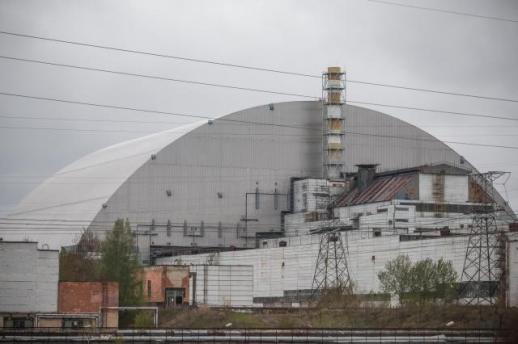 Forty years after Chernobyl and nuclear power is back in vogue SEOUL, April 27 (AJP) - Forty years ago today, the Chernobyl Nuclear Power Plant became a global epitaph for technological hubris. The radioactive clouds that drifted across Europe did more than contaminate soil; they poisoned the public's trust in the atom for a generation. In a historical paradox, the very anniversary of the disaster finds the world—and South Korea included—sprinting back toward nuclear energy with newfound urgency. The shift is being driven by today's "perfect storm": a volatile Middle East destabilizing energy markets, the relentless power hunger of the AI revolution, and the unforgiving clock of the climate crisis. For decades, Chernobyl stood as the ultimate cautionary tale. However, the narrative among experts has shifted from categorical fear to forensic distinction. "Chernobyl was a bizarre event stemming from reckless behavior and a flawed RBMK design that lacked a containment structure," says Jacopo Buongiorno, professor of nuclear science at MIT. Modern engineering has effectively "designed out" the vulnerabilities of the past. Today’s Western-standard reactors, such as the AP1000 or South Korea’s APR-1400, utilize passive safety systems—mechanisms that rely on the laws of physics, like gravity and natural convection, to cool a core without human intervention or external power. “No modern reactor approved under a Western regulatory framework combines those characteristics,” said Sara A. Pozzi, professor of nuclear engineering and radiological sciences at the University of Michigan and president of the IEEE Nuclear and Plasma Sciences Society. Nuclear energy is now undergoing a broad reassessment, driven by converging pressures: climate change, energy security, and surging electricity demand from artificial intelligence and digital infrastructure. It already covers roughly 10 percent of global electricity and about a quarter of all low-carbon power. More than 400 nuclear reactors are in operation across 31 countries, with about 70 more under construction. The United States remains the largest producer, operating 94 reactors and aiming to quadruple nuclear capacity by 2050. China, meanwhile, is rapidly expanding, with nearly 40 reactors under construction and ambitions to surpass the U.S. “The world cannot power its industries, meet the demands of artificial intelligence or secure its energy future without nuclear power,” U.S. Undersecretary of State Thomas DiNanno said recently. Even Europe, once the epicenter of anti-nuclear sentiment, is shifting its stance. European Commission President Ursula von der Leyen has acknowledged that turning away from nuclear energy was a “strategic mistake,” citing the continent’s growing dependence on imported fossil fuels. Geopolitical shocks have accelerated the shift. Russia’s invasion of Ukraine exposed Europe’s energy vulnerabilities, while Middle East tensions have underscored the fragility of global supply chains. Ukraine itself still relies on nuclear power for roughly half its electricity—even during wartime. In this environment, nuclear energy is no longer viewed solely as a climate solution, but increasingly as a strategic asset. “Nuclear power is among the safest and cleanest power options,” said Daniel Hoornweg, faculty member in engineering and applied science at Ontario Tech University. “Yes, they are safe—historical accidents cannot happen,” Pavel Tsvetkov of Texas A&M University also assured. But the drawbacks are equally clear: high upfront costs, long construction timelines, regulatory hurdles and persistent public skepticism. Waste management and proliferation concerns remain unresolved, complicating expansion. “The challenges with Fukushima and TMI are largely about public perception,” Hoornweg added. At the forefront of the next phase are small modular reactors (SMRs), which promise lower costs, faster deployment and greater flexibility. Yet their commercial viability remains uncertain. While pilot projects are underway, particularly in Canada, their economics are still unproven. “They may remain a niche solution,” Hoornweg added. “SMRs are not commercially available yet,” Buongiorno agreed. South Korea remains a titan in the nuclear sector, boasting a robust supply chain and the rare ability to build reactors on time and within budget. However, the domestic path is fraught with political and social friction. While the current administration has signaled support, domestic experts like Lee Jeong-ik of KAIST argue that policy has yet to fully revitalize the industry. The 12th Basic Plan for Electricity Supply and Demand remains a point of contention, with critics arguing it lacks the aggressive expansion needed for Small Modular Reactors (SMRs)—the factory-built, "plug-and-play" future of the industry, he pointed out. The massive upfront costs and the perennial "NIMBY" (Not In My Backyard) sentiment also pose setback. For Koreans, the memories of the 2011 Fukushima meltdown remain vivid, even as the "inconvenience" of energy price hikes pushes the public toward pragmatic acceptance. As the world marks four decades since the tragedy in Ukraine, the atom has undergone a profound rebranding. It is no longer just a source of fear, but a source of possibility. The question for 2026 is no longer whether we can afford to live with nuclear power, but whether we can afford to live without it. 2026-04-27 18:08:47
 -
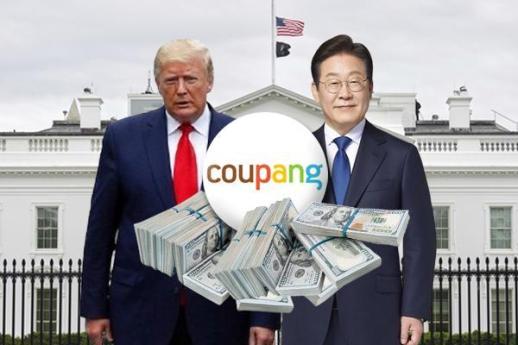 Coupang overstretches into security front, stirring Korea-U.S. friction SEOUL, April 24 (AJP) - In a rare and uneasy convergence, a retail dispute has spilled into the security domain between Seoul and Washington, underscoring the growing political reach of Coupang, a New York-listed retailer whose business is almost entirely rooted in South Korea. According to lobbying disclosure reports filed with the U.S. Congress, Coupang spent a combined $1.785 million in the first quarter of 2026 – nearly doubled from $895,000 in the previous quarter - as political and legal scrutiny mounted for a massive data leak in Korea last November. The filings show that Coupang not only boosted its in-house lobbying to $1.09 million, but also expanded its roster of external firms, adding Ballard Partners, Crossroads Strategies and Williams & Jensen to existing partners including Miller Strategies, Continental Strategy and Monument Advocacy. While the disclosed amount reflects only direct lobbying activities required under U.S. law, it excludes broader advisory and strategic consulting fees, suggesting total spending may be significantly higher. The scope of engagement has also widened. In late 2025, Coupang’s lobbying focused largely on trade-related agencies such as the Commerce Department, the Office of the U.S. Trade Representative and the State Department. By early 2026, outreach had expanded to include the White House, the Office of the Vice President and even the National Security Council, indicating that discussions may have entered security-sensitive territory. The involvement of high-profile lobbyists with deep ties to U.S. policymakers — including figures connected to Secretary of State Marco Rubio and former White House advisory teams — underscores the strategic nature of the campaign. Its efforts appear to have paid off. U.S. Vice President J.D. Vance reportedly raised concerns about Coupang during a January meeting with South Korean Prime Minister Kim Min-seok, while Rubio has also referenced the company in discussions with Korean officials. The issue further blew over this week when 54 Republican lawmakers affiliated with the Republican Study Committee sent a letter to South Korea’s ambassador in Washington, urging Seoul to halt what they described as “discriminatory regulations” against U.S. firms — explicitly naming Coupang alongside Apple Inc., Alphabet Inc.’s Google and Meta Platforms Inc.. According to people familiar with the matter, U.S. officials have also conveyed concerns through diplomatic channels about potential legal actions against Coupang Chairman Bom Kim, warning such moves could complicate high-level security consultations between the allies. Underscoring the elevation of the agenda, South Korea’s National Security Adviser Wi Sung-lac acknowledged the spillover effect during an overseas briefing while accompanying the president in Vietnam. “This is fundamentally a corporate issue, but it is true that it is influencing security consultations between South Korea and the United States,” Wi said. “We do not believe it is desirable for corporate matters and security negotiations to become linked.” He added that delays in security talks are already occurring and warned that prolonged disruptions could harm the alliance. At home, the response has been more forceful. National Assembly Speaker Woo Won-shik described the U.S. lawmakers’ letter as “a clear interference in domestic affairs,” stressing that companies operating in Korea must comply with Korean law. “There have been large-scale personal data leaks and allegations of algorithm manipulation. These are clear violations of current law,” Woo said. The company denied any wrongdoing and dismissed claims that its lobbying extends into security issues as “categorically false,” stating its activities focus on economic cooperation, trade expansion and technology partnerships, including artificial intelligence initiatives. It also emphasized that its lobbying expenditures remain modest compared with other major U.S. and Korean corporations. Founded in 2010 by Bom Kim, Coupang has grown into South Korea’s largest e-commerce platform, often compared to Amazon for its logistics-driven model and rapid delivery services. Headquartered in Seattle, incorporated in Delaware and listed on the New York Stock Exchange, it occupies an ambiguous identity — structurally American, operationally Korean. Its rapid growth has been accompanied by controversy. The company has faced criticism over industrial safety conditions in its logistics network, with several worker deaths linked by labor groups to harsh working conditions. It has also been embroiled in a major personal data breach that intensified regulatory scrutiny, alongside allegations of algorithm manipulation to favor its own products — claims the company denies. The dispute may ultimately move into the courts, with lawmakers exploring legal options including class action mechanisms. “We are reviewing class action legislation,” said Kim Yong-min of the Democratic Party of Korea, noting that such systems are already well established in the United States. Meanwhile, Lee Un-ju, a member of the party’s Supreme Council, pointed to a fundamental perception gap in Washington. “In the United States, people tend to think of Coupang simply as an American company,” she said. “They don’t realize that most of its revenue is generated in Korea, and that the majority of victims in the personal data breach are also in Korea.” Lee said she conveyed this view directly to U.S. policymakers during a recent visit, emphasizing that understanding Coupang’s operational reality is key to evaluating the dispute. “It is very important to recognize that Coupang is, in effect, a Korean company,” she said. 2026-04-24 16:37:51
 -
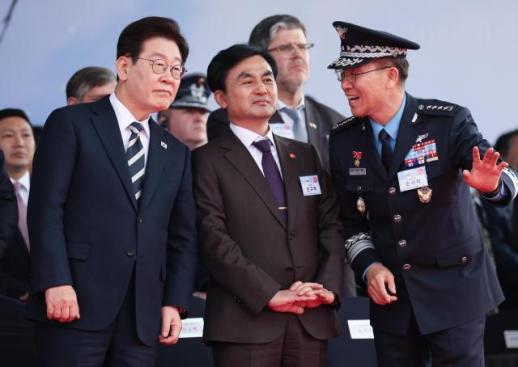 Seoul pushes for wartime command transfer as U.S. urges caution on timeline SEOUL, April 23 (AJP) - A long-simmering question at the heart of the U.S.–South Korea alliance is once again coming into sharper focus: when — and under what conditions — should Seoul take full wartime command of its own and U.S. military forces on the peninsula? Behind the scenes, officials in Seoul and Washington are quietly diverging over the timeline for transferring wartime operational control, or OPCON, with South Korea favoring an earlier date and U.S. military leaders urging a slower, conditions-based approach. Timeline divides the allies South Korean officials have been working toward completing the transition before 2028, aligning with President Lee Jae Myung’s term in office. But recent comments by Gen. Xavier Brunson, commander of U.S. Forces Korea, suggest Washington may be working on a different timeline. “Political expediency must not outpace the conditions,” Gen. Brunson said in congressional testimony on Tuesday (local time), cautioning against setting deadlines that could compromise readiness. According to defense officials familiar with the discussions, the U.S. military has been working internally toward a target closer to early 2029 — a timeline not fully coordinated with Seoul. A South Korean government official, speaking on condition of anonymity, acknowledged the gap. “We are not fundamentally apart on the goal,” the official said. “But there is clearly a difference in how fast we believe we can get there.” Political pressure vs. military conditions Operational control of South Korean troops was handed over to the U.S.-led U.N. Command during the 1950–53 Korean War and later transferred to the Combined Forces Command in 1978. Peacetime operational control reverted to Seoul in 1994. The OPCON transition would place combined Korea–U.S. forces under the command of a four-star South Korean general in wartime, with a four-star U.S. general serving in a supporting role. At the center of the timing debate is a tension between political preference and military preparedness. Rep. Yoo Yong-won, a senior opposition People Power Party lawmaker on the National Assembly’s Defense Committee, criticized what he described as the prioritization of political considerations. “The government is pushing this too hard because it wants to achieve it within its term,” he said. “That is not desirable. The conditions must come first.” Experts with military and intelligence backgrounds also stressed that the OPCON transfer is fundamentally a structural security issue. Chae Sung-jun, a former National Intelligence Service (NIS) official and now head of the Department of Military Studies at Seokyeong University, said the transition must be approached with caution. “This is not simply about reclaiming authority,” he said. “It is about maintaining deterrence under a new command structure — and that is far more complex.” He added that the issue should be understood in its historical and strategic context. “The debate is not about whether to regain control, but how to integrate wartime command into an alliance structure without weakening deterrence,” he said. Lingering dependence Despite improvements in South Korea’s military capabilities, reliance on U.S. assets remains significant. Yoon Sang-yong, a military studies professor at Seokyeong University, pointed to persistent gaps in intelligence and operational integration. “We are still heavily dependent on U.S. intelligence, surveillance and reconnaissance assets,” he said. “These are not capabilities that can be replaced quickly.” He also raised concerns about alliance dynamics after the transfer. “If the command structure changes, there is a legitimate question as to whether the United States will respond with the same level of immediacy and scale in a crisis,” he said. Alliance in transition For Washington, the issue is shaped by long-standing institutional norms. The U.S. military has historically been reluctant to place its personnel under full foreign command — a practice sometimes referred to as the “Pershing Principle.” However, it has granted operational control to foreign commanders in joint-force arrangements during combat. At the same time, American strategy is shifting toward encouraging allies to assume greater responsibility for regional security. This creates a delicate balance: supporting South Korea’s autonomy while ensuring that the alliance’s deterrence posture remains intact. The risk of miscalculation Security experts warn that how the transition is handled could influence North Korea’s strategic calculations. “Command structures send signals,” Chae said. “If the transition is not backed by sufficient capability, it could invite miscalculation.” Others argue that further delays could undermine South Korea’s credibility as a self-reliant military power. A narrow window The coming months will be critical, with working-level consultations expected to intensify ahead of the annual Security Consultative Meeting in Washington later this year. A senior South Korean defense official, speaking anonymously, emphasized the stakes. “This is ultimately both a military and political decision,” the official said. “But if the balance is wrong, the consequences will be strategic.” 2026-04-23 18:00:39
 -
 Unregulated Fight Videos Spread Online in South Korea, Reaching Teens In the 1999 U.S. film “Fight Club,” the first rule is not to talk about it. In today’s South Korean version, that taboo has collapsed. Violence is no longer confined to the shadows; it is filmed, distributed and monetized as content. Fight videos are spreading quickly on social media and streaming platforms such as YouTube and Telegram. Blurring the line between sport and violence, the genre draws millions of views and has become a form of mass entertainment — echoing the voyeuristic consumption of violence depicted in Netflix’s “Squid Game.” At the center is so-called “yacha rule,” an informal fighting format presented as consensual. Promoted as a “raw, real fight,” it has spread rapidly. One video titled “Real fight between construction workers in their 20s #yacharule” has surpassed 12 million views. The footage shows two shirtless men trading punches as a crowd watches, evoking a modern-day coliseum. The name is believed to come from “yacha,” a predatory being in Buddhist folklore. Unlike mixed martial arts or boxing, there is little protective gear and few rules; the main restriction is a ban on eye-gouging. Viewers cite that unfiltered “realism” as the appeal. The market is sizable. Related YouTube channels have logged more than 180 million cumulative views, and individual videos often reach the millions. Given the advertising model, violence itself functions as a revenue stream. The concern is how far it is spilling into everyday life. Some creators, claiming “teaching a lesson,” seek out specific people, fight them and livestream it. More alarming is the spread into teen spaces. One Telegram channel was reported to buy and distribute real assault videos involving minors, paying providers from 5,000 won to 50,000 won. Many clips show victims bleeding or losing consciousness. Viewers are not just observers. Through comments, donations and sharing, they participate, and some videos are paired with gambling ads. A violence-centered “ecosystem” is taking shape. Experts link the trend to human instincts. Rosie Dirt, a professor of psychology at the University of North Carolina, said people are naturally drawn to threat and conflict, and violent stimuli grab attention quickly and hold it. As that “safe danger” experience is reinforced online, she said, people’s sensitivity to violence can dull over time. Social learning also plays a role. Under psychologist Albert Bandura’s theory, if repeated behavior is shown being rewarded, it can come to be seen as normal. The more fights are packaged as happening under “agreed rules,” the more likely viewers are to justify violence, experts say. Dirt said sustained exposure to violent media can lead to desensitization, reduced emotional response and gradual shifts in what people see as socially acceptable aggression. When such content is rewarded with visibility and attention online, she said, imitation or performative violence can increase. The University of North Carolina’s Rosa Lee introduced “socialization effects” — the tendency to become more like one’s group, environment and consumed content — and “selection effects,” in which people with violent tendencies consume more violent content or choose like-minded friends. Lee said when those psychological tendencies combine with social media algorithms, a nontraditional form of socialization can occur, allowing violent content to shape thinking and behavior. She said the interview request reminded her of decadeslong debates over the effects of violent TV shows, films and video games. In 2021, 13-year-old Olly Stephens in the United Kingdom was stabbed to death by peers. He went to a park after being lured by a girl he knew and was ambushed by two boys. The attack was later found to have been planned amid conflict and message exchanges on social media. The British daily The Times said the case was not only a personal tragedy but also an example of rising teen knife crime and the influence of the online environment. It said teen knife-related deaths in the U.K. have risen sharply in recent years, driven in part by social media. The victim’s parents have since campaigned for stronger social media regulation and youth protections, and experts have said online conditions and access to weapons must be addressed together. The Washington Post also analyzed the impact of graphic video on young people after the killing of Charlie Kirk in Utah in September 2025, when footage of his death spread rapidly on social media and reached children and teens. The video circulated quickly on major platforms including TikTok, Instagram and YouTube, and some students shared or watched it at school. Parents said they were shocked their children saw the images without warning. Some teens responded that it was “shocking but important” or “just weird,” raising concerns about desensitization. The Post said the spread was tied to algorithmic systems that prioritize sensational, attention-grabbing content. Platforms tried to remove the video or apply age limits, but altered versions kept appearing, making control difficult. Parental controls also failed to work effectively. Experts called for stronger regulation and urged parents to talk with children and respond actively. Legal judgment is clear, experts say. Seong Jung-tak, a professor at Kyungpook National University Law School, said yacha rule is unlikely to receive a legal pass even if there was “consent.” Assault causing injury is not a crime that can be dropped solely at the victim’s request, he said, meaning investigations and punishment can proceed even if the victim signs an agreement saying they do not want the attacker punished. Seong cited a Supreme Court ruling that when a victim’s consent violates social norms, illegality is not removed. Legal responsibility may extend beyond the fighters. Watching or distributing yacha rule content can also be punished under the Criminal Act, the Information and Communications Network Act and the Juvenile Protection Act. As Rome’s Colosseum showed, violence has long been part of entertainment. But the current shift is different in kind: the boundary between reality and performance is fading, and audiences are moving from passive consumers to active participants. As violence-as-content spreads, calls are growing for debate over how to regulate it — and how to build stronger protections for minors. 2026-04-23 10:52:19
 -
 How a single remark exposed deeper fault lines in U.S.–South Korea relation SEOUL, April 22 (AJP) - When South Korean Unification Minister Chung Dong-young told lawmakers in March that North Korea was operating uranium enrichment facilities in Yongbyon, Kangson and Kusong, he intended to highlight the growing sophistication of its nuclear program. Instead, his remarks triggered an intelligence dispute with Washington and a controversy within the highly divisive Korean society. At the heart of the dispute is Kusong, a location that Washington claims had never been officially acknowledged at such a high level. That is not to say it had not appeared in open-source analyses, according to Chung's defense. "This statement was based on publicly available sources, including reports by the Institute for Science and International Security and media reports," the minister said in a recent interview. "Framing this as a leak of classified information is deeply regrettable and raises questions about the motive." A ministry spokesperson followed up by stating that "no such information was provided by any foreign government." Despite these denials, U.S. concerns appear to center on perception rather than strict classification boundaries as intelligence-sharing relationships depend not only on what is disclosed, but also on how it is publicly framed. Victor Cha, Korea chair at the Center for Strategic and International Studies (CSIS), pushed back directly against Chung’s justification. "We did not report on enrichment activities, which is the claim by the minister. We reported on high-explosive test triggers. Big difference," Cha wrote on X on Tuesday. "CSIS has never done a report on nuclear facilities at Kusong. Just setting the record straight." This distinction is significant. While earlier research pointed to possible high-explosives testing in Kusong — relevant to nuclear detonation mechanisms — it did not confirm uranium enrichment activities. For U.S. officials, conflating the two could imply a higher level of certainty than the intelligence supports. Analysts suggest that Washington's response reflects accumulated frustration over a range of issues rather than a single incident. "It is possible that accumulated dissatisfaction between South Korea and the United States over North Korea and foreign policy has surfaced through the minister's remarks," said Hwang Jin-tae, a professor of North Korean studies at Dongguk University. "The United States may suspect that sensitive information it collected was used as the basis for the statement." Recent flashpoints include South Korea's push for greater control over the Demilitarized Zone (DMZ), debates over joint military exercises, and disagreements over communication regarding U.S. Forces Korea operations. The reported restriction of intelligence sharing underscores how sensitive the issue has become. "Reports say the United States has withheld 50 to 100 pages of North Korea-related intelligence per day for a week," People Power Party lawmaker Kim Gunn wrote on Facebook on Tuesday. "This is a serious issue that must be resolved quickly." "In foreign and security affairs, remarks by senior officials are not personal opinions," Kim said. "They are strategic messages. Especially on sensitive issues like North Korea's nuclear program, government messaging must be precise and fact-based." However, not everyone agrees with Washington's response. "There is no doubt that the existence of nuclear-related facilities in Kusong had already been widely known through academic papers and media reports," President Lee Jae Myung wrote on X on Monday in defense of his minister. The controversy has quickly become politicized in Seoul. Conservative lawmakers have accused Chung of undermining trust, while progressives argue he has been unfairly targeted. "Restricting information unilaterally when it is not classified violates the spirit of the alliance," said Yang Moo-jin, a professor at the University of North Korean Studies. "The Kusong uranium enrichment issue has already been disclosed publicly, so it is clearly not subject to protection." "Amplifying this issue domestically does not help the U.S.–South Korea alliance," he added. Beyond the political fallout lies the core concern that Pyongyang's nuclear program is expanding beyond known facilities. Historically, Kusong has been associated with high-explosives testing. Identifying it as a uranium enrichment site marks a significant escalation in official rhetoric — one that carries strategic implications for both intelligence assessment and diplomacy. Ultimately, the Kusong controversy is less about whether the information was technically classified and more about the fragile trust underpinning intelligence cooperation. Whether the two sides can manage these tensions without undermining cooperation remains an open question. 2026-04-22 17:46:55
 -
 S. Korea resumes public repatriation of Chinese war dead in sign of thaw SEOUL, April 22 (AJP) - South Korea on Tuesday repatriated the remains of Chinese soldiers killed in the 1950–53 Korean War, resuming a public handover ceremony for the first time in three years in a move seen as signaling a modest thaw in ties with Beijing. The Defense Ministry said the 13th transfer ceremony was held at Incheon International Airport, attended by Vice Defense Minister Lee Doo-hee and Xu Yao, vice minister of China’s Ministry of Veterans Affairs. The remains of 12 Chinese soldiers were returned, bringing the total repatriated since 2014 to 1,023. The ceremony included the signing of transfer documents, a Chinese memorial rite and the loading of the remains onto a military aircraft. China's state broadcaster CCTV said a delegation arrived in South Korea on April 19 and departed the same day with the remains aboard a Y-20B strategic transport aircraft. Seoul had conducted the past two handovers without public ceremonies. The restoration of a formal, vice-ministerial event under the administration of President Lee Jae Myung was viewed as a gesture of goodwill. "This handover ceremony has resumed as a public event for the first time in three years, reflecting the restoration of South Korea-China relations and the spirit of good-neighborly friendship," Lee Kwang-seok, director-general for international policy at the ministry, said. "We will continue to repatriate the remains of Chinese soldiers discovered in the future." The Korean War, which began on June 25, 1950, and ended with an armistice on July 27, 1953, drew in a U.S.-led United Nations Command supporting South Korea and Chinese forces backing North Korea, turning the peninsula into a major Cold War battleground. Sixteen countries sent combat troops under the UN flag. The United States deployed about 1.79 million personnel, the largest contingent, followed by the United Kingdom, Canada, Turkey, Australia and the Philippines. Others — including Thailand, the Netherlands, Colombia, Greece, New Zealand, Ethiopia, France, Belgium, South Africa and Luxembourg — also contributed forces, while several countries provided medical and humanitarian support. China entered the war in October 1950 through the People's Volunteer Army. Chinese military deaths are estimated at between 180,000 and 400,000, though figures vary. The conflict remains one of the deadliest since World War II, with total casualties — including civilians — estimated at up to 4 million, about 70 percent of them civilians. Seoul said it will continue to return the remains of Chinese soldiers found on its soil in line with humanitarian principles and international law. 2026-04-22 14:32:02
 -
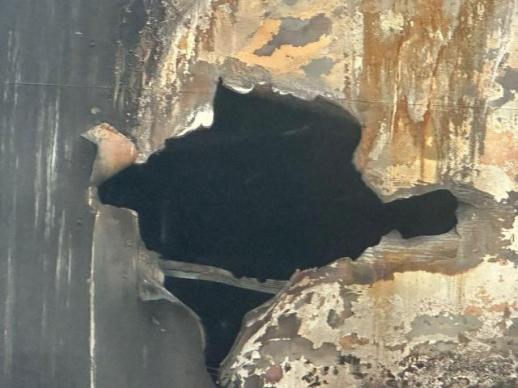 Korea's pump prices rise faster than Japan and US SEOUL, April 22 (AJP) - Kuwait’s declaration of force majeure on crude exports is adding to supply concerns at a time when South Korea’s fuel prices are already rising sharply, amplifying the impact of the prolonged Middle East conflict. State-run Kuwait Petroleum Corp. last Friday notified buyers that it would maintain contractual force majeure for an extended period, citing damage to infrastructure and the time needed to restore full operations. South Korea relied on Kuwait for 8.7 percent of its crude imports last year. With the Strait of Hormuz effectively closed for nearly two months, Seoul has been forced to turn to longer shipping routes to secure additional volumes from other Gulf producers such as Saudi Arabia and the United Arab Emirates. Unlike the two, Kuwait relies entirely on the crippled waterway to ship out its energy. The strain is already visible at the pump. Gasoline prices have climbed above 2,000 won per liter, with the national average reaching 2,003.17 won as of Tuesday, while diesel stood at 1,996.76 won, rising 18.4 percent and 25.0 percent, respectively, from Feb. 27, before the conflict escalated, according to the Ministry of Trade, Industry, and Resources Wednesday. Neighboring Japan has kept gasoline prices in the 1,500 won range — 1,527 won as of April 19 — through sustained government subsidies, limiting increases to single digits over the same period. Korea’s prices are 23.8 percent higher than Japan’s for gasoline and 28.3 percent higher for diesel. “While Korea has implemented a price ceiling, our rate of increase is more than double that of Japan,” Yang Ki-wook, deputy minister for industrial resource security, admitted at a briefing of the government’s Middle East response task force. “Japan appears to be continuing to inject substantial subsidies.” The United States presents a more mixed pattern. Gasoline prices stood at 1,586 won per liter as of April 20, about 20.8 percent below Korea’s level, while diesel was higher at 2,170 won, reflecting stronger freight demand and refining margins. The comparison comes as Seoul faces mounting calls to more aggressively curb prices through fiscal measures. Officials maintain that Korea is focused on managing the pace of increases — through a combination of price ceilings and fuel tax adjustments — rather than directly subsidizing retail prices. "With wide variations in price levels and increases across countries, whether Korea is excessively suppressing prices should be assessed in comparison with other cases,” Yang said. Korean refiners have been diversifying import sources to secure replacement volumes, but dependence on the Middle East continues to constrain flexibility. Four of Korea’s top five crude suppliers — excluding the United States — are located in the region, leaving supply exposed if disruptions persist. The pressure is also spilling into industrial supply chains. Concerns over ethylene gas — a key input derived from naphtha and used in shipbuilding — have prompted emergency coordination between the government and industry. HD Hyundai has begun producing and supplying ethylene through its affiliate HD Hyundai Chemical, shipping around 2,000 tons from the Daesan petrochemical complex to shipyards near Ulsan. About 200 tons will be allocated to smaller shipbuilders. “We will continue to expand public-private cooperation to prevent production disruptions amid supply chain instability,” Yang said. 2026-04-22 11:30:14