
Journalist

KIM NA YOON
critic@ajunews.com
-
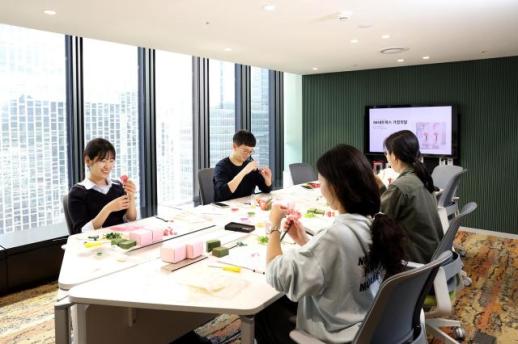 SK Networks Expands Hands-On Programs, Executive Forums to Strengthen Workplace Culture SK Networks is expanding hands-on employee programs and executive communication events as it pushes to build what it calls a company that grows together. The company said the effort goes beyond benefits, aiming to strengthen interaction and collaboration among employees through workplace culture. The company said it recently held a “carnation candle-making” event ahead of Family Month and Parents’ Day, allowing employees to create gifts for their parents. Earlier, during the Lunar New Year holiday period, it ran an “icing cookie class” where employees decorated cookies as a creative break from work. SK Networks said it continues to offer experience-based programs that support work-life balance, including a spring “Cheonggyecheon running class” and a “personal tea blending class.” The company said the activities are intended to do more than provide hobbies, helping employees communicate more naturally and build a collaborative culture. One employee who joined the icing cookie class said it was “a time to put down work stress for a while and recharge creative energy,” adding, “I hope there will be more programs like this where we can communicate comfortably with colleagues.” The company is also strengthening forums that bring management and employees together. SK Networks said it runs “SKMS Day” on the third Friday of every month, including a “Connect Time” session in which the CEO and other executives share the company’s status and direction. Connect Time includes team introductions, presentations on best practices in AI and digital transformation, an SKMS quiz and lectures by outside speakers, the company said. It is held both online and offline so all employees can participate, and it also serves as a platform where employee feedback can be reflected in management, SK Networks said. The company said interest and participation have risen this year as it has expanded content on strong AX (AI transformation) cases and practical experience sharing. SK Networks said it plans to further broaden field-focused communication to strengthen execution and organizational cohesion. “Communication between management and employees is key to strengthening execution,” a SK Networks official said. “As an AI-centered business holding company, we will continue to expand sincere communication programs to build a foundation for growth.”* This article has been translated by AI. 2026-04-29 09:28:45
 -
 Epson Korea Expands Total Labeling Solutions From Home Use to Industrial Safety Epson Korea’s dedicated label-printer brand “Namer,” launched late last year, has gained traction in the home labeler market in about four months, industry officials said. The product is being used not only for organizing items but also for diary decorating and other lifestyle uses. According to the industry on April 28, Namer is positioned as a platform for expressing personal taste and lifestyle, beyond a basic label-printing tool. The brand’s concept is “Build my world with my own name,” reflecting a consumer trend that treats organizing as a hobby for shaping one’s personal space. After the launch, Epson Korea collaborated with popular character intellectual property such as Disney and Sanrio, drawing interest from younger consumers and homemakers. Through its brand webzine, “Namer Magazine,” the company also shares labeling trends and practical ideas, building an archive so users can choose and enjoy labels in a range of styles. Epson Korea is also expanding into business-to-business demand, citing growing needs for identification and safety in construction and manufacturing sites. The company recently partnered with global power-tool brand Milwaukee to introduce a professional package called “Precise Power,” combining power tools with a durable labeling solution to help workers manage materials and equipment systematically. Growth is also evident in distribution and logistics, where on-demand printing is used for product information labels, price tags, shipping invoices and receipts. Epson Korea said printing as needed can reduce the burden of holding preprinted inventory and allow faster adjustments as work requirements change. A company official said label printers have become a tool for self-expression in daily life and a core solution for efficiency and safety in industrial settings. The official said Epson Korea will continue brand collaborations so labeling technology can create new value linking personal life and business workplaces.* This article has been translated by AI. 2026-04-29 05:03:17
 -
 Korean Unions Escalate Bonus Demands, Raising Concerns Over Competitiveness Major South Korean conglomerate unions are escalating demands for performance bonuses, prompting growing concern inside and outside industry. After SK Hynix reached a deal tying bonuses to operating profit, unions at Samsung Electronics and Hyundai Motor have followed with tougher demands. Industry officials describe it as a competitive one-upmanship in bonus negotiations. According to industry officials on April 26, Samsung’s union is demanding that 15% of operating profit be set aside for performance bonuses and that the company abolish caps on payouts. The union has also raised the possibility of a general strike. SK Hynix previously agreed to scrap a cap of 1,000% of base pay and to pay bonuses equal to 10% of operating profit. Based on projected operating profit this year, some analysts say that could allow bonuses of about 700 million won per employee. Hyundai Motor’s union also included in this year’s wage talks a demand for performance bonuses worth about 30% of last year’s net profit. Critics say bonus demands are increasingly driven less by productivity or individual performance than by comparisons with payouts at other companies. Some in the business community say SK Hynix’s unusually generous agreement spurred Samsung’s union, and that Samsung’s case is now pushing Hyundai Motor’s demands higher. In the semiconductor sector, many executives and analysts argue that much of the recent earnings strength reflects improved market conditions rather than gains in individual productivity. “Recent improvements in memory-chip results were driven decisively by rising server demand from expanded AI investment and higher prices for commodity DRAM,” one industry expert said. “Many assessments say the DRAM price increase stems from global supply-demand conditions and market shifts, making it hard to link directly to individual employees’ efforts.” Some analysts also say competitiveness in high-bandwidth memory, or HBM, reflects the combined impact of a small group of key researchers, long-term investment decisions and management judgment. Industry sources say there is discomfort with a 분위기 in which even junior employees with limited tenure demand bonuses worth hundreds of millions of won as a matter of course during an upcycle. “One semiconductor industry official said the current mood looks less like profit-sharing than a scramble for bonuses riding a market boom,” adding that “a pattern could repeat in which workers take as much as possible when times are good and then blame underinvestment when conditions turn.” Lee Gyu-bok, a former president of the Semiconductor Engineering Society, said the AI chip era will require far more capital and warned that missing development windows could cost customers to rivals. If too much money is diverted away from investment, he said, research and development schedules could slip. Some analysts say prolonged internal conflict at Samsung is being watched by Taiwanese competitors as an opportunity. Taiwanese media and industry have suggested that if production disruptions at Samsung materialize, local companies such as TSMC could gain market share and strengthen pricing leverage. Concerns are sharper in autos. Despite weaker first-quarter results as uncertainty grows from U.S. tariff burdens and a slowdown in the global electric-vehicle market, Hyundai Motor’s union is seeking what the industry describes as record-high bonuses. Some warn the stance could spread across corporate Korea alongside debate over the so-called Yellow Envelope Act. “A performance bonus itself isn’t the problem,” an industry official said. “The problem is a structure where demands surge competitively whenever the business cycle improves. If this trend hardens, weaker investment capacity and supply-chain instability could ultimately shake overall industrial competitiveness.”* This article has been translated by AI. 2026-04-26 18:04:57
 -
 LG Unveils Hybrid In-Vehicle Emergency Call System That Works Across 2G-5G Networks LG Electronics has unveiled an in-vehicle “Hybrid e-Call” system designed to quickly send crash information to emergency rescue centers after an accident. The company said April 26 that it demonstrated the system on April 23 at the 37th General Assembly of the 5G Automotive Association, a global vehicle communications group, in Gothenburg, Sweden. An e-call system is an in-car emergency communications function that automatically transmits details such as the crash location, time and vehicle information to a nearby rescue center when an accident occurs. In Europe, e-call systems have been mandatory on newly launched vehicles since 2018. Starting next year, Europe will require “NG e-Call” (Next Generation emergency-Call), a 4G- and 5G-based system. The regulation is expected to expand to regions including China and the Middle East. LG’s Hybrid e-Call is installed in a vehicle telematics control unit and supports networks from 2G through 5G. The company said it combines the fast, high-capacity data transmission of 4G and 5G with the broader coverage of 2G and 3G to minimize connectivity dead zones. LG said it has completed reliability verification and has been supplying the system to global automakers since this year. At last year’s 5GAA general assembly in Paris, LG unveiled a solution using satellite-based non-terrestrial networks, or NTN, to enable two-way in-vehicle communications in areas where terrestrial networks are difficult to access. The company is also expanding its telematics certification capabilities. LG said its VS Certification Lab, under its Vehicle Solution business division, operates a testing and evaluation system based on the international standard ISO/IEC 17025. The lab obtained accreditation last year as an authorized testing institution from the Korea Laboratory Accreditation Scheme, or KOLAS, and also secured qualifications for major European and North American communications certifications, including GCF (Global Certification Forum) and PTCRB. LG said this allows it to handle the full process in-house, from development and testing to conformity certification for vehicle communications components. “Based on world-class technology, we will further strengthen our leadership in the global telematics market,” said Lee Sang-yong, vice president and head of LG Electronics’ VS Research Laboratory.* This article has been translated by AI. 2026-04-26 10:19:08
 -
 Samsung Heat Pumps and Air Conditioners Rank No. 1 in Italy Consumer Satisfaction Survey Samsung Electronics said its HVAC products, including heat pumps and air conditioners, ranked first in an Italian consumer satisfaction survey. The company said April 26 it was named No. 1 in the heat pump and air conditioner categories in the “Best Value for Money Quality 2026” study conducted by the German Institute for Quality and Finance (ITQF). ITQF, described as a leading brand-preference research group in Italy, evaluated about 1,350 brands across 127 industries by analyzing roughly 640,000 consumer review data points. Samsung placed first in heat pumps for the third consecutive year and in air conditioners for the sixth straight year, it said. It also ranked No. 1 for six consecutive years in major home appliances such as refrigerators and washing machines, and for five straight years in vacuum cleaners. Samsung said it is strengthening its lineup of high-efficiency heat pumps as Europe’s market for environmentally friendly heating and cooling expands. Heat pumps use air heat and electricity to provide space heating and hot water, and the company said they produce less carbon emissions and offer higher energy efficiency than conventional gas boilers. Samsung said its EHS All-in-One, which received strong marks in the survey, provides air heating and cooling, floor heating and cooling, and hot-water supply using a single outdoor unit. It also includes a heat recovery function that reuses waste heat generated during cooling to improve energy efficiency. The product is designed to operate in heating mode at temperatures as low as minus 25 degrees Celsius and to supply hot water up to 65 degrees Celsius, the company said. In air conditioners, Samsung said its WindFree technology was rated highly. The company said the approach reduces direct airflow, targeting European consumers who are sensitive to drafts. Samsung said it has also applied artificial intelligence features to strengthen personalized cooling based on users’ living patterns and indoor conditions, improving energy-use efficiency and convenience. “This result shows the trust local consumers have in Samsung HVAC products,” said Ettore Giovane, an executive director at Samsung Electronics’ Italy unit. “We will continue to strengthen our competitiveness in the global HVAC market.” Samsung said it plans to expand into the electric-based heating market by launching in Korea this month heat pump boiler products that have been proven in global markets.* This article has been translated by AI. 2026-04-26 10:12:17
 -
 Samsung’s ‘Coral in Focus’ wins international awards for reef restoration using Galaxy cameras Samsung Electronics said its coral-reef restoration project, 'Coral in Focus,' which uses Galaxy smartphone camera technology, has received a series of international awards in global social contribution and marine-related categories. Samsung said April 26 that the project won a gold award in the sustainability and environmental conservation category at the 2026 Halo Awards, a global corporate social responsibility awards program. A documentary on the project also received the Coastal and Island Culture Award at the 23rd International Ocean Film Festival, a North American marine-focused film festival, Samsung said. Samsung has been running the reef restoration project since 2024, using a Galaxy camera feature called Ocean Mode. The mode is designed to reduce excessive blue tones in underwater shots and better reproduce the natural colors of coral reefs. It also aims to minimize camera shake and motion blur underwater through optimized shutter speed and multi-frame processing, the company said. Coral-reef images captured by local activists using Galaxy AI phones are sent to research institutions, where they are used to build 3D reef restoration models and support marine research. Samsung said more than 80 3D coral-reef models have been created so far, helping restore more than 20,000 corals. Samsung said it plans to make Ocean Mode available to general users through its Expert RAW app starting with the Galaxy S26 series, and to expand the feature to some additional products later.* This article has been translated by AI. 2026-04-26 10:09:16
 -
 Academics warn Samsung strike could drive customers away and disrupt supply chain With a Samsung Electronics union warning it may strike next month, an academic has cautioned that the bigger risk may be not the immediate production hit but the possibility that global customers shift orders and reshape supply chains. According to industry officials on the 26th, Song Heon-jae, a professor in the economics department at the University of Seoul, presented the analysis in a recent seminar held by the Anmin Policy Forum under the topic “The ripple effects of a Samsung Electronics union strike.” The Anmin Policy Forum is a private policy research forum chaired by Yoo Il-ho. Song estimated that if semiconductor fabs stop running, losses could reach tens of billions of won per minute, or about 1 trillion won per day. If a strike drags on, he said, the decline in operating profit in the semiconductor business could widen to as much as 10 trillion won. He said the more serious issue is weakened customer confidence and the risk of losing clients. Global big tech companies could diversify supply to competitors such as TSMC to reduce supply-chain risk, he said. “The semiconductor industry is structured so that process qualification requires enormous time and cost,” Song said. “Once a customer leaves the supply chain, it is not easy to bring them back.” Major global companies, he said, treat supply stability as a core evaluation standard. AMD reflects supply-chain resilience in ESG assessments, and NVIDIA is known to use supplier evaluation results when allocating volumes. Song divided strike-related costs into “visible costs,” such as halted production and lost sales, and “invisible costs,” such as eroded trust, delayed investment and shocks to the industrial ecosystem. He said the latter could weaken market standing and undermine industrial competitiveness. He listed key risks as weakened customer trust, permanent loss of market share, delays in AI semiconductor competition, an outflow of key talent and a deepening “Korea discount.” He also said a strike could ripple through suppliers and local economies. About 1,700 materials, parts and equipment suppliers that do business with Samsung Electronics could be affected directly or indirectly, and a production halt at the Pyeongtaek campus could add pressure on jobs and nearby businesses. Song pointed to opaque performance-bonus criteria and information asymmetry as factors behind the dispute. He recommended overhauling compensation based on objective management indicators, adding external verification mechanisms and institutionalizing pre-strike mediation procedures. “With competition in AI semiconductors intensifying, a prolonged internal conflict itself can be a significant opportunity cost,” he said. 2026-04-26 09:39:19
 -
 Why Central Asia Should Be a Strategic Market for Korea’s Export Diversification Last November, the leaders of Central Asia’s five countries met with President Donald Trump in Washington to discuss securing critical minerals, the Trump Peace Route (TRIPP) and cooperation on artificial intelligence. A platform that began as a ministerial meeting in 2015 was elevated to a leaders’ summit within 10 years, signaling the start of supply-chain and trade shifts in a region long dominated by Russian and Chinese influence. The United States is not alone. China and Japan are also strengthening C5+1 (Central Asia 5+1) cooperation with the five countries. The United States, in particular, is using the B5+1 (Business 5+1) forum to explore cooperation in agriculture, banking and finance, critical minerals, e-commerce and IT, telecommunications and logistics, and tourism. For South Korea, which is seeking both supply-chain stability and export diversification, the trend carries clear implications. Central Asia has historically served as a conduit for technology and culture among major powers such as China, Russia, Britain and Turkey. With about 130 ethnic groups maintaining distinct identities, the region also shows diverse consumer demand. Exports to Central Asia rose about 42% last year, far outpacing South Korea’s overall export growth rate of 3.8% and exceeding gains seen in many other Global South markets, including Southeast Asia, the Middle East and Latin America. While competition is intensifying in those markets, Central Asia is seeing new supply chains form due to the Russia-Ukraine situation. The region also has strong awareness of Korean consumer goods, steady economic growth and a high average birthrate close to three children, factors that point to significant growth potential. Central Asia should be viewed not as a stopgap market but as a strategic buffer as Korean companies adapt to a changing trade order. The more dependence rises on any single market, the more vulnerable firms become to external shocks. Building an early foothold in emerging markets where competition is less overheated can help spread medium- and long-term trade risks. That requires a shift in mindset from seeking a short-term export outlet to making a proactive investment in resilience. Three keywords can serve as a practical map for using Central Asia as a strategic market for export diversification: Market Test, Area Expansion and Pilot Sandbox. First, Market Test: Central Asia can be used to test export suitability across a range of products. As supply chains are reshaped, companies should use access to major local distribution channels while accounting for clearly segmented demand by income level in industries such as autos, cosmetics, food, and medical and biotech products. In Uzbekistan, the IT Park has set up overseas offices in South Korea, the United States and China to expand startup cooperation and is pursuing projects such as building green data centers. Second, Area Expansion: The region can be linked to entry into nearby large markets. In Kazakhstan, CU convenience stores and Artbox have entered for the first time in the former Soviet bloc, and BBQ Chicken is expected to enter soon. Companies should use a start in Central Asia as a bridge to Russia, where language and business conditions are similar and many Western firms have withdrawn. Kaspi, Central Asia’s largest e-commerce company, is expanding into Azerbaijan and Ukraine. Freedom Holding, a U.S.-based fintech company, is also expanding beyond Kazakhstan into Uzbekistan and Kyrgyzstan. Third, Pilot Sandbox: Central Asia has strong interest in advanced-industry cooperation, offering Korean companies opportunities to build technical data in areas such as sovereign AI, cryptocurrency, autonomous driving and drones (UAM). Kazakhstan’s Alatau new city, now under construction, is promoting regulatory sandboxes in fields including blockchain, AI and drones to attract foreign companies. Uzbekistan has also moved to improve the business environment by deciding to pilot stablecoin payments. In a fast-changing global market, Korean companies should aim to use Central Asia to succeed in diversifying exports. 2026-04-24 05:04:11
 -
 SK hynix posts record Q1 operating profit as Hyundai Motor margin slides SK hynix posted its best quarterly results on record on surging demand for artificial intelligence chips, while Hyundai Motor saw profitability weaken despite higher sales, raising fresh concerns about Korea’s growing reliance on semiconductors. On the 23rd, SK hynix said first-quarter revenue rose to 52.5763 trillion won and operating profit to 37.6103 trillion won. That was up 198.1% and 405.5% from a year earlier, respectively, and marked a record for any quarter. Its operating margin reached 72%, the company said. The results were unusual for a seasonally slow period, helped by expanding AI infrastructure investment and a shift toward higher-value products. The boom could continue as AI demand broadens from training to real-time inference, strengthening the base for memory demand. Some in the securities industry have forecast SK hynix’s annual operating profit could exceed 200 trillion won, which would place it fourth globally. Hyundai Motor and Kia, however, showed weaker profitability even as sales grew. Hyundai Motor’s first-quarter revenue rose 3.4% from a year earlier to 45.9389 trillion won, but operating profit fell 30.8% to 2.5147 trillion won. Kia, which is set to report on the 24th, is expected to post operating profit of 2.2986 trillion won, down about 24%, according to the consensus estimate cited in the report. The two automakers posted record sales in the U.S. market, but tariff costs weighed heavily on earnings, the report said. Hyundai Motor said it spent 860 billion won on tariff costs in the first quarter. Kia’s tariff costs are estimated at 500 billion to 700 billion won. Other headwinds included higher oil prices tied to the Middle East war, rising raw material prices and a weaker currency. The report said a fire at a parts supplier in Daejeon caused production disruptions of about 30,000 vehicles, while Middle East risks added pressure to both logistics costs and the sales environment. With autos, a key export industry, also hit by worsening external conditions, the profit structure of Korean industry is becoming more concentrated in semiconductors, the report said. In an AI-driven industrial reshuffle, semiconductors have moved into an outsized-profit phase, while autos remain highly exposed to policy and cost variables, it added. Kim Pil-su, a professor in the Department of Future Automotive Engineering at Daelim University, said reliance on Samsung Electronics and SK hynix for AI semiconductors such as high-bandwidth memory, or HBM, means the semiconductor tilt is likely to persist for now. He added that uncertainty over auto tariffs continues and geopolitical risks in the Middle East are growing. 2026-04-23 18:04:17
 -
 SK hynix sees strong AI-driven memory demand; targets HBM4E mass production in 2027 SK hynix said it expects the memory upcycle to remain strong as demand tied to artificial intelligence expands, and it outlined plans to strengthen its lead in high-bandwidth memory by applying its 1c-nanometer process to next-generation HBM4E. In a first-quarter 2026 earnings conference call on Wednesday, the company reported revenue of 12.4296 trillion won and operating profit of 5.2886 trillion won. SK hynix said some demand has softened in PCs and mobile devices due to rising prices, but server memory demand remains strong and is driving the broader market. It added that as AI spreads, demand for high-performance memory is rising quickly and customers are increasingly prioritizing securing supply over price. The company forecast higher shipments in the second quarter. It said DRAM shipments are expected to rise by a high single-digit percentage from the previous quarter, supported by high-capacity server modules and mobile demand. NAND shipments are expected to increase in the mid-teens, driven by 321-layer products and expanded enterprise SSD sales, it said. SK hynix again highlighted its HBM competitiveness, saying the business depends on overall strength that includes yield and supply stability as well as performance. It said it is preparing to supply HBM4 in line with customers’ mass-production schedules and that demand over the next three years will far exceed current capacity. Still, it said it will maintain a balanced supply strategy between HBM and conventional DRAM within limited production capacity. On HBM4E, the company said it plans to apply its 1c-nanometer process to the core die to meet customer performance requirements. It said it aims to provide samples in the second half of the year and pursue mass production in 2027, adding that the 1c-nanometer process has already reached a stable stage in manufacturability and yield. SK hynix also projected a prolonged supply shortage. It said spot-price swings are not representative of the overall market, and that demand is rising for HBM, server DRAM and enterprise SSDs while supply growth remains limited. If the imbalance persists, the memory price upcycle could last longer than in the past, it said. The company said changes in AI technology are also supporting demand. It said memory-efficiency technologies are evolving to maximize information processing per unit of memory, creating a virtuous cycle that expands the AI services market and increases memory demand. On investment and supply strategy, SK hynix said it sees limited risk of oversupply and will proceed as planned with mid- to long-term investments to secure production capacity, centered on its Yongin cluster. It said long-term supply agreements can improve demand visibility, but current supply constraints make it difficult to meet all customer requests. SK hynix also outlined financial and shareholder-return plans. It said securing financial soundness with net cash of more than 100 trillion won and expanding dividends are goals that can be pursued at the same time. It added that it plans to prepare additional shareholder-return measures, including share buybacks and cancellations, within the year. The company said it is also pursuing access to U.S. capital markets. It said it has submitted a registration statement for an ADR listing and is aiming to list within the year, with details to be decided based on market conditions and other factors.* This article has been translated by AI. 2026-04-23 10:46:15