

Journalist

Seo Hye Seung, Kim Yeon-jae
duswogmlwo77@ajupress.com
-
 Korean bond yields soar as if in tightening cycle amid widening Gulf war SEOUL, Mar. 13 (AJP) — South Korean government bond yields are climbing sharply as investors demand higher risk premiums amid intensifying conflict in the Middle East and a renewed rise in global interest rates. Yields on sovereign debt have followed a steep upward trajectory since the beginning of the year, reflecting both external shocks and shifting global capital flows. According to the Korea Financial Investment Association (KOFIA) on Friday, the three-year government bond yield rose 6.7 basis points to close at 3.338 percent, while the 10-year yield gained 5.2 basis points to finish at 3.701 percent. The benchmark 10-year yield has breached the 3.7 percent threshold four times this year, including a sharp 12.3 basis point surge on March 9. The pace of the increase has been striking. From the market close on Jan. 2 to the March 9 peak, three-year and 10-year yields rose by 48.5 basis points and 35.3 basis points, respectively — a rapid adjustment even by the standards of recent global tightening cycles. The March 9 jump marked the largest single-day spike since Sept. 26, 2022, when global bond markets were roiled by the United Kingdom’s ill-fated “mini-budget.” At that time, Korean yields surged by 34.9 basis points for the three-year tenor and 22.3 basis points for the 10-year bond in a single session. Market participants say the current move is less about domestic growth optimism and more about rising geopolitical risk and inflation concerns as the Middle East conflict pushes oil prices back toward the $100-per-barrel mark. The yield spread between South Korea and the United States has also narrowed considerably. As of March 9, the gap between the U.S. 10-year Treasury yield, at 4.13 percent, and Korea’s 10-year government bond yield stood at roughly 39.5 basis points. Under normal circumstances, a narrowing differential would lend support to the Korean won by making local assets relatively more attractive. The currency’s continued weakness, however, suggests that investors are demanding additional compensation for risk rather than expressing confidence in the domestic outlook. In other words, the market is repricing geopolitical uncertainty rather than rewarding growth prospects — a dynamic that could accelerate the global shift toward traditional safe-haven assets. Foreign capital flows remain a critical variable. According to the Bank of Korea (BOK), overseas investment in South Korean government bonds recorded seven consecutive months of net inflows through February. But traders say the heightened volatility in yields and the exchange rate this month raises the risk of a reversal. The pressure is compounded by a renewed climb in U.S. Treasury yields. The U.S. 10-year benchmark has recently risen to 4.277 percent, potentially widening the yield gap again and drawing global liquidity back toward dollar assets. Even so, policymakers stress that the current market turbulence bears little resemblance to the systemic stress seen during the 1997 Asian Financial Crisis. Bank of Korea Governor Rhee Chang-yong noted that South Korea’s macroeconomic fundamentals remain significantly stronger today. The country now holds more than $400 billion in foreign exchange reserves, compared with roughly $20 billion at the height of the 1997 crisis, and has since become a net external creditor. “If you are referring to the risk of national sovereign default, I do not agree,” Rhee said during a press briefing on inflation at the Bank of Korea on Dec. 17 last year, dismissing alarmist interpretations of rising yields. Still, with oil prices surging, shipping routes through the Strait of Hormuz under strain and global bond markets resetting higher, Korean debt markets are likely to remain sensitive to external shocks in the weeks ahead. 2026-03-13 17:34:51
 -
 Korea's M2 rise picks up in Jan as stock invest and dollar savings pile up SEOUL, Mar 13 (AJP) —South Korea’s M2 money supply grew at a faster pace in January than previous months on strong stock market and U.S.-dollar-denominated savings on expectations of continued greenback strength. According to a Bank of Korea (BOK) release on Friday, the M2 money supply grew 0.7 percent month-on-month in January to reach 4,108.9 trillion won ($2.83 trillion). Under the previous M2 standard (used prior to November statistics), the figure rose 1.2 percent to 4,521.1 trillion won, indicating an even sharper upward trend. The M2 money supply grew by 4.5 percent throughout 2025 (under the new standard) and 7.4 percent (under the previous standard), a marked acceleration from the 3.3 percent and 5.6 percent growth rates recorded in 2024. Compared to January of last year, M2 increased by 4.6 percent (new) and 8.4 percent (previous). While the growth rate under the new standard—which excludes ETFs and long-term deposits—narrowed by 0.1 percentage points, the previous standard showed an expansion of 0.4 percentage points. The expansion was largely fueled by a stellar performance in the South Korean stock market in January. The benchmark KOSPI surged more than 21 percent in a single month, rising from 4,309.63 on Jan. 2 to close at 5,224.36 on Jan. 30. The tech-heavy KOSDAQ followed suit, jumping over 20 percent to finish the month at 1,149.21. KOSPI was trading down 1.3 percent at 5,510 Friday. After hitting an all-time high of 6,307.27 on Feb. 26, the index suffered a 20 percent plunge in early March, triggered by the Middle East crisis and the blockade of the Strait of Hormuz. Liquidity in other financial institutions, including asset management firms, increased by 15.2 trillion won, reflecting the January market boom. Demand deposits, which typically serve as a cash pool for equity investment, grew by 15.5 trillion won, more than doubling the 7 trillion won increase seen the previous month. The period was also marked by a significant buildup in foreign currency liquidity. Other monetary products, primarily foreign currency deposits with maturities of less than two years, surged by 21 trillion won—double the 10 trillion won increase in the prior month. The won, which stood at 1,445 per dollar on Jan. 2, weakened to 1,453 by Jan. 30, a depreciation of approximately 0.6 percent. Amid the ongoing Hormuz crisis, the currency has since plummeted to the 1,490 level as of 11:15 a.m. Friday. Bond prices also retreated. The yield on the 10-year government bond rose from 3.386 percent on Jan. 2 to close at 3.607 percent on Jan. 30, an increase of 22.1 basis points. While yields briefly dipped in February on safe-haven demand, the Hormuz shock pushed them back up, with the 10-year yield closing at 3.649 percent on Thursday, up 4.1 basis points. 2026-03-13 14:26:52
 -
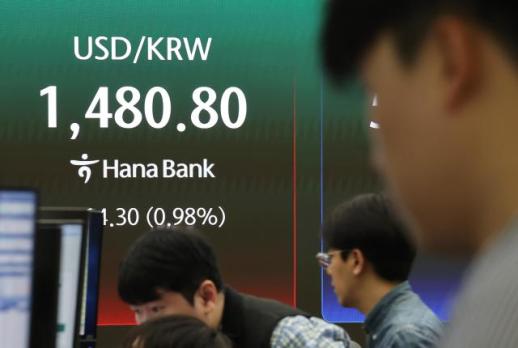 Foreign investors flee Seoul as KRW weakness persists SEOUL, Mar. 12 (AJP) — Foreign investors pivoted to a net sell-off in South Korean financial markets between February and March, marking the first net outflow in six months. The South Korean won continued its steady decline, extending a period of weakness that began last month. The value of the won has depreciated by 2 percent since February, falling from a January average of 1,439.5 per dollar to 1,469.2 as of March 10 according to a Bank of Korea (BOK) release on Thursday, marking the second consecutive month of decline, following a 1.4 percent weakening in January. While the won’s fall last month occurred even as the U.S. Dollar Index softened, the current depreciation has been exacerbated by a 1.9 percent surge in the dollar index, fueled by escalating conflict in the Middle East. Among emerging market currencies, the won’s decline was surpassed only by the Russian ruble, which fell 3.7 percent. In stark contrast, the Brazilian real emerged as the top performer, appreciating by 1.9 percent this month following a 5.7 percent surge last month, bolstered by the Brazilian central bank’s fiscal tightening and interest rate hikes. While advanced currencies also weakened—with the euro falling 2 percent, the yen 2.1 percent, and the pound 1.9 percent—the underlying drivers differed significantly from the won. The weakness in these currencies was largely driven by dovish expectations: the yen softened following Prime Minister Sanae Takaichi’s nomination of a dovish policy board member, while the euro fell as CPI dipped below the 2 percent target. The won, however, continued to slide despite the BOK ruling out the possibility of rate cuts. Volatility is also on the rise. The won’s daily fluctuation range expanded from 0.36 percent in December to 0.45 percent in January, reaching 0.58 percent in February. Foreign portfolio investment saw a net outflow of $7.76 billion, the first shift to negative territory since August. This represents the second-largest monthly net outflow on record, eclipsed only by the $8.97 billion flight during the July 2008 financial crisis. Equity markets bore the brunt of the exodus, with $13.5 billion in foreign capital exiting the KOSPI. This surpassed the previous record of $11.04 billion set during the onset of the Covid-19 pandemic in March 2020, marking the largest monthly equity outflow in South Korean history. Conversely, the bond market saw a net inflow of $5.74 billion, as investors engaged in bargain hunting amid falling Korean bond prices. This marks the fourth consecutive month of net inflows into fixed income since October. External borrowing conditions remain relatively stable. The spread on short-term external borrowing held steady at 11 basis points, while the CDS premium stood at 22 basis points, marginally up from 21 basis points last month. However, mid-to-long-term external borrowing spreads edged up from 42 basis points to 46 basis points, reflecting deteriorating external conditions, including the Middle East conflict and the blockade of the Strait of Hormuz. 2026-03-12 13:36:07
 -
 Leveraged stock bets show signs of peaking even before Gulf crisis rattled Seoul SEOUL, Mar. 11 (AJP) — South Korea’s red-hot equity rally has drawn a flood of money into stock-linked funds, swelling assets at investment managers, but leveraged investment was already showing signs of topping out even before the Middle East crisis jolted markets. According to data released Wednesday by the Bank of Korea, total deposits at financial institutions reached 93.9 trillion won ($64.05 billion) in February, up 46.4 percent from a year earlier. The surge was particularly pronounced at asset management firms, driven largely by inflows into equity-linked funds, which attracted 34.1 trillion won during the month. Following 37 trillion won in January, the two-month inflow represents a more than tenfold increase compared with the same period in 2025, when equity fund inflows totaled just 7.1 trillion won. The influx came as the benchmark KOSPI surged roughly 50 percent during the first two months of the year, fueled by optimism that South Korea would dominate next-generation memory chips critical for the artificial intelligence boom. What had looked like an unstoppable rally abruptly stalled after U.S.-led strikes on Iran on Feb. 28 and the subsequent blockade of the Strait of Hormuz rattled global markets. The KOSPI, which hit an all-time high of 6,307 on Feb. 26, plunged nearly 20 percent between March 3 and March 4, briefly falling below the 5,100 mark. As of Wednesday, the index had recovered 1.4 percent to 5,609.95, supported by hopes for a ceasefire, discussions among Group of Seven nations on releasing strategic oil reserves and announcements of treasury stock cancellations by conglomerates such as Samsung Electronics and SK Inc. following revisions to the Commercial Act. Even so, the index remains more than 10 percent below its recent peak. Leverage nearing its limits Signs of fatigue had already emerged in credit-driven investment. Money Market Funds, which serve as liquidity pools for stock trading, recorded inflows of 5.5 trillion won in February — far below the 21.7 trillion won seen a year earlier. The slowdown suggests the market was hitting record highs even as momentum behind credit-fueled trading began to fade. Outstanding margin debt reached a record 33.7 trillion won on March 5, before retreating to about 31 trillion won following the sharp market slide. Similarly, unsettled brokerage accounts fell from 2 trillion won on March 6 to 1.3 trillion won by Monday. The pullback partly reflected credit limits being exhausted at major brokerages. Korea Investment & Securities suspended margin purchases and short selling on March 5 after reaching its credit ceiling, with NH Investment & Securities taking similar steps. The scale of leverage has amplified market volatility. Forced liquidations accounted for 6.5 percent of unsettled accounts on March 5, the highest level in 31 months since the market slump in October 2023. “Since credit balances had reached their limit, they became a significant burden on the market,” said Yeom Dong-chan, a researcher at Korea Investment & Securities. Risk aversion hits KRW and bonds Meanwhile, flows into fixed-income products weakened as investors reassessed risks. Bond funds recorded a net outflow of 200 billion won, reflecting heightened volatility in the debt market. Government bond yields have swung sharply. The three-year treasury yield, which had fallen to 2.95 percent in December, climbed to 3.04 percent in February, while the 10-year yield rose from 3.39 percent to 3.45 percent as markets digested signals from the Federal Reserve under Chair Kevin Warsh. Following the Hormuz crisis, yields spiked by more than 10 basis points in early March, briefly inverting the spread on March 9 — a signal that heightened concerns about stagflation. In Wednesday morning trading, the three-year yield slipped 2.7 basis points to 3.256 percent, while the 10-year yield fell 2 basis points to 3.609 percent. Despite the easing, bond prices remain under pressure. Risk aversion also hit the currency. The Korean won, which began the year near 1,440 per dollar, briefly plunged toward 1,500 during overnight trading on March 4. As of 3:30 p.m. Wednesday, the won stood at 1,466 per dollar, down 3 won from the previous day and about 1.6 percent weaker than at the start of the year. 2026-03-11 16:41:21
 -
 Toss Bank faces FSS investigation after transaction glitch SEOUL, March 11 (AJP) — The Financial Supervisory Service (FSS) is set to conduct an on-site inspection of online banking platform Toss Bank on Wednesday. The inspection comes a day after an error in Toss's foreign exchange system that resulted in massive financial losses. At around 7:30 p.m. the previous day, a glitch in its mobile app allowed users to exchange yen at a rate of roughly 470 Korean won per 100 yen. Given that the actual market rate was approximately 934 won, the currency was traded at about half its market value. While Toss Bank immediately suspended transactions upon discovering the error, the glitch reportedly incurred losses of approximately 10 billion won. Some users who had set up automated buy orders found transactions already processed, while others rushed to purchase yen after receiving alerts of the sudden price drop. Transactions resumed at 9:00 p.m. after a suspension of around two hours. The financial watchdog seeks to investigate the cause of the system failure, the total volume of transactions, and the potential impact on users. This is not the first time Toss Bank has mismanaged exchange rate settings. In September 2022, the bank displayed the FX rate at 1,290 per dollar for nearly 30 minutes, despite the actual rate exceeding 1,400 at the time. The incident adds to a string of clerical errors across the financial sector. In February last year, Hana Bank mistakenly posted the Vietnamese dong at one-tenth of its actual value, leading to the cancellation of transactions. In January this year, cryptocurrency exchange Bithumb failed to recover approximately 13 billion won ($9.8 million) worth of assets after a clerical error led to the over-distribution of 620,000 bitcoins. 2026-03-11 10:14:40
 -
 Weak won, Middle East risks weigh on Korean economy as Taiwan pulls ahead SEOUL, Mar 10 (AJP) — South Korea’s economy is increasingly lagging behind technology-driven regional peers such as Japan and Taiwan, weighed down by a structurally weak currency and fading industrial competitiveness — pressures that could deepen if the Middle East conflict drags on. According to the Bank of Korea (BOK) on Tuesday, South Korea’s GDP per capita stood at about $35,800 in 2025, largely unchanged from recent years. Per capita gross national income (GNI) reached 52.46 million won ($36,855), rising 4.6 percent in won terms but only 0.3 percent in U.S. dollar terms, reflecting the drag from currency depreciation. By contrast, Taiwan and Japan posted stronger gains. Both countries — which had trailed South Korea in per capita income over the past three years — reported higher provisional figures for 2025, with Taiwan at $40,585 and Japan around $38,000, surpassing South Korea’s GNI range of $36,000 to $37,000. For Seoul, the reversal against Taiwan is particularly symbolic. South Korea first overtook Taiwan in 2003, when its per capita GNI reached $12,000 compared with Taiwan’s $11,000, and maintained the lead for more than two decades. That advantage has now effectively disappeared. Weak won erodes income gains The South Korean won entered 2026 on fragile footing after ending 2025 at 1,421.9 per dollar, a 2.1 percent depreciation from the previous year’s close of 1,392.5. At its weakest intraday level last year, the currency touched 1,487.6 won per dollar, surrendering nearly 6.8 percent of its value compared with the previous year. The slide has been notable because it occurred even while the U.S. Dollar Index remained below the 100 level for extended periods, suggesting the won weakened despite a relatively soft global dollar. In contrast, the New Taiwan dollar strengthened by about 2 to 3 percent against the greenback during the same period. “Assuming no exchange-rate impact, South Korea’s GDP per capita could exceed $40,000 as early as 2027,” said Kim Hwa-yong, head of the BOK’s National Income Department, underscoring how strongly currency movements influence real income levels. The downward pressure intensified earlier this year as geopolitical tensions triggered capital outflows. The won briefly touched the 1,500 level in overnight trading on March 4, following the escalation of the U.S.-Iran conflict. The currency later rebounded to below 1,470 per dollar on Tuesday as oil prices stabilized after U.S. President Donald Trump signaled that the conflict could end soon. Taiwan’s chip boom leaves Korea trailing The BOK on Tuesday confirmed that South Korea’s GDP growth slowed to 1 percent in 2025, matching the central bank’s earlier projection but falling short of 1.5–1.6 percent estimates from institutions such as the International Monetary Fund (IMF) and the Korea Development Institute (KDI). Taiwan, by contrast, posted a striking 8.63 percent growth rate, far above the roughly 7 percent consensus, while Japan recorded 1.1 percent growth, surpassing South Korea for the first time in 27 years. Taiwan’s surge reflects its dominant position in the global semiconductor supply chain. With TSMC controlling much of the world’s advanced chip manufacturing, the island has captured a disproportionate share of growth generated by the artificial intelligence boom. South Korea also benefited from strong demand for AI-related chips through Samsung Electronics and SK hynix, but the broader economy struggled to keep pace. According to BOK data, the semiconductor sector contributed 0.9 percentage points of the economy’s 1 percent growth in the fourth quarter, effectively accounting for nearly all of the expansion. Outside semiconductors, export momentum weakened. Industries that traditionally anchored Korean manufacturing — automobiles, shipbuilding and defense — lost steam in the second half of the year. Sectors facing intense competition from China, including secondary batteries, steel and petrochemicals, also recorded declining exports. Japan, meanwhile, saw improvements in both capital investment and exports. Facility investment rose 4 percent in 2025, while exports — historically a weaker pillar of the Japanese economy — also grew 4 percent. South Korea’s investment cycle told a different story. Facility investment stagnated in the second half, resulting in zero growth for the year. Automobile exports also showed no annual growth, while steel and petrochemical shipments declined, contributing to an overall 2 percent drop in exports. Hormuz disruption adds new risks The Middle East conflict is now adding a fresh layer of uncertainty to the outlook. Following the Feb. 28 strikes, Iran’s Islamic Revolutionary Guard Corps (IRGC) effectively imposed a blockade on the Strait of Hormuz, according to South Korea’s Defense Intelligence Agency (DIA). Maritime traffic through the strait — which averaged about 98 vessels per day in late February — has reportedly plunged to as few as one ship daily. South Korea is among the economies most exposed to such disruption. Data from the Korea National Oil Corporation (KNOC) show that about 70 percent of South Korea’s crude oil imports come from five Middle Eastern countries — Saudi Arabia, the UAE, Kuwait, Qatar and Iraq — all of which rely on the Hormuz passage. “Major Asian economies such as China, India, Japan and South Korea could be particularly affected, as over 80 percent of oil and LNG shipments through the strait are destined for Asia,” the Center for Strategic and International Studies (CSIS) said in a recent analysis. Oil markets have already reacted sharply. WTI crude, which closed at $67 on Feb. 27, surged to $108.5 by March 8 before retreating below $90 on Tuesday after Trump suggested the conflict could end soon and G7 nations signaled possible strategic reserve releases. Even after the pullback, prices remain roughly 30 percent above recent lows. The BOK, which had recently raised its 2026 growth forecast from 1.8 percent to 2 percent, may now face pressure to revise that outlook. A Citigroup report on March 3 estimated that if international oil prices average $82 or higher this year, South Korea’s GDP growth could fall by 0.45 percentage points to around 1.5 percent. At the same time, consumer inflation could rise by about 1.1 percentage points to 3.2 percent, raising the risk of stagflation, according to the Hyundai Research Institute (HRI). “We expect domestic growth and inflation to be negatively affected,” Kim of the BOK said during a press briefing Tuesday. “The ultimate economic impact will largely depend on whether the conflict becomes prolonged.” 2026-03-10 17:37:05
 -
 South Korea GDP confirmed contracting in Q4, 2025 growth slowest in five years SEOUL, Mar. 10 (AJP) — South Korea confirmed that its economy contracted in the fourth quarter of 2025, while full-year growth slowed to its weakest pace in five years amid a slump in construction and slowed investment activity. According to final data released by the Bank of Korea on Tuesday, real gross domestic product (GDP) fell 0.2 percent from the previous quarter in the October–December period, marking a return to contraction after earlier gains in the year. The decline reflected weakness in key sectors of the economy. Manufacturing output dropped 1.5 percent from the previous quarter, while construction shrank 4.5 percent as both building and civil engineering projects slowed. The services sector expanded 0.6 percent, supported by gains in finance, healthcare and social services. On the expenditure side, private consumption rose 0.3 percent, mostly on health care spending, while government consumption increased 1.3 percent largely due to higher health insurance payouts. Construction investment fell 3.5 percent and facility investment declined 1.7 percent, while exports slipped 1.7 percent from the previous quarter. For the full year, South Korea’s economy grew 1.0 percent in 2025, sharply slowing from 2.0 percent in 2024 and marking the weakest expansion since the pandemic-hit year of 2020. Nominal GDP reached 2,663.3 trillion won last year, up 4.2 percent from the previous year but down 0.1 percent to about $1.87 trillion when converted to U.S. dollar, as the Korean won averaged a record low of 1,439 per dollar during the year. Gross national income per capita stood at 52.4 million won, up 4.6 percent from a year earlier. In dollar terms, however, it rose only 0.3 percent to $36,855, leaving Korea’s per-capita income in the $36,000 range for a third consecutive year as currency weakness offset domestic income gains. The GDP deflator, a broad measure of price levels across the economy, rose 3.1 percent in 2025. Real gross national income (GNI) expanded 1.4 percent in the fourth quarter, reflecting improved terms of trade and higher overseas income receipts. 2026-03-10 09:04:07
 -
 S&P Global inspectors arrive in Seoul to conduct annual review SEOUL, March 9 (AJP) - American credit rating agency S&P Global is set to conduct its annual review of South Korea's sovereign credit rating. A delegation led by Kim Eng Tan and Andrew Wood, executive directors responsible for the agency's Asia Pacific region, arrived in Seoul on Monday for a three-day consultation ahead of the upcoming review, the Ministry of Economy and Finance said. They are scheduled to talk with key financial and economic officials including those from the Bank of Korea (BOK) and the Financial Services Commission (FSC). They will also meet with researchers and other staff from state-run think tanks such as the Korea Institute for International Economic Policy (KIEP) and the Korea Development Institute (KDI). According to the ministry, their evaluation is expected to primarily focus on monetary and fiscal policies in order to assess the country's capacity to manage internal and external uncertainties and economic variables. In particular, S&P Global is expected to assess how South Korea will respond to the fallout from the Middle East conflict following U.S.-led airstrikes on Iran earlier this month and possible disruptions from the closure of the Strait of Hormuz, which have further weakened the already declining Korean won amid heightened financial market volatility that began in the second half of last year. The agency's annual review is typically released in April after completing these evaluations. South Korea's sovereign rating has remained unchanged at "AA" for the past nine years, one notch below a top-tier triple-A, following its last upgrade from "AA−" in 2016. The ministry, led by Deputy Prime Minister and Finance Minister Koo Yun-cheol, plans to coordinate with other relevant ministries to stress the resilience of the South Korean economy. 2026-03-09 17:31:12
 -
 Black Monday exposes vulnerabilities of external-reliant Korean economy SEOUL, Mar 09 (AJP) - The Black Monday bombshell in South Korean capital markets has once again laid bare the vulnerabilities of the country’s external-reliant economy, now facing the dreaded triple highs of oil prices, the dollar and interest rates — a classic recipe for stagflation. Crude prices touched above $110 per barrel for the first time since the early months of Russia’s invasion of Ukraine in 2022, marking one of the fastest climbs since the oil crises of the 1980s. Futures on U.S. benchmark West Texas Intermediate (WTI) and Brent crude soared more than 25 percent Sunday and more than 50 percent since attacks on Iran began on Feb. 28. Dubai crude — the benchmark most relevant for South Korea — closed Friday at $99.14. The jump marks the sharpest escalation in 31 months, since intraday prices briefly cleared $100 in mid-2022 following Russia’s invasion of Ukraine. The sudden spike in the three major benchmarks — which had stabilized near $80 just a week earlier — was triggered by news that Mojtaba Khamenei, the second son of Iran’s late supreme leader Ali Khamenei, has officially succeeded his father. Mojtaba, long seen as a shadow power broker who famously backed former President Mahmoud Ahmadinejad, is widely viewed as a hardliner whose ascension reinforces fears of a prolonged conflict and the potential shutdown of the Strait of Hormuz. The conflict has already brought tanker traffic through the Strait of Hormuz to a near standstill. Roughly 20 million barrels of oil per day — about one-fifth of the world’s seaborne crude supply — normally passes through the narrow waterway linking the Persian Gulf to global markets. Data from Vortexa shows that roughly 16 million barrels per day of oil have effectively been stranded behind the strait and cut off from global supply chains. Retail fuel prices have quickly followed the surge. As of Sunday, the average price of gasoline at filling stations in the Seoul metropolitan area reached 1,945.73 won ($1.35) per liter, while diesel climbed to 1,967.19 won — up 11 percent and 18 percent respectively since Feb. 28. In a rare reversal, diesel prices have now surpassed gasoline for the first time since February 2023. Analysts attribute the inversion to rising marine fuel demand and surging maritime logistics costs as tanker traffic reroutes. U.S. President Donald Trump attempted to calm markets by granting India a temporary waiver to import Russian oil and posting on social media that prices would drop “when the destruction of the Iranian nuclear threat is over.” Market sentiment, however, remained rattled. Asia’s energy exposure magnifies the shock The rapid breach of the $100 psychological threshold reverberated across East Asian markets due to the region’s heavy dependence on Middle Eastern energy supplies. In 2025, Asia absorbed 87 percent of the crude oil and 86 percent of liquefied natural gas (LNG) shipments passing through the Strait of Hormuz. South Korea remains particularly exposed. The country relies on the Middle East for 70.7 percent of its oil imports and 20.4 percent of LNG supplies, of which roughly 15 percent comes from Qatar. Compounding concerns, Qatar’s main LNG export facility — which normally accounts for roughly 17 percent of global LNG flows — is currently offline after being struck by an Iranian drone. On March 6, Qatar’s energy minister Saad al-Kaabi told the Financial Times that it could take “weeks to months” to restore normal operations even if the war were to end immediately. Financial markets buckle Foreign investors reacted swiftly to the deteriorating outlook, dumping more than 3.3 trillion won ($2.4 billion) worth of KOSPI shares on Monday. The benchmark index plunged nearly 8 percent, while the Korean won weakened toward the 1,500-per-dollar level — its lowest point since the aftermath of the global financial crisis 17 years ago. The panic quickly spilled into the bond market. The three-year government bond yield jumped 25 basis points to 3.477 percent, while the 10-year yield rose 15.3 basis points to 3.769 percent — the biggest single-day increase in 41 months since the aftermath of the U.S. Federal Reserve’s aggressive tightening cycle in September 2022. Verbal intervention from policymakers did little to calm investors. President Lee Jae Myung ordered “extraordinary vigilance” from fiscal and monetary authorities, while Bank of Korea senior deputy governor Ryoo Sang-dai warned that the moves in interest rates and the exchange rate appeared “excessive.” The central bank also announced an extension of its currency swap agreement with the Swiss National Bank. Spillover into the real economy The financial turbulence underscores how sensitive South Korea’s economy remains to oil price shocks. A report released March 3 by the Hyundai Research Institute noted that while South Korea ranked as the world’s 12th-largest economy in 2024, it was the seventh-largest consumer of oil globally. The combined shock of rising crude prices and a weakening won is expected to intensify inflationary pressure. Hyundai Research Institute estimates that if international oil prices average $150 per barrel, consumer inflation could rise by 0.8 percentage points to 2.9 percent, while economic growth could slow by a similar margin from its current 2 percent forecast. The Bank of Korea and government projections of roughly 2 percent growth were based on oil prices averaging around $62 per barrel. Should growth slip below 2 percent — following an already weak 1 percent expansion in 2025 — economists warn the economy could drift toward stagflation as import-driven inflation collides with slowing output. “As South Korea is a net energy importer, the upward trend in the current account surplus is likely to lose momentum as oil prices rise,” said Lee Min-hyuk, a researcher at KB Kookmin Bank. Stock rally loses steam The geopolitical shock has also punctured the optimism surrounding Korea’s stock market rally. “Since the KOSPI had outperformed other markets, there is still room for profit-taking, and with a lack of positive catalysts further declines are possible,” said Cho Jun-ki, an analyst at SK Securities. The benchmark index surged 76 percent in 2025 — nearly triple the gains of Japan’s Nikkei 225 or Taiwan’s TAIEX. Even before Monday’s crash, the KOSPI had risen 14.9 percent in 2026, more than double the Nikkei’s roughly 7 percent gain. Bond markets may also face sustained pressure. “During the 2011 Libyan crisis, government bond yields rose by more than one percentage point between the start of the year and August,” said Kim Sung-soo, a researcher at Hanwha Investment & Securities. Kim expects a similar trajectory this year, projecting a ceiling of around 3.5 percent for the three-year yield and 3.9 percent for the 10-year yield. “A quick recovery is unlikely,” he said. Oil outlook remains grim Energy markets are bracing for further volatility. Goldman Sachs warned in a Sunday report that crude prices could exceed $150 per barrel by the end of March, noting that the roughly 20 million barrels of oil transiting the Strait of Hormuz each day places the current crisis on a scale comparable to the oil shocks of the 1970s. Daishin Securities reached a similar conclusion, saying oil could remain above $100 for an extended period if global strategic petroleum reserves begin to tighten. South Korea currently holds strategic petroleum reserves equivalent to roughly 200 days of consumption, according to the Korea National Oil Corporation — the sixth-largest reserve among non-oil-producing countries. 2026-03-09 15:54:59
 -
 Seoul issues verbal intervention as won hits lowest since global financial crisis SEOUL, March 09 (AJP) - South Korean authorities issued a verbal intervention Monday as the won weakened to its lowest level since the global financial crisis, with officials warning they would take “appropriate” measures to stabilize financial markets. “The bond yields and the won-dollar exchange rate are showing excessive volatility compared with Korea’s economic fundamentals due to Middle East risks,” Bank of Korea Senior Deputy Governor Yoo Sang-dai said during an emergency meeting. The comment came as oil prices surged amid expanding battle zones and fuel production disruptions across the Middle East, including the de facto closure of the Strait of Hormuz, a key artery for global oil shipments to Asia. Market anxiety has also intensified after Iran named Mojtaba Khamenei, a hardline son of the slain supreme leader, as the country’s new leader — a move seen as signaling a prolonged conflict. The U.S. dollar jumped to 1,495.50 won, approaching the psychologically important 1,500-won level for the first time since the aftermath of the global financial crisis on March 12, 2009. The sharp move came as foreign and domestic institutions rushed to sell Korean assets. Foreign investors dumped more than 2 trillion won ($1.5 billion) worth of shares on the benchmark KOSPI in early trading. Government bond yields also climbed in line with global markets, tracking a sharp rise in overseas rates, including nearly 10 basis points in the U.K. 10-year gilt yield. 2026-03-09 11:21:57