
Journalist

Seo Hye Seung
ellenshs@ajunews.com
-
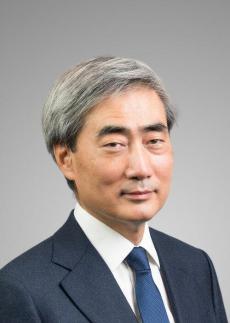 Shin nomination signals BOK shift toward financial stability, external shock shield SEOUL, March 22 (AJP) - President Lee Jae Myung on Sunday nominated Shin Hyun-song, economic adviser and head of the Monetary and Economic Department at the Bank for International Settlements (BIS), as the next governor of the Bank of Korea, tasked with navigating monetary policy amid the economic fallout from the Gulf war crisis. The presidential office said Shin’s combination of academic depth and policy experience makes him well suited to manage rising uncertainty linked to geopolitical tensions and inflation risks, while balancing price stability and growth. Shin, a former Princeton University professor and senior adviser to former conservative President Lee Myung-bak in 2010, has spent the past decade at the Bank for International Settlements, where his work has centered on global liquidity, financial cycles and systemic risk. Shin’s research indicates a policy approach that places financial stability at the core of monetary decision-making. In “Global Banking Glut and Loan Risk Premium” (IMF Working Paper, 2011), Shin argues that financial conditions are driven by the balance sheet expansion of global banks and leverage cycles, rather than policy rates alone. In a related line of work, “Global Liquidity and Procyclicality” (BIS/NBER), he elaborates that credit supply expands and contracts with global banking conditions, amplifying boom-bust cycles across economies. These findings suggest that central banks need to monitor credit growth, leverage and asset prices alongside inflation. His arguments point to the need for close attention to household debt management and macroprudential policy tools. A central theme in Shin’s work is the dominant role of the U.S. dollar in the global financial system. In BIS Quarterly Review articles, including “The Dollar, Bank Leverage and the Deviation from Covered Interest Parity” (BIS, 2018), Shin documents how dollar-denominated credit outside the United States exposes borrowers to funding risks when the dollar strengthens. His research shows that tighter global dollar liquidity can lead to capital outflows, currency depreciation and tighter financial conditions, regardless of domestic policy settings. Shin’s appointment comes as the won is at its weakest level against the U.S. dollar since the global financial crisis, ending last week at around 1,500 per dollar. Shin has also emphasized that inflation dynamics are increasingly influenced by external forces. In a BIS speech, “Inflation: Drivers and Dynamics” (2022), he highlights the role of commodity prices, exchange rates and global financial conditions in shaping inflation, especially in open economies. This suggests that monetary policy decisions will need to account for imported inflation and exchange rate pass-through, particularly as oil prices and energy supply disruptions weigh on import-dependent Korea. Under his watch, the Bank of Korea may prioritize financial stability and systemic risk monitoring, global liquidity and capital flow conditions, and exercise caution on rate cuts amid U.S. dollar strength. Following a parliamentary confirmation hearing, Shin is expected to succeed current Bank of Korea Governor Rhee Chang-yong, whose four-year term ends on April 20. 2026-03-22 17:27:40
 -
 SONGZIO X BTS turns comeback stage into a living archive of Korean history SEOUL, March 22 (AJP) -SEOUL, March 22 (AJP) — BTS’s comeback stage at Gwanghwamun was not only a musical return but a carefully constructed visual manifesto, where fashion became the medium through which history, identity and future ambition converged. At the center of that statement was “Lyrical Armor,” a collaborative collection with Korean designer Songzio, which transformed the seven members into embodiments of Korea’s evolving cultural narrative. Rather than treating costume as embellishment, the collection functioned as narrative architecture — a wearable interpretation of Korea’s past reframed for a global present. The conceptual foundation drew from early Joseon-era armor, juxtaposed with the fluidity of hanbok and the expressive tradition of poets, painters and sorigun (traditional vocal performers). Armor plates became fragmented panels. Hanbok lines were stretched, tilted and reassembled. Seams were deliberately left raw, exposing what appeared to be the “wounds” of history — not concealed, but integrated into the design language. Within this framework, each BTS member occupied a symbolic role, turning the stage into a tableau of archetypes. RM, positioned as the “Hero,” wore a long, hanbok-inspired coat structured with armor-like plating. The piece balanced weight and flow, authority and restraint — a visual articulation of leadership grounded in cultural lineage. Jin’s “Artist” translated traditional elegance into modern tailoring, with layered structures referencing armor yet softened through draped movement, suggesting the transformation of emotion into form. SUGA, cast as the “Architect,” embodied construction itself. His look emphasized structure and tension — rigid elements offset by fluid lines — mirroring the duality of composition and introspection that defines his musical identity. J-Hope’s “Sorigun” brought rhythm into fabric. A reinterpretation of the dopo through a streetwear lens, his silhouette moved with kinetic asymmetry, reflecting both performance and improvisation. Jimin’s “Poet” leaned into fragility and lightness. His layered armor dissolved into air-like textures, with delicate embellishments that captured motion as if writing verse through movement. V’s “Doryeong” distilled restraint. Drawing from the scholar class, his look combined controlled tailoring with layered drapery, projecting quiet authority rather than overt spectacle. Jungkook, as the “Vanguard,” pushed forward. His deconstructed, military-inflected silhouette conveyed propulsion — a figure not rooted in history but moving through it, carrying its fragments into the future. Across all seven, a common language emerged: asymmetry, layering, and tension between structure and flow. It was a language that spoke to rupture — and to rebuilding. In doing so, “Lyrical Armor” aligned seamlessly with the broader arc of BTS’s comeback project, “Arirang,” which seeks to reconnect with Korean identity at a moment of global saturation. The conceptual core of “Lyrical Armor”, explained designer Jay Songzio in his homepage, lies in the fusion of strength and lyricism — combining the rigid armor worn by early Joseon warriors with the flowing hanbok of poets and sorigun who distilled collective grief and aspiration into verse and song. The result is a vision of “new-era heroes” who carry history not as burden, but as momentum toward the future. Songzio described the collection as an act of resistance against conventional boundaries of time, form and dress. Traditional structures were dismantled and reassembled into abstract fragments, creating avant-garde silhouettes that oscillate between expansion and restraint. Volumes swell and recede, while non-structural patterns and fluid draping move like kinetic sculpture, blurring the line between reality and imagination. As BTS stood before a crowd of more than 100,000 and millions more watching worldwide, they were not only performing songs. They were wearing a narrative — one that suggested that the future of K-fashion, like K-pop itself, based on hanbok identity. 2026-03-22 15:36:48
 -
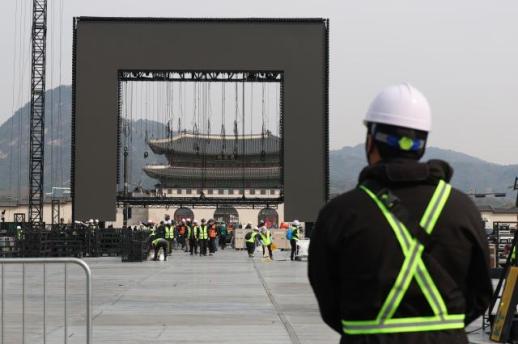 BTS comeback draws 104,000 to Seoul, lifts retail sales as event concludes safely SEOUL, March 22 (AJP) -The BTS’s comeback concert in central Seoul on Saturday drew more than 100,000 people and ended without a single major incident, delivering both a powerful display of K-culture’s global reach and a sharp boost to retail sales around the event zone. According to the Seoul Metropolitan Government on Sunday, an estimated 104,000 spectators gathered around Gwanghwamun Plaza on Saturday, as global fans — known as ARMY — joined Seoul residents in a rare citywide celebration. The event doubled as an economic catalyst, with convenience store sales in the area surging dramatically on the day of the concert. CU, operated by BGF Retail, said sales at 10 stores near Gwanghwamun jumped 270.9 percent from a week earlier, while three stores closest to the venue saw sales soar 547.8 percent. Sales of albums and newspapers, including BTS releases, surged 214.3 times, while demand for concert essentials spiked. Batteries rose 50.7 times, hot packs 12.8 times, portable chargers 11.9 times, cosmetics 11.4 times, and tissues 10.2 times, driven largely by fans preparing for long hours outdoors. Food and beverage sales also climbed sharply, with gimbap up 1,380.4 percent, sandwiches 1,146.7 percent, triangle kimbap 884.3 percent, bottled water 831.4 percent, and iced drinks 813.4 percent. GS25 reported similar trends, with sales at five nearby stores rising 233.1 percent, and the busiest location posting gains of up to 378.4 percent. Hot packs surged 5,698.8 percent, portable chargers 2,016.9 percent, and batteries 3,530.8 percent, while transportation card sales rose 647.5 percent amid heavy foot traffic and increased purchases by foreign visitors. Seven-Eleven said sales at 40 stores in the Gwanghwamun and Myeong-dong areas increased 117.0 percent from a month earlier, with some stores near the venue seeing sales jump as much as sevenfold. Emart24 also reported steady increases, including a 400 percent rise in battery sales and 260 percent in wet tissues compared with the previous week. Apart from law enforcement forces, city authorities mounted a large-scale safety operation to manage the crowds. A total of 3,400 personnel from city agencies were deployed, rising to about 8,200 when combined with staff from event organizer HYBE. A joint command post was activated at the Sejong Center for the Performing Arts from 10 a.m., 10 hours before the concert, coordinating efforts among city officials, police, fire authorities and organizers to monitor crowd conditions in real time. The Seoul Fire and Disaster Headquarters deployed 102 fire vehicles and 803 personnel, while police implemented a “stadium-style” crowd control system to disperse foot traffic and prevent congestion. Despite dense crowds, no safety incidents were reported. Preventive measures included the installation of safety barriers at 82 key locations, such as subway ventilation shafts and station entrances. Cleanup operations were completed swiftly, with 274 personnel and 53 vehicles deployed and about 40 tons of waste collected over two days. Major roads, including Sejong-daero, were reopened early Sunday morning after overnight restoration. Extensive multilingual support was also provided for international visitors. More than 600 interpreters and volunteers were deployed, and transport systems offered guidance in multiple languages across subway stations and bus stops. Seoul Mayor Oh Se-hoon said the event demonstrated the city’s global competitiveness. “This was more than a comeback stage — it was an opportunity to showcase Seoul’s cultural capacity and global standing,” he said. The city plans to extend the festive atmosphere through HYBE’s “The City Arirang Seoul” program, running through April 19 across key landmarks including the Han River and Dongdaemun Design Plaza. 2026-03-22 13:24:26
 -
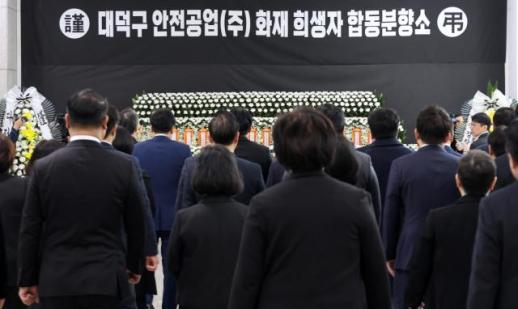 Daejeon factory fire kills 14; company chief apologizes amid probe into cause SEOUL, March 22 (AJP) - The head of a South Korean auto parts manufacturer publicly apologized on Sunday after a devastating factory fire in Daejeon left at least 14 workers dead and dozens injured, as authorities launched a full-scale investigation into the cause of the blaze. Sohn Ju-hwan, CEO of Anjeon Industry, visited a joint memorial altar set up at Daejeon City Hall, where he bowed deeply and expressed remorse before the victims. Holding a white chrysanthemum, Sohn stood in silence before the memorial tablets of the 14 deceased workers. After a prolonged pause, he broke down in tears, repeatedly saying, “I am truly sorry.” About 30 company employees accompanied him, some visibly emotional as they echoed his apology toward the victims. In a statement posted a day earlier on the company’s website, Sohn pledged full cooperation with authorities and promised support for victims and their families. “We extend our deepest condolences and sincere apologies to all those who lost their lives or were injured, as well as to their families,” he said. “We will take full responsibility by providing necessary support and ensuring recovery efforts.” The fire broke out at around 1:17 p.m. on Friday at the Anjeon Industry plant in Daedeok District, Daejeon, where about 170 workers were on site. The blaze, which took more than 10 hours to fully extinguish, left 14 people dead and at least 60 others injured, including two firefighters. Rescue teams recovered the final three missing victims from the charred second floor late Saturday afternoon, bringing the death toll to 14. Authorities said the fire spread rapidly, fueled by oil residue and accumulated dust inside the facility, while some 200 kilograms of sodium stored on site raised the risk of explosions and complicated firefighting efforts. At the time of the incident, many workers were resting near upper floors during lunch break, when thick smoke quickly blocked evacuation routes. Some reportedly jumped from windows to escape. The exact cause of the fire remains under investigation, though witnesses reported hearing an explosion shortly after the blaze began. Police have deployed a 131-member task force to determine the cause and assess potential negligence. A joint forensic inspection involving police, fire authorities and other agencies is expected once structural safety at the site is secured. Identification of the victims is ongoing, with DNA analysis being conducted by the National Forensic Service. As of Sunday, only one victim — a man in his 40s — had been formally identified. Authorities expect the identification process to be completed as early as Monday, after which families will be officially notified. President Lee Jae Myung visited the site on Saturday, calling for a thorough investigation and measures to prevent similar tragedies. “We will make every effort to determine the cause and ensure such incidents do not happen again,” said Kim Seung-ryong, commissioner general of the National Fire Agency. The Daejeon Metropolitan Government has established a joint memorial altar at City Hall, where citizens continue to pay their respects. 2026-03-22 13:06:00
 -
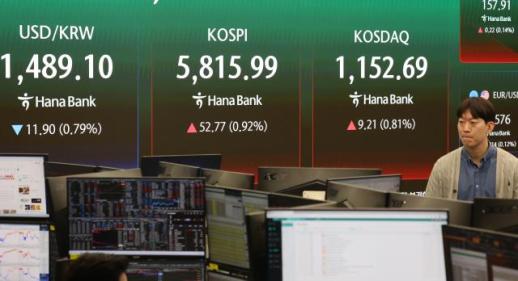 Retail inflows sustain KOSPI with bubble warning triggered SEOUL, March 22 (AJP) - South Korea’s stock market remains one of the world’s top performers over the past year, backed by heavy retail influx despite rapid foreign pullback due to the economy's heavy exposure to the crippled Strait of Hormuz, causing warnings of bubbly risks. The benchmark KOSPI hovers around 5,800 despite escalating oil prices and tensions in the Gulf after rising more than 150 percent in less than a year amid heavy swings since the war. It held tough versus other major markets in the war wake, with the S&P 500 down nearly 4 percent from end-February levels, while Europe’s Stoxx 600 and Germany’s DAX have fallen around 8 percent to 10 percent. Japan’s Nikkei 225 has also retreated more than 9 percent. By comparison, the KOSPI remains up more than 37 percent from end-2025 levels. Bank of America (BofA) found the market’s behavior as a “textbook bubble,” pointing to extreme reversals — including a double-digit plunge followed by a near double-digit rebound — that resemble patterns seen during past crises such as 1997 and 2008. Its proprietary Bubble Risk Indicator, which combines returns, volatility, momentum and fragility, places Korea at near-extreme levels of bubble risk, underscoring the intensity of recent price action. Valuation metrics add to the caution. The Buffett Indicator has risen above 200 percent, a level widely viewed as significantly overvalued, while the VKOSPI volatility index remains elevated after briefly hitting record highs earlier this month. The primary force is retail capital returning at scale. According to Korea Exchange and Koscom data, individual investors have purchased more than 21.8 trillion won ($16 billion) worth of KOSPI shares so far this month, already approaching the record monthly inflows seen during the 2021 pandemic-era rally. Since January, cumulative net buying by retail investors has reached 34.7 trillion won, and rises to as much as 50 trillion won when exchange-traded funds are included. During the same period, foreign investors sold nearly 50 trillion won worth of Korean equities. The inflows reflect a broader “money move” across asset classes. Funds are rotating out of bank deposits, overseas equities and cryptocurrencies, as domestic investors reposition toward Korean equities amid a combination of strong returns and shifting global conditions. Deposits have declined despite rising interest rates, while trading volumes in the crypto market have dropped sharply, signaling waning momentum in alternative assets. The return of retail investors is not limited to small accounts. High-net-worth individuals are also rotating back into domestic large-cap stocks, while margin borrowing has surged — particularly among younger investors seeking to catch up with the rally. Data from major brokerages show that margin investors posted average losses of around 19 percent during recent declines, more than double the losses of unleveraged investors. The gap is even wider among younger and smaller investors, where concentrated positions have magnified losses. Still, many analysts argue the market’s fundamentals remain intact. On a forward basis, the KOSPI trades at around 9.5 times earnings, below its 10-year average, suggesting that valuations remain relatively attractive after recent corrections. The rally continues to be anchored by the semiconductor supercycle, with strong earnings momentum in Samsung Electronics and SK hynix supporting broader index gains. At the same time, external uncertainties — including geopolitical tensions in the Middle East and rising energy prices — continue to inject volatility, with markets reacting sharply to headlines and policy signals. The result is a market increasingly defined by a tension between liquidity and risk. 2026-03-22 10:30:05
 -
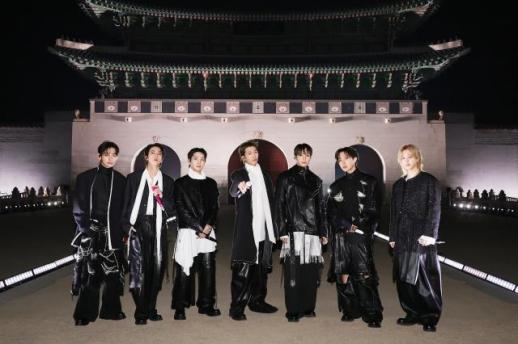 BTS' comeback album and show 'ARIRANG' make a splash on Spotfiy and Netflix SEOUL, March 22 (AJP) -BTS’ first studio album in six years, “Arirang,” has opened with a blockbuster showing on Spotify, underlining the group’s enduring global pull and setting the pace for music releases in 2026. The album recorded 110 million streams worldwide on its first day, according to figures cited in the report, making it the biggest Spotify debut of the year so far and the largest opening day ever for a K-pop release on the platform. It also ranked as the 12th biggest first-day album debut in Spotify history, placing BTS in rare company among the platform’s top global performers. The opening figure comfortably surpassed the previous 2026 leader, Harry Styles’ “Kiss All the Time. Disco, Occasionally,” which reportedly drew 63 million first-day streams. Other major releases this year, including albums by J. Cole, A$AP Rock, Bruno Mars and Blackpink, trailed well behind BTS’ opening tally. The strong start suggests “Arirang” is well positioned to become the year’s biggest music release so far once broader weekly industry data, including sales and airplay, are compiled. While full Billboard and Luminate figures are still pending, Spotify’s early results point to a commercial performance that few 2026 releases are likely to match. The album’s dominance was also visible across Spotify’s track rankings. On the Global Top 50, songs from “Arirang” occupied all 14 of the top positions in uninterrupted order. In the United States, BTS held the top two spots with “Swim” and “Body to Body,” while all 14 album tracks landed within the chart’s top 26. Spotify had signaled the scale of anticipation even before release, saying “Arirang” became one of the most pre-saved Countdown Page albums in the platform’s history, with more than 5 million presaves. The service has since expanded promotional partnerships tied to the album, including fan events and interactive experiences. For BTS, the explosive debut marks more than a successful comeback. It confirms that after years of solo activities and military service, the seven-member group remains one of the few acts in the world capable of turning a new album into an immediate global event. “안녕 Seoul, we’re back,” leader RM declared, stepping onto the stage at Gwanghwamun Square on Saturday night, a day after the album release, as the group returned before a global audience streaming live on Netflix. The choice of venue — a 600-year-old civic and historical landmark — turned the comeback into something larger than a concert: a statement of identity. After nearly four years apart due to military service, the seven members stood together again, anchoring their return in the symbolic heart of Korea. They opened with “Body to Body,” the first track of Arirang, a declaration set to a pulsating beat — “Born in Korea, playing for the world.” The performance seamlessly wove in traditional “Arirang” motifs, delivered by musicians in hanbok, linking the group’s global rise to Korean cultural roots. From there, the show moved between reinvention and legacy. “Hooligan” showcased sharp, theatrical choreography with masked dancers, while “2.0” leaned into a stripped-down, confident hip-hop groove. Even with RM seated at times due to an ankle injury, the group’s stage command remained intact — a reminder that absence had not dulled their edge. Mid-set, BTS emphasized the album’s direction. “We wanted to show the most honest side of the seven of us,” SUGA said, describing Arirang as a “more mature and evolved” BTS. Jungkook acknowledged the pressure of returning, but added, “Being here in front of you all, it feels great.” That evolution played out sonically. Tracks like “SWIM” introduced fluid, expressive choreography, while “Like Animals” and “Normal” shifted into a more introspective, soft-rock tone, addressing the emotional toll of global fame. BTS did not abandon their past. Hits such as “Butter,” “MIC Drop,” and “Dynamite” brought a surge of collective memory, bridging eras and reaffirming their global reach. The night closed with “Mikrokosmos,” a tribute to fans — a fitting finale for a comeback defined as much by reunion as reinvention. Netflix has yet to reveal the global viewership of the livestream. 2026-03-22 09:51:08
 -
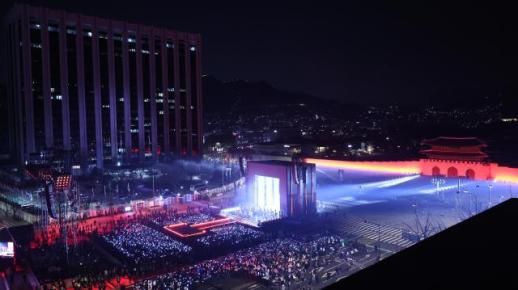 OPINION: A century show, carried with care SEOUL, March 22 (AJP) -It was billed as a comeback. It became something larger: a test of scale, identity and control — and, ultimately, a quiet assertion of how far K-pop, and Korea, have come. BTS returned to Gwanghwamun Plaza not just as artists resuming a career, but as men who had completed a national duty and reassembled a global phenomenon. Thirteen years into their journey, the performance was less about proving relevance than about defining legacy. The numbers alone strained belief. Roughly 40,000 filled the tightly managed square, while tens of thousands more watched from surrounding streets and screens. Beyond Seoul, audiences in 190 countries tuned in via Netflix, turning a historic civic space into a synchronized global venue. Yet scale was not the defining feature. Control was. Nearly 15,000 personnel — an extraordinary deployment — managed the crowd with strict routing, metal detectors and enforced movement through narrow corridors. The experience, at times, felt excessive, even rigid. Fans waited, shuffled, and surrendered spontaneity to structure. And still, not a single major incident. In an era where mass gatherings often carry an undertone of risk, the absence of chaos became its own statement. Order was not incidental; it was engineered — and, notably, accepted. Fans from across continents complied with patience, even humor, some carrying trash bags and leaving the site as clean as they had found it. That discipline, as much as the music, defined the night. On stage, the narrative was deliberately balanced. New tracks from the fifth album ARIRANG — including “Body to Body” and “SWIM” — were interwoven with global hits like “Dynamite” and “Butter.” The message was continuity, not reinvention. RM, seated with an injured ankle, declared simply: “We’re back.” Jimin, voice wavering, offered the album’s thesis in a single line: “Keep swimming.” It was less spectacle than reassurance — a reaffirmation of presence after absence, of identity after uncertainty. The setting amplified that message. Framed by Gyeongbokgung Palace, and watched over by statues of King Sejong the Great and Admiral Yi Sun-sin, the performance fused heritage with hyper-modern production. This was not accidental staging. It was narrative architecture: a global act returning to a national axis. Even the broadcast carried symbolic weight. The live stream held steady under immense global traffic, marking a technical milestone for Netflix’s expansion into large-scale live music. The platform proved it could handle not just content, but simultaneity — a crucial distinction in the evolving competition for live audiences. There were imperfections. Safety protocols thinned out visible crowd density on screen, muting some of the visceral energy that defines concerts. Subtitles lagged, and the user interface occasionally fell short of the production’s visual ambition. But these were, in essence, second-order problems — the kind that emerge only after first-order challenges have been solved. And that is the point. What unfolded at Gwanghwamun was not merely a concert. It was a demonstration: that a dense urban core can host a massive live event without disorder; that a global fandom can self-regulate; that a cultural product can integrate tradition, technology and scale without losing coherence. K-pop has long excelled at spectacle. What it showed here was something subtler — governance. The century-defining aspect of the show was not its size, nor even its global reach. It was the way it was carried out: with restraint, coordination and a collective awareness that the moment was bigger than any individual. In the end, the loudest message was delivered quietly. Not just that BTS is back. But that the system around them has matured. 2026-03-22 09:25:15
 -
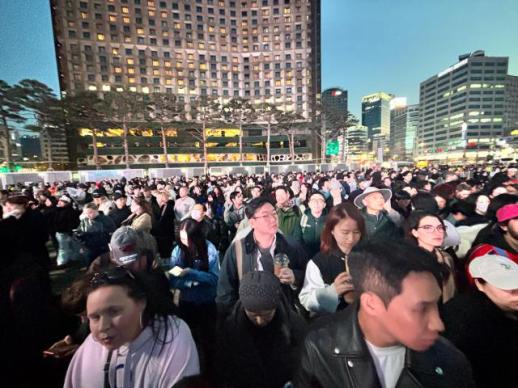 BTS Live: Packed, pushed, imperfect, yet orderly for BTS moment SEOUL, March 21 (AJP) -Two hours before BTS’s comeback concert, hundreds of fans without tickets for the free reserved seats had already formed tightly packed lines, hoping they would lead as close to the stage as possible beyond the police fence. The official seating at Gwanghwamun Plaza totaled 22,000, divided into Zone A for standing, Zone B for reserved seating and Zone C for additional seats. The rest were left to watch from around the plaza. Of those, 15,000 seats vanished almost instantly when online booking opened on Feb. 23, followed a week later by another 7,000 standing tickets. Police estimated that as many as 260,000 people could gather from the stage area to Sungnyemun, making it the largest crowd in central Seoul since the 2002 World Cup street cheering, when 200,000 to 250,000 people filled the area. Officers repeatedly urged pedestrians to keep moving whenever foot traffic slowed. “You cannot stand here. Please move,” they said in Korean, while foreign visitors were met with a constant refrain of “Move, move!” Access to Gwanghwamun Plaza was restricted to 31 gates equipped with metal detectors to block hazardous items, with police special forces also deployed inside. As crowds swelled, some gates were temporarily closed. When frustrated citizens protested, officers redirected them, warning that certain entry points were already overcrowded. Fans who failed to secure tickets adopted their own strategies to claim the best possible viewing spots. Some brought newspapers to sit on, others folding fishing stools. Even benches became contested territory. One concertgoer let out a sigh after losing a hard-won seat during a brief trip to the restroom. In front of the Kyobo Life building, some spectators sat on the pavement and stretched out their legs, prompting police to ask them to move for safety reasons. Near the KT building, there was not even room to sit, leaving fans standing for hours. The lines stretched endlessly, and many were not even sure where they were heading. After nearly an hour, the flow of people spilled into City Hall Plaza — a walk that would normally take 15 minutes. Hundreds, who thought they were heading toward Gwanghwamun, settled instead in front of giant outdoor screens. Those inside the perimeter faced their own constraints. Entry required arrival by 5 p.m., three hours before the concert, and all food except a bottle of water was confiscated. Those in standing zones hesitated to leave even for the restroom, fearing they would lose their hard-earned spots. An AJP reporter inside also reported intermittent internet outages as networks became overloaded. Still, for many, the experience was worth it. Paula, 27, from Chile, who had attended BTS’s last concert before the members began their military service, said the decision was simple. “I could watch it on Netflix, but I wanted to hear their voices in person.” Nearby cafés were already filled with fans waiting with BTS content playing on their screens. She and a Spanish friend she had met just 15 minutes earlier were simply hoping to catch even a partial view. “I just want to be part of this historic moment in a historic place,” she said. Drifting farther away from the venue with each police-guided step, Lil Reinhart, 21, from Germany, found herself pushed toward the outer edges of the crowd. Yet she had come anyway. “At least you can hear their real voice,” she said, her breath visible in the cold after six hours of waiting on the street. It was her first time traveling abroad alone. She booked her flight two months earlier, paying around 800 euros — well above the usual 500 — for what she called a “once-in-a-lifetime event.” “This kind of comeback won’t happen again,” she said. “Not with this many people, live in front of you.” Her determination was shaped by disappointment. She had failed to secure tickets for BTS’s Germany tour, an experience she described as “strong disappointment.” This time, she was not willing to miss it entirely. “I really wanted to see them at least once in my life.” Even as access to the venue became effectively impossible and the crowd was steadily pushed farther away, she stayed. The plan, if there was one, was simple: wait and hope. “Somewhere,” she said, “where I can at least hear their voices.” “I think as soon as I see them,” she said, “I’ll just be like — oh my gosh.” 2026-03-21 19:32:06
 -
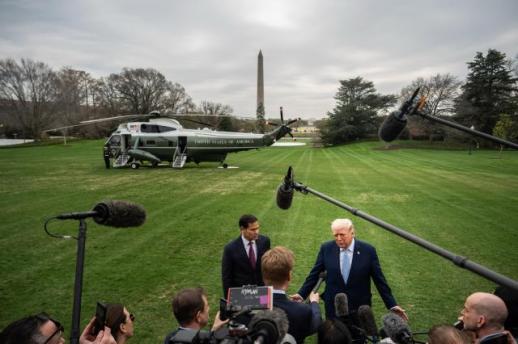 GULF CRISIS: Trump signals "winding-down" , Seoul joins statement on Iran SEOUL, March 21 (AJP) - U.S. President Donald Trump signaled a potential shift toward winding down military operations against Iran while he continuing to press key Asian allies, including South Korea, to take a more active role in securing the Strait of Hormuz, a critical global energy artery. South Korea belatedly joined a statement by Japan and other non-Gulf countries condemning Iran for weaponizing the Strait of Hormuz. In a post on Truth Social on Friday, Trump said Washington was “considering a gradual wind down” of its large-scale military campaign in the Middle East, adding that U.S. forces were “very close” to achieving their objectives. He outlined five core goals of the operation: neutralizing Iran’s missile capabilities, dismantling its defense industry, incapacitating its naval and air forces including air defense systems, permanently blocking its nuclear capabilities, and ensuring maximum protection for U.S. allies in the region. The remarks suggested that Washington may be exploring an exit strategy after nearly three weeks of escalating conflict. However, Trump’s messaging remained contradictory. Hours earlier, he dismissed the idea of a cease-fire, saying, “You don’t do a cease-fire when you’re literally obliterating the other side.” The ambiguity has left markets and allies uncertain whether the U.S. is genuinely preparing to de-escalate or simply attempting to stabilize oil prices and financial volatility without a concrete disengagement plan. But developments on the battleground pointed to continued escalation rather than de-escalation. The Pentagon is deploying additional Marines and three more warships to the region, marking the second reinforcement in a week and fueling speculation over a potential ground operation. Iran remains defiant. Its newly installed supreme leader warned that “safety must be taken away” from its enemies, while the Islamic Revolutionary Guard Corps rejected claims that its missile capabilities had been crippled. Israel said it had eliminated key leadership figures within the Basij militia, including its intelligence chief, in targeted strikes. The conflict has already begun spilling across the region. Gulf states reported intercepting drones and missiles, while NATO withdrew all personnel from Iraq to Europe, underscoring rising security risks. Oil markets remain on edge. Brent crude settled at $112.19 per barrel — the highest close since 2022 — after briefly spiking to $119 intraday, reflecting fears of prolonged disruption to global energy supply. Even as he hinted at a drawdown, Trump renewed calls for U.S. allies to shoulder more responsibility for securing the Strait of Hormuz, which Iran has effectively choked off. “We don’t use the strait. We don’t need it,” Trump told reporters at the White House. “Europe needs it. Korea, Japan, China — a lot of other people — so they’ll have to get involved.” He added that countries dependent on the route should “guard and police” it themselves, with the U.S. offering support only if requested. The remarks reflect Washington’s growing push to shift the burden of maritime security to energy-importing economies, particularly in Asia, even as it continues military operations against Iran. Seoul has responded cautiously, seeking to balance alliance coordination with domestic and regional constraints. South Korea’s Foreign Ministry late Friday said it would join a joint statement issued by seven countries — including the United Kingdom, France, Germany and Japan — condemning Iran’s effective blockade of the Strait of Hormuz and calling for the protection of freedom of navigation. “The decision reflects our fundamental position on ensuring safe maritime routes and the direct impact of disruptions on our energy security and economy,” the ministry said. The move signals diplomatic alignment with the U.S. and European partners while stopping short of committing to direct military participation such as dispatching naval forces. The joint statement itself was widely interpreted as a symbolic show of support rather than a binding operational commitment. Public sentiment in South Korea remains a key constraint. A Gallup Korea poll released Friday showed that 55 percent of respondents oppose sending naval forces to the Strait of Hormuz, compared with 30 percent in favor. Opposition was particularly strong among centrists and progressives, while conservative voters were more evenly split. The data highlights the political risk for Seoul in responding to Washington’s request for military involvement, particularly amid heightened uncertainty over the trajectory of the conflict. Still, some ruling party lawmakers have suggested leveraging potential participation as a bargaining chip in negotiations with the U.S., including securing greater autonomy over nuclear-powered submarine development. 2026-03-21 07:57:25
 -
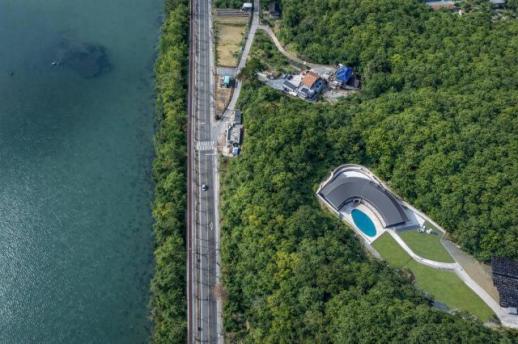 From ashes to rebirth: Yoon Kyeong-sik wins World Architecture Awards SEOUL, March 18 (AJP) - In March 2026, the announcement came from the United Kingdom: the World Architecture Community Awards, 53rd cycle. It was not simply a prize. It was recognition that something quiet, something deeply human, had spoken across borders. Among works from 53 countries and judged by 243 jurors, the Inwolsa Dharma Center was chosen — not for spectacle, but for the depth of its question. This was not architecture of reconstruction. It was architecture of renewal. “The fire burned the buildings, but it could not burn our practice. What we rebuilt was not a temple, but the mind.” With these words, Venerable Jaebeom condensed the entire narrative of Inwolsa. What stands today is not only designed — it is gathered. From quiet donations, from unseen solidarity, from a shared refusal to let meaning disappear. As the Buddhist teaching goes: All things arise from the mind. Inwolsa is that mind made visible. Faced with the ruins, architect Yoon Kyeong-sik did not choose restoration. He chose not to repeat the past. He chose to reinterpret it. “Inwol” — the moon reflected on water. One moon, infinitely mirrored. From this idea, he translated philosophy into space. The curve of the crescent moon, the arc of the Buddha’s brow. No rigid lines, but flowing continuity. No division, but relationship. Architecture here becomes thought. Inside, the central space opens — empty, yet full. This emptiness is not absence. It is potential. The meditation hall and prayer spaces unfold as separate functions within a single continuous flow. To be empty is to hold everything. The Indra Wall forms the heart of the building. A field of color, light, and deliberate voids.Each opening receives light, and reflects it onward. Yoon Kyeong-sik does not build religion. He builds questions. “Architecture is not where people stay. It is where people change.” At Inwolsa, this is not an idea. It is an experience. His work resists spectacle. It returns to essence. Inwolsa gathers all of this into one place. It is not merely a temple. It is a record of loss, a form shaped by community, a vessel of spirit. Fire destroys. But it cannot touch the mind. And the mind, in time, builds again. Yoon’s architecture stands as proof. About the author: Architect Yoon Kyeong-sik is widely regarded as one of the defining voices in contemporary spiritual architecture, known for his philosophy of harmonizing tradition and modernity through nature-responsive design and humanistic inquiry. Over a career spanning more than 35 years, Yoon has earned over 24 international architecture awards. His work extends beyond the physical realm, positioning architecture as an intellectual and philosophical practice—one that engages with the humanities, aesthetics and the inner life of space. Among his most celebrated works, the Haselina Ninebridge Clubhouse has drawn international attention. The project was featured by the BBC for its striking ceiling design, noted for its sculptural interplay of light and structure. It was also highlighted by The New York Times as a distinctive architectural destination, underscoring its global cultural resonance. Yoon’s portfolio has been recognized with major honors including the International Architecture Awards (IAA), the iF Design Award and the Architecture MasterPrize (AMP). Notably, he became the first non-European architect to receive top recognition at an Italian sustainable architecture award, marking a significant milestone in the field. 2026-03-18 20:01:19