
Journalist

Oh Jooseok
farbrother@ajunews.com
-
 Jeju Air Adds Ninth Boeing 737-8 as It Pushes Fleet Modernization Jeju Air said Thursday it has added its ninth Boeing 737-8, a next-generation aircraft, through a purchase. With the latest delivery, next-generation aircraft now account for 21% of its passenger fleet, and owned aircraft make up 35%, the airline said. Jeju Air began purchasing 737-8s in 2023 and brought in a total of eight next-generation aircraft through last year. It plans to add seven more purchased 737-8s this year, including the ninth aircraft, focusing on fleet modernization, operational improvements and flight stability. The airline is also replacing older aircraft. After returning one aging aircraft when its lease expired in November, it plans to return another this month, it said. Jeju Air said it is strengthening maintenance capabilities and pilot training to support safe operations. It has also signed a business agreement with Boeing on competency-based training and assessment, or CBTA, to improve emergency response capabilities. "Introducing next-generation aircraft and increasing the share of owned planes is a mid- to long-term strategy to boost both operational stability and cost competitiveness," a Jeju Air official said. "Through fleet modernization, we will further solidify the foundation for sustainable growth." 2026-02-06 09:48:00
 -
 Hanwha Aerospace, KAI sign MOU to cooperate on defense and space aviation R&D Hanwha Aerospace has joined hands with Korea Aerospace Industries, or KAI, to cooperate on future core projects in defense and the space and aviation sectors. Building on aviation technology developed over the past 40 years, the companies plan to pursue development of homegrown engines and unmanned aircraft. Hanwha Aerospace and KAI said Thursday they signed a memorandum of understanding on Feb. 5 at Hanwha Building in central Seoul to strengthen the global competitiveness of South Korea’s defense industry. Attendees included Hanwha Aerospace CEO Son Jae Il and KAI CEO Cha Jae Byung, along with other officials from both companies. Under the agreement, the companies said they will cooperate on joint development and export efforts for unmanned aircraft; development and joint marketing of aircraft equipped with domestically produced engines; and collaboration aimed at entering the global commercial space market. Hanwha Aerospace and KAI said they each have more than 40 years of experience in aircraft airframe development and production. They also cited prior work with the Agency for Defense Development on state-led programs, including development of unmanned aircraft airframes and onboard engines, and said they expect synergies from the partnership. The companies said they will run joint research and development and technical support programs. They said they expect to pursue joint development of an advanced aircraft engine to be installed on a follow-on model to the domestically developed KF-21 fighter. They also plan to regularly operate a “Future Aerospace Strategy Committee” involving top executives to build a mid- to long-term cooperation framework. Cha said, “Through this strategic cooperation, we will support the government’s balanced regional development policy and further expand the export footprint of K-defense.” Son said the MOU is intended to “present a new model for exports and shared growth based on ecosystem innovation across the defense and space aviation sectors,” adding that the company will “step by step expand a win-win growth and cooperation model” with KAI. 2026-02-06 09:33:00
 -
 Hyundai Motor Group Wins Back-to-Back Honors From Top U.S. Auto Outlets Hyundai Motor Group said Thursday it has posted a string of wins in major U.S. auto awards, highlighting its competitiveness in the market. The group said Car and Driver named 17 of its models as best in their segments in the magazine’s 2026 Editors’ Choice Awards: eight Hyundai vehicles, five Kia vehicles and four Genesis vehicles. Car and Driver selects its Editors’ Choice winners each year after its editors test-drive vehicles sold in the U.S. market and rate them across categories and segments. The outlet cited Hyundai Motor Group’s design, value and driving performance as key strengths, the company said. Hyundai’s Palisade was named best in its class for a seventh straight year, recognized for its exterior styling, upscale interior and broad list of standard convenience features. The Ioniq 5 was cited for fast charging and nimble, stable driving. The Elantra N was praised for handling, and the Santa Cruz for its upscale cabin and ride comfort. Kia’s EV6 was recognized for rapid charging and stable driving performance. The Carnival was cited for its styling and responsive driving, while the K5 was praised for its bold design and class-leading standard features, the group said. Genesis’ GV70 was recognized for its interior and exterior design and convenience features. The GV80 and G80 were cited for elegant interiors and strong value for their classes. The G90 was praised for a quiet, composed ride, a premium cabin and a wide range of convenience features, the company said. Hyundai Motor Group also reported wins from other major U.S. auto outlets. In MotorWeek’s 2026 Drivers’ Choice Awards, the Palisade was named best large utility, and the Kia K4 won best family car. The group said MotorWeek praised the Palisade for a next-generation hybrid system that improves both performance and fuel economy, along with a range of advanced convenience features. The K4 was recognized for its roomy, comfortable interior and smooth driving performance. The company said the Palisade, which it described as a North American Car of the Year winner, also took top honors from both Car and Driver and MotorWeek. In Cars.com’s 2026 Best of Awards, Hyundai’s Santa Fe and Santa Fe Hybrid were named best family car, and the Kia EV9 was selected as best electric vehicle, the group said. “Earning strong results in consecutive evaluations by leading U.S. automotive media outlets reflects recognition of our continued efforts to strengthen product competitiveness from the customer’s perspective,” a Hyundai Motor Group official said. * This article has been translated by AI. 2026-02-06 09:12:00
 -
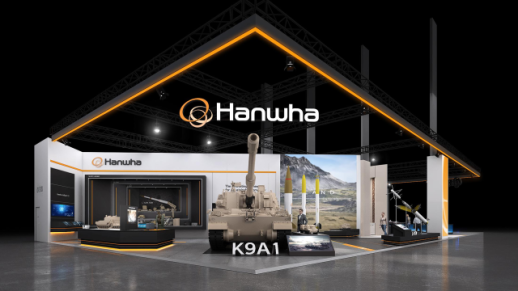 Hanwha to Debut AI-Enabled Loitering Precision-Guided Weapon at Saudi Defense Show Hanwha is set to unveil advanced weapons systems to the global market for the first time, including an artificial intelligence-enabled “loitering precision-guided weapon (L-PGW).” Hanwha Aerospace, Hanwha Systems and Hanwha Ocean said Tuesday they will take part in the World Defense Show 2026 in Riyadh, Saudi Arabia, from Feb. 8-12 with their largest-ever integrated booth, covering 677 square meters (including 50 square meters outdoors). The biennial show is being held for the third time this year, with 773 companies from 76 countries participating. Hanwha Aerospace’s L-PGW is described as a next-generation capability in which AI independently scouts, identifies and strikes targets. The system uses a new concept in which a suicide drone separates and launches at the moment of attack. Hanwha said it will be the weapon’s first public showing in the global advanced-arms market, which has been led by major U.S. and European firms. Hanwha Systems will also present its vision for AI-based future weapons spanning surveillance and reconnaissance, space and maritime operations. It plans to debut a multipurpose radar (MMR) designed to operate with ground weapon systems and counter evolving low-altitude air threats such as drones. The companies will showcase an AI-based combat management system (CMS), an AESA-based four-sided fixed multifunction radar (MFR), and a “smart battleship” concept incorporating unmanned systems and stealth design. A K9A1 self-propelled howitzer fitted with an STX Engine from South Korea will be displayed as a physical unit and was built to meet Saudi export requirements. Hanwha will also exhibit the Jangbogo-III Batch-II 3,000-ton-class submarine launched in a ceremony last October, along with a submarine base, surface ships and unmanned surface vessels. A Hanwha official said the company will work as “one team” with the South Korean government to develop global markets and enter overseas markets with partner firms, adding it will “make a practical contribution” to Saudi Arabia’s defense and industrial self-reliance and strengthen a strategic partnership.* This article has been translated by AI. 2026-02-04 17:30:00
 -
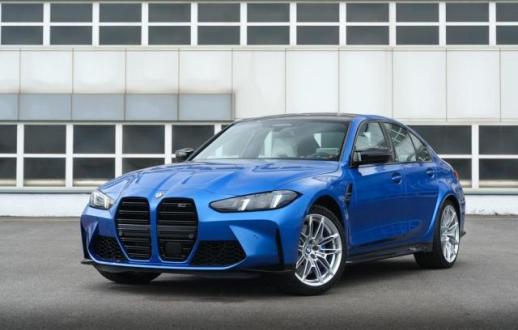 South Korea’s Imported Car Sales Jump 37.6% in January to 20,960, Led by BMW BMW continued to lead South Korea’s imported-car market in January. The Korea Automobile Importers & Distributors Association said Tuesday that new registrations of imported passenger cars totaled 20,960 in January, up 37.6% from a year earlier. The figure was down 26.7% from December. By brand, BMW ranked first with 6,270 registrations, ahead of Mercedes-Benz with 5,121. It was followed by Tesla (1,966), Lexus (1,464), BYD (1,347), Volvo (1,037), Audi (847) and Porsche (702). By engine displacement, vehicles under 2,000cc accounted for 9,711 (46.3%). Models from 2,000cc to under 3,000cc totaled 5,781 (27.6%); 3,000cc to under 4,000cc, 694 (3.3%); and 4,000cc or more, 344 (1.6%). Other categories, including electric vehicles, totaled 4,430 (21.1%). By origin, European brands made up 15,132 registrations (72.2%), followed by the United States with 2,291 (10.9%), Japan with 2,190 (10.4%) and China with 1,347 (6.4%). By fuel type, hybrids led with 13,949 (66.6%), followed by electric vehicles with 4,430 (21.1%), gasoline with 2,441 (11.6%) and diesel with 140 (0.7%). Of the 20,960 vehicles sold, individual buyers accounted for 12,200 (58.2%) and corporate buyers for 8,760 (41.8%). Among individual purchases, registrations were highest in Gyeonggi (3,711, 30.4%), Seoul (2,464, 20.2%) and Incheon (726, 6.0%). For corporate purchases, Incheon led with 2,930 (33.4%), followed by Seoul with 2,678 (30.6%) and South Gyeongsang with 1,335 (15.2%). The best-selling model in January was the Mercedes-Benz E 200 with 1,207 registrations. The BMW 520 (1,162) and Tesla Model Y (1,134) also ranked near the top. KAIDA Vice Chairman Jeong Yun-young said January registrations rose from a year earlier due to increased electric-vehicle sales and the impact of new brands. 2026-02-04 10:12:00
 -
 Actor Kim Woo Bin Named Polestar Brand Ambassador Swedish electric-vehicle brand Polestar said Tuesday it has selected actor Kim Woo Bin as a brand ambassador. Under the partnership, Kim will experience Polestar products and the brand firsthand and take part in a range of online and in-person activities, including brand events and digital content, to broaden engagement with Polestar customers. Polestar Korea said it focused on Kim’s polished, trustworthy image, saying it aligns with Polestar’s core values of Scandinavian design, performance and sustainability. The company said his emphasis on restrained aesthetics and authenticity is expected to help deliver Polestar’s brand message. Ham Jong Sung, CEO of Polestar Korea, said, “Actor Kim Woo Bin has been loved for a long time based on his distinct style and trustworthy image,” adding that he is expected to convey Polestar’s values of design, performance and sustainability to customers “more sincerely.” Kim said, “I’m happy to be with Polestar. I want to share the brand’s appeal honestly and sincerely.” * This article has been translated by AI. 2026-02-04 09:30:00
 -
 Korean Air Launches Generative AI Chatbot for Customer Service Korean Air said Tuesday it has launched the “Korean Air AI Chatbot,” adding generative artificial intelligence to its online customer-service chatbot. The chatbot is built on generative AI trained on a large volume of data, including airline rules, the company said. Customers can type questions in everyday language — for example, asking how many checked bags are allowed for an economy-class trip from Incheon to Paris — and receive an answer tailored to the request. To improve reliability, Korean Air said the chatbot provides the source of its answers along with links to related pages. The airline also said it has completed an AI-focused database designed to minimize “hallucinations” and deliver verified responses. The service is available on Korean Air’s official website and mobile app. Korean Air expanded language support from four — Korean, English, simplified Chinese and Japanese — to 13 by adding traditional Chinese, French, Russian, German, Portuguese, Spanish, Italian, Thai and Vietnamese. If users need more help beyond the chatbot’s response, they can type “connect to an agent” to move directly from the chatbot screen to a customer-service representative, the airline said. Agent support is available only in Korean and English. Korean Air said it plans to add features in stages based on customer experience, expanding beyond information such as airline policies to functions including ticket purchases and reservation lookups. “With the AI chatbot service, customers can experience more accurate and faster support, as well as convenient and smart service for global customers,” a Korean Air official said.* This article has been translated by AI. 2026-02-04 09:00:00
 -
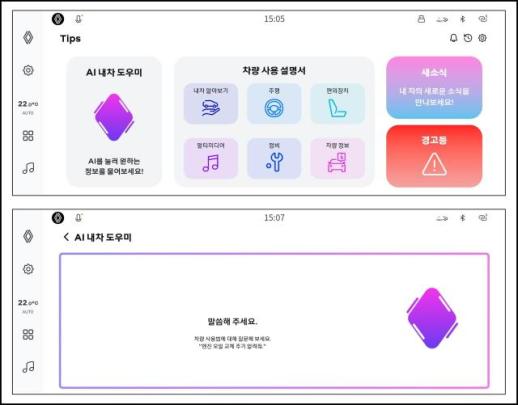 Renault Korea Adds ChatGPT-Based Generative AI to Renault Filante Tips App Renault Korea said Tuesday it has added ChatGPT-based generative artificial intelligence to “Tips,” its vehicle guide application for Renault Filante. Tips is an integrated guide service designed to help drivers quickly resolve questions that come up while using the vehicle, the company said. Its main feature, “AI My Car Assistant,” uses generative AI to provide information in a conversational format. Unlike keyword-based searches, it allows users to continue exploring information through dialogue for more natural guidance, Renault Korea said. The app also offers a digital owner’s manual so drivers can view vehicle information at a glance. Users can browse categories such as getting to know the car, driving, convenience features, multimedia, maintenance and vehicle information, or ask the AI assistant directly. For information that may be needed immediately while driving, the app provides separate menus. A news section offers the latest vehicle-related updates and key notices, while a warning-lights section explains dashboard warning indicators to help drivers quickly understand the situation. “While vehicle functions have become more advanced and the amount of information provided has continued to grow, many drivers still struggle to find what they need during actual driving,” said Choi Seong Gyu, head of Renault Korea’s research center. “Renault Korea has actively introduced AI-based features so customers can use their vehicles more easily and conveniently,” he said.* This article has been translated by AI. 2026-02-04 08:30:00
 -
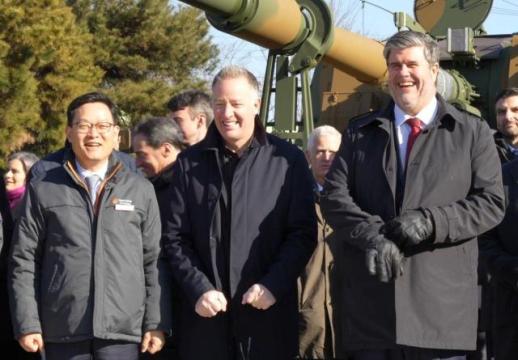 Canada’s defense procurement minister visits Hanwha Aerospace plant, cites potential for deeper cooperation Canadian Minister of State for Defense Procurement Stephen Fuhr visited Hanwha Aerospace’s Changwon site, a day after touring facilities run by Hanwha Ocean and Hyundai Rotem to review major South Korean defense systems. Hanwha Aerospace said Fuhr, a delegation of Canadian company representatives and others — about 30 people — visited its Plants 2 and 3 in Changwon, South Gyeongsang province, on Feb. 3. The group toured production lines for the K9 self-propelled howitzer, the K10 ammunition resupply vehicle and the Chunmoo multiple rocket launcher system. They also watched mobility demonstrations of the K9, the Redback infantry fighting vehicle and the K21 armored vehicle, and rode in key equipment to experience performance firsthand. Hanwha said the visit was aimed at assessing South Korea’s defense capabilities ahead of Canada’s large-scale military modernization effort, the Indirect Fire Modernization (IFM) program. Canada plans to introduce about 250 infantry fighting vehicles into its army by 2030, six years earlier than scheduled. Hanwha Aerospace said it proposed an integrated “firepower-and-mobility solution” linking the K9, Chunmoo and Redback — systems it said are operated in more than 10 countries, including six NATO members. The company also proposed a partnership to help build a local defense industrial ecosystem in Canada, beyond simply supplying equipment. The company said the approach is intended to meet Canada’s priorities for local production and supply-chain security, while expanding cooperation in North America and NATO markets with Canada as a hub. “We will be the best partner for Canada’s military modernization, based on Hanwha’s decades of accumulated technology and our ability to meet delivery schedules,” Hanwha Aerospace CEO Son Jae-il said. Fuhr said Hanwha’s modern production facilities and high level of technology were “very impressive and surprising,” adding that the visit would be an important opportunity to make bilateral defense cooperation more concrete. Fuhr visited Hanwha Ocean the previous day, where he looked at a model of the Jang Yeong-sil ship and requested cooperation in the automotive sector. At Hyundai Rotem, he reviewed production processes for major defense systems including the K2 tank.* This article has been translated by AI. 2026-02-03 17:27:00
 -
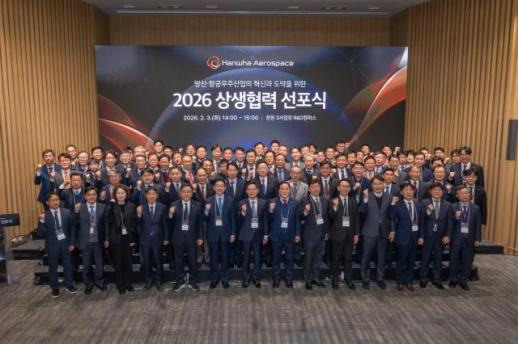 Hanwha Aerospace Launches $22 Million Supplier Innovation Profit-Sharing Program Hanwha Aerospace said it will launch a supplier innovation profit-sharing program aimed at advancing cutting-edge defense technology and supporting shared growth by directing its defense R&D funding to suppliers’ research and expanded intellectual property. The company held a ceremony on Monday at its R&D center at its Plant 3 site in Changwon, South Korea, with about 80 attendees, including representatives from 56 suppliers as well as central and local government officials. Hanwha Aerospace said it will begin the program this year with a total budget of 30 billion won. Under the plan, if suppliers pursue advanced R&D and localization of key components, Hanwha Aerospace will cover 100% of required R&D costs, including direct development expenses, research activity funding, facility investment and infrastructure. When suppliers participate in government small-business R&D programs — including those run by the Korea Institute for Advancement of Technology for defense component localization and the Ministry of SMEs and Startups for public-private technology commercialization — Hanwha Aerospace will also pay the suppliers’ required contributions. The company said not only existing suppliers but also promising small firms and startups can join R&D in strategic defense areas such as AI and robotics. Hanwha Aerospace said it will also significantly expand financial support for suppliers, tripling its shared-growth fund to 150 billion won from 50 billion won to back rising defense demand and export opportunities. It also said it will work with the Defense Industry Mutual Aid Association to create an advance-payment performance bond fee reduction program — the first such move in the defense industry — to ease suppliers’ financial burden during export contract processes. Jo Jeong Hyun, CEO of SG Solution and head of the shared-growth cooperation council, said, “With the new shared-growth cooperation program, we will trust Hanwha Aerospace as a strong partner and take bolder challenges to achieve technological independence and global growth.” He added, “We appreciate the creation of this program and look forward to a stronger future.” Hanwha Aerospace CEO Son Jae Il said, “The competitiveness of K-defense begins with suppliers’ competitiveness in components,” adding that the company will treat suppliers “not as simple counterparties, but as strategic partners that share technology and drive growth together,” putting into practice the group’s shared-growth management philosophy of “going far together.” 2026-02-03 16:36:00