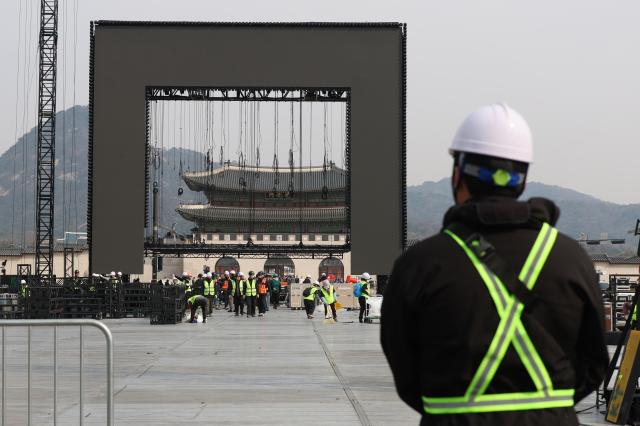
SEOUL, March 22 (AJP) -The BTS’s comeback concert in central Seoul on Saturday drew more than 100,000 people and ended without a single major incident, delivering both a powerful display of K-culture’s global reach and a sharp boost to retail sales around the event zone.
According to the Seoul Metropolitan Government on Sunday, an estimated 104,000 spectators gathered around Gwanghwamun Plaza on Saturday, as global fans — known as ARMY — joined Seoul residents in a rare citywide celebration.
The event doubled as an economic catalyst, with convenience store sales in the area surging dramatically on the day of the concert.
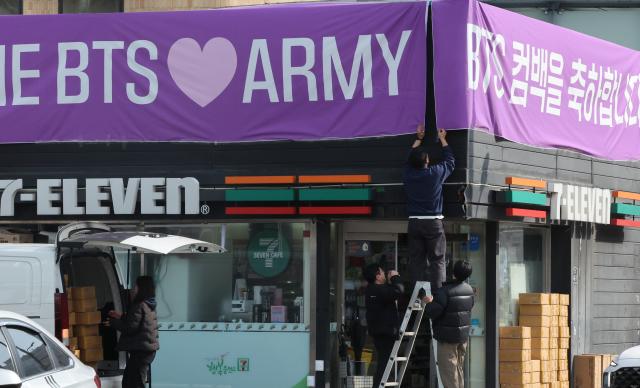
CU, operated by BGF Retail, said sales at 10 stores near Gwanghwamun jumped 270.9 percent from a week earlier, while three stores closest to the venue saw sales soar 547.8 percent.
Sales of albums and newspapers, including BTS releases, surged 214.3 times, while demand for concert essentials spiked. Batteries rose 50.7 times, hot packs 12.8 times, portable chargers 11.9 times, cosmetics 11.4 times, and tissues 10.2 times, driven largely by fans preparing for long hours outdoors.
Food and beverage sales also climbed sharply, with gimbap up 1,380.4 percent, sandwiches 1,146.7 percent, triangle kimbap 884.3 percent, bottled water 831.4 percent, and iced drinks 813.4 percent.
GS25 reported similar trends, with sales at five nearby stores rising 233.1 percent, and the busiest location posting gains of up to 378.4 percent. Hot packs surged 5,698.8 percent, portable chargers 2,016.9 percent, and batteries 3,530.8 percent, while transportation card sales rose 647.5 percent amid heavy foot traffic and increased purchases by foreign visitors.
Seven-Eleven said sales at 40 stores in the Gwanghwamun and Myeong-dong areas increased 117.0 percent from a month earlier, with some stores near the venue seeing sales jump as much as sevenfold. Emart24 also reported steady increases, including a 400 percent rise in battery sales and 260 percent in wet tissues compared with the previous week.
Apart from law enforcement forces, city authorities mounted a large-scale safety operation to manage the crowds. A total of 3,400 personnel from city agencies were deployed, rising to about 8,200 when combined with staff from event organizer HYBE.
A joint command post was activated at the Sejong Center for the Performing Arts from 10 a.m., 10 hours before the concert, coordinating efforts among city officials, police, fire authorities and organizers to monitor crowd conditions in real time.
The Seoul Fire and Disaster Headquarters deployed 102 fire vehicles and 803 personnel, while police implemented a “stadium-style” crowd control system to disperse foot traffic and prevent congestion.
Despite dense crowds, no safety incidents were reported. Preventive measures included the installation of safety barriers at 82 key locations, such as subway ventilation shafts and station entrances.
Cleanup operations were completed swiftly, with 274 personnel and 53 vehicles deployed and about 40 tons of waste collected over two days. Major roads, including Sejong-daero, were reopened early Sunday morning after overnight restoration.
Extensive multilingual support was also provided for international visitors. More than 600 interpreters and volunteers were deployed, and transport systems offered guidance in multiple languages across subway stations and bus stops.
Seoul Mayor Oh Se-hoon said the event demonstrated the city’s global competitiveness. “This was more than a comeback stage — it was an opportunity to showcase Seoul’s cultural capacity and global standing,” he said.
The city plans to extend the festive atmosphere through HYBE’s “The City Arirang Seoul” program, running through April 19 across key landmarks including the Han River and Dongdaemun Design Plaza.
Copyright ⓒ Aju Press All rights reserved.