

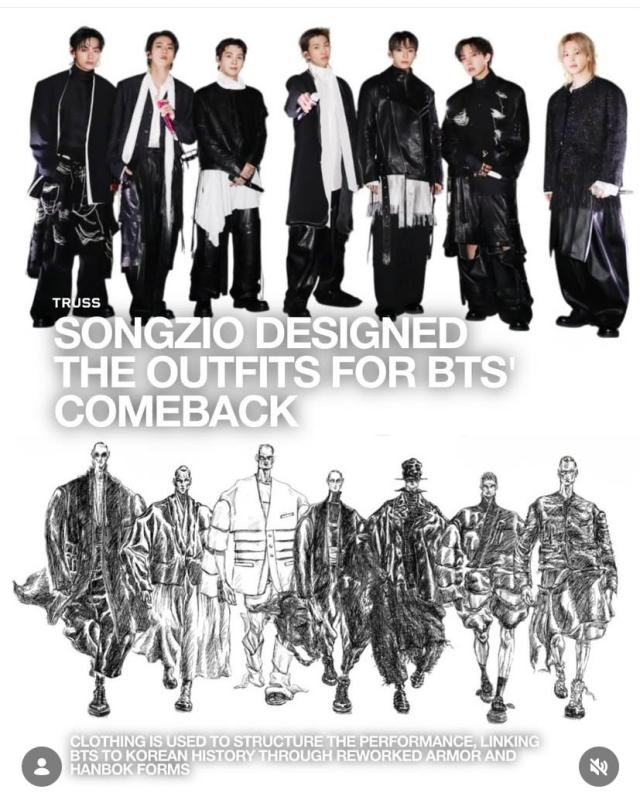
SEOUL, March 22 (AJP) -SEOUL, March 22 (AJP) — BTS’s comeback stage at Gwanghwamun was not only a musical return but a carefully constructed visual manifesto, where fashion became the medium through which history, identity and future ambition converged.
At the center of that statement was “Lyrical Armor,” a collaborative collection with Korean designer Songzio, which transformed the seven members into embodiments of Korea’s evolving cultural narrative.
Rather than treating costume as embellishment, the collection functioned as narrative architecture — a wearable interpretation of Korea’s past reframed for a global present.
The conceptual foundation drew from early Joseon-era armor, juxtaposed with the fluidity of hanbok and the expressive tradition of poets, painters and sorigun (traditional vocal performers).
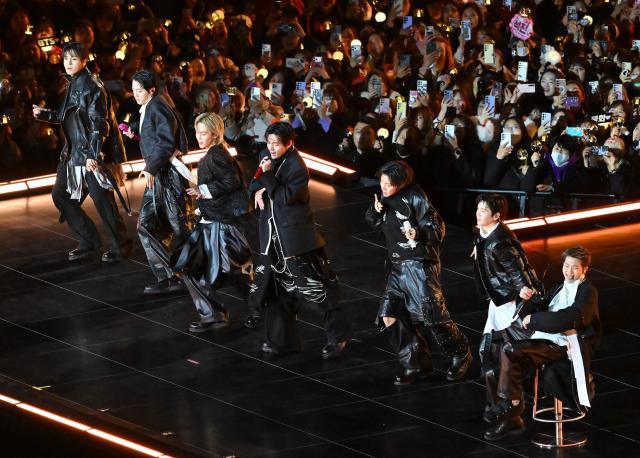
Armor plates became fragmented panels. Hanbok lines were stretched, tilted and reassembled. Seams were deliberately left raw, exposing what appeared to be the “wounds” of history — not concealed, but integrated into the design language.
Within this framework, each BTS member occupied a symbolic role, turning the stage into a tableau of archetypes.
RM, positioned as the “Hero,” wore a long, hanbok-inspired coat structured with armor-like plating. The piece balanced weight and flow, authority and restraint — a visual articulation of leadership grounded in cultural lineage.
Jin’s “Artist” translated traditional elegance into modern tailoring, with layered structures referencing armor yet softened through draped movement, suggesting the transformation of emotion into form.
SUGA, cast as the “Architect,” embodied construction itself. His look emphasized structure and tension — rigid elements offset by fluid lines — mirroring the duality of composition and introspection that defines his musical identity.
J-Hope’s “Sorigun” brought rhythm into fabric. A reinterpretation of the dopo through a streetwear lens, his silhouette moved with kinetic asymmetry, reflecting both performance and improvisation.
Jimin’s “Poet” leaned into fragility and lightness. His layered armor dissolved into air-like textures, with delicate embellishments that captured motion as if writing verse through movement.
V’s “Doryeong” distilled restraint. Drawing from the scholar class, his look combined controlled tailoring with layered drapery, projecting quiet authority rather than overt spectacle.
Jungkook, as the “Vanguard,” pushed forward. His deconstructed, military-inflected silhouette conveyed propulsion — a figure not rooted in history but moving through it, carrying its fragments into the future.
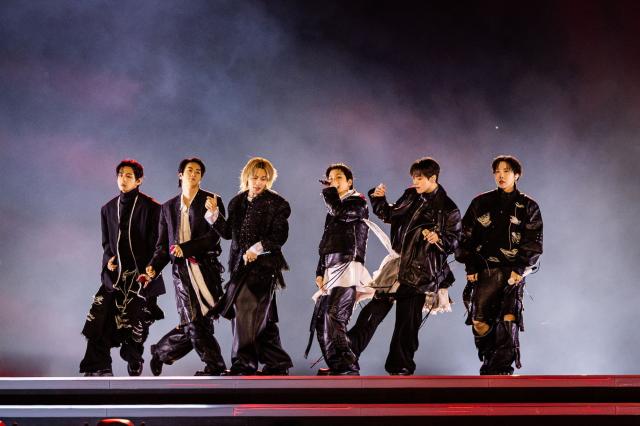
Across all seven, a common language emerged: asymmetry, layering, and tension between structure and flow. It was a language that spoke to rupture — and to rebuilding.
In doing so, “Lyrical Armor” aligned seamlessly with the broader arc of BTS’s comeback project, “Arirang,” which seeks to reconnect with Korean identity at a moment of global saturation.
The conceptual core of “Lyrical Armor”, explained designer Jay Songzio in his homepage, lies in the fusion of strength and lyricism — combining the rigid armor worn by early Joseon warriors with the flowing hanbok of poets and sorigun who distilled collective grief and aspiration into verse and song. The result is a vision of “new-era heroes” who carry history not as burden, but as momentum toward the future.
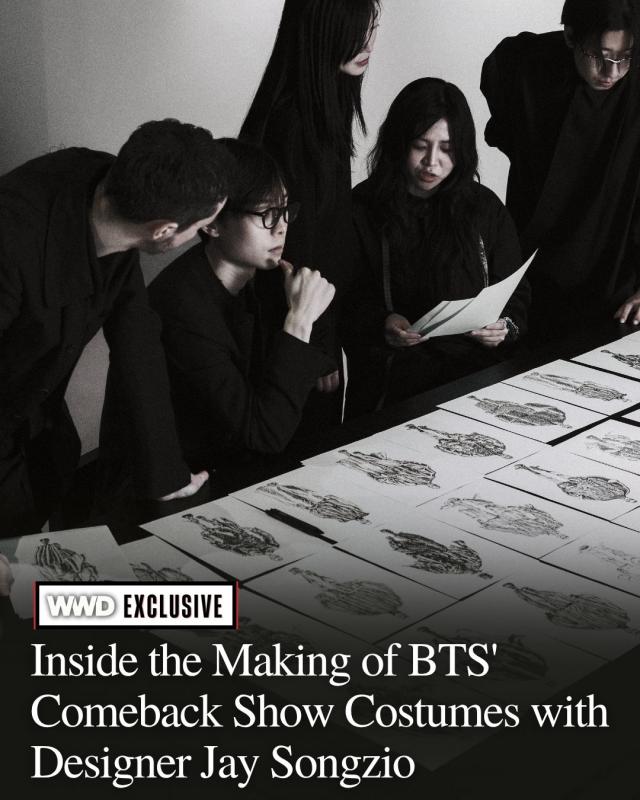
Songzio described the collection as an act of resistance against conventional boundaries of time, form and dress.
Traditional structures were dismantled and reassembled into abstract fragments, creating avant-garde silhouettes that oscillate between expansion and restraint. Volumes swell and recede, while non-structural patterns and fluid draping move like kinetic sculpture, blurring the line between reality and imagination.
As BTS stood before a crowd of more than 100,000 and millions more watching worldwide, they were not only performing songs.
They were wearing a narrative — one that suggested that the future of K-fashion, like K-pop itself, based on hanbok identity.
Copyright ⓒ Aju Press All rights reserved.
