

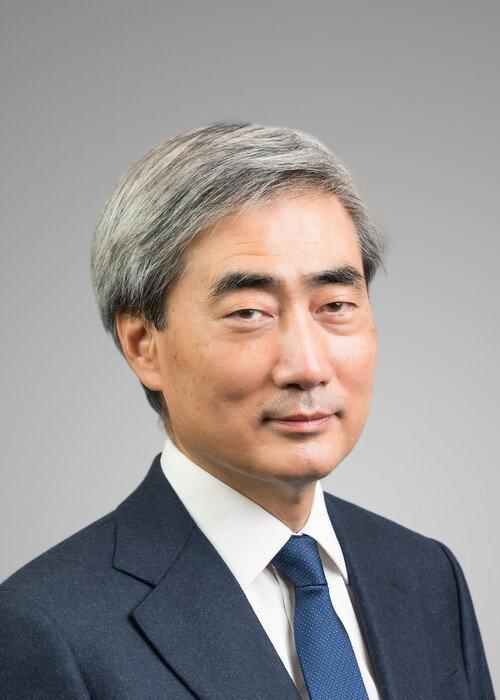
The presidential office said Shin’s combination of academic depth and policy experience makes him well suited to manage rising uncertainty linked to geopolitical tensions and inflation risks, while balancing price stability and growth.
Shin, a former Princeton University professor and senior adviser to former conservative President Lee Myung-bak in 2010, has spent the past decade at the Bank for International Settlements, where his work has centered on global liquidity, financial cycles and systemic risk.
Shin’s research indicates a policy approach that places financial stability at the core of monetary decision-making.
In “Global Banking Glut and Loan Risk Premium” (IMF Working Paper, 2011), Shin argues that financial conditions are driven by the balance sheet expansion of global banks and leverage cycles, rather than policy rates alone.
In a related line of work, “Global Liquidity and Procyclicality” (BIS/NBER), he elaborates that credit supply expands and contracts with global banking conditions, amplifying boom-bust cycles across economies.
These findings suggest that central banks need to monitor credit growth, leverage and asset prices alongside inflation.
His arguments point to the need for close attention to household debt management and macroprudential policy tools.
A central theme in Shin’s work is the dominant role of the U.S. dollar in the global financial system.
In BIS Quarterly Review articles, including “The Dollar, Bank Leverage and the Deviation from Covered Interest Parity” (BIS, 2018), Shin documents how dollar-denominated credit outside the United States exposes borrowers to funding risks when the dollar strengthens.
His research shows that tighter global dollar liquidity can lead to capital outflows, currency depreciation and tighter financial conditions, regardless of domestic policy settings.
Shin’s appointment comes as the won is at its weakest level against the U.S. dollar since the global financial crisis, ending last week at around 1,500 per dollar.
Shin has also emphasized that inflation dynamics are increasingly influenced by external forces. In a BIS speech, “Inflation: Drivers and Dynamics” (2022), he highlights the role of commodity prices, exchange rates and global financial conditions in shaping inflation, especially in open economies.
This suggests that monetary policy decisions will need to account for imported inflation and exchange rate pass-through, particularly as oil prices and energy supply disruptions weigh on import-dependent Korea.
Under his watch, the Bank of Korea may prioritize financial stability and systemic risk monitoring, global liquidity and capital flow conditions, and exercise caution on rate cuts amid U.S. dollar strength.
Following a parliamentary confirmation hearing, Shin is expected to succeed current Bank of Korea Governor Rhee Chang-yong, whose four-year term ends on April 20.
Copyright ⓒ Aju Press All rights reserved.
