

Journalist

Shin Jia and Kim Hee-su
fromjia@ajunews.com
-
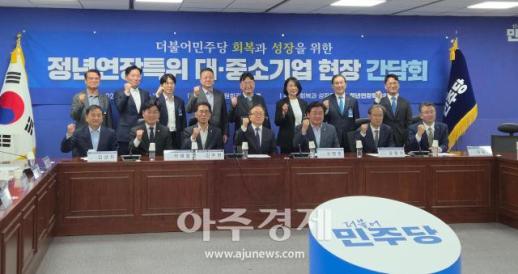 Business groups say raising retirement age to 65 must include wage system overhaul The government is accelerating plans to raise the mandatory retirement age to 65, and business groups are urging that wage adjustments for workers 60 and older be recognized as an exception to age-discrimination rules. The government says it plans to submit legislation in the first half of the year, but no agreement has been reached on wages or employment arrangements. On the 30th, the Democratic Party’s special committee on extending the retirement age held a meeting with business representatives from large and small companies to discuss directions for overhauling wage systems. Business groups say they can accept a higher retirement age, but only if wage systems are restructured. The Korea Employers Federation said it recently interviewed many Japanese companies, where continued employment after age 60 has been established earlier than in South Korea, to review how the policy was introduced and how it operates in practice. The federation is calling for a compromise that allows voluntary implementation reflecting each company’s personnel system. It also wants to ease the added labor-cost burden of keeping older workers by shifting to job- and performance-based pay. A uniform wage cut, it argues, could weaken motivation and reduce productivity, so compensation should be differentiated based on expertise and results. According to the federation, Japan shares the social costs of extending older-worker employment among labor, management and government. Companies employ all applicants, but wages upon rehire are adjusted to about 20% to 30% below previous levels, with the government covering a substantial portion. Japan keeps the legal retirement age at 60 but requires measures to secure employment through 65. Companies choose one of three options: rehiring, extending retirement, or abolishing retirement. Japan has also reduced corporate burdens by allowing changes to work rules deemed socially reasonable without going through labor-management agreement procedures. Nissan Motor, for example, provides differentiated incentives to workers over 60 who deliver performance or have strong technical skills. Lee Dong-geun, vice chairman of the Korea Employers Federation, told Aju Business that because Japan’s industry and employment structure are similar, “the most desirable approach is a company-choice model following Japan’s precedent.” He added that if the retirement age is extended, “the wage system must also be reformed” to address concerns about reduced youth hiring. Shin Chang-hoon, a managing director at Lotte Holdings, said problems tied to seniority-based pay are serious, adding that if flexibility in seniority and employment is secured, extending the retirement age “would not be a big issue.” An industry official said no agreement was reached at the meeting. “It was simply a chance to hear companies’ situations,” the official said, adding that discussions would likely become more substantive after local elections. With labor and management far apart on wage cuts, conflict is expected to continue during the legislative process. Participants included the Korea Employers Federation, the Korea Federation of SMEs, Samsung Global Research, Hyundai Motor, SK Supex Council, LG Electronics and Lotte Holdings.* This article has been translated by AI. 2026-04-30 15:18:19
 -
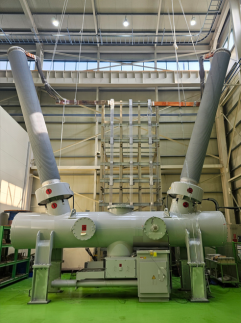 Hyosung Heavy Industries to Showcase AI Data Center Grid Solutions at IEEE PES T&D 2026 Hyosung Heavy Industries will present what it calls a “total solution” for power grids serving artificial intelligence data centers at the largest U.S. transmission and distribution exhibition. The company said Wednesday it will take part in IEEE PES T&D 2026, to be held May 4-7 (local time) in Chicago. The event will be held under the theme “Powering Reliability, Engineering Resilience.” Hyosung Heavy said it will showcase solutions linking today’s grid needs with future demand. Products highlighted include the world’s largest-capacity 800kV 7,000A GCB (gas-insulated circuit breaker); an SST (solid-state transformer) positioned as a core power solution for next-generation data centers; a voltage-source HVDC (high-voltage direct current transmission system) developed with what it said is the first domestically owned technology of its kind; and a STATCOM (static synchronous compensator) aimed at strengthening power stability for data centers and renewable energy. The 800kV 7,000A GCB to be displayed is a U.S. export-focused model developed in March. Hyosung Heavy said design optimization kept it the same size as its existing 5,000A product while enabling stable handling of 7,000A current. The company will also exhibit a submodule of its 22.9kV SST, which it said it developed first in the world and which is designed to significantly improve data center power efficiency. Hyosung Heavy said it plans to maximize competitiveness in established equipment such as extra-high-voltage transformers and circuit breakers as local power demand is expected to surge, while also promoting next-generation technologies including SST and HVDC to reinforce its position as a total-solution provider. “Through this exhibition, we will demonstrate to power-industry stakeholders that Hyosung Heavy Industries is the most reliable partner for building AI power grids,” a company official said. “We will combine the power-infrastructure technology we have accumulated with future-oriented solutions to lead a paradigm shift in the U.S. market.” Meanwhile, IEEE PES T&D is a global exhibition and conference hosted by the Institute of Electrical and Electronics Engineers and held every two years. More than 800 companies from around the world participate to share power-industry trends and solutions. * This article has been translated by AI. 2026-04-30 09:24:19
 -
 SM Group Rolls Out Google Workspace Across Company to Speed AI Shift SM Group said Wednesday it will introduce the cloud-based collaboration platform Google Workspace (GWS) across the company as it pushes an artificial intelligence transformation aimed at strengthening future competitiveness. In the first phase, the group has applied GWS to 38 of its 54 affiliates, building an environment needed for work innovation and integrated operations. The company said the move goes beyond swapping collaboration tools and is intended to support a shift toward a “smart enterprise” that makes decisions and executes work based on data. As part of that effort, it set up an “AI Research Task Force Team” last month under the group’s management support division. The AI research task force will pursue a two-track roadmap tied to the GWS rollout: modernizing infrastructure by moving legacy systems to the cloud and standardizing fragmented work data, while also seeking new business value to deliver measurable gains in efficiency and profitability, the company said. SM Group said it expects visible changes including unified communications and turning information into managed assets. It consolidated communications that had been centered on individual affiliates into an official platform based on a groupwide domain (@smgroup.co.kr). The company said the change will reduce barriers between the group and affiliates and strengthen security so intellectual assets can be protected more systematically. The group also said it will step up adoption of “agentic AI.” Using Gemini Enterprise, it plans to integrate and analyze data in real time from headquarters, worksites and branches, and to reduce routine reporting and compilation work so employees can focus on higher-value tasks. For the AI transformation, SM Group named SM Hi-Plus as the control tower. SM Hi-Plus completed a cloud migration based on Amazon Web Services in December, the company said, improving system stability and security. Building on that, the group plans to run a “Leadership AI Conference,” where executives directly use AI tools to develop business solutions, and to train department-level talent as innovation champions to spread practical AI use across the organization. “GWS is not just a collection of tools, but the starting point of a work ecosystem where AI is connected in real time and organically,” said Ahn Byeong-hyeon, CEO of SM Hi-Plus. He said the group will pursue a strategy that combines broad infrastructure upgrades with agentic AI to improve effectiveness and efficiency and maximize value across SM Group’s businesses, including manufacturing and services, shipping and construction.* This article has been translated by AI. 2026-04-30 09:11:36
 -
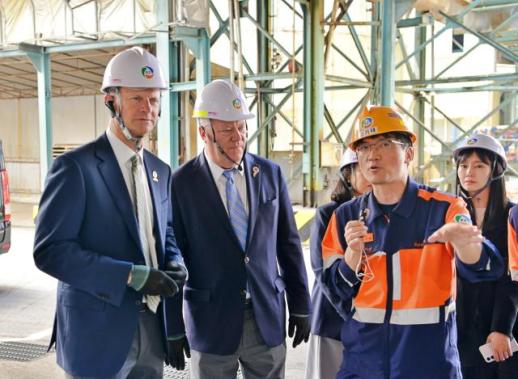 Korea Zinc, Tennessee Step Up Cooperation on U.S. Smelter Project Crucible Korea Zinc said cooperation with the state of Tennessee is accelerating as the company moves ahead with “Project Crucible,” its plan to build an integrated smelter in the United States. The company said Tennessee officials, including Lt. Gov. Stuart McWhorter, visited Korea Zinc’s Onsan smelter on April 28 and discussed ways to strengthen cooperation. Korea Zinc described the Onsan facility as a model for the planned U.S. project. Korea Zinc said the visit was arranged to help state officials better understand smelting operations and to discuss additional cooperation needed to keep Project Crucible on track. McWhorter met with Korea Zinc officials, including Kim Seung-hyeon, vice president and head of the Onsan smelter, to hear about the plant’s technology and its operating approach on environmental management and safety. The two sides also shared the company’s vision for the U.S. integrated smelter, Korea Zinc said. McWhorter said Project Crucible is expected to have a positive impact on the local economy, including job creation, and could also serve as an important opportunity to strengthen the South Korea-U.S. partnership and bolster supply chains for critical minerals to improve economic security. During the meeting, the sides discussed administrative procedures, the project schedule and operating plans needed for smooth execution, Korea Zinc said. McWhorter pledged full administrative support going forward, the company said. In comments to reporters, McWhorter again cited stronger bilateral partnership, economic security and job creation as the project’s core significance, saying it carries added weight because it is being pursued under the leadership of both governments and because stronger critical-mineral supply chains can play a major role in economic security. Asked about environmental and safety concerns raised in Tennessee, McWhorter said Korea Zinc has decades of smelting technology and operating experience. He also said the company’s silver and copper products use 100% recycled feedstock and received certification last year from global certification body SGS. McWhorter said Tennessee is working on infrastructure beyond the smelter itself, including power supply, housing for Korean personnel and training programs for local workers. He said the state holds weekly meetings with Korea Zinc and that permits under the Trump administration would allow the project to move quickly, shortening the timeline from construction to commercial operations. He added that he viewed smooth communication as a major strength in working with Korea Zinc and said he was confident the project would be carried out successfully. During the tour, Tennessee officials reviewed production processes for base metals such as zinc, lead and copper, as well as critical minerals including indium, Korea Zinc said. At a site slated for a new germanium plant, the officials expressed expectations for expanded cooperation between the two sides, the company said. McWhorter said he has held ongoing meetings with Chairman Choi Yoon-beom and other executives and again cited Korea Zinc’s communication as a strength. He said the visit broadened his understanding of the smelting industry and increased his expectations for Project Crucible. He said the state government would look for ways to actively support the project, including securing electricity and helping with administrative procedures, and expressed hope that the effort to build another world-class facility in the United States, like the Onsan smelter, would proceed successfully. Kim said that if the Onsan smelter — which he described as the world’s only facility capable of producing zinc, lead and copper as well as critical minerals — is replicated in the United States, it could become a catalyst for innovation across the smelting industry. He said the U.S. integrated smelter is planned as a smart smelter applying Onsan’s technology along with artificial intelligence and automation, and he expects the technology to be applied back at Onsan as well, creating synergy. Project Crucible is set to begin site preparation work this year and aims for completion in 2029, Korea Zinc said. After completion, the facility is expected to produce zinc, lead and copper first, followed by 13 nonferrous metals including 11 types of critical minerals designated by the U.S. government, such as indium and gallium, as well as semiconductor-grade sulfuric acid.* This article has been translated by AI. 2026-04-29 18:09:37
 -
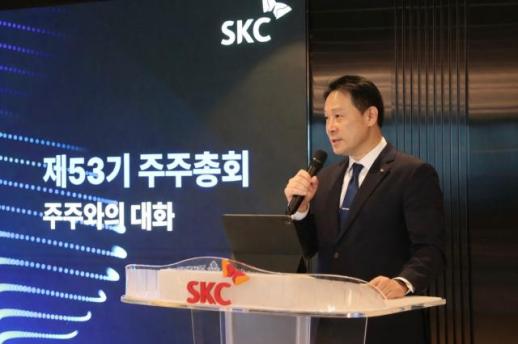 SKC Posts First Positive EBITDA in 10 Quarters as Semiconductor, Chemical Units Rebound SKC said it rebounded on improved results in its semiconductor and chemical businesses. The company said Tuesday that first-quarter consolidated revenue totaled 496.6 billion won, while it posted an operating loss of 28.7 billion won. The loss narrowed sharply from the previous quarter, and earnings before interest, taxes, depreciation and amortization came to 10 billion won, turning positive for the first time in 10 quarters. Kim Jong-woo, who took office in November, got off to a strong start, the company said. Its semiconductor materials unit posted first-quarter revenue of 68.3 billion won and operating profit of 23.6 billion won. The operating margin reached 34.5%, helped by higher sales of high-value test sockets as demand grew for AI data centers. SKC said it was the unit’s best quarterly performance on record. The chemical business also returned to profit, with first-quarter revenue of 270.8 billion won and operating profit of 9.6 billion won, its first profit in 13 quarters. SKC cited a windfall from the war in the Middle East and an expanded sales strategy for high-value propylene glycol. SK Nexilis, the battery materials affiliate led by Kim as CEO, also supported the turnaround, SKC said. The company said it benefited from reshaping its business around North America and the energy storage system market. It also pointed to efforts after Kim’s appointment to clear one-off costs and cut manufacturing costs by expanding operations at its Malaysia plant during the first quarter. SKC said preparations for mass production of semiconductor glass substrates, a future growth driver, are proceeding as planned. It has begun making samples for customer evaluations, aims to complete reliability tests within the year, and plans to diversify applications by reviewing new projects with multiple global big-tech customers in the second quarter. Separately, SKC said its planned 1 trillion won rights offering to fund new businesses and improve its financial structure drew strong internal demand, with employee subscription demand reaching 132% of the amount offered. * This article has been translated by AI. 2026-04-29 18:08:48
 -
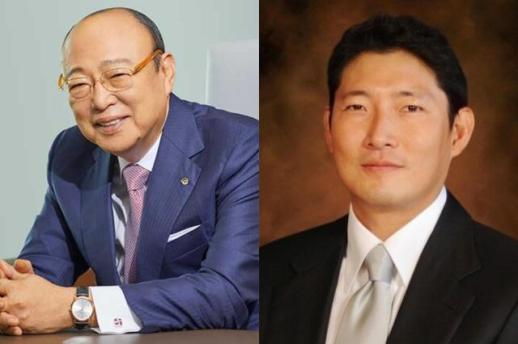 Hanwha Jumps to No. 5 in Korea Conglomerate Rankings; Hyosung Rises on Power Gear Boom Hanwha Group and Hyosung Group have expanded rapidly, reshaping South Korea’s top-30 conglomerate rankings, which have typically seen limited movement. According to the Fair Trade Commission’s disclosure on large business groups released on the 29th, Hanwha rose to fifth from seventh. Hyosung also moved up, to 28th from 31st. Hanwha’s total assets increased by about 24 trillion won, to 149.6 trillion won this year from 125.7 trillion won last year, overtaking Lotte Group and POSCO Group. The rise was attributed to combined growth across defense, shipbuilding and energy businesses. In defense, expanded orders at Hanwha Aerospace were a key driver. As of the end of 2025, its backlog for ground-defense systems stood at 37 trillion won, and its annual operating profit topped 3 trillion won. In shipbuilding, Hanwha Ocean’s turnaround stood out. It posted operating profit of 441.1 billion won in the first quarter of 2026, up more than 70% from a year earlier. Analysts cited a strategy focused on high-value LNG carrier orders and increased investment aimed at entering the U.S. naval maintenance and repair (MRO) market as factors behind the asset gains. Energy and infrastructure also contributed. Hanwha Solutions expanded its foothold in the North American solar market, supported by operations at its U.S. “Solar Hub.” Hyosung’s rise was largely attributed to improved performance at Hyosung Heavy Industries, which helped drive growth as its total order backlog exceeded 15 trillion won. The company benefited from a transformer boom tied to rising global demand to replace aging power infrastructure. In the United States, demand for grid upgrades has surged, and supplies of extra-high-voltage transformers have not kept pace. With shortages strengthening pricing power, profitability has been assessed as improving sharply. The spread of artificial intelligence data centers was also cited as a factor. As global big tech companies expand data center construction, demand for large-scale power supply equipment has increased, lifting demand for Hyosung Heavy Industries’ power solutions. A business community official said the top-30 rankings usually do not shift much, but this round of changes was heavily influenced by strong conditions in energy, defense and shipbuilding. The official added that defense-related demand has also been significant due to the prolonged Iran war.* This article has been translated by AI. 2026-04-29 16:56:41
 -
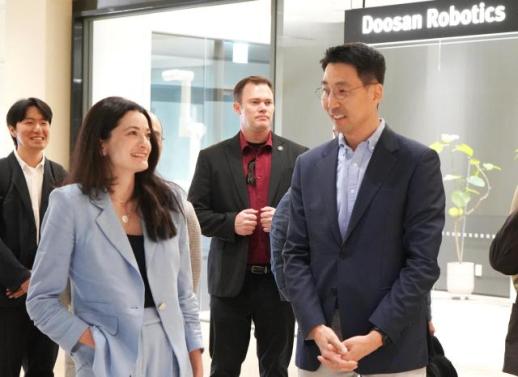 Nvidia Executive Visits Doosan Robotics to Discuss Industrial Humanoid Commercialization Doosan Robotics and Nvidia are teaming up to prepare for the next phase of humanoid robotics. Doosan Group said on the 29th that Madison Hwang, Nvidia’s senior director for Omniverse and robotics product marketing, visited the Doosan Robotics Innovation Center in Bundang-gu, Seongnam, and met with Doosan Robotics CEO Kim Min-pyo to discuss technical cooperation between the two companies. The visit was arranged to explore how Nvidia’s AI and robotics ecosystem could be applied to Doosan Robotics’ intelligent robot solutions and industrial humanoids now under development. At the center of the talks is linking Doosan Robotics’ robot-dedicated execution software, the “Agentic Robot O/S,” with Nvidia’s AI and robotics simulation and training infrastructure. The companies said they aim to build a robot execution platform that can be deployed in real industrial workplaces. Doosan Robotics described the Agentic Robot O/S as software that uses AI to understand a work environment, optimize routes and support safe, precise operations. To advance the operating system, the company said it is reviewing steps including building a robot-to-AI interface, developing standard robot-control protocols, connecting specialized task models and applying technical guardrails for safety control, with plans to flesh out those efforts through cooperation with Nvidia. Doosan Robotics said it plans to roll out an intelligent robot solution based on the Agentic Robot O/S in 2027, followed by an industrial humanoid product in 2028. It also said it is pursuing a plan to present the results of the collaboration with Nvidia at major global exhibitions such as CES in 2027. “The success of physical AI depends not only on how smart the AI model is, but also on the stability of the execution platform that runs it in the field without error,” Kim said. “Based on today’s discussions, we will combine Doosan’s hardware manufacturing capabilities with Nvidia’s software ecosystem to push commercialization of intelligent robot solutions and industrial humanoids.”* This article has been translated by AI. 2026-04-29 15:52:49
 -
 EcoPro BM Q1 Operating Profit Jumps 823% as ESS Cathode Sales Rise EcoPro BM said in a regulatory filing on Tuesday that it posted first-quarter consolidated revenue of 605.4 billion won and operating profit of 20.9 billion won. Revenue fell 3.9% from a year earlier, while operating profit surged 822.6%. The company attributed the results to increased cathode material supply for electric vehicles in Europe and rising global demand for energy storage systems driven by the spread of AI infrastructure. Sales of cathode materials for ESS used to provide stable power for data centers rose 140% from a year earlier. As AI-related semiconductor production facilities expand and more large-scale data centers are built, shipments for power applications such as power tools increased 44% from a year earlier. Kim Jang-woo, EcoPro BM’s CEO, said the company will continue to expand supplies of high value-added cathode materials in line with the spread of AI and a recovery in the electric vehicle market. “Through the successful mass production at our Hungary plant, we will establish ourselves as a key player in the European supply chain and maintain a steady growth trajectory,” Kim said.* This article has been translated by AI. 2026-04-29 15:44:43
 -
 SeAH Besteel Holdings Q1 2026 Operating Profit Jumps to 30.7 Billion Won SeAH Besteel Holdings said it posted first-quarter 2026 consolidated revenue of 967.6 billion won and operating profit of 30.7 billion won, according to a regulatory filing. That was up 7.5% and 69.8%, respectively, from a year earlier. From the previous quarter, revenue rose 12.3% and operating profit jumped 247.1% as sales volumes recovered after the year-end slow season and selling prices increased on higher raw material costs. Its subsidiaries also showed broadly improving results. SeAH Aerospace & Defense Materials reported quarter-on-quarter gains of 14.0% in revenue and 58.0% in operating profit, citing expanding global aircraft demand and growth in the defense market. SeAH Besteel said revenue rose 6.0% and operating profit increased 106.2% from a year earlier, even as low-priced imports from China increased. It said sales volumes grew on demand recovery in sectors including eco-friendly vehicles, infrastructure and defense. From the previous quarter, revenue increased 13.8% and operating profit surged 3212.1% on a sales rebound and higher selling prices. SeAH Changwon Specialty Steel said revenue increased 3.9% and operating profit rose 13.3% from a year earlier as demand grew with expanded investment in semiconductor equipment, boosting sales of stainless steel wire rod and bar steel. From the previous quarter, revenue rose 11.2% and operating profit increased 186.3%, helped by recovering volumes and a larger share of high value-added products. Looking ahead, SeAH Besteel Holdings said it plans to expand sales of high value-added products and focus on developing new markets, centered on high-growth industries such as eco-friendly vehicles, semiconductors and nuclear power. It also said it will respond actively to anti-dumping issues involving Chinese special steel and bar steel products to curb low-priced imports and support a recovery in the domestic market. The company said it will also strengthen strategic synergies between its domestic subsidiaries and its U.S. special alloy production unit, SeAH Superalloy Technologies, to improve global supply-chain competitiveness in materials for aviation, space and defense. SeAH Besteel Holdings said, "We plan to accelerate completion of our global supply-chain portfolio centered on our U.S. base, which is scheduled to begin commercial production in the second half of 2026."* This article has been translated by AI. 2026-04-29 15:25:54
 -
 Ecopro posts 602 billion won Q1 operating profit, up 42-fold Ecopro said in a regulatory filing on the 29th that it posted first-quarter 2026 consolidated revenue of 822.0 billion won and operating profit of 60.2 billion won. Revenue rose about 2% from a year earlier, while operating profit jumped 42-fold from 1.4 billion won. The company attributed the results to a rebound at its secondary-battery affiliates, the consolidation of the GEN (Green Eco Nickel) smelter in Indonesia, and higher metal prices. It said lithium hydroxide prices climbed about 80%, to $18.5 per kilogram from $10.3, helping lift selling prices. By unit, Ecopro BM reported revenue of 605.4 billion won and operating profit of 20.9 billion won, as profitability improved. The company cited expanded cathode-material supplies for electric vehicles in Europe and rising demand for energy storage systems as AI infrastructure spreads. Ecopro Materials posted revenue of 166.5 billion won and operating profit of 15.7 billion won, extending a second straight quarter of profit after returning to the black. It credited the GEN consolidation and increased sales of precursors for ESS use. Ecopro HN reported revenue of 34.7 billion won and operating profit of 5.0 billion won, reflecting stronger demand for chemical filters tied to expanded semiconductor equipment investment and more orders for environmental facilities. Other subsidiaries, including Ecopro Innovation and Ecopro CNG, also showed steady performance, the company said. Ecopro said it is accelerating overseas expansion. Following its move into Morowali (IMIP) in Indonesia, it is pursuing the IGIP (International Green Industrial Park) project. Its BNSI nickel smelter, with annual capacity of 66,000 tons, is targeting mass production next year. For Europe, the company said its Hungary cathode-material plant is set to begin mass production in the second quarter, aiming to secure local customers and diversify sales. A company official said Ecopro maintained profitability on “balanced growth across all business divisions,” adding that “from the second quarter, when higher metal prices are reflected, the pace of earnings improvement will accelerate further.” CEO Song Ho-jun said “preemptive investments, including process innovation and the Indonesia smelting business, are translating into results,” and added that once the Hungary plant ramps up and the IGIP project moves into full swing, the company’s global competitiveness will strengthen further.* This article has been translated by AI. 2026-04-29 15:25:06