

Journalist

Han Joon-ho
hanjh@ajunews.com
-
 Why Political Campaigns Focus on Strong Supporters Instead of Centrists There is a recurring scene during elections: as the campaign nears its end, politicians' rhetoric becomes more aggressive, and attacks on opponents intensify. Rather than persuading centrist voters, candidates increasingly focus on energizing their base. Policy discussions fade away, leaving only emotional appeals. The upcoming June 3 local elections are no exception. Interestingly, while political leaders often emphasize the importance of centrist voters, their actions suggest otherwise. Political analysts have long noted that in national elections, it is ultimately the 5% of centrist voters who decide the outcome. Historical election results show that the final decision often rests not with the strong supporters but with undecided centrists. Yet, as the election approaches, political parties tend to prioritize rallying their base over expanding their appeal to centrist voters. This local election follows a similar trend. Leaders from both major parties are making strong statements daily. While criticisms of the opposing camp have escalated, strategies for regional development and visions for citizens' livelihoods are relatively absent. In fact, party leaders who should be guiding the election are sometimes viewed as liabilities in competitive districts. Why do political parties make such choices? The answer lies in the fact that while centrist voters are difficult to mobilize, strong supporters react immediately. Strong rhetoric generates news coverage and spreads rapidly on social media, often earning immediate applause. In contrast, persuading centrist voters is a slow and complex process that requires explaining policies and presenting realistic alternatives, which takes time. While a politics centered on strong supporters may benefit elections, it incurs costs for society as a whole. The public becomes increasingly polarized, and opposing factions are viewed not as discussion partners but as targets for attack. When the goal of politics shifts from problem-solving to consolidating factions, national competitiveness inevitably declines. Voters also need to change. Each election cycle, sensational statements and political disputes dominate the news, but ultimately, it is not these words that will shape the future of communities. What matters is not who delivers the most flamboyant attacks, but who has the capability to foster urban growth. It is not about who shouts the loudest, but who can create jobs and support local industries. Politics should inherently aim for the middle ground. The essence of politics is to persuade individuals with diverse viewpoints and find common ground. However, recent trends show that political parties are increasingly veering toward the extremes. This tendency intensifies as elections draw nearer. Ultimately, it is not the voices of politicians that sustain democracy, but the judgments of voters. The assertion that the 5% of centrist voters decide elections is not merely electoral engineering; it signifies that the direction of South Korea is ultimately determined by citizens who quietly observe and then head to the polls. Politics should be driven by reasoned judgment, not excitement. A healthy democracy is shaped not by the loudest voices but by the wisest choices.“The Gi·Won·Sang column is a representative opinion piece that identifies the essence of Korean society and global trends based on the principles of 'basic, principle, common sense' of Aju Economy.” 2026-05-31 13:09:00
 -
 Masayoshi Son's Strategic Vision: The AI War Began a Decade Ago In the summer of 2016, Masayoshi Son, chairman of SoftBank, acquired the British semiconductor design company ARM for 3.3 trillion yen. At the time, both Japanese media and global financial markets were puzzled. "Why is a telecom company president buying a semiconductor firm?""Isn't that too expensive?""What is the synergy?" Questions poured in. Son's response was unexpected. "In terms of Go, it's like placing a stone 50 moves ahead." Few understood the significance of his statement back then. Now, a decade later, the meaning of those 50 moves is gradually becoming clear. Today, three companies sit at the center of the global AI industry: OpenAI, NVIDIA, and ARM. Son had already secured one of them a decade ago. He is now investing tens of trillions of yen into OpenAI. In Japan, Son's approach to mergers and acquisitions is referred to as 'Go-style M&A.' In South Korea, mergers and acquisitions are often viewed through the lens of market share expansion or economies of scale.However, Son's method is different. He is not merely a man of the present; he is more like a visionary who sketches the future and moves the present accordingly. A look at SoftBank's history reveals consistency. In the 1990s, he invested in Yahoo. In the 2000s, he nurtured Alibaba. During the mobile era, he dominated telecommunications networks. Now, with the advent of the AI era, he has chosen ARM and OpenAI.On the surface, it may seem that his investment targets are constantly changing. Yet the essence remains unchanged. He has always aimed to capture both platforms and infrastructure. In the internet era, it was Yahoo and telecommunications; in the AI era, it encompasses OpenAI and semiconductors. Son sees not just technology but the world that technology will transform. This perspective often leads Japanese business circles to regard him more as a futurist than an entrepreneur. Interestingly, Japanese society traditionally does not favor this type of leader. The core of Japanese corporate culture is stability and accumulation. Toyota has integrated subsidiaries over decades through relationship-building, and Japanese companies have generally preferred gradual evolution over rapid change. Choosing a proven path over high-risk ventures is characteristic of Japanese management. In this context, Son has always been an outlier. As a third-generation Korean resident in Japan, he grew up outside the norms of mainstream Japanese society. From a young age, he traveled between Japan and the United States to conceptualize business ideas, free from the hierarchical and organizational constraints typical of Japanese corporations. He is one of the few Japanese business leaders who openly discusses "10 years later" or "30 years later."In fact, Son has spoken of the concept of a 300-year company since his early days. He has expressed the desire for SoftBank to remain a company that contributes to human civilization even after his death. This renewed attention from Japanese media towards Son stems from this vision. While he was once seen as a reckless gambler, the arrival of the AI era is gradually validating his long-term strategies. Of course, his path has not always been successful. The failed investment in WeWork is a notable example, resulting in significant losses for SoftBank. In Japan, some have declared that "the Masayoshi Son myth has ended." However, Son did not retreat. Instead, he intensified his focus on AI. Recent developments at SoftBank indicate a clear intention to transform from a mere investment company into an AI enterprise. They are developing semiconductors, constructing one of the world's largest data centers, acquiring robotics companies, and collaborating with OpenAI to build a new AI ecosystem. This signifies a commitment not just to invest but to take the lead in the AI industry. The Japanese economy has long grappled with the narrative of the 'lost 30 years.' During this time, while Japanese companies succeeded in stable management, they struggled to position themselves at the forefront of new industrial revolutions. There was a time when Sony, Panasonic, Toshiba, and Sharp led the global electronics industry. However, in the smartphone and platform revolutions, American and Chinese companies seized the initiative. In this sense, Masayoshi Son symbolizes the lost spirit of challenge in the Japanese economy. The outcome remains uncertain. It is unclear whether OpenAI will maintain its current position, or if Chinese companies will dominate the AI robotics market. The effectiveness of ARM's strategy is also uncertain. However, one thing is clear: amid the global competition for AI supremacy, the person with the biggest dreams in Japan is Masayoshi Son. And that dream did not begin yesterday; it started a decade ago with the acquisition of ARM. In Go, the move made now often determines the outcome. However, true masters see not just the current move but the 50 moves yet to come. The reason Masayoshi Son continues to astonish the world may lie in this very difference. The battle of the AI era is not just about technology; it is a contest of time and imagination. Son aims to arrive at the future ahead of everyone else and bring that future into the present.* This article has been translated by AI. 2026-05-30 08:03:00
 -
 Japan Shifts AI Strategy, Moves Away from ChatGPT Competition Japan's political landscape is changing its perspective on artificial intelligence (AI). Instead of the rallying cry of "catching up to the U.S. and China," a more pragmatic approach has emerged, focusing on areas where Japan can excel. This shift is symbolized by recent AI policy proposals from the ruling Liberal Democratic Party (LDP), which emphasize that "complete domestic production of AI across all fields is neither realistic nor strategic."Historically, Japan has been known for its strong nationalist tendencies, striving for self-sufficiency in sectors like semiconductors, operating systems, and mobile phones. However, this approach has led to harsh realities, as Japan's platforms, disconnected from global standards, have fallen behind in international competition. The term "Galapagosization" is often used in Japanese industry to describe this failure. The current AI strategy signals a commitment to avoid repeating past mistakes.Notably, the Japanese government and the LDP have effectively stepped back from competing in the development of a "Japanese version of ChatGPT." Initially, the Ministry of Economy, Trade and Industry aimed to invest government funds into developing a large-scale language model (LLM) unique to Japan. However, strong internal opposition within the LDP argued that pursuing this with limited resources against the U.S. and China was reckless. Consequently, the government has essentially abandoned its goal of developing a large foundational model.Japan's decision appears pragmatic when considering the current landscape of generative AI, which is dominated by the U.S. and China. Companies like OpenAI and Google in the U.S., along with Baidu and DeepMind in China, operate with astronomical capital, data, and semiconductor infrastructure. Between 2019 and 2023, Japan's AI investment was approximately $10 billion, while the U.S. invested $329 billion and China $133 billion, highlighting a significant disparity.Instead, Japan is pivoting towards areas where it has strengths, such as manufacturing, healthcare, robotics, and infrastructure control—collectively referred to as "field-based AI." The emphasis on physical AI has emerged from this focus, indicating a commitment to developing AI that can operate in factories, hospitals, and with vehicles and robots, rather than merely conversational AI.This strategy aligns closely with Japan's industrial structure. The country still possesses some of the world's best manufacturing data, with decades of accumulated information from automotive factories, precision machinery, and industrial robotics. While U.S. companies excel in platform and software competitiveness, Japan holds a wealth of data on actual industrial processes and production. The strategy is to exploit this niche.Interestingly, Japan is beginning to view AI not just as a technological competition but as a matter of economic security. The LDP's recent proposals even included the term "AI sovereignty." However, this does not imply a complete push for domestic production. Instead, it suggests a strategic distinction between what Japan will control directly and what it will collaborate on with allied nations.This approach resonates with Japan's long-standing practical industrial strategy. By cooperating with U.S. technology while retaining control over revenue-generating structures and core data, Japan aims to apply the same logic to AI.Underlying this shift is a sense of urgency within Japanese society. The country's digital deficit has ballooned to approximately 5 trillion yen (about $50 billion) annually, with cloud services, software, and platform fees predominantly flowing overseas. There is a strong concern that increased reliance on American platforms for AI could push Japanese industries into an "AI subcontracting structure."As a result, Japan is moving closer to the goal of "surviving as a manufacturing powerhouse in the AI era" rather than striving to create the world's best generative AI. While stepping back from the flashy generative AI competition, Japan is determined to maintain its leadership in the industrial sectors of factories, hospitals, vehicles, and robotics. This may well be the most authentically Japanese strategy for AI survival that the country has chosen today.* This article has been translated by AI. 2026-05-24 11:27:56
 -
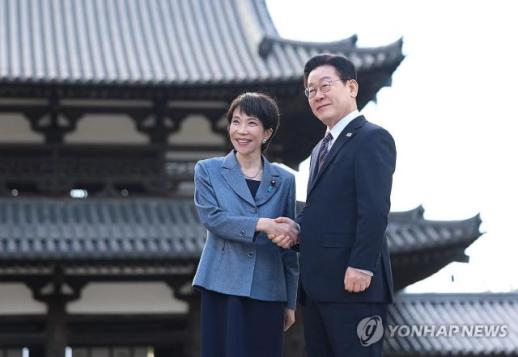 Japanese Prime Minister Visits Andong as Korea-Japan Relations Shift to 'Hometown Diplomacy' Diplomacy often carries a stronger message when tied to a specific location. The venue of a summit is not merely a matter of protocol; it symbolizes the direction and atmosphere of the relationship. In this context, the Korea-Japan summit scheduled for May 19 in Andong, North Gyeongsang Province, may encapsulate the recent changes in Korea-Japan relations. Japanese Prime Minister Sanae Takaiichi will visit Andong, the hometown of President Lee Jae-myung. This visit serves as a reciprocal gesture following President Lee's trip to Nara, Japan, in January, which is Takaiichi's political base and hometown. The Blue House described this as the "first realization of mutual hometown visits between the leaders." This marks a shift from traditional shuttle diplomacy between Seoul and Tokyo to a new phase of 'hometown diplomacy,' where leaders visit each other's political and cultural roots directly. The upcoming summit in Andong is also seen as highly symbolic within Japan. Officials from the Japanese Foreign Ministry suggest that Takaiichi's background as a politician from the Kansai region may influence this diplomatic style. The Kansai area has historically engaged in active exchanges with the Korean Peninsula, and a significant Korean community has developed around Osaka, Kyoto, and Nara. Many in Japanese diplomacy view Takaiichi as a politician with relatively less distance from Korean culture and sentiments. In fact, Nara, Takaiichi's political base, has deep historical connections with the Korean Peninsula. It is known for retaining strong influences from Baekje and Silla cultures during the formation of ancient Japanese culture. This context adds significance to President Lee's visit to Nara in January, which was interpreted as more than just a local visit. The Andong summit also connects to the historical flow of Korea-Japan diplomatic relations. A notable example is the 2004 summit between President Roh Moo-hyun and Prime Minister Junichiro Koizumi in Jeju. At that time, tensions were high due to the Dokdo issue and historical conflicts, yet the leaders chose Jeju as the meeting location. This decision aimed to reduce diplomatic tension and foster trust in a more human atmosphere. However, the upcoming Andong summit represents a step further than the Jeju meeting. While Jeju was characterized as 'neutral space diplomacy,' Andong embodies a more direct form of 'hometown diplomacy.' It involves sharing the life spaces and cultural roots of the leaders, aiming to build trust as a diplomatic asset rather than merely a social event. The symbolism of Andong is significant. It is a center of Korean Confucian culture and traditional spirit, home to Hahoe Folk Village, Dosan Seowon, and the lineage culture. The visit of a Japanese prime minister to such a space carries implications beyond a simple local itinerary. The image of a Japanese leader visiting the heart of Korean traditional culture sends a diplomatic message in itself. This summit is particularly noteworthy amid changing international dynamics. The North Korean situation remains unstable, and the U.S.-China strategic competition is intensifying. Coupled with unrest in the Middle East, risks related to energy and maritime security are also rising. The Japanese government has publicly emphasized that "the importance of Korea-Japan relations and Korea-U.S.-Japan cooperation is growing," reflecting this backdrop. Ultimately, both Korea and Japan find themselves in urgent need of stabilizing their relationship. Japan's security strategy, centered on the U.S., faces challenges without cooperation from Korea, while Korea also recognizes the necessity of collaboration with Japan in terms of supply chains, advanced industries, and economic security. Of course, historical issues remain a challenge. However, diplomacy ultimately hinges on how well future needs can manage past conflicts. The Andong summit indicates that Korea-Japan relations are moving beyond mere practical diplomacy to a stage where they are adjusting the 'temperature of the relationship.' Just as the Jeju summit between Roh Moo-hyun and Koizumi remains a symbolic moment in that era of Korea-Japan relations, the upcoming Andong summit between Lee Jae-myung and Takaiichi is likely to be frequently referenced in discussions about the future of Korea-Japan relations. This time, it is neither Seoul nor Tokyo, but each leader's hometown. This shift itself speaks to a new direction in Korea-Japan relations. 2026-05-17 16:13:09
 -
 Why Xi Jinping Cannot Abandon Taiwan During a summit between U.S. President Donald Trump and Chinese President Xi Jinping, the most extensively and sensitively discussed topic was Taiwan. Trump revealed that Xi asked whether the U.S. would defend Taiwan, indicating that Taiwan was at the forefront of Xi's concerns, despite discussions on tariffs, trade, and supply chains.China has long referred to the Taiwan issue as a "core interest." However, this obsession has intensified recently, primarily because Taiwan has become the heart of the global artificial intelligence (AI) industry.Until a few years ago, the Taiwan issue was mainly interpreted through the lenses of history, nationalism, and territorial sovereignty. While these factors remain significant, under Xi's regime, the notion of the "great rejuvenation of the Chinese nation" is not merely a slogan for economic growth; it is a political project aimed at achieving unification with Taiwan by 2049, the centenary of the founding of the People's Republic of China. For the Chinese Communist Party, Taiwan symbolizes regime legitimacy. However, Taiwan now holds an additional significance: AI dominance.Today, the global AI industry cannot function without Taiwan. NVIDIA's AI semiconductors, as well as servers from Apple and Meta, and Tesla's autonomous driving systems, all rely on advanced processes from Taiwan's TSMC. No matter how well U.S. tech companies design their products, they depend on Taiwan for production, making Taiwan the focal point of the world's cutting-edge semiconductor supply chain.Interestingly, China's situation is not much different. Amid U.S. semiconductor sanctions, China has been advocating for an "AI ecosystem without NVIDIA," yet many AI semiconductors developed by Chinese companies still rely on TSMC's production lines. Even AI vehicle chips showcased by Chinese semiconductor firms at the Beijing International Auto Show were noted to be produced using TSMC's 4-nanometer process.Ultimately, both the U.S. and China, as well as the entire global AI industry, are dependent on Taiwan. This is why Xi cannot abandon Taiwan. While historically Taiwan was a political symbol, it has now become a strategic asset for future industries. Semiconductors are no longer just components; they are a crucial infrastructure for national security, influencing military power, economic strength, and AI competitiveness. For Xi, Taiwan is both "territory that must be unified" and a "technological stronghold that cannot be surrendered to the U.S."Another critical aspect is the Chinese leadership's perception of time. While U.S. policies can shift dramatically with elections, China operates on a 10- to 20-year timeline. There is a strong belief within China that "time is on China's side." In fact, economic ties between China and Taiwan have deepened significantly, with trade volumes increasing substantially over the past decade and industrial connections strengthening.Xi's regime is also solidifying its long-term governance structure. China has entered a new five-year planning phase, and discussions suggest that Xi's leadership may continue beyond 2027. This indicates that Taiwan strategy is not a short-term event but a long-term project.The challenge is that as the AI era progresses, Taiwan's strategic value will only increase. Just as past power struggles over oil shook the Middle East, future global competition over semiconductors is likely to disrupt East Asia, with Taiwan at its center.In 1954, Mao Zedong stated, "The most important issue in U.S.-China relations is the Taiwan issue, which is a long-term problem." Seventy years later, that statement remains largely true. The only change is that while Taiwan was once a geopolitical issue of the Cold War, it has now become a key engine of the global economy in the AI era.This is why Xi cannot relinquish Taiwan—not just for territorial reasons, but because the future world order hinges on that island. 2026-05-17 09:49:10
 -
 Korea and Japan Stock Markets Surge Amid AI Semiconductor Rally In just a few days, the stock markets in South Korea and Japan have set historic records. The KOSPI index in South Korea surpassed 7,000, while Japan's Nikkei average soared by 3,320 yen to reach an all-time high. The surge is largely driven by the demand for AI semiconductors. Interestingly, the market dynamics in the two countries differ. The South Korean market is primarily influenced by Samsung Electronics and SK Hynix, fueled by expectations of explosive demand for memory semiconductors due to the expansion of AI servers and data centers. Samsung's market capitalization has now exceeded $1 trillion, positioning South Korea as a key player in the 'AI memory supply chain.' Conversely, the Japanese market is also experiencing an AI rally, with Advantest, Tokyo Electron, and SoftBank Group seeing significant gains, and Kioxia hitting its upper limit. The strong performance of U.S. companies like AMD and Micron, along with the Philadelphia Semiconductor Index reaching new heights, has also boosted Japanese stocks. However, there are concerns in Japan regarding the concentration of gains in certain AI and semiconductor stocks. The NT ratio, which quickly gauges market trends, has reached historic highs, prompting experts to caution that the sustainability of this tech-focused rally may be limited. Currently, the market is not merely searching for 'good companies' but is instead seeking supply chains that can thrive in the AI era. In this context, South Korea and Japan find themselves in different positions. South Korea holds the critical component of memory semiconductors, benefiting directly from the increase in AI servers. In contrast, Japan excels in semiconductor equipment, materials, and testing tools. In simple terms, South Korea produces the 'heart,' while Japan manufactures the 'surgical tools.' Both are essential, but the market reacts more strongly to core components. This shift also reflects a reversal in the industrial histories of South Korea and Japan. In the 1980s, Japan was the dominant force in the global semiconductor and electronics industry, while South Korea was learning from Japanese technology. However, the AI era has changed the order. Japan has remained focused on finished products and precision manufacturing, while South Korea has bet on a memory-centric strategy. The greatest anxiety for the Japanese economy lies here. In the past, Japan viewed South Korea as a country within its industrial ecosystem. Now, however, the Japanese market is increasingly following the trends set by Samsung and SK Hynix. The surge in Japanese semiconductor stocks is ultimately underpinned by expectations of an AI boom among South Korean and American memory firms. While the current rally may not last indefinitely, there is a risk of overheating in AI investments, and the semiconductor cycle can be volatile. Japan's market has already begun to signal risks associated with a 'semiconductor concentration.' South Korea faces similar risks due to the overwhelming influence of Samsung and SK Hynix. Nonetheless, it is clear that the global market is shifting from an era dominated by automobiles, steel, and home appliances to one focused on AI infrastructure. In this transformation, the positions of South Korea and Japan are also changing. Japan's recent sensitivity to Samsung and the KOSPI reflects this reality: for the first time in the AI era, South Korea is beginning to take the lead over Japan in industrial order.* This article has been translated by AI. 2026-05-08 07:03:28
 -
 Scenes From the CES 2026: Rise of physical AI and rise testing Korea The artificial intelligence now has a ‘body,’ not just words The CES 2026 no longer felt like a stage for showcasing what technology might do. It looked more like a declaration that the technology is already operating inside real industries. At the center was “physical AI.” If generative AI handles language and images, physical AI drives robots, machines and vehicles. At this year’s show, the shift moved from promises to execution. One striking scene was companies laying out mass-production plans for humanoid robots. Hyundai Motor presented a detailed roadmap to produce AI-equipped robots in the tens of thousands a year, aiming to deploy them in factories for repetitive work and assembly. The message was that the discussion has moved beyond robots walking and carrying objects to measuring productivity. On the CES floor, robots were no longer “future tech” but “labor.” The push was not limited to one company. U.S., Chinese and South Korean firms rolled out humanoid and industrial robots, while home, logistics and manufacturing robots advanced in parallel. The trend suggests a broader industrial shift: AI is moving beyond replacing human judgment to taking on physical roles. Semiconductor and platform companies were another pillar. What ultimately moves robots is computing power and training data, and chipmakers highlighted robots and autonomous driving as core growth engines. AI is no longer only a software business; it is being rebuilt as industrial infrastructure linking factories, roads and warehouses. There were also differences by country. The United States, China and South Korea aggressively paired robots with AI, while Japan — once seen as a robotics powerhouse — appeared less prominent. The impression was not a lack of technology, but a loss of leadership in combining it with AI. Patent and investment trends, the column notes, reflect where competition is heading. Barriers remain. For humanoid robots to settle into industrial sites, reliability, safety and rules for working alongside people are needed. Robots that require constant human monitoring cannot be deployed on productivity alone. Regulatory and institutional debates can no longer be delayed. CES 2026 posed a question: Will AI be treated only as a technology that “talks well,” or as a “bodied” technology that moves industry? The spread of physical AI is not optional, the column argues, and South Korean industry faces a choice between watching and designing. Big booths fade as global giants move on Another change at CES 2026 was not the technology itself, but the distance kept by traditional headliners. Global conglomerates that once defined CES have changed how they show up. The pattern looks less like simple cost-cutting and more like a shared shift in how companies view the event. Sony, which has participated for more than 50 years as a leading Japanese presence, no longer filled the main hall under the “Sony Group” name. Instead, it put a narrower theme front and center: its mobility joint venture. That looked less like a retreat than a focus. Sony has evolved from a home electronics maker into an entertainment company built around content, platforms and image sensors, and a product-lined showroom no longer fits. Samsung Electronics appeared to reach a similar conclusion. After running one of CES’ largest booths for decades, it chose a separate venue this year rather than the traditional exhibition hall. The approach signaled a move from broadcasting to the general public toward selective communication aimed at key partners and customers. Global giants can now generate attention without CES, and they can choose the timing and format. The shift also signals how CES itself has changed. It is no longer a “consumer electronics fair” where buyers compared new products and placed orders. Today’s main players are startups, technology platforms and cross-industry combinations. Thousands of smaller companies arrive with new business models and look for partners; conglomerates have little reason to compete in the same way. That does not mean CES matters less. The column argues it matters more — as a crossroads where regulation, standards, investment and policy signals circulate. Big companies may shrink their exhibition footprint while keeping ties with organizers: less visibility, but no broken connections. For South Korean companies, the implication is clear: What matters is not how big a booth is, but why they are there — to show technology, find partners or read policy signals. The less clear the purpose, the bigger the booth tends to get and the weaker the message becomes. Chinese companies push straight into CES CES 2026 also underscored the growing presence of Chinese companies. The approach was not flashy, but more strategic than before. Despite structural constraints such as tariffs, regulation and U.S.-China tensions, Chinese firms are using CES as a channel to global markets. CES has long searched for its direction. After a period when it was seen as car-centered, it is again putting consumer products and AI at the forefront. That shift has created an opening for Chinese companies strong in hardware manufacturing, which are pairing products with AI to redefine themselves as technology firms rather than low-cost manufacturers. Lenovo was cited as a leading example. Once mainly seen as a PC brand, it is embedding AI across devices, solutions and software. Taking the CES keynote stage while running a separate large event signaled confidence — and a belief that CES still boosts global recognition. Chinese TV makers also stood out. TCL and Hisense delivered their message through scale and location, not just product lineups. Large booths in the middle of the hall remain symbolic, and the companies did not pull back. Even with tariff barriers, they signaled a willingness to face U.S. consumers and the market directly. Their confidence stemmed from the outreach of Chinese digital services already embedded in U.S. life, from short-form video and e-commerce to generative AI. CES became a place to see that online shift reflected offline. The stance of CES organizers was also notable. The Consumer Technology Association, which runs CES, publicly said Chinese participation has continued to rise even amid U.S.-China tensions. The message was an effort to keep CES as a platform for dialogue through technology and industry, not a battleground — and a sign that the show is also functioning as a space for tech diplomacy. CES asks South Korean companies an uncomfortable question The thread running through CES 2026 was not technology or booth size, but strategic clarity. U.S. companies redefined the stage, and Chinese companies pushed through head-on. The question, the column argues, is what South Korean companies showed. South Korean firms still had a strong presence, and their names were easy to find across the halls. Their technology remains competitive. The problem comes next: It is hard to sum up South Korean companies’ CES strategy in a single sentence. For many, participation still appeared driven by complacency. “Because we go every year” and “because we can’t skip it” stand in for strategy. Exhibits remain, but messages scatter; there is plenty of technology, but a weaker narrative. The issue is not engineering, but planning and judgment. The same applies to physical AI and industrial transition, which dominated CES 2026. South Korea is one of the few countries with strength in robots, semiconductors and manufacturing at once. Even so, the column questions whether South Korea read as a “designer of industrial transition” on the show floor. Individual technologies were visible, but a clear picture of how industry would be reshaped did not come through. South Korean companies now need to answer three questions at CES: - What industry’s future are we describing? - Who are we trying to persuade? - Why does it have to be CES? Without answers, booth size and spectacle become a burden. CES is no longer a stage where participation alone earns credit, and strategy-free attendance does not build presence. CES 2026 left a blunt message. The technology race has already moved to the next phase. The contest is no longer who has the most technology, but who can tie it into industry and a coherent story. If South Korean companies cannot answer that challenge, CES will become more a cost than an opportunity. *The author is the editor in chief of Aju Business Daily who led the Aju Media Group team to the CES 2026. 2026-01-11 17:16:29