

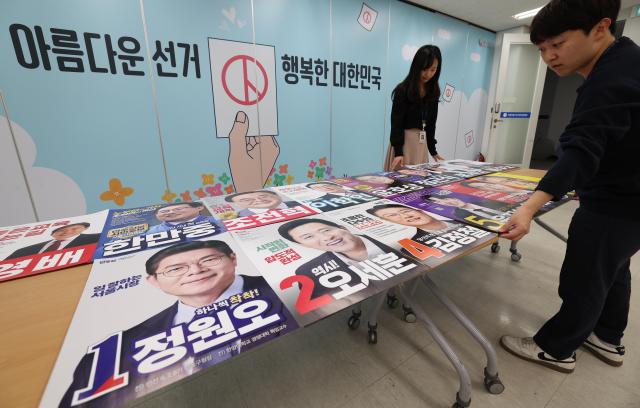
There is a recurring scene during elections: as the campaign nears its end, politicians' rhetoric becomes more aggressive, and attacks on opponents intensify. Rather than persuading centrist voters, candidates increasingly focus on energizing their base. Policy discussions fade away, leaving only emotional appeals. The upcoming June 3 local elections are no exception.
Interestingly, while political leaders often emphasize the importance of centrist voters, their actions suggest otherwise. Political analysts have long noted that in national elections, it is ultimately the 5% of centrist voters who decide the outcome. Historical election results show that the final decision often rests not with the strong supporters but with undecided centrists. Yet, as the election approaches, political parties tend to prioritize rallying their base over expanding their appeal to centrist voters.
This local election follows a similar trend. Leaders from both major parties are making strong statements daily. While criticisms of the opposing camp have escalated, strategies for regional development and visions for citizens' livelihoods are relatively absent. In fact, party leaders who should be guiding the election are sometimes viewed as liabilities in competitive districts.
Why do political parties make such choices? The answer lies in the fact that while centrist voters are difficult to mobilize, strong supporters react immediately. Strong rhetoric generates news coverage and spreads rapidly on social media, often earning immediate applause. In contrast, persuading centrist voters is a slow and complex process that requires explaining policies and presenting realistic alternatives, which takes time.
While a politics centered on strong supporters may benefit elections, it incurs costs for society as a whole. The public becomes increasingly polarized, and opposing factions are viewed not as discussion partners but as targets for attack. When the goal of politics shifts from problem-solving to consolidating factions, national competitiveness inevitably declines.
Voters also need to change. Each election cycle, sensational statements and political disputes dominate the news, but ultimately, it is not these words that will shape the future of communities. What matters is not who delivers the most flamboyant attacks, but who has the capability to foster urban growth. It is not about who shouts the loudest, but who can create jobs and support local industries.
Politics should inherently aim for the middle ground. The essence of politics is to persuade individuals with diverse viewpoints and find common ground. However, recent trends show that political parties are increasingly veering toward the extremes. This tendency intensifies as elections draw nearer.
Ultimately, it is not the voices of politicians that sustain democracy, but the judgments of voters. The assertion that the 5% of centrist voters decide elections is not merely electoral engineering; it signifies that the direction of South Korea is ultimately determined by citizens who quietly observe and then head to the polls. Politics should be driven by reasoned judgment, not excitement. A healthy democracy is shaped not by the loudest voices but by the wisest choices.
“The Gi·Won·Sang column is a representative opinion piece that identifies the essence of Korean society and global trends based on the principles of 'basic, principle, common sense' of Aju Economy.”
* This article has been translated by AI.

Copyright ⓒ Aju Press All rights reserved.