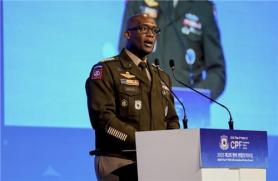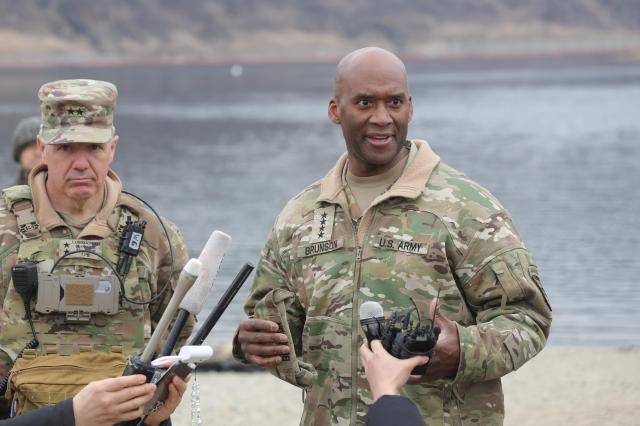
SEOUL, May 30 (AJP) -South Korea has conveyed its position to Washington over U.S. Forces Korea Commander Gen. Xavier Brunson's controversial description of the Korean Peninsula as "the dagger in the heart of Asia," presidential officials said Saturday, after the remarks drew a diplomatic protest from China and reignited debate over the evolving role of the U.S.-South Korea alliance.
National Security Adviser Wi Sung-lac, the defense ministry and the foreign ministry delivered Seoul's position through diplomatic and security channels, according to Cheong Wa Dae.
While officials declined to disclose the contents of the message, security observers said Seoul likely expressed regret over remarks that risked unnecessarily complicating relations with Beijing at a time when the Lee Jae Myung administration is seeking to stabilize ties with both Washington and China.
The controversy stems from comments Brunson made during a recent podcast hosted by the U.S. Army War College, where he described South Korea as "the dagger in the heart of Asia" while discussing the region's strategic geography.
The remarks quickly drew criticism from China's Embassy in Seoul, which accused the U.S. general of "crossing the line" and exposing a confrontational posture toward China.
Beijing argued that the comments reflected a Cold War mentality and warned against turning regional security cooperation into geopolitical confrontation.
The episode has highlighted growing sensitivities surrounding the future mission of U.S. Forces Korea as Washington increasingly emphasizes strategic competition with China alongside its longstanding objective of deterring North Korea.
While Seoul and Washington officially maintain that the alliance's primary mission remains defending the Korean Peninsula, U.S. military planners have increasingly described South Korea as a critical hub within a broader Indo-Pacific security architecture.
Analysts say Brunson's remarks touched a diplomatic nerve because they appeared to frame South Korea not only as a frontline state against North Korean threats but also as a strategic position in the wider U.S.-China rivalry.
"What I said was trying to describe the operating environment because what's incredibly important is being able to describe the environment where we're working in," he said.
Brunson said the remarks were made in the context of viewing regional geography from a different strategic perspective based on an "east-up" map orientation.
"By changing our perspective, we take into account how others might see us in the region," he added.
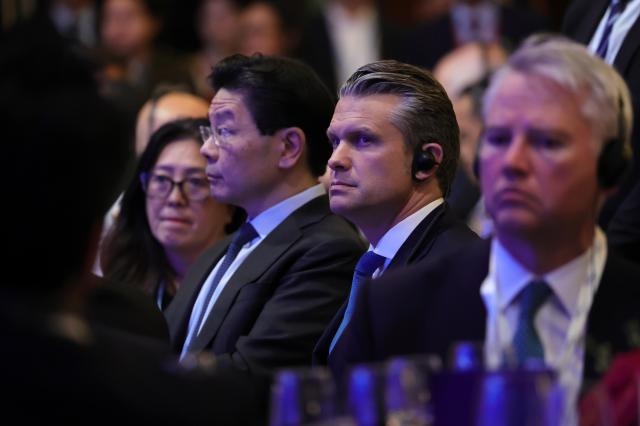
Also speaking at the Singapore forum, U.S. Defense Secretary Pete Hegseth praised South Korea's efforts to assume greater responsibility for its own defense and welcomed Seoul's desire to regain wartime operational control of its military.
"I think we have to find the balance of where our military plans and the responsibilities that U.S. uniformed members have had for decades now are honored, as we phase over to wartime OPCON transfer for the Republic of Korea," Hegseth said.
The comments came as Seoul seeks to complete the transfer of wartime operational control, or OPCON, before President Lee's five-year term ends in 2030.
Hegseth described South Korea's push to reclaim wartime command authority as a "breath of fresh air" and said Washington supported allies taking greater responsibility for their own defense. "It is an instinct we want to continue to incentivize," he said.
The defense secretary also reaffirmed U.S. support for South Korea's efforts to strengthen its military capabilities, including plans to develop conventionally armed nuclear-powered submarines.
"We applaud the pragmatism and leadership demonstrated by Seoul," he said. "The region will be far more stable and more secure when other allies and partners follow that path."
Copyright ⓒ Aju Press All rights reserved.