The October crash has prompted the president to complain that Korean equities are too undervalued Korean equities. Investors, however, remain wary of how much the country’s chip earnings will be worth if global AI spending subsides.
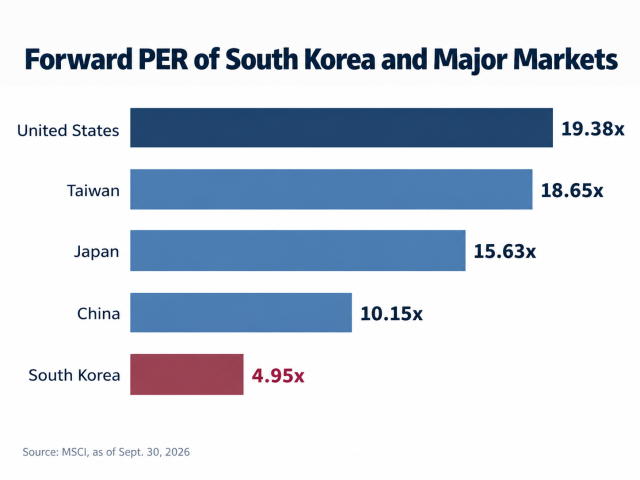
South Korea’s 12-month forward price-to-earnings ratio (PER) stood at 4.95 times as of Sept. 30, according to global index provider MSCI.
Comparable ratios were 19.38 times for the United States, 18.65 times for Taiwan, 15.63 times for Japan and 10.15 times for China. The measure compares stock prices with expected earnings over the next 12 months.
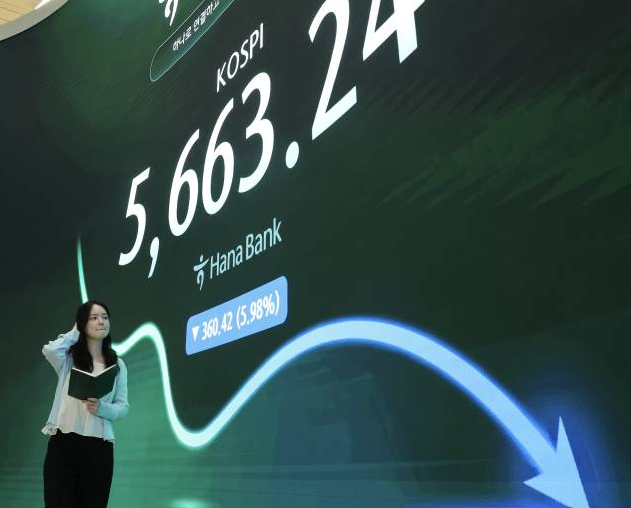
Seoul's figure does not capture the October rout. The KOSPI has lost 19 percent this month through Friday, while the junior KOSDAQ has fallen 12 percent. The KOSPI is nearly 40 percent below its June 22 peak.
The KOSPI’s forward PER has fallen to 4.41 times from 5.43 earlier this month, according to financial data provider FnGuide — below the roughly 7 to 8 times recorded during the 2008 global financial crisis and the COVID-19 market turmoil in 2020.
Yet analysts caution against treating low earnings multiples as an automatic buying signal.
“By that logic, even if the KOSPI reached 11,000, it could still be considered undervalued,” said an analyst at Yuanta Securities.
The unusually low ratio reflects both falling share prices and soaring earnings expectations for the country’s dominant chipmakers.
Hanwha Investment & Securities raised its 2027 operating profit forecast for Samsung Electronics by 8 percent to 606 trillion won ($458.3 billion) on Oct. 6, citing higher prices and shipments of next-generation high-bandwidth memory, or HBM4.
Such upgrades lower forward PERs even when share prices do not fall. When prices also retreat, the apparent discount becomes more striking.
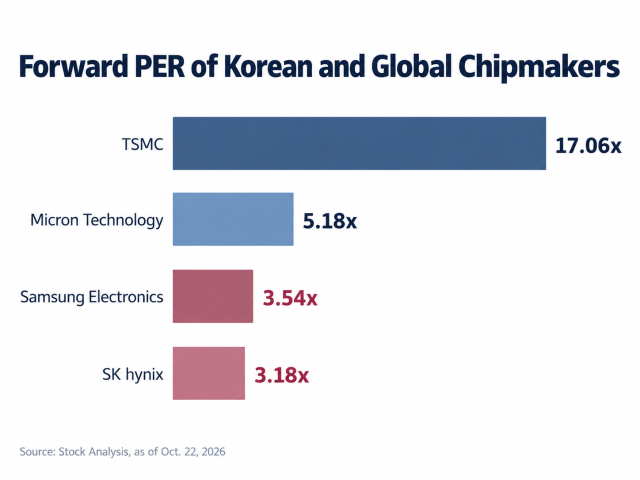
Samsung Electronics and SK hynix traded at 3.54 times and 3.18 times forward earnings, respectively, as of Thursday, according to financial data platform Stock Analysis.
Taiwan Semiconductor Manufacturing Co. (TSMC) traded at 17.06 times, while U.S. memory-chip maker Micron Technology traded at 5.18 times.
The gap extends beyond chips, though it is less pronounced. Hyundai Motor traded at 8.64 times forward earnings, compared with 11.03 times for Japan’s Toyota Motor.
But the Yuanta analyst cautioned that different markets command different multiples.
“The S&P 500 generally trades at a higher earnings multiple than the KOSPI, so you cannot simply compare SK hynix with Micron.”
Even securities representing ownership in the same company can trade at different valuations. SK hynix’s American depositary receipts traded at a premium of about 43 percent to its Seoul-listed shares as of Thursday.
“The valuation standards are different for companies listed in Korea and those listed in the United States,” the analyst said. “You cannot simply compare the absolute numbers.”
The headline KOSPI multiple also conceals a less dramatic picture across the rest of the market.
Excluding chipmakers, the index’s forward PER stands at 10.3 times, down from this year’s peak of 14.5 but close to its 20-year average of 10.4, according to Kiwoom Securities.
Much of the apparent bargain therefore rests on the earnings forecasts of a handful of semiconductor companies.
“The question is no longer whether the chipmakers will deliver strong earnings, but whether those profits can be sustained,” the Yuanta analyst said.
Another measure offers a potentially stronger argument for undervaluation. Samsung Electronics and SK hynix both had 24-month forward price-to-book ratios (PBRs) below one, according to Yuanta.
That means their current market values were below their projected net assets two years ahead. But those projections, too, depend on the profits the companies are expected to accumulate.
The valuation debate ultimately returns to the durability of AI demand.
Large technology companies and specialized AI infrastructure providers have poured money into data centers, servers and computing capacity. As some rely increasingly on debt, investors are questioning whether the eventual returns will justify the spending.
“Companies can borrow money to invest, but eventually they have to generate enough profit to recover that investment,” the analyst said. “The question is whether that can be sustained.”
Those concerns are weighing on CoreWeave, which rents out computing power for AI applications and has accumulated about $50 billion in debt. Yields on some of its bonds climbed to around 15 to 16 percent in mid-October as investors grew wary of its borrowing.
The pressure extends to larger technology companies. Meta Platforms on Wednesday raised the lower end of its 2026 capital spending forecast to $135 billion from $130 billion, leaving the upper end at $145 billion. It reported negative free cash flow of $2.12 billion in the third quarter despite a 26 percent rise in revenue.
For Korean chipmakers, the risk is that financing pressures eventually slow the infrastructure spending driving demand for their products.
Strong current earnings are already proving insufficient to reassure investors elsewhere in the semiconductor industry.
U.S. equipment maker Lam Research reported quarterly revenue and earnings above market expectations on Wednesday, yet its shares fell about 6 percent in after-hours trading as investors weighed supply-chain constraints and a weaker outlook for sales to China.
Samsung Electronics and SK hynix face a similar test: record profits may do little for their valuations if investors see them as a cyclical peak.
Foreign investors sold a net 11.24 trillion won ($8.4 billion) of KOSPI shares during the week of Oct. 12–16, including 8.85 trillion won in the two chipmakers, according to Koscom CHECK data.
Selling continued on Friday despite a modest market rebound. Foreign investors sold a net 982.6 billion won, while institutions bought 937.7 billion won and retail investors purchased 44.9 billion won.
Korea’s longstanding corporate governance concerns provide another reason to demand a discount.
“In the United States, shareholders are treated as the owners of the company, and companies return value to them,” the Yuanta analyst said.
In Korea, he said, decisions favoring controlling shareholders, corporate restructuring and subsidiary listings can leave investors uncertain whether rising profits will benefit them.
Those concerns surfaced in the debate over a proposed U.S. listing of Solidigm, SK hynix’s NAND flash memory subsidiary. The plan drew scrutiny over the potential dilution of shareholder value through a separate listing.
SK hynix said Friday it had stopped reviewing the listing, citing market conditions and share price movements.
Hanwha has set a 2027 KOSPI target of 8,500 within a projected range of 6,000 to 9,300. Its target implies upside of about 53 percent from Friday’s close of 5,550.30.
The forecast rests on the gap between corporate profitability and share prices.
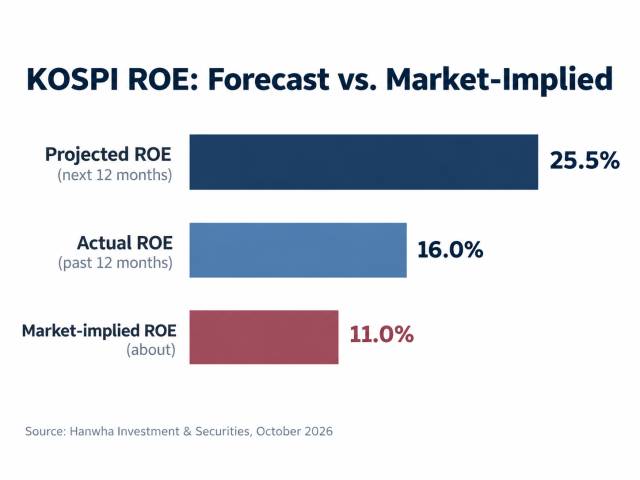
The KOSPI’s projected return on equity (ROE), which measures profits relative to shareholders’ capital, stands at 25.5 percent for the next 12 months, near a record high. Yet its forward PBR was just 1.08 times as of Oct. 16.
Based on historical relationships, Hanwha estimates that such profitability could justify a PBR of around two times. Current prices instead imply an ROE of about 11 percent, below the 16 percent recorded over the past year.
The brokerage found that since 2005, similar periods when market-implied ROE fell below actual ROE were followed by an average KOSPI gain of 28 percent over the next year. Returns were positive in 84 percent of cases.
Its 8,500 target assumes a more modest valuation recovery, with forward PBR rising to 1.32 times. Hanwha expects an initial rebound toward 7,600 by year-end, followed by more gradual gains in 2027.
The Yuanta analyst said the index could eventually surpass even Hanwha’s upper projection of 9,300. But it could fall further first, making a market bottom difficult to call.
The next clues will come from SK hynix’s earnings announcement on Oct. 28 and Samsung Electronics’ earnings call on Oct. 29. Investors will scrutinize their outlooks for 2027 and 2028 and any new shareholder return plans.
The U.S. midterm elections on Nov. 3 could also influence expectations for fiscal policy and long-term interest rates.
At home, the scope for policy to deliver a lasting valuation recovery remains contested.
“Perhaps doing nothing would be more helpful,” the Yuanta analyst said, questioning the effectiveness of measures introduced this year. Governance and shareholder rights problems would take time to resolve, he added.
Monetary policy offers little immediate relief. The Bank of Korea held its benchmark rate at 3.00 percent on Thursday and left the door open to further increases as inflation remains elevated.
Korean stocks may look cheap against the profits analysts expect. To become a convincing bargain, investors need confidence that those profits will endure — and that shareholders will receive their share.

Copyright ⓒ Aju Press All rights reserved.