

Journalist

Han Ji-hyun
hanji@ajunews.com
-
 Hyundai’s Middle East growth push faces war risk as U.S.-Iran conflict disrupts demand and shipping Hyundai Motor Group’s push to build a “second Middle East boom” to offset expanding U.S. high-tariff pressure is facing a new obstacle: war risk. With Iran launching indiscriminate attacks that also hit key regional markets such as Saudi Arabia, the United Arab Emirates and Kuwait, the industry expects weaker auto demand across the Gulf Cooperation Council and disruptions to logistics. If the conflict drags on, Hyundai’s planned Middle East production base — targeted to begin operations in the fourth quarter — could also be delayed. The unexpected shock of the U.S.-Israel and Iran war is also clouding Hyundai’s goal of reaching a 20% market share in the region by 2030. According to industry officials on the 9th, Hyundai and Kia sold about 320,000 vehicles in the Middle East last year, maintaining a market share of roughly 15%. The region accounts for about 8% of their global sales, making it their fifth-largest market after North America, Europe, India and South Korea. The Middle East market is a three-way contest among South Korea, China and Japan: Toyota ranks first with about 450,000 vehicles a year, Hyundai and Kia are second, and third place is held by multiple Chinese EV brands including Chery Automobile. Hyundai has focused on the Middle East because of its growth. The regional auto market is valued at $25.6 billion and is projected to expand 5.2% annually to $35.4 billion by 2030 — more than 1.5 times the global auto market’s average growth rate of about 3%. The GCC accounts for 60% of the market and Iran 40%. Hyundai and Kia plan to raise annual Middle East sales to 550,000 vehicles by 2030, centered on Saudi Arabia, positioning the region as a growth market alongside India and Latin America. The war, however, could derail those plans. If it becomes prolonged, operations at Hyundai’s Middle East manufacturing unit, being built with Saudi Arabia’s Public Investment Fund and slated for a fourth-quarter start, are expected to face setbacks. The plant is designed to produce 50,000 vehicles a year, including internal combustion models and EVs, and is reported to be about 50% complete. Because the facility is to run on a complete knockdown, or CKD, model — importing parts for local assembly — it must complete staffing and the setup of parts and equipment up to six months in advance. “Skilled workers are essential for stable CKD operations, but if the war continues, it becomes nearly impossible to put key personnel in place,” an auto industry official said. “Hyundai Motor Group’s core strategy of countering U.S. high-tariff pressure by expanding Middle East sales is now under threat.” A bigger concern is a potential contraction in regional demand and shipping. Toyota plans to cut production by 40,000 vehicles to prepare for possible logistics disruptions. Hyundai has also temporarily halted shipping schedules from its India unit, HMIL, to the Middle East as the closure of the Strait of Hormuz has continued for more than 10 days. A Hyundai official said that if the war is prolonged, delays in transporting equipment and materials are expected to be unavoidable. “Because this situation could have a significant impact on key local markets such as Saudi Arabia and the UAE, we are strengthening monitoring,” the official said. * This article has been translated by AI. 2026-03-09 18:24:21
 -
 Hyundai Motor, Kia Picked for South Korea’s ‘K-Autonomous Driving’ Pilot in Gwangju Hyundai Motor and Kia said Monday they have been selected as the automaker and transportation platform operator for the government-led “K-autonomous driving cooperation model,” part of the Ministry of Land, Infrastructure and Transport’s autonomous-driving test city initiative. The project, to be carried out in the city of Gwangju, is South Korea’s first effort to test autonomous-driving technology at the city level. The ministry said the large-scale trials are expected to secure high-quality real-world driving data while standards for technology development and related regulations are updated in parallel. Hyundai Motor and Kia were chosen to handle two areas in the demonstration: producing vehicles dedicated to autonomous-driving development and operating the transportation platform. The companies said building development vehicles requires not only supplying cars but also adding sensors tailored to each autonomous-driving approach, integrating vehicle controls and enabling over-the-air updates, among other functions needed for development and verification. Hyundai Motor and Kia said they have already built such capabilities by providing Ioniq 5-based autonomous vehicles in a foundry-style model to their autonomous-driving joint venture Motional and to Waymo’s robotaxi program. In the Gwangju project, they plan to support production of development vehicles and share vehicle and operational data generated during the trials with developers to help advance the technology. They also plan to deploy a dispatch and ride-hailing platform tailored for autonomous services based on their Shucle platform. The companies said Shucle’s core functions include AI- and real-time traffic-based route optimization, managing passenger pick-ups and drop-offs, and safety oversight through fleet monitoring. Hyundai Motor and Kia said they have strengthened operational stability by providing call and dispatch services since 2019 across 33 local governments and more than 82 service areas. Using Shucle in the demonstration, the companies said they aim to complete an integrated autonomous-service model that smoothly connects vehicles, the platform and users, and to lead efforts to build a new mobility experience and ecosystem. “This demonstration is an important opportunity to verify Hyundai Motor and Kia’s integrated autonomous-driving capabilities in a real urban environment,” said Kim Su-young, an executive director in the companies’ mobility business division. “We will focus our efforts on advancing the technology so that a system in which vehicles, autonomous-driving technology and the platform are organically linked can be established, and the results can develop into scalable standards.” * This article has been translated by AI. 2026-03-09 13:48:17
 -
 Hyundai Wia Holds 2026 Partnership Day, Pledges Shared Growth With Suppliers Hyundai Wia said it held its “2026 Partnership Day” on March 6-7 at Haevichi Hotel & Resort in Seogwipo on Jeju Island, where it shared its business strategy and vision with suppliers. The event brought together 123 key suppliers to discuss ways to pursue sustainable shared growth. Hyundai Wia holds the gathering each year in early January on Jeju Island. This year’s theme was “Our journey together creates a bigger future.” CEO Kwon Oh-sung said, “The foundation of Hyundai Wia’s 50-year history has been our suppliers,” adding that they are “true partners” who go beyond transactions to think through technology, overcome crises and share results. Hyundai Wia said it will work with suppliers to strengthen technology leadership, including collaborating from the product planning stage and jointly pursuing development and cost innovation for mass production. The company also said it will accelerate digital transformation using artificial intelligence to shorten development timelines and prevent potential mistakes in production and quality processes. To support suppliers’ AI adoption and technical capabilities, Hyundai Wia said it will expand training support by using Hyundai Motor Group’s Global Shared Growth Cooperation Center to provide practical education that can be applied on the job. At the event, it hosted an AI lecture by Park Hee-jun, a professor in Yonsei University’s industrial engineering department, to help suppliers strengthen AI and digital transformation skills. Hyundai Wia said it will expand shared-growth programs, including offering low-interest loans to suppliers through a 68 billion won fund. It said it will pay all amounts in cash to small and midsize suppliers with annual sales under 100 billion won and will make holiday payments early. The company also said it will strengthen support for suppliers’ safety management. Hyundai Wia said it will also help suppliers expand sales channels by supporting participation costs for overseas exhibitions and covering expenses for obtaining Korea Customs Service’s Authorized Economic Operator certification to strengthen import-export operations. A Hyundai Wia official said the company’s 50th anniversary this year was possible thanks to its suppliers, adding that it will “open the next 100 years” through shared growth with partners. * This article has been translated by AI. 2026-03-09 09:57:00
 -
 Hyundai Rotem Unveils Supplier Support Plan for Korea Defense Industry Hyundai Rotem said it will introduce a new profit-sharing program and sharply expand financial support to help its partner companies grow alongside the firm. The company said Monday it unveiled its strategy at the “2026 Hyundai Rotem Defense Co-Growth Cooperation Conference,” held March 6 at its Changwon plant in Changwon, South Gyeongsang Province. The plan focuses on supporting suppliers’ localization of parts and research and development for future advanced weapons. The strategy is aimed at expanding access to financing and widening opportunities for technological self-reliance, Hyundai Rotem said, as part of efforts to strengthen the quality of South Korea’s defense industry ecosystem. Attendees included local district lawmakers, representatives from 67 partner companies and Hyundai Rotem employees. In welcoming remarks, CEO Lee Yong-bae said the world is paying attention to the capabilities and role of South Korea’s defense industry amid rapidly changing international conditions. He called on Hyundai Rotem and its partners to “bind together as a community of shared destiny” and deepen mutual trust. Hyundai Rotem said it will significantly expand financial support for partner companies starting this year. It will introduce a new “co-growth profit-sharing program” under which, when the company wins new overseas orders, it will share results with suppliers that helped improve export competitiveness. Under the program, after a localized parts development succeeds and a first contract is signed, Hyundai Rotem will return 100% of cost savings from localization to the supplier in the contract year and 50% the following year. If transactions for the localized part or technology continue over the long term, the company said it will provide additional support by guaranteeing order volumes for the supplier. To help suppliers raise funds, Hyundai Rotem said it expanded its “co-growth fund” to 150 billion won, more than double the previous 70 billion won. On March 6, it signed a three-way memorandum of understanding with partner companies and Shinhan Bank on “Hyundai Rotem partner company co-growth and productive financial support.” The company said it plans to support trade finance, guarantees and preferential loan rates, alongside efficient operation of the fund. Hyundai Rotem also said it will invest 200 billion won in R&D through 2027 to support development of future advanced weapons, localization of parts and performance improvements. The scope includes next-generation manned and unmanned ground weapons platforms, aerospace, artificial intelligence and unmanned systems, as well as localization and performance upgrades of key components. The company said it will also run technical support and training programs. It plans to form a consultative group with partner companies, universities and research institutes to facilitate technical exchanges, and to support self-reliance by linking partner proposals and business needs to government projects. Hyundai Rotem said it will expand training for partner-company employees through its technical training institute, with more than 5,600 participants expected this year. Hyundai Rotem said it will step up efforts to prevent leaks of partner companies’ technology and personnel. It will provide expert consulting to improve security management systems, including simulated hacking and training to respond to malicious emails. When requesting technical materials from partners, the company said it will require a strengthened security system, and it will add a clause to its ethics code aimed at preventing poaching of partner-company personnel to protect key talent. The company also reorganized to strengthen co-growth cooperation. Previously handled by the purchasing planning team under the purchasing division, the work will now be led by a newly created co-growth cooperation office directly under the purchasing division, with a co-growth cooperation team under it. The office will form a consultative body with all relevant departments and provide on-site support for partner companies’ technology and quality in coordination with the government and related agencies, Hyundai Rotem said. A Hyundai Rotem official said the technological competitiveness of South Korea’s defense industry comes from growing together with partner companies, and the company will continue support to build a solid industrial foundation where all can grow.* This article has been translated by AI. 2026-03-09 09:09:25
 -
 Hyundai, Kia’s X-ble Shoulder wearable robot wins South Korea KS certification Hyundai Motor and Kia said Monday their industrial wearable robot, the X-ble Shoulder, has received KS certification from the Korea Institute for Robot Industry Advancement. KS certification is a state-run system that verifies products and services meet Korean Industrial Standards. The process is carried out through organizations designated by the Korean Agency for Technology and Standards; in robotics, it is administered by the Korea Institute for Robot Industry Advancement. The company said the approval is the first case in South Korea in which the quality of a wearable robot has been secured under nationally recognized standards. The X-ble Shoulder is designed to reduce musculoskeletal strain for workers in industrial settings, and the certification formally recognizes its safety and quality, Hyundai Motor and Kia said. Hyundai Motor and Kia said they are continuing development and commercialization of the X-ble series, which they describe as human-centered robotics technology. The X-ble Shoulder uses a non-powered torque-generation structure, making it lightweight and eliminating the need for charging, the company said. It also applies a muscle-compensation module to generate assistance, which can reduce shoulder joint load by up to 60% and activation of the anterior and lateral deltoid muscles by up to 30%, it said. The robot is being used at worksites across Hyundai Motor Group affiliates as well as at Korean Air and Korea Railroad Corp., the company said. It added that it is expanding the business scope, including by signing a memorandum of understanding last year with the Rural Development Administration. Hyundai Motor and Kia said they are also developing the X-ble Waist to help reduce strain for workers handling heavy loads. In addition, research and development is underway on the X-ble MEX, a wearable robot intended to help paraplegic patients walk, for use in rehabilitation and medical fields. Choi Ri-gun, a managing director at Hyundai Motor and Kia Robotics Lab, said the X-ble Shoulder “has come to lead safety and quality standards for industrial wearable robots in Korea” through KS certification. He said the company will focus on developing products that improve the practicality of robotics technology and can contribute to industrial worksites globally. Hyundai Motor and Kia also cited overseas safety recognition. The company said the X-ble Shoulder received ISO 13482 certification from DNV (Der Norske Veritas), a European Union integrated certification mark registration body, in February last year, and later obtained additional certification under the EU Machinery Directive in May.* This article has been translated by AI. 2026-03-09 08:52:47
 -
 Korea’s ‘Yellow Envelope’ Labor Law Takes Effect, Industry Warns of Disruption Business groups say the so-called Yellow Envelope Act — revisions to Articles 2 and 3 of the Trade Union and Labor Relations Adjustment Act — will take full effect starting on the 10th, and they warn it could trigger major disruption across industry. Korea’s manufacturing base — including autos, defense, shipbuilding and construction — relies on dense networks of first-tier suppliers and multilayer subcontractors. An industry official said the subcontracting structure became entrenched during Korea’s rapid industrialization and warned that if the law is used to increase management pressure or as a tool in strikes, companies could face a worst-case scenario of being consumed by labor talks year-round. As of the 8th, industry officials said they expect more labor-management disputes if the law expands the definition of “employer,” and they fear a rise in cases in which subcontractors challenge corporate management rights. Under the revisions, a prime contractor can be treated as an employer even without a direct employment contract if it is in a practical position to control subcontracted workers’ hours, wages or work methods. Observers say the change could directly affect industries where multilevel subcontracting is common, including shipbuilding, autos, construction, steel, petrochemicals, semiconductors, IT, platform businesses and services. Hyundai Motor, for example, has about 5,000 subcontractors, including first-, second- and third-tier suppliers. In construction, where partners are often organized by project, three major builders — Samsung C&T, Hyundai Engineering & Construction and GS E&C — have about 1,900 first-tier partners and roughly 16,000 partners in total. Shipbuilding has fewer partner firms than autos or construction, but it relies far more heavily on outsourced labor. The combined subcontractor workforce at three major shipbuilders — HD Hyundai, Samsung Heavy Industries and Hanwha Ocean — totals about 45,000, about 1.5 times their directly employed workforce of 31,000. An industry official said that with grievances among subcontracted workers already accumulated, negotiations could, in some cases, lead to a surge of demands. The official warned that normal business operations could become difficult and that manufacturing sites could be thrown into confusion and conflict. Business groups also voiced concern that the law is taking effect as the economy faces multiple pressures, including U.S.-driven tariff risks, a reshaping of global supply chains and what they described as “three highs” — a weak currency, high interest rates and high oil prices — linked to the war in the Middle East. A business official said that with companies facing unprecedented external uncertainty, the law’s ambiguity could make management decisions even harder, and urged labor and management to pursue coexistence for shared interests rather than deepen distrust.* This article has been translated by AI. 2026-03-08 18:05:45
 -
 Volkswagen Group EV Deliveries Top 4 Million, Plans 20-Plus New Models This Year Volkswagen Group said Thursday that cumulative deliveries of its battery-electric vehicles have surpassed 4 million. On the back of that milestone, the automaker said it holds about 27% of Europe’s EV market. Of the 4 million EVs delivered, 77% were built in Europe. Volkswagen Group has 11 production sites there: Emden, Zwickau, Hanover, Bratislava, Mlada Boleslav, Ingolstadt, Neckarsulm, Leipzig, Zuffenhausen, Munich and Sodertalje. Two additional plants set to begin operating this year — Pamplona and Martorell — will produce the Core Brand Group’s city EV family models. The Wolfsburg plant, Volkswagen’s main production hub, and Bentley’s plant in Crewe, England, are also preparing for EV production, the company said. About 20% of the group’s EVs are currently produced in China, where it has four production sites: Anting, Foshan, Hefei and Changchun. Volkswagen Group said 95% of its EV deliveries are concentrated in three key markets — Europe, China and the United States. Europe accounted for 68%, followed by China at 20% and the U.S. at 8%. Other markets made up about 5%. Compact-class vehicles were the most popular segment, representing about 70% of deliveries. Key models include the Volkswagen ID.3 and ID.4, the Skoda Enyaq, the Cupra Born and the Audi Q4 e-tron. By body type, SUVs and crossover-style models accounted for more than half of demand. The group’s first mass-produced EV model was the VW e-up, launched in 2013, followed by the VW e-Golf in 2014. Since 2019, it has rolled out cross-brand models based on its dedicated EV platform, MEB (Modular Electric Drive Matrix). About 3 million MEB-based vehicles have been delivered, the company said. Over the past two years, Volkswagen Group said it has refreshed its portfolio with about 60 new models, about one-third of them fully electric. In passenger cars alone, it now offers more than 30 battery-electric models, ranging from small cars to luxury SUVs. It has also expanded its lineup to include battery-electric trucks and buses from TRATON brands including Scania, MAN, International and Volkswagen Truck & Bus. Volkswagen Group said it plans to add more than 20 new models this year, about half of them fully electric. The rollout includes new EVs aimed at China and an entry-segment “city EV family” of four models for Europe. * This article has been translated by AI. 2026-03-06 16:48:19
 -
 LIG Nex1 Named KRX’s 2025 Award Winner for English-Language Disclosures LIG Nex1 said March 5 it was selected as a “2025 Excellent English-Language Disclosure Company” at an awards ceremony hosted by the Korea Exchange (KRX). The KRX honor recognizes companies that provide high-quality English disclosures quickly and accurately, helping improve capital-market transparency and strengthen trust among global investors. Award recipients receive benefits including a five-year grace period from designation as an unfaithful disclosure company, exemption from annual training and exemption from listing fees. LIG Nex1 said it began issuing English disclosures in 2021, ahead of the phased introduction of mandatory English disclosures, to reduce information gaps between domestic and overseas investors by providing timely and accurate filings. The company said the latest recognition follows its selection as a “2022 Excellent Disclosure Company” for corporate governance report filings and as a “2024 KOSPI Market Excellent Disclosure Company.” “This achievement reflects the results of 10 years of efforts to faithfully meet disclosure obligations since listing on the KOSPI market,” a company official said. “We will continue to prioritize transparent communication with investors at home and abroad to enhance our corporate value in the capital market.”* This article has been translated by AI. 2026-03-06 16:09:20
 -
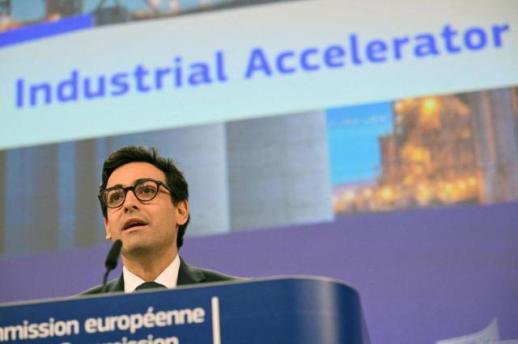 Hyundai, Kia face challenges amid EU's push for local EV production SEOUL, March 6 (AJP) - Auto industry workers are closely monitoring developments as the European Union unveiled its Industrial Accelerator Act (IAA) earlier this week, a proposal aimed at boosting local manufacturing by imposing stricter requirements on global automakers. In a press release out on Wednesday, the European Commission said it has "adopted a legislative proposal to increase demand for low-carbon, European-made technologies and products," adding that IAA will "boost manufacturing, grow businesses, and create jobs in the EU, while supporting industry's adoption of cleaner, future-ready technologies." The commission also said the act "sets a goal to increase manufacturing's share of EU GDP to 20 percent by 2035." Once fully implemented, the IAA would require South Korean automakers to produce at least 70 percent of their vehicles' parts in the EU to be eligible for subsidies offered for eco-friendly vehicles. The country's largest automaker Hyundai Motor Group, which manufactures more than 80 percent of its European EV exports in South Korea, now needs to adjust to comply with the new rules under the IAA. The commission indicated that these requirements would cover "selected strategic sectors" such as steel, cement, aluminum, cars, and net-zero technologies, with the possibility of being expanded to "other energy-intensive sectors such as chemicals." The IAA also sets rules on foreign direct investment. If a country controlling more than 40 percent of global production capacity invests over 100 million euros in Europe, it must ensure at least half of its workforce are EU workers, limit foreign ownership to below 50 percent, and meet other obligations such as technology transfers. "Most automakers including Hyundai and its affiliate Kia export the majority of the EVs they sell in Europe rather than assembling them locally," an industry official said. "Unlike South Korea, which provides subsidies regardless of where a vehicle is made, Europe's proposed rules would effectively disadvantage imported vehicles." Hyundai and Kia sold 183,912 electric vehicles in Europe last year, but locally produced models stood at about 31,722 units, accounting for just a 17.2 percent of the total. Hyundai currently operates two manufacturing facilities in Europe — in Nošovice, the Czech Republic and Izmit, Türkiye — while Kia has one in Žilina, Slovakia. But their production capacity remains heavily concentrated on internal combustion models, while key EVs such as the Ioniq 5 and 6 and the EV5, EV6 and EV9 are all produced in South Korea and exported to Europe. The two automakers plan to gradually expand the production of EV models in Europe. Hyundai plans to begin mass production of the Ioniq 3 in the Czech Republic in August and convert its plant in Türkiye to EV production, targeting an annual capacity of 200,000 units. Kia already began mass production of the EV4 in Slovakia in August last year, with plans to rapidly expand its EV production by 2027. "We will speed up the transition of our plants for EV production ahead of the IAA's implementation," said a Hyundai staffer. "At the same time, we aim to maintain our market share by offering a broader range of EVs tailored to European motorists." However, a long legislative road still lies ahead for the implementation of the IAA, as it must be negotiated and approved by both the European Parliament and the Council of the European Union before adoption. 2026-03-06 14:30:20
 -
 Lexus Korea Extends Team Lexus Ambassador Deals With KPGA Golfers Park Sang-hyun and Ham Jung-woo Lexus Korea said Thursday it has extended its 2026 “Team Lexus” ambassador agreements with Korea Professional Golfers’ Association players Park Sang-hyun of Dong-A Pharmaceutical and Ham Jung-woo of Hana Financial Group. Under the renewed deals, the golfers will represent the Lexus brand in marketing activities through December. Park will mark his sixth consecutive year with Team Lexus, and Ham his seventh, the company said. To support their tournament schedules and training, Lexus Korea will provide its flagship “L Series” vehicles, it said. The company said the two will also take part in customer-facing programs, including “Amazing Swing” private golf lessons and one-on-one golf mentoring content. Park is a veteran on the domestic circuit with 16 career wins since joining the KPGA, including two on overseas tours, and ranks first on the KPGA career money list, Lexus Korea said. Ham has four KPGA wins and won the 2023 KPGA Genesis Award, the company said, citing his steady play and focus. At the signing ceremony, Lexus Korea President Manabu Koyama thanked Park and Ham for their long-running role with the brand, saying the partnership goes beyond a simple collaboration and is a relationship that inspires both the brand and the players. Separately, Lexus Korea said it signed a business agreement with the KPGA in February to stage the 2026 Lexus Masters, underscoring its commitment to promoting golf culture in South Korea. The tournament, held for a third straight year since its launch in 2024, will offer total prize money of 1 billion won and run from Oct. 29 to Nov. 1. * This article has been translated by AI. 2026-03-06 09:39:19