
Journalist

Han Ji-yeon
hanji@ajunews.com
-
 Trade Chief Yeo Calls for Stronger South Korea-Japan Supply Chain Cooperation As the second Trump administration in the United States strengthens trade policy centered on economic security, a call is growing for South Korea and Japan to respond jointly to the reshaping of supply chains for critical minerals and advanced industries. The proposal urges the two countries to identify joint projects using overseas resource development and multilateral cooperation platforms to secure industrial competitiveness amid global supply chain shifts. The Korea Economic Research Institute, affiliated with the Federation of Korean Industries, said the message was shared at the “Korea-Japan New Economic Cooperation Seminar in an Era of Compound Crises,” held on 22 at the Keidanren Kaikan international conference hall with the Keidanren Institute of Policy and Management. Organizers said the seminar was convened to seek new directions for bilateral economic cooperation amid a rapidly changing global economy. Yeo Han-koo, South Korea’s trade minister, said in a keynote speech on “Directions for Korea-Japan Economic and Trade Cooperation” that the two countries face “shared challenges and uncertainty.” With instability in the Middle East continuing and U.S.-China strategic competition intensifying, he said, flexible solidarity is needed among countries that share values and interests. Yeo said supply chain cooperation should be built on the Korea-Japan Supply Chain Partnership Arrangement, including responses to disruptions and joint exploration and investment in critical minerals. He also emphasized cooperation through multilateral platforms such as the Forum for Geo-strategic Resource Cooperation and the International Energy Agency. South Korea and Japan have focused on strengthening cooperation in advanced industries such as semiconductors and stabilizing supply chains for rare earths and other materials. South Korea is pursuing three supply chain laws and a comprehensive rare earths plan, while Japan is conducting domestic rare earth exploration and development under its economic security law. Yeo said the two countries should strengthen mutual stockpiling and swap cooperation for oil and gas to enable rapid joint responses if a supply crisis occurs. He said South Korea has the world’s largest storage infrastructure, while Japan operates surplus volumes beyond domestic demand, creating potential synergies. In March, on the sidelines of the Indo-Pacific Energy Security Ministerial Meeting, Korea Gas Corp. and Japan’s largest LNG company, JERA, signed an agreement on LNG supply and demand cooperation and pledged to pursue measures including LNG swaps. Ahn Sung-bae, vice president of the Korea Institute for International Economic Policy, said the two countries should expand joint projects in third countries, including mining development and infrastructure investment. He said South Korea and Japan already have experience cooperating on resource development projects involving nickel, copper and iron ore. Ahn added that coordination is important because the multilateral Agreement on Critical Minerals could influence future price mechanisms, investment standards and supply chain rules. Ahn said it is urgent for South Korea and Japan to reduce dependence on specific countries for key minerals such as lithium, graphite and rare earths. He said both are exposed to supply chain risks because dependence is high at the refining and processing stages, and called for diversification centered on strategic industries including critical minerals, semiconductors and energy. Kuno Arata, a professor at Asia University, said the top priority is reducing reliance on specific countries in strategic industries such as semiconductors, batteries and critical minerals, and building a system that allows joint responses in a crisis. He called for more practical cooperation mechanisms, including information sharing, joint procurement and production cooperation. Lee Hyuk, South Korea’s ambassador to Japan, said in congratulatory remarks that the establishment of shuttle diplomacy between the two countries’ leaders is driving deeper cooperation across a wide range of areas, including trade and investment, economic security, advanced technology, supply chain stability and the shaping of international rules. He said the key is ensuring those diplomatic gains translate into economic results felt on the ground. * This article has been translated by AI. 2026-04-22 10:10:00
 -
 LIG D&A, South Africa’s Milkor to Co-Develop Unmanned Aircraft Platform LIG Defense&Aerospace, or LIG D&A, is partnering with South African defense company Milkor to pursue the global market for next-generation unmanned aerial systems, the company said. LIG D&A said it signed a memorandum of understanding with Milkor on Monday (local time) at DSA 2026 in Kuala Lumpur, Malaysia, covering cooperation on future unmanned aircraft platforms and integrated mission systems technology. The agreement aims at joint development of unmanned reconnaissance aircraft platforms and advanced mission equipment carried on them, which the companies described as increasingly essential on modern battlefields. LIG D&A and Milkor said they plan to deepen the partnership beyond technical exchanges, including jointly planning weapons-system development. Under the MOU, the companies plan to pursue system-integration options that would combine LIG D&A’s in-house active electronically scanned array, or AESA, radar and advanced electronic warfare equipment with Milkor’s next-generation unmanned aircraft platform. The goal is a turnkey integrated unmanned system that can carry out missions ranging from surveillance and reconnaissance to precision strikes on a single platform. A LIG D&A official said the combination of the company’s mission-system technology and Milkor’s proven unmanned platform would help secure a competitive product for the global market. The official said LIG D&A will continue efforts to develop unmanned-system solutions optimized for future battlefields and to strengthen the standing of South Korea’s defense industry.* This article has been translated by AI. 2026-04-22 09:36:18
 -
 Hanwha Aerospace, Northrop Grumman to Co-Develop Long-Range AReS Missile System Hanwha Aerospace said it will work with Northrop Grumman to jointly develop a new long-range missile system. The company said April 22 that it signed a memorandum of agreement with Northrop Grumman on April 21 (local time) at the Sea-Air-Space 2026 exhibition in National Harbor, Maryland, to cooperate on developing the first-stage solid-fuel rocket motor for the AReS (Advanced Reactive Strike) missile system. AReS is a ground-launched long-range missile weapon system that Northrop Grumman is developing. The system is known to require advanced propulsion to enable rapid movement and quick launch. Under the agreement, Hanwha Aerospace will take part from the early stage of developing AReS’ first-stage rocket motor. The company said it plans to use its global production capacity and advanced manufacturing technology to speed development and mass production. The jointly developed system is aimed for a demonstration in 2027. A Hanwha Aerospace official said, “In the rapidly changing nature of modern warfare, a strong defense industrial base is key for the United States and its allies to secure deterrence,” adding that the partnership will further strengthen the company’s technology and manufacturing capabilities for entering the U.S. defense market. A Northrop Grumman official said developing weapon systems that ensure an advantage for the United States and its allies is important as air and maritime threats evolve quickly, and said the company will work with Hanwha Aerospace to offer “innovative and cost-effective solutions.” * This article has been translated by AI. 2026-04-22 08:44:05
 -
 Hyundai Bets on IONIQ EVs and Self-Driving Tech to Rebuild in China China is the world’s largest auto market, with about 25 million new vehicles sold a year, and Hyundai Motor Group is trying to regain ground there. The company is now leaning on its IONIQ electric-vehicle brand, after past missteps in reading China’s fast-changing demand. Industry officials said China’s shift to electrification is moving quickly, with electric vehicles accounting for about 50% of new-car sales. Hyundai, citing that trend, decided to deploy IONIQ models designed to match Chinese consumer preferences. Two China-focused concept vehicles unveiled earlier this year in Beijing — the “Venus Concept” and “Earth Concept” — highlight the approach. They feature a gold color favored by Chinese buyers, a futuristic design and an SUV-oriented lineup. A Hyundai official said the vehicles were planned “from the beginning” to reflect Chinese lifestyles and that the company introduced a new naming system, different from existing IONIQ conventions, using “planets” as the motif. Hyundai also outlined a China-centered technology roadmap. It is working with Chinese company Momenta to develop locally optimized autonomous-driving technology. It also plans to introduce its first EREV (extended-range electric vehicle) technology in China, taking into account charging infrastructure and long-distance driving conditions. Li Fenggang, general manager of Beijing Hyundai, said the company will complete mass-produced products that “perfectly combine” smart driving favored by Chinese customers with in-cabin UX experiences. Hyundai has previously faced setbacks in localization. As China’s auto market grew under the lead of foreign brands from Germany, Japan and South Korea, Hyundai gained popularity with a “good value” positioning. But it expanded its sedan lineup as demand for SUVs surged and failed to keep pace with Chinese government policies aimed at expanding the EV market. Meanwhile, the competitiveness of Chinese local brands strengthened to the point of challenging Hyundai. Experts said Hyundai needs a multi-layered strategy that reflects structural changes in China’s mobility market. Kim Junseong, an analyst at Meritz Securities, said the old approach of offering China-tailored EVs at low prices is no longer enough, and urged Hyundai to accelerate the launch of autonomous-driving smart cars that can win support from both the government and the market, whether developed independently or through partnerships. Kim Dongyoung, a senior research fellow at the Korea Development Institute, said Hyundai should not view China simply as a market to restore sales, but as a test bed to secure leadership in future mobility. He called for a broader playbook, including working with local companies to learn autonomous-driving technology and improving access to China’s parts suppliers and software ecosystem. 2026-04-22 05:04:30
 -
 Hyundai Motor Pushes to Rebuild in China as Market Share Stays Below 1% "China is the fastest-moving market. With a humble approach, we will increase production and sales in China." (Chung Euisun, chairman of Hyundai Motor Group, in an interview after a Korea-China business forum in January) Hyundai Motor Group is regrouping as it declares a renewed push into China, a market it says it cannot afford to abandon as the country emerges as the world’s largest future-mobility arena. After a peak near 2 million vehicles a year and a long slide since, the group is betting on China-tailored mobility products that closely reflect local consumer lifestyles. According to the auto industry on Monday, Hyundai Motor and Kia sold 227,000 vehicles in China last year, up 11.8% from a year earlier. Even so, their share of China’s domestic market was 0.9%, remaining below 1% for a 10th straight year — a weak showing for the world’s No. 3 automaker. Hyundai Motor Group entered China in 2002 and hit a high in 2016, selling a combined 1.8 million Hyundai and Kia vehicles. Sales then fell sharply to 1.15 million in 2017 after the THAAD dispute, and dropped to 930,000 in 2019, breaking below the 1 million mark. The decline continued: 510,000 in 2021, 325,000 in 2023 and 203,000 in 2024. Analysts cite multiple factors behind the slump, including misreading market trends, a delayed shift to electric vehicles and insufficient localization. Some also point to lingering negative perceptions tied to an early focus on taxi fleet sales that helped cement an image as a low-priced imported brand. One industry official said that as China’s auto market matured and split quickly into premium and budget segments, Hyundai lost its footing — squeezed by German brands on prestige and by Chinese automakers on price. The official added that while China’s government pushed an EV transition, Hyundai stuck with internal-combustion models, and misjudged demand by focusing on sedans even as rivals expanded sport utility vehicle lineups. Still, expanding its China presence is essential if Hyundai is to rise to the top globally, said Park Cheol-wan, a professor at Seojeong College. “If you win in China, you secure a foundation to win worldwide,” Park said, urging the company to acknowledge past failures and craft strategies to beat Chinese firms in batteries and electric vehicles.* This article has been translated by AI. 2026-04-22 05:03:20
 -
 Hanwha Aerospace Raises Stake in KAI as LIG-LS Consortium Emerges as Dark Horse Korea Aerospace Industries’ long-discussed privatization is drawing renewed attention as potential bidders position themselves for a possible takeover of the country’s only aircraft manufacturer. According to the industry on the 22nd, Hanwha Aerospace said in its business report that it holds 4,864,000 KAI common shares, a 4.41% stake. Including the 0.58% held by affiliate Hanwha Systems, Hanwha Group’s combined stake totals 4.99%, making it KAI’s fourth-largest shareholder. Industry watchers view the share purchase as a preliminary move toward a bid. If Hanwha Aerospace were to acquire KAI, it could build a vertically integrated defense aerospace chain spanning aircraft engines, radar, artificial intelligence-based combat systems and airframe integration, potentially shortening development timelines and cutting costs. LIG Nex1 has also been mentioned as a contender. It was recently reported to have formed a task force to review participation in a KAI acquisition. Analysts say combining LIG Nex1’s strengths in guided weapons such as the Cheongung system, along with radar and communications equipment, with KAI’s systems-integration capabilities could generate significant synergy. If LIG Nex1 enters the race, a joint consortium with LS Group is also being discussed. The two companies, often described as part of the broader LG family, have maintained business ties even after corporate separation. LS Group’s defense affiliate LS Mtron is seen as globally competitive in tracked systems used in tanks, armored vehicles and self-propelled artillery. A combination of LIG Nex1’s precision-strike technology, LS Mtron’s mobility-component expertise and KAI’s systems integration could support integrated weapons systems across ground and air domains. KAI is listed, but the Export-Import Bank of Korea (26.41%) and the National Pension Service (8.20%) are its first- and second-largest shareholders. If a takeover contest accelerates, key variables are expected to include industrial competitiveness, financing capacity and the government’s stance. The industry estimates KAI’s fair value at about 5.8 trillion to 6.2 trillion won, reflecting the value of the top shareholder’s stake and a 20% to 30% control premium on the current share price. As of last year, Hanwha Aerospace’s cash and cash equivalents totaled 12.6692 trillion won, its highest level on record, giving it an advantage in funding, according to the industry. LIG Nex1 is viewed as weaker on liquidity but stronger on technological fit and market diversification. The government is also said to be concerned that if Hanwha adds airframe integration capabilities, it could dominate more than 50% of the defense market. President Lee Jae-myung has said, “It would be problematic if the defense ecosystem becomes monopolized by a specific company.” Hyundai Motor Group and Korean Air have also been cited as possible bidders. Hyundai Motor Group was a founding member of KAI in 1999 and once held a 10% stake, but in 2016 Hyundai Motor Chairman Chung Eui-sun sold the shares, saying the group would focus on its core auto business. With defense affiliate Hyundai Rotem and recent moves into urban air mobility, interest in aerospace has been rising. Korean Air previously pursued KAI acquisitions in 2003 and 2009, but both attempts fell through. Industry officials say privatization should be accelerated to strengthen KAI’s export competitiveness, arguing that modern warfare is shifting toward AI, drones and space operations and that KAI will struggle without stronger software capabilities. “If Hanwha acquires KAI, strong vertical integration and cost reductions could create a Korean version of Lockheed Martin,” one industry official said. “If LIG Nex1 and LS acquire it, they could form a two-pillar structure with Hanwha and foster a healthier market ecosystem.”* This article has been translated by AI. 2026-04-21 10:55:23
 -
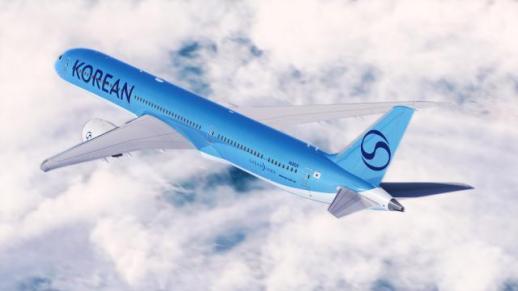 Record-high fuel surcharges to push up airfares ahead of peak summer travel season SEOUL, April 16 (AJP) - Fuel surcharges on international flights will rise to record-high levels next month as oil prices remain high, even as there are some hopes for an end to the prolonged conflict in the Middle East. Both international and domestic flight routes are subject to these surcharges, which airlines adjust based on changes in the average price of fuel traded on Singapore's spot market. According to aviation industry data released on Thursday, the average price of Singapore jet fuel, known as MOPS, soared to 511.21 cents per gallon for the period from March 16 to last Wednesday, which is used to set surcharges for May. The persistently high price will push fuel surcharges for May to the highest level on the 33-tier scale, a jump of 15 levels from this month's level of 18, the biggest jump since the scale was first implemented in 2016. Flagship carrier Korean Air will impose fuel surcharges ranging from 75,000 won to 564,000 won depending on routes, while Asiana Airlines, acquired by Korean Air in December 2024 and set to be fully integrated by early 2027, will charge between 85,400 won and 476,200 won. Low-cost carriers including Jeju Air and T'way Air have yet to release their respective surcharges for the coming month, but similar levels are expected. Accordingly, round-trip fares on long-haul routes such as those from Incheon to Europe or the U.S. are expected to rise by more than 1 million won compared with the previous month. "Hikes in fuel surcharges are unavoidable as airlines seek to recover losses caused by high oil prices," an industry insider said. "However, higher surcharges will inevitably lead to higher ticket prices, raising concerns that travel demand could weaken ahead of the peak summer vacation season." 2026-04-16 13:52:50
 -
 Hyundai unveils two Ioniq concepts in Beijing SEOUL, April 10 (AJP) - Hyundai Motor's two concept cars for electric vehicles have been unveiled at a three-day event in Beijing, the automaker said on Friday. The event, which kicked off last Tuesday, was held to mark the launch of its flagship Ioniq brand in the world's most populous country. Stressing that it has "invested years in preparing" the brand to meet the demand and tastes of Chinese customers, it explained that Ioniq "evolves beyond a traditional product lineup into a broader mobility ecosystem" by integrating technologies based on its "globally validated expertise." Hyundai said the concepts, called "Venus" and "Earth," reflect its goals for a renewed presence in the Chinese market. "Inspired by the planetary system revolving around the sun, the Ioniq lineup takes its names from the planets, symbolizing a universe centered on the customer. Through this distinct approach, Hyundai aims to complete a fully customized EV experience," it explained. With the world premiere of the two concepts, the automaker also outlined its roadmap for the Chinese market, which includes the development of locally optimized self-driving technology in collaboration with Chinese autonomous-driving firm Momenta. Aiming to reach annual sales of 500,000 vehicles in China, it also plans to release its first extended-range electric vehicles (EREVs), which are electrified vehicles powered exclusively by electric motors, in China, in consideration of the country's charging infrastructure and long-distance driving conditions. "Built on Ioniq's uncompromising principles of world-class safety and quality, we will soon introduce production models that seamlessly combine the smart driving and smart cabin experiences demanded by Chinese consumers," said Li Fenggang, president of the automaker's Beijing office. Hyundai will rev up its promotional activities with Chinese customers by showcasing a full lineup of electric vehicles at this year's Auto China, the biennial auto show in Beijing, which will run from April 24 to May 3. 2026-04-10 16:30:09
 -
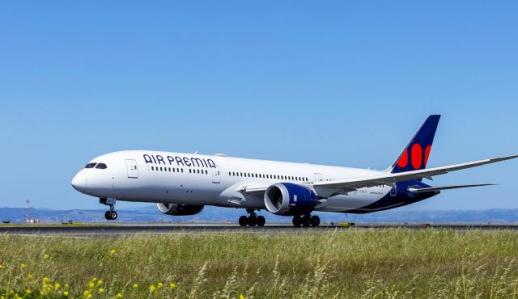 Low-cost carrier Air Premia tops 3 million int'l passengers SEOUL, April 10 (AJP) - Air Premia has surpassed 3 million in the cumulative number of international passengers, the low-cost carrier said on Friday. The milestone comes about three years and nine months after launching its first international routes in July 2022. Of its total of 11,458 international flights, which flew about 62.74 million kilometers, about 45.40 million kilometers or 72.3 percent of the accumulated flight distance, came from routes to North America. The average flight distance per trip was about 5,475 kilometers, which reflects the carrier's strategy of focusing on long-haul routes as it has pursued qualitative growth rather than simply increasing passenger volumes. Air Premia currently operates eight international routes, with four in the U.S., including Honolulu, Los Angeles, New York and San Francisco, and four in Asia including Bangkok, Da Nang, Hong Kong and Narita. It plans to add a route to Washington, D.C. on April 24. Boeing's 787-9 Dreamliner, a long-range jet, is deployed across all routes due to its high fuel efficiency, according to an Air Premia spokesperson. "If current demand continues, we expect to surpass 4 million passengers this year," he said. 2026-04-10 11:28:38
 -
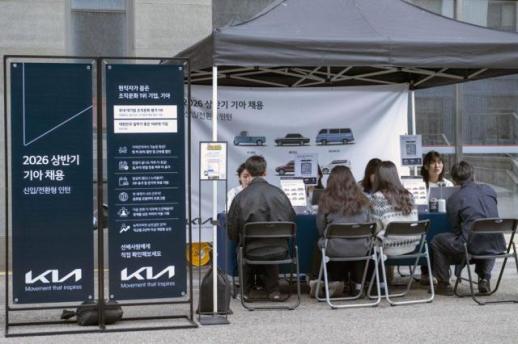 Kia launches massive recruitment drive SEOUL, April 1 (AJP) - Kia will hire a large number of new employees in the first half of this year, a rare move at a time when many companies are tightening their belts amid a prolonged economic slowdown, exacerbated by the ongoing conflict in the Middle East. The automaker said on Wednesday that the recruitment drive, which will hire both entry-level and experienced workers as well as interns across some 34 fields within the company, aims to expand opportunities for young talent amid a tough job market, while also strengthening its competitiveness in new business areas. It will accept applications by mid-April for entry-level positions, while experienced workers will have a few more weeks to apply until late April. To encourage more job seekers to apply, Kia is also holding an on-campus recruitment campaign at roughly a dozen universities through next week, highlighting its 80-year history and future vision and providing career mentoring from alumni employees. "We hope all talented individuals who will lead Kia's next 80 years will apply," a Kia spokesman said. 2026-04-01 14:20:31