

Journalist

Jinkyu, Myung
hisunny20@ajunews.com
-
 Pentagon Orders Withdrawal of About 5,000 U.S. Troops From Germany Within a Year The United States has decided to withdraw about 5,000 U.S. troops stationed in Germany, a move expected to be carried out over the next year as part of a broader review of force posture in Europe. According to Yonhap News Agency and other reports on May 2, the Donald Trump administration made the decision on May 1 local time to pull 5,000 troops from Germany. Sean Parnell, the Pentagon’s chief spokesperson, told Yonhap that Defense Secretary Pete Hegseth ordered the withdrawal of about 5,000 troops from Germany. Parnell said the decision followed a review of overall U.S. force posture in Europe and took into account theater requirements and local conditions. The withdrawal is expected to be completed within six to 12 months. About 36,436 U.S. troops are currently stationed in Germany; if the plan proceeds, the total would fall to about 31,000, a reduction of roughly 14%. Germany is the second-largest host of U.S. forces overseas after Japan. Yonhap reported that Germany is a key hub that hosts the headquarters of U.S. European Command and U.S. Africa Command and has played a central role in European security since World War II. About 28,500 U.S. troops are stationed in South Korea, the third-largest overseas presence after Germany and Japan. They are deployed around Camp Humphreys in Pyeongtaek and in Daegu, Gunsan and Osan. The U.S. Forces Korea presence is assessed as a core capability for deterring North Korea and as part of an Indo-Pacific strategy that includes countering China and Russia. The Pentagon told Yonhap it could not comment on any impact the Germany drawdown might have on U.S. forces in South Korea, citing potential posture adjustments. It added that U.S. Forces Korea remains focused on deterrence and readiness and that the U.S. commitment to South Korea’s defense is unchanged. * This article has been translated by AI. 2026-05-02 08:45:17
 -
 Holiday Weekend Day 2: Mostly Cloudy Nationwide; Rain Overnight in Seoul Area Saturday the nation was expected to be mostly cloudy, with rain starting overnight mainly in the Seoul metropolitan area and inland Gangwon Province. The Korea Meteorological Administration said very dry conditions would persist around Seoul as well as inland parts of the Chungcheong and North Gyeongsang regions. Rain was forecast to begin in some areas overnight Saturday and spread nationwide between daytime Sunday and Monday. Forecast rainfall totals were 5-30 millimeters for Seoul, Incheon and Gyeonggi; 10-40 mm for Gangwon; 10-40 mm for North Chungcheong; 5-30 mm for Daejeon, Sejong and South Chungcheong; and 10-40 mm for Gwangju, South Jeolla and North Jeolla. The South Jeolla coast and the Busan and South Gyeongsang south coast were expected to get 20-60 mm, while Ulsan and inland South Gyeongsang were forecast at 10-40 mm. Daegu, North Gyeongsang, Ulleungdo and Dokdo were forecast at 5-30 mm. Jeju Island was expected to see 30-80 mm of rain in all areas except the north. Morning lows were forecast at 8.4-13.3 C, with daytime highs of 19.7-24.8 C. Forecast highs included 22 C in Seoul, 20 C in Incheon, 22 C in Suwon, 23 C in Chuncheon, 23 C in Wonju, 22 C in Gangneung, 24 C in Cheongju, 23 C in Daejeon, 23 C in Jeonju, 23 C in Gwangju, 26 C in Daegu, 22 C in Busan, 26 C in Ulsan and 21 C in Jeju. Seas were forecast at 0.5-2.5 meters. In the Yellow Sea, waves were expected at 0.5-1.0 meters in nearshore and inner offshore waters and 0.5-1.5 meters farther offshore. The South Sea was forecast at 0.5-1.5 meters. In the East Sea, waves were expected at 0.5-1.5 meters nearshore, 0.5-2.0 meters in inner offshore waters and up to 2.5 meters farther offshore. Fine dust levels were forecast to be moderate nationwide.* This article has been translated by AI. 2026-05-02 08:21:18
 -
 LG Uplus to Retire 5.4 Million Treasury Shares in 80 Billion Won Cancellation LG Uplus said Wednesday it will cancel all about 5.4 million treasury shares it bought last year, as it moves to accelerate its “value-up plan” aimed at boosting shareholder value. In a regulatory filing, the company said it will cancel treasury stock worth about 80 billion won in book value on May 15. The cancellation covers all roughly 5.4 million shares acquired since last year, equal to 1.26% of total shares outstanding. LG Uplus previously canceled about 6.78 million shares, worth about 100 billion won in book value, on Aug. 5 last year. The company announced its value-up plan in November 2024, outlining mid- to long-term financial targets, steps to reach them and shareholder return policies. “This treasury share cancellation is part of our value-up plan to enhance shareholder value and strengthen investor trust,” a company official said. “Following last year, we are canceling previously acquired treasury shares again this year and carrying out our shareholder return policy without disruption.” * This article has been translated by AI. 2026-04-30 16:06:22
 -
 South Korea to Overhaul 2027 R&D Budget, Shift Funds to Strategic Technologies The government is moving to restructure funding for 2027 research and development, concentrating investment on national strategic technologies such as semiconductors, artificial intelligence, advanced bio and quantum technology. It also plans to streamline R&D spending across ministries by cutting discretionary outlays by about 15% and mandatory spending by about 10%. The Ministry of Science and ICT and the Office of Budget Planning said they held a budget strategy meeting on the afternoon of April 30 to discuss the “2027 R&D investment strategy.” The meeting was chaired by Park In-gyu, head of the Science and Technology Innovation Office at the ministry, and attended by more than 30 ministries and agencies that run R&D programs. Under the Framework Act on Science and Technology, the ministry’s Science and Technology Innovation Office draws up a plan each year to allocate and adjust the next year’s national R&D budget, after deliberation and approval by the National Science and Technology Advisory Council by the end of June. The budget office then compiles and considers the plan in drafting the final government budget proposal. The government said the 2027 allocation and adjustment plan will focus on: strengthening strategy through cross-government “one-team” cooperation; restructuring government R&D and reinvesting in priority areas; overhauling programs through broad evaluation and feedback; and introducing an equity-investment approach to R&D support to build a virtuous investment cycle. To improve efficiency and consistency, the government said it will reduce barriers between ministries and allocate R&D budgets from an integrated national perspective. It will also set shared goals and expand cooperation, including strengthening “inter-ministerial collaborative R&D.” It will also pursue spending restructuring for government R&D. More than 30 ministries and agencies will work on budget efficiency and spending adjustments, using benchmarks of 15% for discretionary spending and 10% for mandatory spending across fiscal programs. With resources secured through the restructuring, the government said it will reinvest in national strategic technologies in line with its “direction for advancing the national strategic technology system.” It previously selected 12 strategic technologies, including manufacturing and energy areas such as semiconductors, secondary batteries and hydrogen; mobility, aerospace and communications; and AI, bio and quantum. It also said it would foster the areas systematically by designating 50 detailed priority technologies. The government also plans to hold a “National Strategic Technology Leading Next Project Promotion Conference” (tentative name) in May to select target projects. It will also move to fix inefficient R&D programs. The innovation office said it will strengthen evaluation and inspections and reorganize programs around areas with higher potential to produce results. In addition, the government said it will newly pursue an equity-investment model for R&D support, shifting away from a grant-centered structure to one that can recover investments. Park said the 2027 R&D budget would be a “golden-time budget” to meet goals over the next four years. “We will thoroughly block waste factors and prepare a performance-centered budget that boldly invests in areas that are truly necessary,” he said, adding that the government would work as “one team” to drive technology-led growth. 2026-04-30 15:33:19
 -
 OneStore Unveils 'All-in-One' Platform Plan, Targets 2 Trillion Won in Transactions by 2030 South Korean app marketplace OneStore on April 30 laid out an “All in ONE Store” vision that combines downloading, payments and play on a single platform, as it moves to expand beyond a traditional app store. The company said it aims to reach 2 trillion won in transaction volume by 2030. OneStore unveiled its growth strategy for the next decade at a 10th anniversary press briefing at SKT’s T Tower in Seoul. CEO Park Tae-young said the past decade was about becoming a leading domestic app marketplace by cutting commissions, and the next phase will be about expanding the app store’s role. “We will open an era where downloading, payment and play happen on one platform,” he said. The company also introduced OneWebShop, a web-based direct-to-consumer (D2C) payment platform, and OnePlay Games, a service that lets users launch games instantly without installing them. OneStore said the additions are meant to offer developers and users more options and strengthen platform competitiveness. OneWebShop is a web-based D2C payment infrastructure offered directly by an app marketplace operator, reflecting OneStore’s experience in payments, settlement and customer support. OneStore said developers can adopt it without separate build development by using existing in-app payment integration standards. Fees, including payment gateway costs, are about 8%. About 40 products are preparing to join, and the service is scheduled for an official launch in late May. OnePlay Games allows users to run games immediately within the OneStore app without installing them. OneStore said it is working with Tencent to provide mini-game content, linking gameplay and item purchases through its login and payment infrastructure. The service is set for an official launch in May after a pilot period. OneStore said it will pursue a mid- to long-term growth strategy built around three pillars: its existing app marketplace, OneWebShop and OnePlay Games. The company said it aims to expand transaction volume and increase time spent on the platform while diversifying its growth model. It also set goals of reaching 2 trillion won in transaction volume by 2030 and providing developers with cumulative benefits of more than 1 trillion won. Park declined to commit to a renewed push for an initial public offering. “More important than when we do an IPO is how we are evaluated as a company,” he said. “An IPO is not the goal but one step in the growth process. For now, we will focus on growing the business based on OneWebShop and OnePlay.” * This article has been translated by AI. 2026-04-30 13:33:17
 -
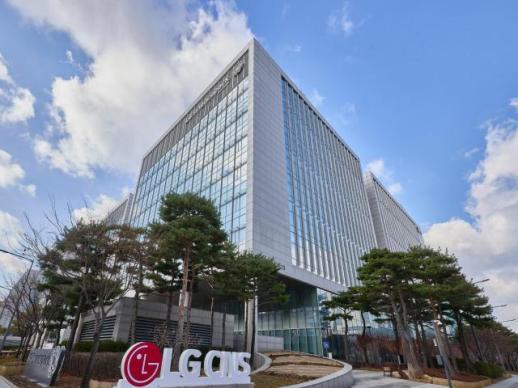 LG CNS Warns Data Center Supply Crunch Will Persist, Expands AI-Focused Business LG CNS said it is accelerating an AI-centered transformation across its businesses — including data centers, finance, manufacturing and digital assets — as it steps up efforts to expand in South Korea and overseas. On its first-quarter conference call on Wednesday, the company said the data center market will remain undersupplied as demand for AI and cloud services grows. It cited constraints on power supply and permitting, saying demand is likely to continue to outstrip supply. In finance, LG CNS said the cycle of rebuilding core systems is resuming and that customers increasingly view AI adoption as essential. It said it plans to strengthen its “AX” competitiveness by using AI technology as legacy systems are converted to Java-based platforms. For overseas growth, LG CNS said it is expanding around U.S. factory automation and the secondary battery sector, and will broaden its footprint through local partnerships and a global delivery system. According to South Korea’s Financial Supervisory Service electronic disclosure system, LG CNS posted first-quarter revenue of 1.315 trillion won and operating profit of 94.2 billion won. Revenue rose 8.6% from a year earlier and operating profit increased 19.4%. Q&A from the conference call What is the outlook for LG CNS’ data center business? -LG CNS said new investment is moving quickly in South Korea, mainly around sites with secured power infrastructure, but supply shortages persist as AI and cloud demand rises. It said power procurement and permitting limits are expected to keep the market in a demand-heavy structure for the time being. In overseas markets, especially Asia-Pacific, major cloud service providers are aggressively expanding data center investment to secure leadership in AI, it said. As GPU upgrade cycles shorten, the ability to rapidly build hyperscale data centers of more than 200 megawatts has emerged as a key competitive edge. It added that container-based modular data centers are spreading for high-density operations and AI optimization, with build times trending about 12 months shorter. What is the strategy for winning next-generation financial projects? -LG CNS said it is maintaining a leading market share by securing major references across finance, including commercial banks and internet-only banks, and has recently begun NH NongHyup Bank’s next-generation project. With core-system rebuilds resuming, it said customers are treating AI adoption as a must-have strategy, and the company is applying solutions co-developed with global advanced firms across project phases. It said it plans to use its AI technology to raise productivity and quality as C-language legacy systems are converted to Java, strengthening competitiveness in the AX market. What is the overseas market plan? -LG CNS said it expects to begin a food factory automation project in Texas in the second quarter and is expanding business with the group’s secondary battery manufacturers. It said it aims to secure price and quality competitiveness with its in-house “mobile shuttle” solution, build references among Korean companies expanding overseas, and then broaden to local customers. The company said it is hiring overseas staff and dispatching headquarters experts, while building cooperation with North American and Chinese systems integration firms. In finance, it said it is shifting from simple SI work to a solutions-centered model and is developing global delivery hubs such as Vietnam and Indonesia into centers of excellence. It also said it is expanding partnerships, including recruiting local experts in places such as Singapore and establishing a joint venture with Indonesia’s Sinar Mas Group. What is the outlook for manufacturing AX and data center profitability? -LG CNS said the manufacturing AX market is showing structural growth regardless of the business cycle, driven by global reshoring, an expansion of high-mix, low-volume production, and responses to ESG and carbon regulations. It said the market is evolving beyond basic automation toward AX·RX·VX models that combine AI, robotics and digital twins, with applications expanding to AI-based quality inspection, predictive maintenance and humanoids. For data center colocation, it said there is a “ramp-up” period between contract signing and customer equipment move-in, but surging AI demand has pushed utilization and ramp-up speed above initial expectations. What is the digital asset outlook and the Palantir cooperation plan? -LG CNS said a significant share of digital asset revenue in 2025–2026 is expected to come from bank-led CBDC projects. It added that starting in the second quarter, revenue tied to a national treasury subsidy project based on the “Project Hangang” platform will be reflected in earnest. It said stablecoins are still in a legal and institutional preparation phase, with consulting-focused work under way, and that it expects follow-on orders for build projects. It added that global research institutions forecast the related market will grow more than 30% annually on average. LG CNS said cooperation with Palantir is meaningful for expanding the domestic market and training talent. It said some LG Group affiliates have completed proofs of concept and moved to actual adoption, with further expansion under discussion. What is the strategy for physical AI and robotics? -LG CNS said it is pursuing physical AI-based robotics projects with group affiliates to drive innovation across the value chain, from production to R&D and logistics. It said North American plants are applying the mobile shuttle, and it is reviewing the use of humanoids for hazardous-material handling processes. It added that demonstrations are under way for logistics transport and dismantling work using autonomous mobile robots, as well as autonomous driving technology for tight spaces. The company said it is combining the group’s foundation model development capabilities with on-site operational know-how to build an industry-specific robot foundation model and advance robot-based automation.* This article has been translated by AI. 2026-04-30 11:43:56
 -
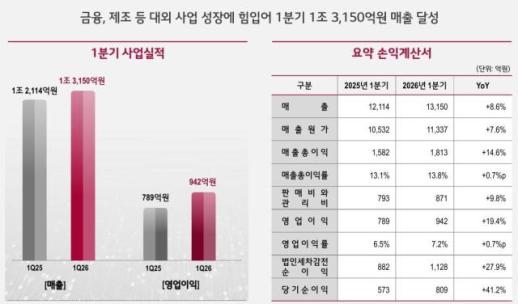 LG CNS Q1 Operating Profit Rises 19.4% to 94.2 Billion Won LG CNS said Thursday it posted broad first-quarter growth across its businesses, helped by expanding AI and cloud operations. The company said rising demand for AI transformation, along with growth in external projects, lifted both profitability and sales. LG CNS reported first-quarter revenue of 1.315 trillion won and operating profit of 94.2 billion won. Revenue rose 8.6% from a year earlier and operating profit increased 19.4%. Revenue from its AI and cloud business, a key growth driver, climbed 6.7% to 765.4 billion won, accounting for about 58% of total sales. The company said it expanded its AI transformation portfolio across industries including the public and defense sectors, finance, manufacturing, pharmaceuticals and biotech, shipbuilding and defense manufacturing. It also said it is expanding external business by providing agentic AI-based multi-agent services and has secured what it described as the largest number of AI transformation implementation cases in South Korea. LG CNS said it is also strengthening global partnerships, expanding cooperation beyond the three major global cloud providers to include OpenAI and Palantir as it targets the enterprise AI transformation market. It began supplying ChatGPT Enterprise in February and has secured about 10 corporate customers. With Palantir, it said dedicated teams are working together to identify high value-added AI transformation projects. In cloud, the company said it is boosting competitiveness through its data center design, build and operate (DBO) business. It said it won orders worth about 1 trillion won for the Samsong data center, reaffirming its position as a domestic DBO provider. It also introduced a modular AI data center that can be built within six months as it expands its infrastructure business. Revenue from its smart engineering business rose 10.4% to 227.8 billion won. The company said its smart logistics business grew on projects to build automated centers in beauty, food, fashion and defense manufacturing, and that it secured global references through its AI-based logistics optimization solution, “Mobile Shuttle.” Its smart factory business also maintained growth as projects won in defense manufacturing, shipbuilding, semiconductors and pharmaceuticals translated into revenue, the company said. It said its lightweight smart factory solution is spreading into new industries including food, medical, electronics and consumer goods, and that its agentic AI-based battery testing facility has received a positive market response. Revenue from digital business services increased 11.9% to 321.9 billion won. The company said performance was driven by next-generation system projects for major financial firms including NH NongHyup Bank, Mirae Asset Life Insurance and Shinhan Investment Corp. Looking ahead, LG CNS said it plans to expand into physical AI. It said it will pursue robot commercialization through a “full-stack RX (Robot Transformation)” service combining an industry-specific robot foundation model, hardware and a platform. It also said it has secured a broader robot lineup, including humanoids, through steps such as investing in U.S. robotics company Dexmate. The company is also expanding overseas business. It said it won an order in August last year for a hyperscale AI data center project in Jakarta worth about 100 billion won and is pushing to complete it by the end of 2026. The project is being carried out through “LG Sinar Mas,” a joint venture established with Indonesia’s Sinar Mas Group. LG CNS said it is stepping up efforts in Japan and the United States centered on enterprise solutions such as “PerfecTwin,” and is expanding its financial digital transformation business mainly across the Asia-Pacific region. 2026-04-30 10:48:19
 -
 South Korea Launches Broad AI Strategy to Upgrade Data, Manufacturing and Government South Korea’s Ministry of Science and ICT is moving ahead with a comprehensive strategy to respond to a sweeping shift driven by artificial intelligence, spanning data 확보, research and development, industrial deployment and global expansion. The government plans to invest more than 60 trillion won in national strategic technologies over the next five years and accelerate its push to become one of the world’s “top three AI powers” by expanding AI-based innovation across manufacturing, public administration and public safety, among other areas. Bae Kyung-hoon, deputy prime minister and minister of science and ICT, chaired the eighth meeting of ministers for science and technology relations at the Government Complex Seoul on Wednesday and discussed seven agenda items, including a draft plan titled “Data Policy Directions in the Era of the AI Transformation.” “AI is having a real impact on solving difficult scientific challenges and on people’s daily lives,” Bae said, adding that the government would expand global cooperation to advance AI-driven science and technology innovation, strengthen the ecosystem and promote responsible use. The meeting reviewed policy directions to energize the data ecosystem, a plan to support “manufacturing AX” based on tacit knowledge to bolster industrial competitiveness, and a rollout plan to expand an AI-based public work platform known as “OnAI.” In manufacturing, the government plans to turn skilled workers’ experience and know-how into data and apply it to AI models and robots. Through a 2026 supplementary budget, it will support building process-by-process datasets totaling 48 billion won and use them to expand manufacturing AI and robotics solutions. In government administration, the OnAI work-management platform will be expanded to about 40 central government ministries. With mobile services enabling access to work networks and collaboration regardless of location, the government expects more efficient decision-making in the public sector. The government also plans to strengthen drug interdiction capabilities using advanced technology, applying detection tools at airports, seaports and other sites and building cooperation among relevant ministries and research institutions to shift toward prevention-focused responses. Investment in national strategic technologies will also be increased, with more than 60 trillion won over five years to concentrate support on key R&D projects and speed results through designated specialized research institutes and expanded corporate support. The government will also step up AI-driven innovation in materials research. By 2030, it plans to develop AI models for materials, build autonomous experimentation centers and upgrade data infrastructure, aiming to shorten research timelines while developing new materials. A global expansion strategy will proceed in parallel. Existing overseas IT support centers will be converted into KAIN (Korea AI Innovation Network) to provide region-specific support in North America, Asia and the Middle East, among other areas, and help domestic AI companies expand overseas. The government said the strategy is intended to build an AI ecosystem that combines data, technology and talent and to secure global competitiveness.* This article has been translated by AI. 2026-04-30 10:08:48
 -
 LG’s EXAONE AI to Power Korea’s Safety Report System, Pilot Service Due This Year LG AI Research is accelerating the use of artificial intelligence in public safety services. LG AI Research said April 30 that it has completed the first phase of development of an “AI Safety Report System” based on its EXAONE model, in cooperation with the Korea Electronics Technology Institute (KETI), and will launch a pilot service within the year. The system is designed to analyze more than 39,000 safety reports filed each day and automate the full workflow — from intake to screening and classification, transfer to the responsible department, and sending a reply. The current Safety Report System uses some keyword-based automatic classification, but accuracy can drop when reports include typos or unclear wording. Reports with photos or videos are handled by staff who review the material and then route it to the relevant agency. LG AI Research said its vision-language model, EXAONE 4.5, addresses those limits by understanding and reasoning over visual information such as photos and videos to improve screening and classification. KETI plans to use the refined report text generated by EXAONE to further break down key categories, shorten transfer times for high-urgency cases and reduce administrative workload. For example, if a user uploads a photo of a clogged storm drain, EXAONE analyzes the image and automatically generates the report text. If the case is classified as high priority — such as a flood risk during the rainy season — it can be sent directly to the response department without intermediate steps, enabling faster action. The two organizations said that as more safety-report data accumulates, they expect to analyze patterns by time, region, type and frequency, and use the results to help develop policies that respond proactively to emerging safety risks. “Through cooperation with LG, we will be able to reduce the administrative burden and operating costs of public services and strengthen citizen safety,” KETI President Shin Hee-dong said. “We will create a model case of AI transformation that people can feel.” Lim Woo-hyung, co-head of LG AI Research, said, “By using EXAONE, we will improve both the speed and quality of safety administration and contribute to improving people’s quality of life.” Separately, LG AI Research said it is also developing “K-EXAONE” and is participating in the Ministry of Science and ICT’s “Independent AI Foundation Model (Dokpamo)” project. It said K-EXAONE earned the top technology score in the first evaluation and ranked first in contributions within the open-source ecosystem. 2026-04-30 10:04:40
 -
 YouTube launches AI-powered search feature for Premium users in the U.S. YouTube is rolling out a generative artificial intelligence search feature, accelerating its shift toward becoming a broader search platform and reshaping how users find information on the service. According to industry sources on the 29th, YouTube introduced an AI search tool called “Ask YouTube” for Premium subscribers ages 18 and older in the United States. The feature combines text and video in its results. When users type detailed questions — such as about travel itineraries or recipes — the AI first summarizes key points in text, then presents related videos and specific segments as clips in a step-by-step format. Unlike the previous approach of listing videos that match keywords, the tool puts an answer first and uses video to support it. That allows users to find needed information without scanning long videos. The move comes as information-seeking habits shift. According to CJ MezzoMedia’s “2026 Target Report,” released the same day, social media accounted for the largest share of information channels among people in their 20s. Among women, social media usage reached 62%. The share of information exposure through video channels was 44% for men and 41% for women, similar to or higher than portal-site search at 33% for men and 42% for women. YouTube’s influence is also evident in search behavior. Among people in their 20s, the share using YouTube to look up information was 47% for men and 39% for women. For men, YouTube ranked as a major channel after Naver at 52% and Google at 51%. Online video has become a central way people consume information. In internet activities among those in their 20s, “watching online video” was the top category at 67% for women and 52% for men. Average daily viewing time was about 1 hour and 50 minutes. Short-form video use reached 98%, and YouTube Shorts use was in the 80% range, the report said. Experts said the strategy reflects Google’s push to strengthen its position in search while maximizing the value of video content. Choi Byeong-ho, a research professor at Korea University’s Artificial Intelligence Research Institute, said the impact could be significant as learning, hobbies and even political activity increasingly center on YouTube. He said the shift could go beyond text-based search to enable video-driven connections such as extracting specific scenes, searching by people or style, and analyzing time-and-place context. He added that combining search AI with generative AI features could further increase users’ dependence on the platform.* This article has been translated by AI. 2026-04-30 00:04:39