
Journalist

Joonha Yoo, and Yoo Na-hyun
joonhayoo94@ajupress.com
-
 From K-Pop to K-Ink: Korea prepares to bring tattooing into the open SEOUL, May 15 (AJP) - Since a 1992 Supreme Court ruling effectively restricted tattoo procedures to medical professionals, South Korea’s tattoo industry has operated in a legal gray zone. Under the newly passed Tattooist Act, the country is now building its first national licensing and safety framework for non-medical tattoo practitioners. The law, overseen by the Ministry of Health and Welfare, passed the National Assembly on Sept. 25, 2025 and is scheduled to take effect two years after promulgation, with enforcement expected around September or October 2027. Despite the legal restrictions, tattoo culture and cosmetic tattoo procedures have expanded rapidly in South Korea alongside the rise of K-beauty and Korean cultural exports. Industry estimates suggest that around 350,000 people were engaged in tattoo-related work in Korea as of 2021, while the Korea Tattoo Association estimates the domestic tattoo market at roughly 1 trillion won, ($667 million). An anonymous tattoo artist said one of the biggest changes under the new system would be the ability to work more openly without fear of legal uncertainty. “For many tattoo artists, being able to work in our own studios without constantly worrying about legal risks is probably the biggest change,” the artist said. Under the new law, non-medical tattoo practitioners who pass a national licensing examination and obtain government certification will be permitted to legally perform tattoo procedures. The framework also introduces hygiene and safety requirements including sterilization standards, single-use needles, infectious waste disposal rules, mandatory safety education and liability insurance requirements for tattoo businesses. Tattoo studios will be required to register with local governments, while tattoo artists must maintain records related to procedures, pigments and side effects. Tattooing minors without parental consent and performing tattoo procedures outside registered workplaces will also be prohibited. The Ministry of Health and Welfare and tattoo-related organizations participated in a consultation meeting attended by more than 40 industry groups on Tuesday, officials discussed licensing examinations, hygiene standards, temporary business registration measures and safety management rules for tattoo facilities. “The purpose of the Tattooist Act is to allow non-medical tattoo practices while ensuring public health and hygiene management,” Vice Health Minister Kim Han-sook said during the meeting, according to the ministry. As the government prepares subordinate regulations for the new framework, industry groups are also moving to establish formal educational standards for tattoo practitioners. On Friday, the Korea Tattoo Association held a publication event in Seoul for three standardized tattoo textbooks covering advanced tattoo techniques, cosmetic tattoo procedures, hygiene management and safety practices. The association said it had officially submitted the books a day earlier to the health ministry, the Korea Health Personnel Licensing Examination Institute and the Ministry of Food and Drug Safety as reference materials for future licensing, regulatory and safety policies. The association described the publication effort as part of a broader push to move the industry away from informal apprenticeship-style training practices that had long dominated the sector amid the absence of official standards. “For a long time, the industry remained outside institutional systems,” Chairman of Korea Tattoo Association, Song Kang-seop said in a statement. “Submitting standards created by the industry itself to government authorities is, in a sense, the first step toward standing before the government with confidence.” 2026-05-15 15:34:37
 -
 KOSPI closes at record high, approaches 8,000 on AI rally SEOUL, May 14 (AJP) - South Korea's main KOSPI extended its record-setting climb to outshine regional and global peers as it moved closer to a new four-digit milestone. The benchmark index touched a high of 7,991.04 before settling at 7,981.41 Thursday, up 137.40 points, or 1.75 percent from the previous session. Retail investors bought 1.84 trillion won ($1.26 billion) worth of shares and institutions added 190.6 billion won, while foreign investors sold 2.14 trillion won. Samsung Electronics rose 4.23 percent to 296,000 won and briefly touched 299,500 won during the session, approaching the closely watched 300,000-won threshold. The rally followed a JP Morgan note reaffirming its buy rating on the stock despite ongoing labor disputes at Samsung’s chip operations. The bank said stronger memory pricing and the broader AI-driven semiconductor upcycle would likely outweigh near-term operational risks. SK hynix slipped 0.30 percent to 1,970,000 won after briefly hitting a record high of 1,994,000 won. The divergence between Samsung and SK hynix reflected a broader rotation within semiconductor shares, as investors shifted toward Samsung after SK hynix’s recent AI-driven rally. AI-related software and infrastructure shares also gained sharply. LG CNS surged 17.1 percent to 86,100 won after unveiling a new enterprise AI platform and a Korean-language large language model developed with Cohere. The company said internal testing showed competitive performance against leading global AI models. Elsewhere, LG Display gained 8.3 percent to 15,340 won on expectations of stronger demand for advanced display panels tied to AI devices, while Jeju Semiconductor jumped 28.4 percent to 75,600 won as speculative buying continued in smaller chip-related stocks. Airline shares also advanced. Korean Air rose 6.02 percent to 27,300 won as investors focused on the planned integration of Hanjin Group’s three low-cost carriers, Jin Air, Air Busan and Air Seoul, which analysts expect could reduce competition and improve profitability in Korea’s budget airline market. Construction shares moved higher on renewed momentum in Seoul’s redevelopment market. Daewoo E&C climbed 12.6 percent to 32,600 won after strong subscription demand and rising apartment prices in Seoul’s Seocho district boosted sentiment toward builders with major residential exposure. On the downside, shipbuilding and power equipment shares pulled back following recent gains. HD Hyundai Heavy Industries fell 8.5 percent to 671,000 won, while Doosan Enerbility slipped 2.4 percent to 117,100 won and Samsung Heavy Industries dropped 2.9 percent to 30,150 won as investors locked in profits after a sharp rally tied to defense and energy infrastructure themes. The junior KOSDAQ rose 1.20 percent to close at 1,191.09 after moving between 1,162.20 and 1,194.03 during the session. Retail investors bought 91.3 billion won worth of shares and institutions added 58.9 billion won, while foreign investors sold 135.4 billion won. Alteogen surged 8.76 percent to become the KOSDAQ market’s largest stock by capitalization, while EcoPro BM and EcoPro gained 6.04 percent and 5.41 percent, respectively. Elsewhere in Asia, Hong Kong’s Hang Seng Index rose 0.2 percent to 26,439.80, Japan’s Nikkei 225 fell 1.0 percent to 62,654.10, and China’s Shanghai Composite slipped 0.9 percent to 4,205.40. The rally in Seoul followed another strong session on Wall Street, where the S&P 500 rose 0.58 percent to a record 7,444.25 and the Nasdaq Composite climbed 1.20 percent to 26,402.34 as investors continued to bet that AI-driven earnings growth would offset inflation concerns. NVIDIA rose 2.3 percent overnight, while Micron Technology climbed 4.8 percent. The Korean won closed little changed at 1,491.00 per dollar, up 0.40 won from the previous session. 2026-05-14 17:53:16
 -
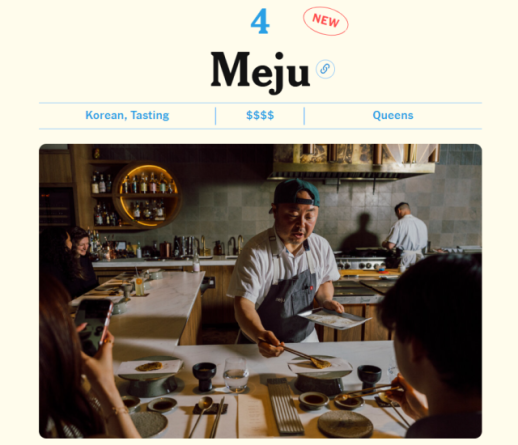 Seven Korean eateries join the NYT list of New York's 100 best restaurants for 2026 SEOUL, May 13 (AJP) - Seven Korean restaurants were included in The New York Times’ latest list of “The 100 Best Restaurants in New York City in 2026,” underscoring the growing influence of K-food and cuisine across New York’s cosmopolitan dining scene. The highest-ranked Korean restaurant was Meju, which placed fourth on the list. The restaurant, led by chef Hooni Kim, was praised for its fermentation-focused tasting menu hidden behind a banchan shop in Long Island City. The newspaper described fermentation as Kim’s central theme, calling it “the manipulations of time and how a dance with decay can change our understanding of what food can be.” It added that the chef “buildan arc with genuine suspense, which he does with a true believer’s fervor.” Coming in seventh was Atomix, the two-Michelin-star Korean fine dining restaurant run by chef Junghyun Park. The NYT described the restaurant’s tasting menu as “a series of meditations,” noting that each course is accompanied by an illustrated card explaining the chef’s thinking behind the dish. At No. 30 was Sunn’s, a restaurant known for elevating Korean banchan into the centerpiece of the dining experience. The paper noted that chef Sunny Lee’s small plates remain “stubbornly original,” blending Korean traditions with occasional French and Italian influences. Jungsik ranked 41st. The restaurant is widely credited with pioneering “New Korean” fine dining in New York and last year became the first Korean restaurant in the city to earn three Michelin stars. The NYT said the restaurant helped introduce New Yorkers to “a rarefied modern elaboration” of Korean cuisine. Korean barbecue restaurant Yoon Haeundae Galbi placed 46th, while tofu specialty restaurant Cho Dang Gol ranked 51st. Also included was Kisa at No. 79, a restaurant inspired by Korea’s working-class diner concept. The NYT described the establishment as a “gleefully un-sleek restaurant styled as a Korean blue-collar cabby spot.” 2026-05-13 13:21:36
 -
 NCT's Jaehyun sells out for his first fan concert after military discharge SEOUL, May 13 (AJP) - K-pop boy band NCT's Jaehyun sold out within minutes for both dates of his upcoming Seoul fan concert, which would be his first major solo event since completing mandatory military service, SM Entertainment said Wednesday. “JAEHYUN FAN-CON TOUR in SEOUL” will take place on June 6 and 7 at Jamsil Indoor Stadium. Tickets released through Melon Ticket on Monday and Tuesday were immediately snapped up after sales opened, according to SM Entertainment. The concerts will be Jaehyun’s first fan concert in about one year and eight months. His previous solo fan event, “2024 JAEHYUN FAN-CON,” held in October 2024 at Seoul’s Ticket Link Live Arena — also known as the Handball Gymnasium — likewise sold out all seats. This year’s concerts were upgraded to the larger Jamsil Indoor Stadium, underscoring rising demand as Jaehyun resumes entertainment activities following his military discharge. SM Entertainment said the new concert continues the storyline established in its predecessor, with “Mono” exploring themes of rediscovery and artistic identity following “Mute.” The performances are expected to include Jaehyun’s solo tracks, live stages and fan interaction segments. Jaehyun debuted with NCT in 2016 and later expanded into solo music activities while building a reputation as one of the group’s prominent vocalists. NCT is currently carrying out the large-scale anniversary project “NCT 10TH ANNIVERSARY ” to commemorate the 10th anniversary of the group’s debut. 2026-05-13 11:44:55
 -
 AI-related policy uncertainty sends KOSPI on rollercoaster ride SEOUL, May 12 (AJP) - South Korea's benchmark KOSPI suffered the sharpest decline among Asian markets on Tuesday, reversing sharply after briefly approaching the 8,000 threshold as foreign investors unloaded semiconductor shares amid growing uncertainty over the country's artificial intelligence (AI)-related policies. The index closed down 2.3 percent at 7,643.15 points after swinging between a high of 7,999.67 and a low of 7,421.71. Investor sentiment deteriorated rapidly after presidential policy chief Kim Yong-beom raised the idea of a so-called "national AI dividend," suggesting that excess tax revenue generated from an AI-driven semiconductor boom could eventually be redistributed through public programs. While Kim later clarified that he was not proposing a new windfall tax on corporations, the remarks heightened concerns over potential government intervention in corporate profits at a time when AI-linked semiconductor shares had already rallied sharply. Foreign investors dumped 5.61 trillion won ($3.77 billion) worth of KOSPI shares, as institutional investors sold 1.21 trillion won. Retail investors absorbed the selling pressure, purchasing 6.68 trillion won worth of stocks. Major chipmakers led the decline. Samsung Electronics fell 2.3 percent to 279,000 won, while SK hynix dropped 2.4 percent to 1,835,000 won as investors locked in profits following months of AI-driven gains. Battery and industrial names also came under pressure, with Samsung SDI plunging 8 percent, EcoPro BM falling 7.4 percent and Hanwha Ocean losing 6.5 percent. The sharp reversal came despite continued strength in global semiconductor sentiment after the Philadelphia Semiconductor Index rose 2.6 percent overnight. However, rising oil prices and growing geopolitical tensions surrounding Iran further weakened risk appetite across Seoul's equity market. WTI crude futures climbed 2.7 percent to $100.7 per barrel, while Brent crude rose 2.2 percent to $106.5 after U.S. President Donald Trump dismissed Iran's latest peace proposal and signaled that additional military options remained under review. The Volatility Index, jumped 8.9 percent to 18.7. The Korean won weakened sharply alongside the equity selloff and rising oil prices, falling 1 percent to 1,489.4 per dollar from the previous session as investors moved toward safe-haven assets. Within other parts of Asia, Japan led regional gains despite broader volatility. The Nikkei 225 rose 0.5 percent to close at 62,742.57, while the broader TOPIX also gained 0.8 percent as investors shrugged off hawkish signals from the Bank of Japan. SoftBank Group climbed 4.3 percent and Sony Group advanced 3.3 percent, although Fast Retailing fell 3.8 percent. Chinese markets were comparatively stable. China's Shanghai Composite rose 0.3 percent to 4,214.5, while Hong Kong's Hang Seng Index slipped 0.1 percent to 26,369.7. The tech-heavy KOSDAQ also closed lower, falling 2.3 percent to 1,179.30 after moving between an intraday high of 1,225.29 and a low of 1,142.49. Unlike the KOSPI, foreign investors were heavy buyers on the KOSDAQ, purchasing 509.5 billion won worth of shares. Institutions sold 260.0 billion won, as retail investors offloaded 220.1 billion won. Biotech shares showed relative resilience despite the broader weakness, with Alteogen rising 5.2 percent as investors rotated into defensive growth sectors. Robotics-related stocks also outperformed, with Cosmo Robotics surging 30 percent. Game developer Pearl Abyss slipped 1.1 percent despite reporting record quarterly earnings driven by strong global demand for "Crimson Desert," underscoring how broader market volatility overshadowed upbeat corporate results. 2026-05-12 17:51:03
 -
 Avignon Festival to spotlight Korean language and contemporary performing arts SEOUL, May 12 (AJP) - The Avignon Festival, one of the world’s leading performing arts festivals, will spotlight the Korean language and contemporary Korean productions during its 80th edition in July, marking the first time an Asian language has been selected as the festival’s official invited language. The Korean-language spotlight program coincides with the 140th anniversary of diplomatic relations between South Korea and France, highlighting the growing cultural exchange between the two countries beyond the global popularity of K-pop, film, and television dramas. Held annually in the southern French city of Avignon, the festival runs from July 4 to 25 and is regarded as one of Europe’s most influential theater and live performance events. Founded in 1947 by French actor and director Jean Vilar, the festival is known for presenting contemporary and experimental productions in historical venues across the city. This year’s program also marks the first time the festival has centered on a single national language as part of its invited language initiative, which highlights the arts and culture of a selected linguistic community each year. English, Spanish, and Arabic were previously featured in 2023, 2024, and 2025, respectively. A total of nine Korean productions will be presented in the festival’s official "In" program, the main section featuring curator-selected works staged across the festival’s principal venues. Among the featured productions is "Oiseau," a staged reading based on Nobel Prize-winning author Han Kang’s novel "We Do Not Part." The performance will take place at the Cour d’Honneur of the Palais des Papes, the festival’s signature venue, and will star French actress Isabelle Huppert alongside Korean actress Lee Hye-young. Other Korean works include playwright and director Jaha Koo’s "Cuckoo," "Haribo Kimchi" and "The History of Korean Western Theatre." Additional productions explore themes ranging from Jeju Island’s haenyeo culture and the Jeju April 3 uprising to the climate crisis and contemporary Korean identity. They include “MULJIL,” "Island Story," "1 Degree Celsius," "KIN: Yeonhee Project I" and "Snow, Snow, Snow." The lineup reflects the expanding global reach of contemporary Korean performing arts as Korean-language productions continue to gain visibility on major international stages. 2026-05-12 13:59:29
 -
 Annual Cannes Film Festival opens with South Korean cinema in spotlight SEOUL, May 12 (AJP) - This year's Cannes Film Festival kicked off its 11-day run in the southern French city on Tuesday, with South Korean films among the highlights. Widely regarded as one of the world's most prestigious film festivals, alongside those in Berlin and Venice, the festival, now in its 79th year, is known for recognizing auteur-driven, bold, and artistic films. Its top prize, the Palme d'Or, also known as Golden Palm, is considered one of the highest honors in global cinema and has often propelled filmmakers and films to international prominence. This year's festival notably features an impressive South Korean lineup across multiple sections, led by director Na Hong-jin's sci-fi thriller "Hope," which was invited to the main competition, marking the first time in four years that a South Korean film has competed for the top honor. Set in a demilitarized border village where unidentified objects suddenly appear, "Hope" is scheduled to make its world premiere on Sunday at the Grand Théâtre Lumière, the festival's main screening venue. The 160-minute film stars veteran actor Hwang Jung-min, along with Zo In-sung and Jung Ho-yeon. The cast also includes Hollywood stars such as Alicia Vikander, Michael Fassbender and Taylor Russell. About 22 films will compete for the Palme d'Or, with works by acclaimed directors including Cristian Mungiu, Hirokazu Kore-eda, and Pedro Almodóvar seen as strong contenders. Among the highlights, award-winning filmmaker Park Chan-wook, best known internationally for "Oldboy" (2003) and "Decision to Leave" (2022), is serving as jury president, becoming the first South Korean to hold the role. Director Yeon Sang-ho, famous for his zombie thriller "Train to Busan" (2016) returns with his new film "Colony," which has been invited to the Midnight Screenings section, dedicated mainly to genre films such as horror and thrillers. The film tells the story of survivors trapped inside a quarantined building amid the outbreak of a mysterious virus. Director July Jung, who attracted attention with dramas "A Girl at My Door" (2014) and "Next Sohee" (2022), was also invited with her new film "Dora," which will be screened in a section dedicated to independent and emerging cinema. The festival runs until May 23, when the Palme d'Or and other major awards will be announced at the closing ceremony. 2026-05-12 11:16:36
 -
 K-pop girl band ITZY to return with 10th mini album 'Motto' on May 18 SEOUL, May 11 (AJP) - K-pop girl band ITZY will return on May 18 with its 10th mini album "Motto," marking the group’s first release in six months following "TUNNEL VISION," JYP Entertainment said Monday. Debuting on Feb. 12, 2019, with "Dalla Dalla," the five-member band quickly emerged as the K-pop super rookie after the music video for its title song surpassed 14 million views within 24 hours and reached 100 million views in 57 days, setting records for a debut release at the time. The group also earned one of the fastest music show wins for a rookie girl group, helping establish ITZY as one of the leading new K-pop acts of its generation. Motto will include eight various tracks, featuring the title song alongside B-sides such as "Glitch" and "you And I." The album will also include solo tracks by the members, some of which were previously performed during the group’s "TUNNEL VISION" world tour. Ahead of the comeback, ITZY released teaser clips previewing all tracks from the album through its official social media channels. ITZY will hold a livestream countdown event at 5 p.m. on the day of the release before the album becomes available an hour later. The band is scheduled to release the album at 6 p.m. (0900 GMT) through major streaming platforms. 2026-05-11 18:03:28
 -
 AI infrastructure rally lifts KOSPI to another record SEOUL, May 11 (AJP) - South Korea’s benchmark KOSPI outperformed regional and global peers Monday, surging more than 4 percent to another record high as investors piled into semiconductor and AI infrastructure-related shares despite escalating geopolitical tensions in the Middle East and heavy foreign selling. The benchmark KOSPI closed up 4.3 percent at 7,822.24 after moving between a low of 7,713.49 and a record intraday high of 7,899.30. The rally contrasted with a 0.5 percent decline in Japan’s Nikkei 225, while China’s Shanghai Composite rose 1.03 percent and Hong Kong’s Hang Seng Index traded little changed. Market momentum remained heavily concentrated in semiconductors and AI-linked infrastructure plays. Samsung Electronics jumped 6.3 percent to 285,500 won, while SK hynix soared 11.5 percent to 1,880,000 won ($1,278) as investor appetite for high-bandwidth memory and AI server demand continued to intensify. Investor enthusiasm also spread to AI infrastructure and networking-related names. Optical communication stocks gained 7.6 percent and communication equipment shares climbed 5.9 percent. Among the biggest gainers, Daehan Optical Communication surged 25.1 percent to 27,950 won as expectations grew for a structural increase in global fiber-optic demand tied to AI data center expansion. The company recently completed the acquisition of a 90 percent stake in U.S.-based Encap America, strengthening its foothold in North American power and optical infrastructure markets. Equipment maker Jusung Engineering climbed 17.9 percent to 163,800 won, while SK Square rose 8.1 percent to 1,187,000 won on continued optimism over AI-related portfolio revaluation. Shipbuilding shares also traded firmly after Seoul and Washington moved to deepen bilateral cooperation in the U.S. shipbuilding sector. Samsung Heavy Industries advanced 6.3 percent to 33,950 won after the Korean government said it would establish a Korea-U.S. shipbuilding partnership center in Washington as part of broader industrial cooperation initiatives tied to the so-called MASGA project. Despite the strong rally, foreign investors remained aggressive sellers, unloading 3.48 trillion won ($2.37 billion) worth of KOSPI shares. Retail investors poured in 2.87 trillion won, while institutions bought a net 619.2 billion won worth of shares. Market volatility briefly intensified during early trading, prompting the Korea Exchange to trigger a buy-side sidecar on the KOSPI market at 9:29 a.m. after KOSPI200 futures surged more than 5 percent. In contrast, the tech-heavy KOSDAQ underperformed the main board and ended nearly flat, slipping 0.03 percent to 1,207.3 after moving between 1,190.6 and 1,212.9 during the session. Foreign investors bought a net 116.0 billion won worth of KOSDAQ shares, while retail investors added 85.1 billion won. Institutions, however, sold a net 163.6 billion won, limiting broader upside momentum. Speculative momentum remained concentrated in newly listed and AI infrastructure-related shares. Cosmo Robotics closed at 24,000 won, quadrupling its IPO price of 6,000 won on its KOSDAQ debut. The wearable robotics company drew strong retail demand during last month’s subscription process, which recorded a competition ratio exceeding 1,114.1 to 1. Battery-related shares remained weak despite the broader rally, with EcoPro BM falling 6.5 percent to 222,000 won. Meanwhile, oil prices rebounded sharply as geopolitical tensions in the Middle East escalated. Brent crude futures climbed 3.4 percent to $104.8 per barrel, while West Texas Intermediate crude rose 3.6 percent to $98.9 after U.S. President Donald Trump rejected Iran’s latest response to a U.S. peace proposal and reports emerged of renewed drone attacks near the Persian Gulf. Despite rising oil prices and renewed concerns surrounding the Strait of Hormuz, Korean equities remained largely fixated on AI-driven growth expectations. The Korean won weakened slightly to 1,471.4 per dollar, while the Volatility Index, widely known as Wall Street’s fear gauge, rose 0.6 percent to 17.19. 2026-05-11 17:58:03
 -
 K-pop band NCT to launch 10th anniversary pop-up in Seoul SEOUL, May 11 (AJP) -K-pop band NCT will open a large-scale pop-up event in Seoul starting Friday as part of the group’s 10th anniversary project, SM Entertainment said Monday. The event, titled "NCT 10TH Anniversary pop up : Neo Ground," will run from May 15 to 23 at Pi Factory in Seoul’s Gwangjin District, a district well-known as a hipster area frequented by tourists from around the world. Debuting in 2016, NCT has expanded into multiple sub-units including NCT 127, NCT Dream, WayV and NCT Wish, building one of K-pop’s largest multi-unit group brands with activities spanning global tours, album releases, and fan-focused content. According to SM Entertainment, the pop-up space will be themed around a futuristic sports concept and feature exhibitions, interactive programs, photo zones, and exclusive merchandise tied to NCT’s 10th anniversary campaign. Fans participating in on-site missions will also be eligible to receive commemorative items during the event. Both online pre-reservations and on-site registration will be available, while designated time slots from noon to 1:00 p.m. (0400 GMT) will be reserved for official fan club members of NCT’s various units. The pop-up is part of NCT’s broader "NCT 10TH Anniversary " project, which has been launched under the slogan "Everything, All at Once, Neo." 2026-05-11 17:53:18