
Journalist

AJU PRESS Visuals Team
jungu141298@ajupress.com
-
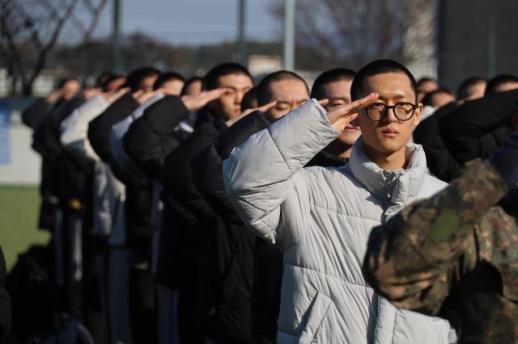 Army's Nonsan training camp welcomes first recruits of 2026 SEOUL, January 06 (AJP) - Korea's biggest Army training center in Nonsan, South Chungcheong Province, officially commenced its 2026 operations on Monday with the year’s first enlistment ceremony. Approximately 1,760 new recruits took part in the proceedings, joined by thousands of family members and friends. As the primary gateway for military service, the Nonsan facility handles approximately 60 percent of all Army enlistees. Following this inaugural intake, the center expects to process and train an estimated 120,000 troops throughout this year. The recruits are scheduled to undergo six weeks of intensive basic combat training. Upon completion of the program, they will be assigned to their permanent units starting next month to fulfill their mandatory military service. 2026-01-06 17:41:06
 -
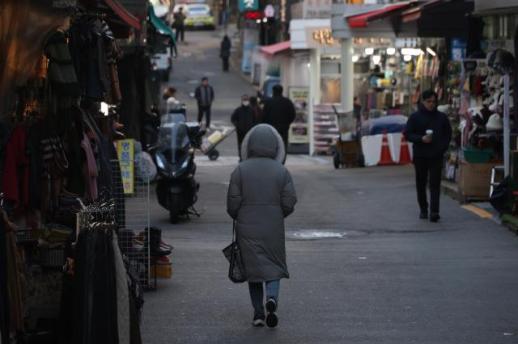 Fresh cold spell grips Seoul SEOUL, January 6 (AJP) - A fresh cold spell returned to Seoul on Tuesday, with a morning low of -6 degrees Celsius, much colder than the previous day's -1 degrees. The mercury barely rose, with daytime temperatures climbing to just 4 degrees as frigid conditions persisted throughout the day. Other cities across the country also faced frigid temperatures, with Chuncheon at -10 degrees, Cheongju at -8 degrees, Daejeon at -7 degrees, and the southern port city of Busan at -2 degrees. 2026-01-06 16:29:00
 -
 PHOTOS:Brushstrokes of heritage: A mother-daughter duo redefine tradition in Bukchon SEOUL, January 05 (AJP) - Tucked away in the winding alleys of Gahoe-dong, the Bukchon Hanok Office serves as a serene sanctuary from the city's modern pulse. In late 2025, this traditional space — operated by the Seoul Metropolitan Government — offered more than just a glimpse of historic architecture; it became the stage for a deeply personal convergence of art and lineage. The exhibition, titled "Yeon: A Mother-Daughter Story Connected by Brush," brought together calligrapher Baek Kyung-ja (known by her art name, Yesol) and her daughter, dancheong (traditional decorative coloring) artist Lee Eun-young. The show’s origin is as heartwarming as the art itself. When Lee suggested her mother hold a solo exhibition, Baek initially declined. The impasse was broken by Lee’s simple, spirited invitation: "Mom, then let's do it together!" Stepping through the sarangchae (guest quarters) and main house, visitors were greeted by a dialogue between generations. Baek, a veteran artist with over 40 years of experience in Korean calligraphy and folk painting, displayed works that radiated the profound weight and refinement of a life dedicated to the brush. Beside her, Lee — who transitioned from fashion design to training under a National Intangible Cultural Heritage master — presented dancheong pieces that felt strikingly modern in their composition and interpretation. As natural light filtered through the hanji (traditional paper) windows, it illuminated the vibrant pigments and deep ink tones of the artworks. Walking through the wooden-floored rooms, the concept of "yeon" — the Korean word for a karmic connection or bond — felt palpable. For those wandering the historic slopes of Bukchon, this modest yet soulful exhibition offered a rare moment where traditional and contemporary artistry harmoniously intertwined, proving that the strongest threads of heritage are often those shared between a mother and her daughter. 2026-01-05 17:18:43
 -
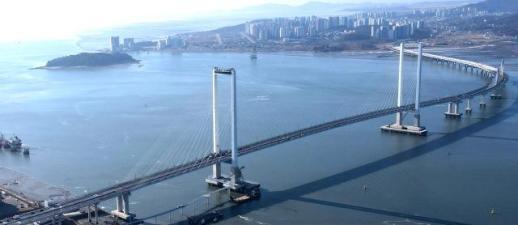 Incheon's third sea bridge opens with world's highest bridge observatory SEOUL, January 05 (AJP) - Incheon's Third Sea Bridge, connecting Yeongjong Island—home to Incheon International Airport—to the mainland, opened at 2 p.m. on January 5. The new crossing is expected to cut travel time from Gangnam in southern Seoul to the airport to about 45 minutes. The 4.68-kilometer-long, 30-meter-wide bridge features six lanes for traffic, plus 3.5-4-meter-wide bicycle paths and pedestrian walkways on both sides. Linking Jungsan-dong in Jung-gu to Cheongna International City in Seo-gu, the bridge is the third sea-crossing structure connecting Yeongjong Island to the mainland. Tolls will be collected starting January 15 after a 10-day trial period of the "smart tolling" (non-stop electronic toll collection) system. Fees are set at 2,000 won for passenger cars, 3,400 won for medium vehicles, and 4,400 won for large vehicles. The bridge's main tower observatory, standing 184.2 meters above sea level, has been certified by Guinness World Records and the World Record Certification (WRC) as the world's highest sea bridge observatory. The observation deck is scheduled to open in March-April 2025. 2026-01-05 17:06:14
 -
 Gangnam Media winter festa illuminates Seoul streets SEOUL, December 31 (AJP) - The "2025 Gangnam Media Winter Festa" opened on December 19 in the G20 Square and K-POP Square near exits 5 and 6 of Samseong Station in Gangnam District, Seoul. Gangnam District describes the event as "an urban festival combining spectacular media technology with warm winter sentiments." The festival features immersive media shows utilizing 17 large LED displays across seven locations in four buildings, incorporating light, sound, and interactive elements. The festival runs for 16 days through January 3, 2026. 2025-12-31 17:45:12
 -
 Public bike stations close ahead of New Year's Eve bell-ringing ceremony SEOUL, December 30 (AJP) - The Seoul Metropolitan Government will temporarily close 16 public bike rental stations near Bosingak Pavilion from 7 p.m. on December 30 to 8 a.m. on January 1 in preparation for large crowds expected at the New Year's Eve bell-ringing ceremony. The measure aims to ensure public safety and prevent accidents as thousands gather for the traditional event. The bell-ringing ceremony, held at midnight on January 1, marks the end of the year and welcomes the new year with 33 strikes of the Bosingak bell. 2025-12-30 17:55:25
 -
 Avatar 3 maintains box office lead for 13th consecutive day SEOUL, December 30 (AJP) - "Avatar: Fire and Ash" continued its box office dominance for the 13th straight day, showing strong momentum in its third week of release. According to the Korean Film Council's integrated computer network on December 30, the film attracted 139,110 viewers on December 29 alone, bringing its total audience to 4.175 million. Directed by James Cameron and released in South Korea on December 17 ahead of its global premiere, the film topped the box office from day one. Notably, "Avatar: Fire and Ash" surpassed the 4 million viewer mark in just 10 days, breaking the record previously held by "Zootopia 2" (13 days) for the fastest film to reach this milestone among 2025 releases. With robust advance ticket sales continuing into its third week, the film signals strong prospects for a long theatrical run. 2025-12-30 15:23:46
 -
 Job security demands shadow S. Korean president's return to Blue House SEOUL, December 29 (AJP) - As South Korean President Lee Jae Myung officially commenced duties at Cheong Wa Dae, the celebratory atmosphere was met with immediate domestic pressure as non-regular presidential staff launched a labor protest through the heart of the capital. On Monday morning, members of the Seoul Regional Public Services Branch — a chapter under the powerful Korean Confederation of Trade Unions — convened at Gwanghwamun Square to demand permanent job security guarantees from the incoming administration. Following a press conference, union members began a traditional form of protest involving full-body bows every few steps — traveling from Gwanghwamun Square toward the presidential office. The demonstration highlights a growing rift between the administration’s symbolic return to the historic "Blue House" and the precarious status of the personnel who maintain it. The protesters represent a segment of "non-regular" workers — contractors and temporary staff — who handle essential services within the presidential complex. The march serves as an early litmus test for the Lee Jae Myung administration’s labor policy. During the presidential campaign, Lee emphasized social equity, yet the union claims the current lack of an official employment roadmap contradicts those promises. 2025-12-29 15:31:07
 -
 PHOTOS: Seoul Illustration Fair highlights growing 'character culture' SEOUL, December 29 (AJP) - South Korea’s premier celebration of visual storytelling, the Seoul Illustration Fair, concluded its 11th-anniversary edition on Sunday, drawing tens of thousands to the COEX convention center in Gangnam. The four-day event, which ran from Dec. 25 to 28, featured over 900 artists and more than 1,000 booths. This year’s iteration saw a significant global presence, with approximately 50 international teams joining a diverse roster of domestic creators. As South Korea’s largest illustration event, the fair lived up to its reputation for high demand. Long queues formed hours before the doors opened each morning, with average wait times exceeding 60 minutes during the weekend peak. The exhibition floor was dominated by the "character culture" that has become a staple of South Korean digital communication. Driven by the mainstream popularity of mobile emoticons, over half of the displays featured animal-themed characters and whimsical graphic styles. However, the fair also maintained space for traditional fine arts, showcasing dreamy watercolors and avant-garde conceptual works. Merchandise sales were brisk, with popular artists reporting "sell-outs" of plush toys, keychains, and stationery within the first day. This year’s theme, "Recording is Existence," served as the finale to an annual trilogy of exhibitions. The theme pavilion focused on the visualization of memory and emotion, offering a more introspective contrast to the high-energy marketplace. 2025-12-29 15:14:29
 -
 Homeless left outdoors in Seoul's deep freeze SEOUL, December 26 (AJP) -A bitter cold settled over Seoul as temperatures fell below zero, pushing the wind chill near minus 17.6 degrees Celsius (0.3 degrees Fahrenheit). Beneath Seoul Station, some homeless people lay on the floor wrapped in cardboard and thin sleeping bags, sheltering under fluorescent lights that never go out. Outside, they huddle inside fragile tents as Arctic air cuts through. The city issued its first freeze warning of the winter and activated round-the-clock monitoring, as forecasters said the cold wave would persist through the weekend. As trains came and went above ground, winter tightened its hold — quiet, relentless, and unevenly felt. 2025-12-26 14:04:50