


Latest by
-
 Hyundai Motor Group Expands Future Air Mobility Efforts with KAI Partnership Hyundai Motor Group is taking aggressive steps to enhance its competitiveness in the future air mobility (AAM) sector by establishing a joint venture with Korea Aerospace Industries (KAI) and significantly increasing recruitment in related fields. This move is seen as a commitment to developing air mobility as a new growth area following humanoid robots. According to industry sources on June 24, Hyundai is discussing plans to establish a joint venture with KAI within the year to strengthen its air mobility business, which it has identified as a key future growth area. The joint venture is a follow-up to the memorandum of understanding (MOU) signed last month for collaborative development of future air mobility vehicles. Both companies agree that higher-level cooperation is necessary to address challenges in technology and human resource sharing, supply chain and parts ecosystems, mass production systems, and expanding global safety certifications. Currently, Hyundai and KAI are jointly developing a five-passenger air taxi. Hyundai aims to develop powertrains and commercialize AAM, while KAI will focus on aircraft design, with the goal of obtaining certification from the Federal Aviation Administration (FAA) and launching in the U.S. market first. A company official stated, "The timing for the joint venture's launch has not been finalized, but there is consensus on the need to enhance the level of cooperation," adding that discussions on various collaboration methods, including the joint venture, are ongoing. Hyundai has also been proactive in recruiting talent in the aviation sector. Recently, it appointed Farhan Gandhi, an authority in vertical takeoff and landing aerodynamics, as the Chief Technology Officer (CTO) of Supernal, accelerating its competitiveness. Gandhi has spent the last 30 years researching rotorcraft and is recognized as an expert in future air mobility. The company is also beginning to hire experienced professionals with master's or doctoral degrees for roles in five areas, including motors for vertical takeoff aircraft, drive control software, battery charging systems, inverter design, and thermal flow analysis for aviation electrification powertrains. The hiring is expected to be in the double digits. The global automotive industry is in fierce competition to dominate the urban air mobility market. Wang Dan, Vice President of Xiaopeng Aero, mentioned plans for flying car sales in the Middle East at the Future Mobility Expo held in Daegu last October. Xiaopeng aims to begin initial deliveries of flying cars by the end of this year and ramp up mass production by 2027. Japanese automakers Toyota and Honda are also investing in future air mobility or developing their own electric vertical takeoff and landing (eVTOL) aircraft. Industry experts predict that the air mobility market will open around 2030. Hyundai has identified humanoid robots for commercialization by 2028 and future air mobility as a key growth area by 2030. Market research firm MarketsandMarkets forecasts that the global urban air mobility market will grow to approximately $23.5 billion by 2030. A Hyundai official stated, "We believe that the era of future air mobility will begin after robotics is fully commercialized, with a significant possibility that the full-scale launch will occur after 2035." 2026-06-24 17:20:00
 -
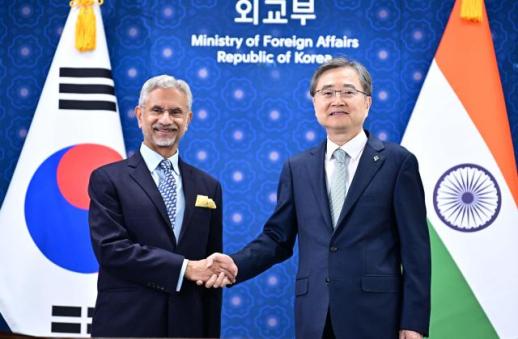 South Korea and India Discuss Middle East Situation and Supply Chain Issues South Korean Foreign Minister Park Jin met with Indian Foreign Minister Subrahmanyam Jaishankar on June 24 at the Ministry of Foreign Affairs in Seoul to discuss key bilateral issues and regional and international developments. According to the Ministry of Foreign Affairs, Park welcomed Jaishankar, who was visiting South Korea for the first time in two years, and noted that both governments have been successfully implementing various economic, social, and cultural initiatives since Indian President Jae-myung Lee's state visit to India in April. Jaishankar expressed his desire to strengthen the special strategic partnership between the two countries, building on the friendship established during Park's tenure as South Korea's ambassador to India, and emphasized the importance of effectively following up on the outcomes of the recent summit. Park highlighted the ongoing 'Korea Week' event organized by the Indian Prime Minister's Office as a significant achievement in implementing the summit's follow-up actions and provided details about the 'Korea-India Practical Cooperation Team' launched by the Ministry of Foreign Affairs in April. The two ministers shared assessments of the situation in the Middle East and supply chain issues, exchanging views on these topics. They agreed on the importance of the swift and safe reopening of the Strait of Hormuz and the free and secure navigation of all vessels, recognizing that these factors are crucial for security and economic stability. Both sides committed to maintaining close communication and continuing to participate in international efforts to address these challenges. Park also discussed the government's efforts for peaceful coexistence on the Korean Peninsula and expressed hope for India's constructive role in maintaining diplomatic communication with North Korea to foster an environment conducive to peace. Jaishankar is scheduled to attend the Jeju Forum for Peace and Security alongside Park in Jeju Island.* This article has been translated by AI. 2026-06-24 17:12:00
 -
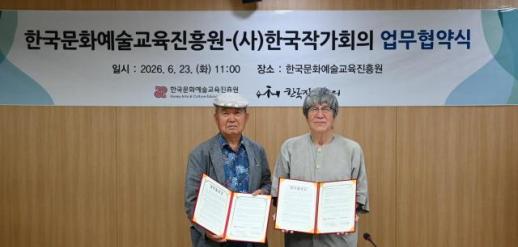 Youth Documenting Seniors' Lives: Partnership Between Arts Institute and Writers Association A new initiative will see young writers documenting the lives of local seniors through a project called "Intergenerational Memoir Writing." The aim is to preserve the life experiences of the elderly while fostering communication between generations. The Korea Arts and Culture Education Institute and the Korean Writers Association signed a memorandum of understanding (MOU) on June 23 to expand intergenerational exchange and promote practical human values. This agreement seeks to enhance communication and empathy between the youth and elderly by facilitating exchanges based on human values. This year, the two organizations plan to implement the "2026 Intergenerational Memoir Writing" project, where young writers will meet with seniors to write memoirs based on their oral histories. As South Korea enters a super-aged society, this initiative is expected to spread practical human values through intergenerational interaction. The Korean Writers Association, established to promote Korean literature, has built a robust network of local writers through its 13 branches and 15 chapters nationwide. It has continuously worked to enhance the rights of writers and elevate the status of Korean literature. Through this MOU, the Korean Writers Association plans to leverage its network of local writers and literary expertise alongside the planning and operational capabilities of the Arts Institute to establish a sustainable cooperative framework aimed at spreading human values. Kang Hyung-cheol, chairman of the Korean Writers Association, stated, "Writing is the best medium for communication, and the interaction between youth and seniors could provide a breakthrough for our society's challenges. I hope this opportunity fosters a social consensus on the dissemination of human values through literature." Im Jin-taek, head of the Korea Arts and Culture Education Institute, expressed hope that the collaboration will create meaningful projects connecting generations through the exchange of long-accumulated policy planning capabilities and literary expertise.* This article has been translated by AI. 2026-06-24 17:12:00
 -
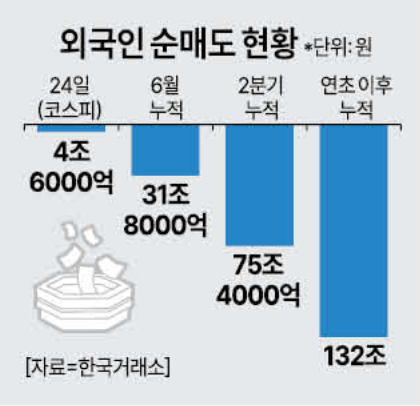 Foreign Investors Sell 71 Trillion Won as National Pension Fund Prepares for 60 Trillion Won Rebalancing This year, foreign investors have sold more than 130 trillion won in the South Korean stock market. The selling is attributed to a rapid rise in the Korean market, prompting global funds to engage in rebalancing. Analysts predict that the National Pension Fund's rebalancing could reach up to 60 trillion won starting in July. This foreign and institutional rebalancing is seen as a significant factor that could shake the stock market.According to the Korea Exchange, foreign investors net sold 4.6 trillion won on the KOSPI market on this day. In the second quarter (April to June), they sold approximately 75.4 trillion won in the securities market, and they have net sold 31.8 trillion won so far this month. The cumulative net selling for the year has reached 132 trillion won. Analysts attribute this to mechanical rebalancing by global funds in response to the surge in the Korean stock market.Meanwhile, a large-scale rebalancing by the National Pension Fund is also anticipated. Concerns are growing that if the National Pension Fund, which has been filling the gap left by foreign investors, also engages in rebalancing, it could significantly disrupt the supply and demand environment in the domestic stock market in the second half of the year.The National Pension Fund's rebalancing is expected to begin next month, as the recent surge in the stock market has pushed its domestic equity holdings well above target levels. As of the end of March, the National Pension Fund's domestic stock holdings were valued at 321 trillion won, accounting for 21% of its total assets of 1,526 trillion won. Following the KOSPI's surge to around 8,500 at the end of May, this proportion increased to approximately 29%. It is estimated that as of June 19, when the KOSPI surpassed 9,000, the domestic equity proportion rose to 31.4%.Consequently, there are forecasts that the National Pension Fund may need to sell up to 60 trillion won to align with its target allocation. In fact, the National Pension Fund has already net sold about 2.3 trillion won this month, leading some in the securities industry to interpret this as a preliminary adjustment ahead of the full rebalancing. However, some analysts suggest that the rebalancing may be executed in a manner that minimizes market shocks, indicating that the actual impact may be less severe than market fears suggest.* This article has been translated by AI. 2026-06-24 17:08:00
 -
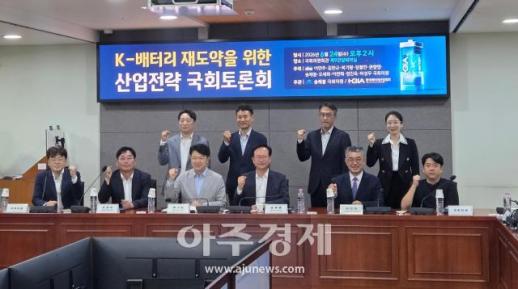 K-Battery Industry Faces Challenges, Calls for Comprehensive Government Support As demand for electric vehicles slows and oversupply from China raises concerns, the K-battery industry is facing significant challenges. A forum titled 'National Assembly Forum on Industrial Strategy for K-Battery Revitalization' was held at the National Assembly. On June 24, the forum, organized by the Korea Battery Industry Association and Democratic Party lawmaker Song Jae-bong, featured participation from numerous secondary battery companies. They discussed tax improvement measures, including direct refunds for investment tax credits and incentives for domestic production, as well as strategies to enhance the competitiveness of K-batteries. Industry representatives pointed out the lack of demand policies for the K-battery sector and the absence of clear support measures for the value chain. While most competing countries are boosting their domestic battery industries through cash support, South Korea's policies have primarily focused on loan assistance, highlighting the need for more direct support such as tax incentives. There are also concerns that supply chain policies aimed at countering China are insufficient compared to those of rival nations. During the discussions, the necessity for tax support and strengthening supply chains in the battery industry was emphasized. Business leaders agreed that, given the declining profitability due to reduced electric vehicle demand and oversupply from China, practical cash support, such as direct refunds for investment tax credits, is essential. Nam Yong-ho, head of Samsung SDI, described the battery industry as "a critical sector that must not fail and still has opportunities to lead." He stressed the need for South Korea to prepare countermeasures as the U.S. and Europe are raising protective barriers for their domestic industries. He called for direct refunds for R&D tax credits in advanced industries and support for material, equipment, and parts manufacturers. Kim Nam-ho, executive director at LG Energy Solution, raised concerns about the effectiveness of the tax credit system. He noted that even with high tax credit rates, companies cannot benefit if they continue to incur losses, suggesting that attaching direct refunds to the domestic production incentive is the most realistic alternative. He also pointed out that government support played a crucial role in the growth of China's CATL. Yoon Young-doo, vice president of SK Innovation, emphasized that the battery industry should be viewed as a foundational sector for environmental transition and future generations. He explained that both electric vehicles and energy storage systems are closely linked to government policies on renewable energy and AI data centers. Yoon mentioned that SK On is undertaking self-rescue efforts, including restructuring and overseas business adjustments, and expressed hope that with additional government support, the company could once again contribute to the national economy. In the materials sector, there were calls for a government-level policy control tower. Choi Woo-young, head of EcoPro, suggested the establishment of a task force under the Prime Minister to oversee the entire battery industry. He added that investments in overseas minerals and refining should also be included in tax credit eligibility to help material companies lower costs and provide better conditions for cell manufacturers. The government has indicated it will prioritize including the battery industry in the production tax credit program. Kang Gyu-hyung, head of the Battery and Electronics Division at the Ministry of Trade, Industry and Energy, stated, "This year, we aim to include the battery industry in the production tax credit program," and noted that a budget of 300 billion won for R&D programs is being pursued to support companies and research institutions in a timely manner. The National Assembly has also pledged legislative support for related measures. Lawmaker Song Jae-bong remarked, "Direct refunds for investment tax credits are the most critical and challenging issue for the industry," and assured that the National Assembly would work to ensure the inclusion of production tax credits and support for stabilizing supply chains. Notable participants in the forum included Nam Yong-ho of Samsung SDI, Kim Nam-ho of LG Energy Solution, Yoon Young-doo of SK Innovation, Choi Woo-young of EcoPro, Lee Hee-hyup of the Korea Battery Industry Association, Kang Gyu-hyung of the Ministry of Trade, Industry and Energy, and lawmakers Song Jae-bong, Bok Gi-wang, Lee Yeon-hee, along with other industry experts and legal advisors.* This article has been translated by AI. 2026-06-24 17:08:00
 -
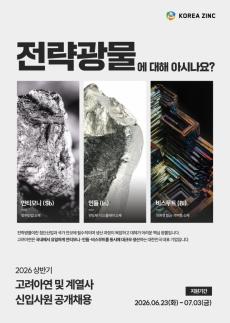 Korea Zinc Expands Recruitment for New Graduates in 2026 Korea Zinc is launching an additional recruitment drive for new graduates in the first half of this year, following a similar effort at the end of last year. The company aims to secure talented individuals who will drive its future growth while fulfilling its social responsibilities. On June 24, Korea Zinc announced its "2026 New Graduate Recruitment" initiative. This marks the first hiring since the announcement of its Project Crucible, a construction project for a smelter in Tennessee, USA, last year. The recruitment will cover 16 positions, including technology, research and development (R&D), finance, accounting, sales, purchasing, and production management. Applications will be accepted through the company’s website until July 3, with successful candidates progressing through a series of assessments, including an online aptitude test, AI competency evaluation, interviews, and health checks, before starting in early September. The recruitment process will focus on Korea Zinc's five core values: honesty, commitment, flexibility, communication, and teamwork. The company is also enhancing its hiring process by incorporating AI assessments to evaluate digital skills and problem-solving abilities comprehensively. In recent years, Korea Zinc has maintained an average annual hiring rate in the triple digits, reflecting its expansion into new business areas such as the Troika Drive and global operations. Currently, 35.5% of employees at its headquarters and Onsan smelter joined the company within the last five years. The demand for talent has increased, particularly in sectors related to key minerals, including Project Crucible. As a result, Korea Zinc has decided to conduct an additional recruitment drive in the first half of the year, in addition to its regular hiring in the second half. This strategy aims to proactively secure key talent with global capabilities and growth potential. Following the announcement of Project Crucible, Korea Zinc has doubled its domestic hiring plans compared to previous years, continuing its commitment to invest in talent. This year, the total recruitment of new graduates is expected to reach four times the usual scale, including both the regular and additional hiring. A company representative stated, "As Korea Zinc's role as a global hub for critical mineral supply chains increases, we recognize the need for proactive investment in securing global talent. This recruitment initiative is a reflection of that understanding. We will continue to focus on securing future growth drivers while fulfilling our social responsibilities through principled talent management and workforce development." Korea Zinc is also committed to providing industry-leading compensation and benefits. The company offers onboarding programs to support new hires, including introductory training, on-the-job training (OJT), mentoring, and Rookie Days for new employees. These initiatives have helped maintain a turnover rate of just over 3% in the past two years, which is below the industry average. The company plans to continue fostering a talent-centered organizational culture based on a stable working environment. Additionally, Korea Zinc has been recognized for its commitment to ESG management, achieving the highest rating from ISS, a leading proxy advisory firm, for nine consecutive months, and becoming the first non-ferrous metal company in Korea to be included in the Dow Jones Sustainability Asia Pacific Index.* This article has been translated by AI. 2026-06-24 17:08:00
 -
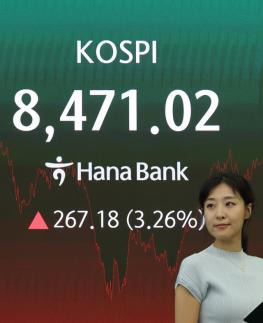 Concerns Over July Market Crash Amid Pension Fund Rebalancing Concerns over foreign net selling and the rebalancing of the National Pension Service (NPS) are increasing uncertainty in the domestic stock market. Online communities are buzzing with claims that the pension fund will dump over 50 trillion won in assets all at once, which is dampening investor sentiment. However, analysts believe the actual impact on the market will not be as severe as feared. On June 24, the Korea Exchange reported that the KOSPI closed at 8,471.02, up 3.26% from the previous trading day, as individual investors took advantage of lower prices following a 9.9% drop. However, foreign investors continued their selling spree, offloading 4.6 trillion won in stocks. The KOSPI 200 Volatility Index (VKOSPI), often referred to as Korea's fear index, surged to 95.45 during the day, marking its highest level of the year. This anxiety is also reflected in online discussions. Posts on the workplace community Blind include statements like, "July, when the pension fund rebalances, will mark the beginning of a major crash," and "The sell-off is imminent, and the pension fund will soon realize profits." Despite these fears, analysts suggest that even if the NPS adjusts its asset allocation, the likelihood of a massive sell-off occurring all at once is low. The recent surge in the KOSPI has pushed the NPS's domestic stock holdings above its target, necessitating a rebalancing. However, releasing tens of trillions of won in assets at once could shock the market and harm the fund's returns. Lee Jong-hyung, head of Kiwoom Securities, stated, "The scenario of a 50 to 60 trillion won sell-off happening all at once starting in July is unrealistic. It is more likely that they will manage daily selling volumes and distribute sales over an extended period, limiting the potential shock to the KOSPI's upward trend." Similarly, Lee Kyung-min, a researcher at Daishin Securities, expressed a similar view. He noted, "If the Korean pension funds needed to sell over 50 trillion won for rebalancing by the end of June, we would have seen significant selling activity earlier this month. Given the limited selling volume throughout June, the chances of a sudden sell-off at the end of the month are low." He added, "While there may be potential selling pressure, it is likely to be executed in a way that minimizes market disruption." Experts also predict that the recent foreign selling will have a limited impact on the domestic market. They argue that the net selling by foreign investors is not due to a decline in the value of the Korean stock market. Lee emphasized, "Recent foreign selling is more about profit-taking and rebalancing in global asset allocation rather than aggressive position reduction. If the won-dollar exchange rate stabilizes and the earnings outlook for semiconductors improves following Micron's results and Samsung Electronics' preliminary earnings announcement, foreign selling may gradually ease."* This article has been translated by AI. 2026-06-24 17:08:00
 -
 Nine Out of Ten Chemical Accidents Caused by Safety Rule Violations, Government to Strengthen Prevention Measures Recent data shows a rise in chemical accidents at workplaces, with nine out of ten incidents resulting in casualties attributed to violations of basic safety protocols. In response, the government plans to implement preventive measures starting at the end of this month, focusing on static electricity management, personal protective equipment usage, and enhanced training for temporary workers.On June 24, the Ministry of Climate, Energy and Environment released statistics indicating that there were 354 chemical accidents in the past three years. Among these, 180 incidents resulted in fatalities or injuries, totaling 293 casualties.Notably, the number of accidents increased from 104 in 2023 to 136 last year, with casualties rising from 67 to 149 during the same period.The government identified that most accidents causing casualties were linked to non-compliance with basic safety rules. Specifically, 159 out of the 180 incidents (88.3%) were found to be caused by human factors.The 159 accidents attributed to human factors resulted in 262 casualties, including 17 fatalities and 245 injuries.Key causes included inadequate management of ignition sources, lack of protective equipment, and insufficient safety training for temporary workers.There were 39 incidents of fires and explosions due to poor ignition source management, where static electricity or sparks were not properly controlled during the handling of flammable materials.Additionally, 44 incidents of burns and poisoning were linked to the failure to wear protective gear. Repeated exposure to hazardous chemicals occurred when workers did not use respiratory protection and safety equipment in confined spaces or dangerous processes.Seventeen accidents involved temporary workers who were unfamiliar with the work environment. The government noted that temporary workers often face higher risks due to frequent changes in work locations and inadequate training before starting their tasks.From April to May, the Ministry gathered feedback from safety managers at major industrial complexes in Ulsan, Yeosu, and Seosan to develop practical preventive measures.To prevent explosions and flammable incidents, the government will enhance static electricity management systems. This includes incorporating static electricity prevention measures, such as grounding and bonding, into mandatory self-inspection items to be checked weekly, and providing tools like discharge pads to help workers eliminate static electricity before starting work.Efforts will also be made to increase the usage rate of protective equipment. Areas for hazardous processes and confined spaces will be designated as chemical safety zones, with audio guidance systems installed at entrances to repeatedly inform workers about safety protocols and the necessity of wearing protective gear.The training approach for temporary workers will be revised. Instead of relying solely on online training, the government plans to expand on-site training that directly addresses the characteristics of handled materials, process-related hazards, accident cases, and emergency response methods.Additionally, the government intends to expand joint inspections of high-risk workplaces and designate the fourth Wednesday of each month as 'Chemical Safety Inspection Day.' This initiative aims to enhance the self-management capabilities of workplaces and strengthen accident prevention systems.Choi Hyun-soo, Director of the Environmental Health Bureau at the Ministry, stated, "To reduce casualties from chemical accidents, it is crucial to strictly adhere to basic safety rules on-site. We will actively promote preventive measures focused on static electricity prevention, protective equipment usage, and pre-work training to ensure the safety of workers and the public."* This article has been translated by AI. 2026-06-24 17:04:00
 -
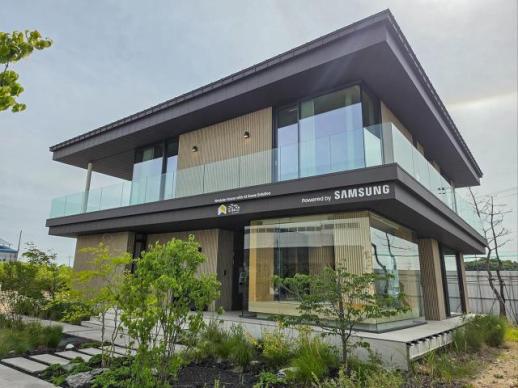 Samsung Enters Modular Housing Market with AI-Integrated Smart Homes Samsung Electronics is making a significant entry into the modular housing market, where homes are manufactured in factories and assembled on-site, aiming to transform the future of residential living. This initiative goes beyond merely supplying appliances; it integrates artificial intelligence (AI) home infrastructure from the design phase, potentially offering a new alternative in the stagnant single-family home market. On June 24, Samsung unveiled the 'Samsung AI Modular Home' in a showroom located in Hwaseong, Gyeonggi Province, in collaboration with Space Production, a company specializing in wooden modular homes. The showcased modular homes significantly reduce construction time to about 20% compared to reinforced concrete houses and lower construction costs by 60% to 70%, ensuring economic viability. If customers choose a pre-designed product, a home can be completed within a week. Park Jeong-jin, CEO of Space Production, stated, "Since over 80% of modular homes are produced using automated factory equipment, we can maintain consistent high quality while drastically reducing construction time and costs. Thanks to our ultra-fast construction methods, this will be a future-oriented home solution that satisfies both young and middle-aged residents." Samsung incorporates appliance specifications and a comprehensive Internet of Things (IoT) environment into the design phase of the modular homes, equipping them with built-in high-efficiency AI appliances. This allows residents to access the entire AI functionality of their home with just one login after moving in, eliminating the hassle of purchasing and installing appliances individually. Notably, the showroom has implemented four specialized solutions considering that 75% of single-family home residents are aged 50 and older, addressing the unique aspects of suburban living, including security, fire and leak detection, energy management, and guest reception. To address security concerns prevalent in single-family homes, the system integrates door cameras, home cameras, and robotic vacuums to work seamlessly together. A subscription service priced at 9,900 won per month includes a 24-hour emergency response system from S1 personnel. In the event of fire or leak situations, the system provides alerts through flashing lights and automatically opens curtains for ventilation. The energy cost burden for single-family homes, which is approximately 1.7 times higher than that of apartments, is designed to be reduced by half through the 'AI Savings Mode' and 'EHS Heat Pump Boiler' based on SmartThings, compared to traditional oil boilers. Samsung aims to equip 10,000 homes with this technology within the next three years. Lee Shin-young, head of Samsung Electronics' DA Division, remarked, "We will actively address the inconveniences and concerns consumers face in their actual living environments using Samsung's AI technology."* This article has been translated by AI. 2026-06-24 17:04:00
 -
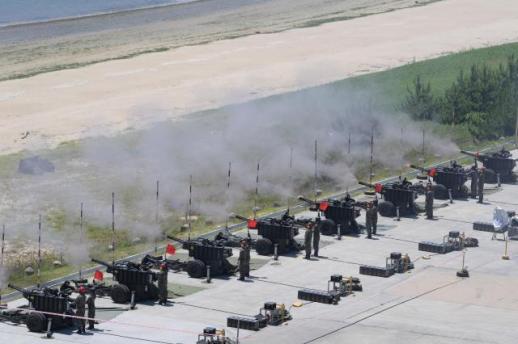 Korean Air Force holds first live-fire drill against drone swarm SEOUL, June 24 (AJP) - The South Korean Air Force has conducted its first live-fire exercise against a swarm of drones, using Vulcan cannons, a portable laser system and shotguns to shoot down 50 targets. The Air Force Missile Defense Command carried out the exercise Tuesday at a training range on the country’s west coast in response to the growing threat posed by drone swarms on modern battlefields, the Air Force said Wednesday. Eight Vulcan cannons opened fire simultaneously on 50 drones approaching at low altitude from about 1 kilometer away, creating a dense wall of fire that brought down 44 of them. The remaining six drones were intercepted at close range using one portable laser system and five shotguns. “This was our first exercise to defend against the growing threat of drone swarms using existing assets, including Vulcan cannons,” said Col. Nam Hyung-joo, the command’s chief of intelligence and operations. “We will continue to develop our counter-drone capabilities based on the results and lessons learned from the exercise,” he added. 2026-06-24 17:03:23