


Latest by
-
 Kakao Splits into AI and Investment Divisions Under New Leadership Kakao announced on August 21 that it will split its business into two divisions: artificial intelligence (AI) and investment. The existing Kakao will remain as the holding company 'Kakao AI,' while the investment-related operations will be separated into a newly established entity called 'Kakao X.'The investment division will be led by Chief Investment Officer Kim Do-young, while the AI division will be headed by Jeong Sin-a. The success of this split hinges on the performance of both leaders in their respective areas, drawing significant industry attention to their execution capabilities.Kakao's rationale for the split is to address the 'conglomerate discount.' The company's self-assessed sum-of-the-parts (SOTP) valuation is 34.2 trillion won, yet its market capitalization stands at only 16.8 trillion won. The argument is that the mixing of various businesses under one entity has prevented individual segments from being valued appropriately by the market.Industry focus is particularly on Kim Do-young, as most of Kakao's future ventures will fall under Kakao X. A key initiative is the development of a won stablecoin. The plan involves partnering with global issuer Circle to establish a won stablecoin ecosystem through KakaoPay and KakaoBank. This will be integrated into a comprehensive digital wallet called 'Super Wallet,' which aims to combine payment, remittance, and asset management into a single financial platform.If the stablecoin project gains traction, Kakao X could evolve from a mere investment firm into a new growth engine for the group. Given the heavy responsibilities of discovering new business opportunities and restructuring the investment portfolio, Kim's performance will be a critical factor in the overall reassessment of Kakao's corporate value.In contrast, Jeong Sin-a's AI division faces different challenges. Regaining lost competitiveness is seen as crucial. Unlike Naver, which is investing up to $10 billion in AI infrastructure in partnership with Nvidia and Brookfield, Kakao believes that the financial burden of infrastructure projects like AI data centers does not justify the expected returns. Instead, it is focusing on B2C services such as agentic AI based on KakaoTalk.KakaoTalk's performance has been strong, reporting a record quarterly revenue of 2.98 trillion won and an operating profit of 277 billion won in the second quarter. The conversational ordering and payment service developed in collaboration with Coupang Eats is also gaining traction. However, there are concerns within the company and the industry that a complex decision-making structure has hindered agility in the rapidly changing AI market.For Jeong, the challenge lies in streamlining the organization to enable quicker responses. The goal of enhancing the conversational AI service 'Kanana' and achieving 20 million daily active users and 6 trillion won in annual revenue by 2030 has become increasingly important.Market reactions have been lukewarm. On the day of the split announcement, Kakao's stock fell by over 13% during trading before closing down by 7%. While the human division is viewed as more shareholder-friendly compared to a physical split, the market did not perceive it as a positive development.Investors still remember the past instances of value erosion during the spin-offs and listings of subsidiaries like Kakao Mobility and KakaoPay, which has contributed to skepticism.Relations with labor unions also remain strained. The Kakao union, Crew Union, responded to the split announcement by calling for joint negotiations. Union leader Seo Seung-wook stated, "The company may split, but it cannot divide its past management failures and responsibilities to its employees." The union demands responsible management, job security, and a process for prior explanation and consultation whenever organizational changes occur.The union plans to hold a joint negotiation declaration ceremony at Pangyo Station on August 26. The KakaoBank union is set to begin a five-day strike starting August 31. The union claims that the company has failed to respond adequately to official inquiries, stating, "Trust between labor and management has been broken."The split proposal will be finalized at an extraordinary shareholders' meeting in December. Therefore, the ability of the two CEOs to present sufficient prospects for future growth to persuade both the union and shareholders will be crucial for the success of this division.* This article has been translated by AI. 2026-08-23 17:12:00
 -
Hanwha Group Donates 3 Billion Won for Flood Recovery in Gyeongnam Hanwha Group announced on August 23 that it will donate 2 billion won to the National Disaster Relief Association to assist in the rapid recovery of areas in Gyeongnam, including Geoje, Tongyeong, and Sacheon, which have suffered significant damage from recent heavy rains. Considering the severe impact, Hanwha has decided to provide funds to ensure prompt assistance for emergency living expenses, temporary housing, and essential supplies for local residents. In addition to the flood recovery support, Hanwha Group will donate an additional 1 billion won to help vulnerable populations in the Gyeongnam region. This funding will be used from September through organizations like the Green Umbrella and the Gyeongsangnam-do Volunteer Center to purchase educational materials for low-income children, support living expenses for elderly individuals living alone, and renovate welfare facilities. Notably, the 1 billion won donation will be distributed entirely in local currency, which is expected to boost sales for traditional markets and small businesses. Following the heavy rain damage, Hanwha Ocean, which operates shipyards in Geoje, provided equipment and personnel, including dredging vehicles, pumps, and generators, to facilitate rapid drainage in flooded areas. The company also supplied water, gloves, and snacks to volunteer groups assisting in recovery efforts. A Hanwha Group representative stated, "We hope this support will help many people who have lost their homes due to the heavy rain recover their daily lives as soon as possible. We will continue to do our best in disaster recovery and support for vulnerable communities." Meanwhile, Kim Seung-yeon, chairman of Hanwha, has emphasized the principle of 'Together, Far' in coexistence management over the past 15 years, highlighting that the local community is also the foundation of Hanwha's business.* This article has been translated by AI. 2026-08-23 17:04:00
-
Rising Treasury Yields Raise Concerns Over Interest Rate Cycle The likelihood of an additional interest rate hike by the Bank of Korea is increasing, which is expected to intensify upward pressure on government bond yields. Rising government bond yields can lead to higher market interest rates, increasing the cost of financing for both businesses and households. This is particularly concerning as companies face greater burdens from refinancing corporate bonds and financing costs for real estate project financing (PF) projects.According to the Seoul bond market on August 23, the yield on three-year government bonds closed at 3.854%, up 4.3 basis points from the previous trading day. This marks a 9.6 basis point increase compared to the end of last month (3.758%). Yields on 10-year and 30-year bonds also rose, closing at 4.376% and 4.703%, respectively. Government bond yields are rising across all maturities.The three-year yield is particularly sensitive to expectations regarding the benchmark interest rate and monetary policy. As the possibility of an additional rate hike at the Bank of Korea's monetary policy committee meeting on August 27 becomes more pronounced, upward pressure on yields is increasing.The rise in three-year government bond yields also adds to the cost of financing for businesses. Corporate bond yields are determined by adding a credit risk premium to government bond yields. When government bond yields rise, even if credit spreads remain stable, the actual financing costs for companies increase. If the benchmark interest rate is also raised, additional upward pressure on market interest rates could further increase the financing burden on businesses.The burden may grow during the refinancing process of corporate bonds issued at lower interest rates in the past. Companies will need to secure funding at higher rates than before, leading to increased interest costs. If interest rates continue to rise, companies with limited financial capacity may face greater refinancing burdens, restricting new investments and working capital.The impact of rising interest rates could also extend to households and the real estate market. Increases in market interest rates, such as government bond yields, affect the borrowing costs for banks, which in turn can drive up mortgage rates. Higher loan rates increase the repayment burden on borrowers and may dampen demand for new housing.As of August 19, the fixed-rate mortgage rates at the five major banks (KB Kookmin, Shinhan, Hana, Woori, and NH Nonghyup) ranged from 4.73% to 7.16%, already exceeding 7%. The financial bond yield for five-year bonds (non-guaranteed, AAA) reached a two-year high of 4.531% on July 27, contributing to the upward trend in financial bond yields. As of August 21, the yield remained high at 4.434%.The real estate PF market is also vulnerable to rising bond yields. Given the high reliance on borrowing for PF projects, an increase in borrowing costs can lead to higher interest expenses and deteriorate project viability. Projects facing bridge loans or nearing maturity may experience greater financial burdens, complicating refinancing or transitions to main PF.A financial industry official stated, "If government bond yields continue to rise from already high levels and the benchmark interest rate increases, market interest rates could rise further. This could increase the financing burden on businesses and households, and in vulnerable sectors like PF, it may lead to deteriorating financing conditions, raising caution in the market."* This article has been translated by AI. 2026-08-23 17:04:00
-
SK Hynix Faces Union Vote on Performance Bonus Amid Cash vs. Stock Debate SK Hynix's tentative agreement for the 2026 wage and collective bargaining negotiations is set to face a decisive test among union members. A key point of contention is the method of performance bonus distribution, with management proposing a 'stock-linked' compensation plan that clashes with the union's strong preference for cash.According to industry sources, the production workers' union at SK Hynix in Icheon and Cheongju will conduct a two-day vote starting August 24 on the tentative agreement for the 2026 negotiations. The technical staff union is also expected to complete its voting this week and announce the results.The core of the agreement involves a complete overhaul of the profit-sharing structure. The parties have agreed to distribute 40% of the performance bonus linked to operating profit in cash, with the remaining 60% in company stock. Of the stock, 40% can be sold in the current year, while 20% will be paid out over two years in a deferred payment scheme.Management has characterized this structure as an advanced approach to aligning corporate value with employee compensation, particularly in light of increased profits from the AI semiconductor boom. The fact that the two sides reached this agreement without strikes or external mediation is also seen as a positive development.However, union members have reacted with skepticism. Many are unhappy that the promise to maintain 80% cash distribution of the performance bonus for ten years was overturned in just one year. This sentiment is particularly strong among younger employees who prefer cash. One member expressed frustration in an anonymous chat, stating, "If they break a promise made just a year ago, how can we trust the company moving forward?" The newly formed 'Unified Union Task Force' is also preparing a response to the tentative agreement, indicating that the division over member sentiment is intensifying.In response to member backlash and concerns over stock price fluctuations, the agreement includes a buffer mechanism. For the first year of the new system, members will have the option to receive cash for the 40% of stock designated for sale. This could raise the actual cash portion to as much as 80%.Additionally, a safeguard has been included that applies the lowest closing price among the tentative performance announcement date, cash payment date, and stock payment date when calculating stock value. The basic salary increase rate has been set at 6.3%, slightly surpassing Samsung Electronics' increase of 6.2% this year. Employee welfare points will also rise from 2.4 million won to 3.6 million won, and the eligibility for housing loan support will be expanded to include all married employees, not just those with multiple children, increasing the loan limit from 200 million won.Since the production and technical staff unions have been negotiating separately with management, each union will conduct its own vote. The agreement will only be finalized if both unions meet the conditions of a majority attendance and majority approval from those present. If either union fails to secure a majority, it will have to start negotiations from scratch with management.SK Hynix has faced rejections in union votes for tentative agreements in 2023 and 2024, leading to renegotiations with management. Notably, in 2024, after negotiations began at the end of June, a vote in September resulted in a rejection, and it took seven rounds of renegotiation before a final agreement was reached four months later.Industry observers note, "The differing perspectives between labor and management over profit distribution have emerged amid a boom in AI memory, generating tens of trillions of won in annual profits. The outcome of this vote will be a significant milestone in the restructuring of performance compensation systems among semiconductor companies." 2026-08-23 17:04:00
-
Debate Over Prosecutorial Discretion in President Lee Jae-myung's Cases The issue of whether to drop charges against President Lee Jae-myung has become a contentious topic in multiple criminal trials.Many citizens argue that "no one is above the law" and that the president should not be an exception. Conservative politicians have expressed strong opposition, stating that dropping charges would signify the "end of the regime," be grounds for impeachment, and constitute a crime of legal distortion. Conversely, a significant number of citizens and some members of the Democratic Party assert that if past investigations were illegal or the charges were fabricated, it is only right to dismiss the charges. They have formed a group advocating for the dismissal of charges and have mentioned the possibility of a national investigation and a special prosecutor.This conflict over the dismissal of charges has escalated beyond a simple legal dispute, consuming national energy and undermining community cohesion, leading to a social crisis.Therefore, the political factions must cease their relentless assertions to push their agendas regarding the dismissal of charges against the president. Instead, a rational and theoretical legal discussion should guide the process toward a forward-looking conclusion.In this context, it is essential to examine the American experience. In the U.S., the issues surrounding federal criminal charges and dismissals against a sitting president have been extensively discussed in constitutional law and legal practice. Notably, the special prosecutor's request to dismiss charges in the criminal case against former President Donald Trump serves as a significant comparative legal example.In the U.S., there have been no reports of Republicans and Democrats engaging in fruitless debates or citizens protesting in the streets over the dismissal of charges against President Trump. This absence of conflict indicates that American constitutional scholars, legal sociologists, and the Department of Justice have already reached a consensus on the principles underlying the U.S. Constitution.The special prosecutor handling the Trump case, Jack Smith, was appointed by the Biden administration, Trump's political rival. He requested the court to dismiss the charges ahead of Trump's inauguration. While Smith indicated that sufficient evidence for a conviction existed, he emphasized that continuing criminal prosecution against a sitting president could undermine the principles of popular sovereignty and separation of powers, significantly hindering the president's constitutional duties. He referenced the longstanding position of the Office of Legal Counsel (OLC) that has limited federal criminal prosecution of sitting presidents, arguing that a president, as the head of state and government, should not be incapacitated by individual criminal cases, as this would contradict constitutional order. His key point was not that the president is above the law, but rather that the timing and method of pursuing criminal responsibility must align with the constitutional principles of separation of powers and governance.The question of whether to dismiss charges against President Lee Jae-myung should not be judged solely from an emotional or partisan perspective. A rational conclusion must be reached through a comparative weighing of conflicting legal interests, rather than unilateral claims from either side. This comparative weighing should involve discussions among the media, legal community, and general public to arrive at a theoretically sound legal decision. This approach represents a forward-looking solution for our society's maturation. The upcoming confirmation hearings for the newly appointed Minister of Justice, Chief of the Serious Crimes Investigation Office, and Chief Prosecutor will likely draw significant attention regarding the candidates' positions on the dismissal of charges against the president.Author's Background:▲ Graduate of Boston University School of Law ▲ Member of the Seoul Bar Association ▲ Member of the New York State Bar Association ▲ Attorney at Law Firm Byeongyoul.* This article has been translated by AI. 2026-08-23 16:48:00
-
Vietnam Defeats Thailand 2-0 in ASEAN Cup Final First Leg Vietnam took a significant step toward winning the 2026 ASEAN Cup by defeating Thailand 2-0 in the first leg of the final held in Bangkok. Coach Kim Sang-sik's strategic substitutions led to goals from Nguyen Hai Long and Nguyen Quang Hai in the second half, marking him as the most successful coach against Thailand.According to local media, including Bongda.com, the Vietnamese national team triumphed over Thailand at the Rajamangala Stadium on August 22. Nguyen Hai Long scored the opening goal in the 62nd minute, followed by an additional goal from Nguyen Quang Hai just seven minutes later.This victory marks Kim's third official win against Thailand as the head coach of Vietnam, all of which occurred in the AFF Cup finals. Previously, he led Vietnam to victories in the 2024 AFF Cup finals, winning the first leg 2-1 and the second leg 3-2.The win is also historically significant for the Vietnamese national team. Since returning to the international stage in 1991, previous coaches like Alfred Riedl, Enrique Calisto, and Park Hang-seo each secured only one victory against Thailand. With this win, Kim has set the record for the most wins against Thailand.Substitutions Prove Decisive as Vietnam Aims for Back-to-Back TitlesThe turning point in the match was Kim's substitutions at the start of the second half. He replaced Nguyen Suan Son and Le Pham Thanh Long with Hai Long and Quang Hai, who both scored within 20 minutes of their introduction, sealing the victory.In the first half, Thailand posed a significant threat. Vietnam created an early opportunity with a long-range shot from Suan Son, while Thailand's Seksan Ratree hit the crossbar in the 30th minute. Just before halftime, Yochakorn Burapha had a one-on-one chance with the goalkeeper but missed the target, leaving the score at 0-0.In the second half, Vietnam took control of the match. Hai Long found the net with a powerful shot after receiving a pass from Nguyen Dinh Bac in the 62nd minute. Quang Hai added the second goal during a quick counterattack seven minutes later. Both substitutes made an immediate impact, confirming Kim's tactical acumen.Despite conceding two goals, Thailand increased their attacking efforts but failed to penetrate Vietnam's defense. Vietnam even created additional chances, with Dinh Bac's long-range shot hitting the crossbar in the 89th minute.Eyes on the Second Leg in HanoiThailand now faces significant pressure heading into the second leg of the final after losing 0-2 at home. Following the match, fans expressed their dissatisfaction with the team's performance on the Thai Football Association's official social media, calling for the return of star player Chanathip Songkrasin and demanding a 3-0 victory in the away match against Vietnam.Criticism of the team's performance was harsh, with some fans stating, "If they play like this, there's no need for a broadcast for fans to watch," while others remarked that the team had already lost before stepping onto the field. Although Thailand created some threatening moments in the first half, they failed to capitalize on their chances, and in the second half, they were overwhelmed by Vietnam's counterattacks.However, some analysts noted that the match was not entirely one-sided. Thailand had opportunities to score in the first half but could not finish, while Vietnam effectively converted their chances following the substitutions. Ultimately, the match was decided by the ability to finish chances.Vietnam will carry a two-goal lead into the second leg of the final, scheduled for August 26 at 8 PM at My Dinh Stadium in Hanoi. As the reigning champions from the 2024 tournament, Vietnam aims to secure back-to-back titles.* This article has been translated by AI. 2026-08-23 16:40:00
-
First Test Voyage of Arctic Shipping Route Begins from Busan A new challenge has begun in South Korea's shipping history. The Panstar Acro, the country's first container ship to test the Arctic shipping route, has departed from Busan New Port. This 2,758 TEU vessel will pass through the Bering Strait and enter the Northeast Passage, stopping in the United Kingdom, the Netherlands, and Poland before returning to Busan in early October. This marks the first time a container ship has navigated the Arctic route in a decade.The significance of this voyage extends beyond merely testing a new shipping lane. The Arctic route has the potential to reshape South Korea's shipping and logistics landscape. It could significantly reduce the distance and time required to reach Europe from Busan compared to the traditional route through the Suez Canal. If logistics costs can be lowered and transportation times shortened, this could provide a new competitive edge for South Korea's export-driven economy.The geopolitical implications are also substantial. As seen with the recent incidents in the Red Sea and the geopolitical instability in the Middle East, excessive reliance on specific shipping routes can disrupt entire supply chains. Adding the Arctic route as an option to the maritime logistics network concentrated around the Suez Canal and the Strait of Malacca could enhance supply chain stability. Busan Port stands to gain an opportunity to become a new logistics hub connecting Asia and Europe.However, the Arctic route will not open up simply based on expectations. The first consideration must be its economic viability. Even with a shorter sailing distance, additional costs arise from building ice-class vessels, insurance premiums, and securing specialized personnel. The operational period is limited by seasonal factors, and the route may change due to ice conditions and weather. It is essential to verify whether the reduction in distance directly translates to lower logistics costs through actual operational data.Safety is an even more critical concern. The Arctic Ocean is subject to severe weather changes, and rescue and support in case of accidents can be challenging. This is why personnel with polar navigation experience are involved in this voyage, and the government is maintaining a 24-hour communication system. To promote regular routes in the future, it will be necessary to establish stricter safety standards for vessels, provide weather and ice information, and enhance emergency response systems.Securing stable cargo is also crucial. Just because a ship can navigate does not mean a route will be established. Consistent cargo flow in both directions—from Busan to Europe and back—is necessary for a regular service. A cargo securing strategy involving domestic shipping companies, exporters, and logistics firms is essential.The government must not treat this voyage as a one-time event. It should accumulate data on sailing times, fuel costs, insurance premiums, cargo volumes, and weather changes to objectively analyze the economic viability of the Arctic route. Long-term preparations should also include developing dedicated vessels and specialized crews, as well as enhancing Busan Port's transshipment, maintenance, and supply capabilities.The departure of the Panstar Acro marks not the completion of a route but the opening of a door to possibilities. True success will not end with a safe return to Busan. The next challenge is to leverage the experiences gained from this voyage to enhance the competitiveness of South Korea's shipping industry and establish Busan as a hub for the Arctic shipping era. Careful preparations must begin now to ensure that the first shipping lane to the Arctic becomes a new economic route for South Korea.* This article has been translated by AI. 2026-08-23 16:32:00
-
Where is Troy Now? Insights from Christopher Nolan's Odyssey After watching Christopher Nolan's film Odyssey, viewers are left with many questions. Why was Odysseus unable to return home for ten years? Where is Ithaca, the place he longed to return to? Did the Cyclopes, Sirens, Circe, and Calypso's islands actually exist?However, before these questions, there is a simpler yet intriguing one: "So, where is Troy now?"Many who read Homer's Iliad and Odyssey or watch the film may assume that Troy is in Greece, as most of the heroes of the Trojan War, such as Agamemnon, Menelaus, Achilles, and Odysseus, are Greek.But Troy is not in present-day Greece.The ruins of Troy are located in Hisarlık, Çanakkale Province, in northwestern Turkey. This site is at the northwestern tip of Asia Minor, across the Aegean Sea from mainland Greece. Even more surprising is Troy's location; according to UNESCO, the ruins are situated just about 4.8 kilometers from the southern entrance of the Dardanelles Strait.This single figure offers a new perspective on Troy's history. Why was Troy located there? Let's unfold a map.To the south lies the Aegean Sea. Heading north from the Aegean leads to the narrow, elongated Dardanelles Strait. Crossing this strait brings you to the Sea of Marmara, and beyond the Bosporus Strait lies the vast Black Sea.Aegean Sea → Dardanelles Strait → Sea of Marmara → Bosporus Strait → Black Sea.This route remains significant on today's world map, and it was even more crucial 3,000 years ago.Troy overlooked this vital passage.UNESCO also recognizes that Troy served as a cultural bridge for thousands of years, connecting Anatolia, the Balkans, the Aegean, and the Black Sea regions, facilitating migration, trade, and the exchange of knowledge. Evidence of human habitation in and around Troy spans approximately 8,000 years.Understanding Troy's geographical position changes the way we view Homer's world.In mythology, the Trojan War began over a woman. Paris, a prince of Troy, took Helen, the wife of Spartan King Menelaus, back to Troy. Enraged, Menelaus and his brother Agamemnon united various Greek forces and launched an attack on Troy, leading to a ten-year war, as recounted in Homer's narrative.However, looking at the map raises another question: Was it truly just for the beautiful Helen?Here, we must distinguish between history and myth. It has not been proven that the Trojan War occurred exactly as described by Homer. The assertion that the war began because of Helen, that Achilles and Hector actually fought, or that the massive wooden horse entered Troy's gates cannot be definitively established as historical fact.However, the existence of the city of Troy is an archaeological fact, as is its proximity to a crucial maritime route of the time.Thus, if the actual historical conflict evolved into Homer's grand narrative, we might consider the interests surrounding trade, maritime routes, and power dynamics as potential underlying causes. Yet, declaring this as the true reason for the Trojan War would lead to writing another myth rather than history.What matters is geography.Geography rarely lies in history. Three thousand years ago, a 'crossroads' meant wealth and power. Throughout human history, the rise and fall of great powers and cities have been linked to routes.There are land routes and sea routes. People and goods traverse these paths. Money flows with goods, and power follows money. Conflicts over power sometimes lead to war.Troy was situated on that route.To travel north from the Aegean world toward the Black Sea, one must pass through the narrow gateway of the Dardanelles. This is why the strategic importance of the Bosporus and Dardanelles remains significant today. Though thousands of years have passed, the sea and straits remain unchanged.Interestingly, just across the Dardanelles from Troy lies the Gallipoli Peninsula, a battleground of World War I. Nearly 3,000 years separate the era of Troy from the Gallipoli campaign, yet the geographical space where people fought has not significantly changed.Why is that?Because it is a crossroads. The best way to understand Troy may be to unfold a world map rather than read another mythological book.Now, in 2026, the world is searching for another island. As 3,000 years have passed, Odyssey is reshaping the world map in a completely different way.On one side, people are looking to Turkey's Çanakkale and Hisarlık to find the true location of Troy. On the other side, they are heading to a small island in the Mediterranean to find the Ithaca of the film.That island is Favignana, located off the western coast of Sicily, Italy.Here, it is necessary to distinguish between actual history and the film. The Ithaca that Homer's Odysseus sought to return to is connected to the modern Greek island of Ithaca. However, Nolan filmed key scenes of Ithaca not on the actual Ithaca but on Favignana.Favignana is an island in the Egadi Islands, located off the coast of Trapani, Sicily. Due to its shape, it is also nicknamed the 'Butterfly Island.'Nolan transformed this location into Odysseus's homeland. The Castello di Santa Caterina, situated on the highest hill of Favignana, became the palace of Odysseus in the film. This site served as a significant backdrop for scenes featuring Penelope and Telemachus. The film crew shot not only in Favignana but also in the surrounding Egadi Islands and Aeolian Islands for various sea and island scenes.The choice of Favignana is intriguing.Production designer Ruth De Jong praised the island's high terrain, which offers views of the sea in all directions, allowing the boats used in filming to approach realistically. This space enabled actors to perform while feeling the actual wind and looking at the real sea, rather than in a computer-generated environment.This is a quintessential Nolan choice.The 'Odyssey effect' has arrived on the island with a population of 3,000. According to Reuters, about 500 local extras and crew were employed during the filming, and direct spending in the area is estimated by local authorities to be between 1 million and 2 million euros. Following the film's release, investors from North America, the Middle East, and India have shown interest in high-end tourism ventures. Local authorities are also planning a permanent exhibition showcasing the film's production process, costumes, and equipment.Interestingly, the island's residents are already contemplating the next question.What will they do if too many people come?This reflects the power of 'screen tourism,' where a single film can create a global tourist destination. According to estimates cited by Reuters from the United Nations related to tourism, locations featured in popular films can experience significant increases in visitors. Favignana is beginning to connect the film's success to its tourism industry while also considering how to avoid overtourism.This is the new Odyssey of 2026.Three thousand years ago, Odysseus wandered the seas to return home. Three thousand years later, tourists from around the world are crossing the seas to trace Odysseus's footsteps.One film has created two maps. Therefore, after watching Odyssey, I would recommend unfolding two maps together.The first map features Troy in Turkey.Locate Çanakkale and Hisarlık, and trace the path to the Dardanelles Strait. Below, see the Aegean Sea, and above, connect your eyes to the Sea of Marmara, the Bosporus, and the Black Sea. You will begin to understand why Troy was located there.The second map features Favignana in Italy.Find Sicily and look westward toward the sea off Trapani, where a small island appears. In the film, that island became Ithaca, the home Odysseus risked his life to return to, the home Penelope awaited, and the home where Telemachus grew up waiting for his father.One is a map of history, and the other is a map of film.One has drawn people for 3,000 years, while the other is beginning to attract global attention through a single film.Yet, the forces driving both places share a strangely similar trait: people move along paths.Three thousand years ago, people crossed the Aegean for trade and war. Today, people board planes to cross the sea for films, stories, and culture. In the past, goods moved people; today, content moves people. Myths become literature, literature becomes film, and film creates tourism and economy.This may be the enduring power of Odyssey, which has survived for 3,000 years.Troy may be gone, but its place remains. Homer may have passed away, but his stories endure. The ship that Odysseus sailed may have vanished, but people still seek the seas he is believed to have traversed.And in the summer of 2026, Nolan's camera has once again turned the world's gaze back to that ancient story.So, if asked about the first travel destination after watching Odyssey, I would mention two places.If you want to know Troy, go to Çanakkale, Turkey.If you want to experience Nolan's Odyssey, head to Favignana, Italy.Between the two lies a journey of 3,000 years of myth, history, and human travel. 2026-08-23 16:28:20
-
Toronto Celebrates BTS Weekend as Group Performs at Rogers Stadium Group BTS's visit to Canada has turned Toronto into a festive atmosphere.BTS is set to perform at Rogers Stadium in Toronto on August 22 and 23 as part of their 'BTS WORLD TOUR 'ARIRANG' IN TORONTO.' Both shows sold out quickly, marking the group's only performance in Canada during this world tour, drawing significant local and international attention.On August 21, the city of Toronto declared August 22 and 23 as 'BTS Weekend' in anticipation of the concerts. During this period, the iconic 'Toronto Sign' at Nathan Phillips Square will be illuminated in purple.Various initiatives across the city have welcomed BTS. On the same day, Toronto held an official ceremony to temporarily rename a section of Yonge Street in North York as 'BTS Boulevard.' This boulevard stretches from North York Boulevard to Finch Avenue and will remain in place until September 23.The newly installed signs feature the red color associated with BTS's fifth studio album, 'ARIRANG.' This project aims to promote the Korean community and culture in North York while boosting local tourism.The Toronto tourism industry is also focusing on BTS's visit. Destination Toronto, the city's official tourism marketing organization, has created 'The Ultimate BTS Weekend Guide.' This guide includes information on Koreatown, Korean cuisine, shopping, attractions, and transportation to Rogers Stadium, allowing fans visiting for the concert to experience various aspects of Toronto.Local media have highlighted the excitement surrounding the concerts. Canadian outlet CityNews reported on fans visiting BTS-related pop-ups and the unveiling of 'BTS Boulevard,' noting that fans from across Canada and abroad are converging on Toronto.To accommodate the large influx of visitors, transportation measures have been implemented. Toronto is expanding public transit services and on-site personnel in preparation for the busy weekend filled with major events, including the BTS concerts.BTS's performances in Toronto are evolving into a significant event that goes beyond a concert, linking city tourism, local businesses, and the promotion of Korean culture.* This article has been translated by AI. 2026-08-23 16:28:00
-
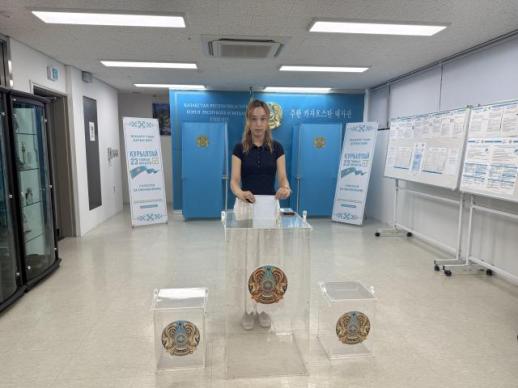 Kazakhs in Seoul vote in first Kurultai election SEOUL, August 23 (AJP) - The first voter reached the Kazakh embassy in Seoul at 7 a.m. Sunday, hours before most of the roughly 300 Kazakh nationals eligible to cast ballots in South Korea would make their way to the compound to help choose their country's new parliament. She was Azhar Karimzhanova, 23, a student at Korea University, according to Rakhymzhan Altynbay, an official at the embassy. By 1:30 p.m., Altynbay said, about 70 people had voted. That is roughly a quarter of the eligible electorate in the country, and they kept arriving through the morning. Some brought children. Some came with family. A few stopped to greet one another at the gate before going in. The Seoul station is one of 79 the Central Election Commission opened at Kazakh diplomatic missions in 61 countries. Voters abroad receive the same ballot as those at home, and there is no postal or online option. At stake are all 145 seats of the Kurultai, the single chamber that replaced the Senate and the Mazhilis when a new constitution took effect July 1. Seven parties are running 545 candidates in one nationwide district. Self-nomination is not allowed. Ulanbek Aueskhan came on his day off with his five-year-old son. He has lived in South Korea for more than 10 years, took his bachelor's degree through his doctorate here, and works as a researcher at Samsung Electronics. He said he brought the boy deliberately. "I wanted to show him," Aueskhan said. "Our country does this. He should see it while he is young, and experience it directly." Voting from abroad, he said, was a way of staying useful to a country he no longer lives in. "We are outside the country, but there is still a contribution to make," he said. "Even from Korea, we can support Kazakhstan." Asked what the new chamber would change, he pointed to the merger itself. "Until now there were the Senate and the Mazhilis," he said. "Now they are combining, so decisions can be made faster." Alisher Saduakas, 28, arrived with him. They are colleagues, both researchers at Samsung Electronics, and Saduakas lives in Suwon. He has been in South Korea for 10 years and had never voted in his life. "I had no plans to vote," he said. "Ulanbek said we should come and do it together. This is the first time, and it feels good." What changed, he said, was that he can now follow what is happening at home. "There was no Kurultai before, and things were complicated," Saduakas said. "Now I can see how it works on social media, what is moving in Kazakhstan. So I thought I could support it too." Kazakhstan's ambassador to South Korea, Asset Issenali, who presented his credentials on July 22, was at the embassy as voters came through. He said the country was in the middle of political and economic transformation, and that the new chamber would let it pass legislation to make economic reform more effective. "This will be a stepping stone," Issenali said. Polls close in Kazakhstan on Sunday evening. The commission has accredited 781 foreign and international observers, among them 39 long-term and 208 short-term monitors sent by the Organization for Security and Co-operation in Europe through its Office for Democratic Institutions and Human Rights. Aueskhan's son waited beside him while he marked his ballot. "From a young age, here, you have to show them," his father said. 2026-08-23 16:22:04