
Journalist

AJP
-
 Late ex-PM Lee Hae-chan's casket arrives from Viet Nam SEOUL, January 27 (AJP) - The body of former Prime Minister Lee Hae-chan, who died last Sunday during a visit to Viet Nam, was returned home on Tuesday. The senior vice chairperson of the Peaceful Unification Advisory Council (PUAC), a presidential consultative body, died of cardiac arrest at a hospital in Ho Chi Minh City. Lee's casket arrived at Incheon International Airport earlier in the day, where government officials and political figures including senior presidential aide Cho Jung-sik gathered to pay their respects, before being transported to Seoul National University Hospital for his funeral service. According to PUAC, Prime Minister Kim Min-seok will oversee Lee's funeral service along with the ruling Democratic Party (DP)'s leader Jeong Cheong-rae. Mourners will be allowed to pay their respects for five days at a memorial altar at the hospital in central Seoul. Born in 1952 in Cheongyang, South Chungcheong Province, the seven-term lawmaker began his political career in 1988 after fighting for South Korea's democracy in the 1970s and went on to serve in numerous government roles. He remained a respected and influential figure within the liberal camp, even after retiring from politics in 2020. 2026-01-27 10:34:59
 -
 LG CNS' annual profit rises on AI and cloud demand SEOUL, January 27 (AJP) - South Korean IT services firm LG CNS reported an 8.4 percent rise in operating profit for 2025, powered by robust demand for artificial intelligence and cloud computing solutions. The company posted an operating profit of 555.8 billion won ($382.8 million) for the year, up from 512.7 billion won in 2024, according to a regulatory filing on Tuesday. Annual revenue edged up 2.5 percent to 6.13 trillion won, while net profit jumped 21.2 percent to 442.2 billion won. Revenue from AI and cloud services, the company's core growth engines, climbed 7.0 percent year-on-year to 3.59 trillion won. LG CNS said it has secured what it described as an industry-leading number of external clients across finance, manufacturing and public sectors for its AI transformation business. Fourth-quarter operating profit rose 7.9 percent to 216 billion won from a year earlier. Revenue for the October-December period reached 1.94 trillion won, with net profit at 180.6 billion won. The IT services provider has been expanding into agentic AI through its AgenticWorks platform and participating in a consortium led by LG AI Research Institute to develop a homegrown AI foundation model. In the cloud segment, LG CNS is accelerating its push into the global AI data center market, having won its first overseas contract in Indonesia. LG CNS said it plans to strengthen its position in AI and robotics transformation this year, developing specialized AI agents for various industries while pursuing partnerships with global technology firms. The company is also conducting proof-of-concept trials for industrial humanoid robots at about 10 client sites, including logistics centers and factories. 2026-01-27 10:16:09
 -
 LS Cable & System secures Malaysia subsea power cable contract SEOUL, January 27 (AJP) - South Korea's LS Cable & System has won a turnkey contract worth about 60 billion won ($41 million) from Malaysia’s national utility, Tenaga Nasional Berhad (TNB), to build a subsea power transmission network. The project involves expanding a 132-kilovolt subsea power link between Malaysia’s mainland and Langkawi Island, a major tourist destination, to enhance the stability of electricity supply, the company said on Tuesday. LS Cable & System secured the contract after beating multiple global competitors, winning the second phase of the Langkawi subsea cable project following the successful completion of the first phase. The company attributed the achievement to trust built through the earlier project and its overall competitiveness in turnkey execution. Countries in Southeast Asia are advancing large-scale subsea grid projects as part of the ASEAN Power Grid (APG) initiative, which aims to interconnect national power systems across the region. Industry estimates cited by the company project the global subsea cable market will grow to about 34 trillion won by 2030, with the Asia-Pacific region accounting for roughly 20 trillion won of that total. LS Cable & System said it plans to leverage the Malaysia project to strengthen its overseas track record. “Based on our proven turnkey capabilities, we aim to successfully deliver backbone grid projects at home and abroad and strengthen our leadership in the subsea cable market,” the company said in a press release. * This article, published by Aju Business Daily, was translated by AI and edited by AJP. 2026-01-27 10:00:36
 -
 SK Innovation E&S starts LNG production at Australia's Barossa offshore field SEOUL, January 27 (AJP) - South Korea's SK Innovation E&S said on Tuesday it has begun full-scale natural gas production at Australia’s Barossa gas field and successfully loaded its first liquefied natural gas (LNG) cargo. The company said gas produced at the offshore Barossa field was transported to the Darwin LNG terminal, where the inaugural LNG shipment was loaded. Barossa is located about 300 kilometers off Australia’s northwest coast. SK Innovation E&S holds a 37.5 percent stake in the project and is a key partner alongside Australia’s Santos, which owns 50 perent, and Japan’s JERA, with 12.5 percent. SK Innovation E&S invested a total of $1.6 billion, or about 2 trillion won, covering reserves assessment, regulatory approvals and construction of offshore and onshore facilities. With production under way, the company said it expects to secure 1.3 million tons of LNG annually for the next 20 years, equivalent to roughly 3 percent of South Korea’s total annual LNG imports. The supply is expected to bolster South Korea’s energy security amid heightened volatility in global energy markets driven by geopolitical risks, including international disputes. The Barossa project adopted a brownfield development strategy by retrofitting and reusing the existing Darwin LNG terminal instead of constructing a new facility, the company said, helping to reduce capital costs. It also cited price competitiveness due to Australia’s proximity, with shipping times of about 10 days compared with longer routes from the Middle East or the United States. Lee Jong Soo, president of SK Innovation E&S, said the start of LNG production at Barossa followed decades of sustained effort by a private company in the high-risk resource development sector. * This article, published by Aju Business Daily, was translated by AI and edited by AJP. 2026-01-27 09:53:47
 -
 Korean materials firm Posco Future M invests in US solid-state battery maker SEOUL, January 27 (AJP) - South Korean battery materials and chemicals company Posco Future M has invested in U.S. solid-state battery company Factorial, stepping up efforts to secure a foothold in next-generation battery technology. The company said Tuesday that it has signed an investment agreement with Factorial on Jan. 7 and completed payment on Monday. Posco Future M didn't disclose the terms of the investment. The move builds on a memorandum of understanding signed in November 2025 to jointly develop solid-state battery technology. Massachusetts-based Factorial is regarded as a leading developer of solid-state batteries and is pursuing a U.S. stock market listing. The company is expanding operations through a solid-state battery pilot plant in Cheonan, South Chungcheong Province. Factorial’s solid-state battery platform, Solstice, is designed to offer higher energy density and improved safety compared with conventional lithium-ion batteries that use liquid electrolytes, the company said. Solid-state batteries, which replace liquid electrolytes with solid materials, are widely seen as a potential breakthrough for electric vehicles and energy storage due to their ability to enhance performance while reducing fire risks. Posco Future M said the investment is expected to deepen cooperation by combining Factorial’s global network with its own battery materials technology. The company has been supplying and testing cathode material samples for Factorial’s solid-state batteries, adding that its products were rated highly among multiple suppliers for quality and power performance. The company has materials design and coating technologies optimized for solid-state batteries and that the investment will help it prepare for rapid growth in the emerging market. Factorial, for its part, aims to secure a stable supply of high-quality materials and strengthen manufacturing competitiveness. “Both companies have advanced materials technology through an ongoing, close partnership,” said Hong Young-jun, head of Posco Future M’s research institute. * This article, published by Aju Business Daily, was translated by AI and edited by AJP. 2026-01-27 09:40:44
 -
 South Korea pushes bid for Canada's submarine project as economic ties deepen SEOUL, January 27 (AJP) - South Korea is stepping up efforts to win Canada’s next-generation submarine contract, leveraging a flurry of industrial cooperation deals and high-level diplomacy aimed at deepening the two countries’ strategic and economic ties. The Ministry of Trade, Industry and Resources said it hosted the South Korea–Canada Industrial Cooperation Forum on Monday at the Park Hyatt hotel in Toronto, bringing together business and government leaders from both countries. The event comprised a two-part program: an automotive industry cooperation forum and a South Korea–Canada CEO dialogue. Senior figures in attendance included presidential chief of staff Kang Hoon-sik, Industry Minister Kim Jung-kwan, and Defense Acquisition Program Administration Commissioner Lee Yong-cheol. From the Canadian side, participants included Philip Jennings, deputy minister of Innovation, Science and Economic Development, and Victor Fedeli, the Ontario minister of economic development, job creation and trade, alongside other federal and provincial officials. Officials discussed strengthening collaboration in future mobility sectors such as eco-friendly and autonomous vehicles. “The auto industry is a core backbone industry that runs through both countries,” Kim said, emphasizing that South Korea will help both nations’ automakers “seek opportunities together and grow.” In a show of expanding cooperation, six memorandums of understanding (MOUs) were signed between major firms in key high-tech and strategic industries. They included agreements between Hanwha Ocean and Algoma Steel (steel), Hanwha Systems with Telesat and MDA Space (low-Earth-orbit satellites), Hanwha Ocean–Hanwha Systems–Cohere (AI), Hanwha Systems and PV Labs (advanced sensors), and POSCO International and Torngat Metals (rare earths). The MOU was signed as part of discussions between the South Korean and Canadian governments and companies on industrial cooperation ahead of Canada’s upcoming submarine procurement program. It outlines a concrete model for industrial collaboration that aligns with the Canadian government’s emphasis on local industry participation and Industrial and Technological Benefits (ITB) — the so-called “Buy Canadian” policy. Hanwha Ocean first signed an agreement with Algoma Steel, Canada’s largest steel manufacturer, to support the Canadian submarine project. If Hanwha wins the submarine contract, the two companies will cooperate on building a steel plant in Canada and establishing a stable supply chain for steel products used in submarine construction and maintenance (MRO) infrastructure. Hanwha Ocean will invest approximately CAD 345 million in the initiative. Hanwha Ocean and Hanwha Systems also entered into an artificial intelligence partnership with Cohere, a leading Canadian AI unicorn, to jointly develop specialized AI technologies applicable to shipbuilding and submarine system integration and operation. The collaboration will utilize Cohere’s large language models (LLMs) and large multimodal models (LMMs) to enhance processes across production planning, design, and manufacturing. Hanwha Systems will further collaborate with Telesat, a Canadian satellite communications company, to develop next-generation low Earth orbit (LEO) satellite communications. By combining Hanwha’s expertise in satellite manufacturing and terminal development with Telesat’s satellite network operation and design capabilities, the two companies aim to deliver a globally competitive LEO satellite communication network for both domestic and international markets. In addition, Hanwha Systems signed an MOU with MDA Space to cooperate on defense and security-oriented satellite communications and space technologies, and another with PV Labs to advance electro-optical and infrared (EO/IR) sensor technologies for defense applications. A study by global consulting firm KPMG estimated that Hanwha’s proposed industrial cooperation plan for the Canadian submarine project could create more than 200,000 cumulative job-years in Canada by 2040. The ministry said the deals are expected to reinforce collaboration across advanced industrial sectors including steel, defense, space, AI, and rare earth development. During the second session, business leaders gathered for the third South Korea–Canada CEO Dialogue, co-hosted by the Federation of Korean Industries and the Business Council of Canada. Executives from 12 South Korean and nine Canadian companies discussed opportunities in supply-chain resilience and strategic industries. “Our companies already see Canada as a trusted, key partner,” Kim said, adding that stronger cooperation will “enhance supply chain stability, create jobs in both countries, and boost global competitiveness.” Strategic Stakes in Canada’s Submarine Modernization Beyond trade, Seoul’s outreach carries strategic weight. South Korean shipbuilders — notably Hanwha Ocean — are reportedly positioning themselves for Canada’s multibillion-dollar Canadian Patrol Submarine Project (CPSP), one of Ottawa’s largest and most consequential defense procurements. Canada’s aging fleet of Victoria-class submarines, built in the 1980s and slated for retirement by the mid-2030s, has prompted Ottawa to pursue up to 12 conventionally powered, under-ice-capable submarines under the CPSP. The project, part of the government’s “Our North, Strong and Free” defense policy, reflects growing security concerns in the rapidly warming Arctic, where Russia and China are expanding their presence. “Submarines are crucial to Canada’s ability to defend its sovereignty, monitor maritime approaches, and project power beyond its shores,” said Julie Kim of the Canadian Global Affairs Institute. “The CPSP has assessed that the most efficient path forward is to procure foreign-built, Military-Off-the-Shelf submarines that meet Canada’s operational needs.” A Deeper Strategic Partnership If South Korea were selected as a partner, analysts say the decision could mark a watershed in bilateral ties. The two nations upgraded their relationship to a Comprehensive Strategic Partnership in 2022, identifying defense cooperation as one of five core pillars. That partnership deepened further with the signing of the Canada–Republic of Korea Security and Defence Cooperation Partnership in October 2025. “With mounting global instability and the shifting dynamics of Canada–U.S. relations, Ottawa is actively seeking reliable defense partners with proven production capacity,” Kim noted. “South Korea has earned a reputation for delivering cost-effective, U.S.-interoperable systems that are already in service with key Western allies.” The Royal Canadian Navy already conducts joint maritime exercises with the ROK Navy through Operation HORIZON and Operation NEON, while also operating together in multinational maneuvers such as RIMPAC and PACIFIC VANGUARD. If Canada were to procure South Korean-built submarines, both navies would share advanced underwater technologies for decades — a move expected to significantly strengthen bilateral defense cooperation and interoperability in the Pacific. 2026-01-27 09:35:14
 -
 South Korea convenes emergency meeting after Trump threatens tariff hike SEOUL, January 27 (AJP) - An emergency meeting was convened to discuss how to respond after U.S. President Donald Trump abruptly threatened to raise tariffs again, Cheong Wa Dae said on Tuesday. The meeting, chaired by presidential policy chief Kim Yong-beom along with key officials from relevant ministries, comes after Trump posted on his own social media platform Truth Social that he would raise reciprocal tariffs from 15 percent to 25 percent, citing delays in their implementation. "South Korea's Legislature is not living up to its Deal with the United States," Trump wrote, citing an agreement reached by the two countries in late October last year. "Because the Korean Legislature hasn't enacted our Historic Trade Agreement, which is their prerogative, I am hereby increasing South Korean TARIFFS on Autos, Lumber, Pharma, and all other Reciprocal TARIFFS, from 15% to 25%," he added. According to Cheong Wa Dae, there was no prior notice or detailed explanation about that from the U.S. Meanwhile, Trade, Industry and Energy Minister Kim Jeong-gwan, who is currently in Canada, is expected to head to Washington, D.C., soon to meet with Commerce Secretary Howard Lutnick to figure out reasons behind Trump's remarks. 2026-01-27 09:07:10
 -
 BTS world tour triggers global travel surge, boosting Korea tourism SEOUL, January 27 (AJP) - Global excitement is building ahead of BTS’s first full-group world tour in more than four years. Fans are moving quickly to secure flights and accommodation to Korea, helping turn “tour tourism” into a major growth driver for the local travel industry. According to global travel platform Hotels.com on January 21, searches for inbound travel to Korea surged in the 48 hours following the announcement of BTS’s new world tour, BTS WORLD TOUR ‘ARIRANG’, on January 13. The spike reflects how global fans’ desire to see the group’s comeback in person quickly turned into travel plans. The surge in interest was also seen in ticket sales, with all BTS shows in North America and Europe selling out. Stadium venues in each region saw seats snapped up shortly after ticket sales opened. The world tour will begin on April 9 at Goyang Sports Complex. All presale dates were sold out. The tour will then move to the Tokyo Dome on April 17. The North American tour will start at Raymond James Stadium in Tampa on April 25, 26 and 28, before moving on to cities including El Paso, Mexico City, Stanford and Las Vegas. In total, BTS will perform 31 shows across 12 cities. BTS will perform 31 shows in 12 cities, with extra dates added in Tampa, Stanford and Las Vegas due to strong demand. The Europe tour will begin at Riyadh Air Metropolitano Stadium in Madrid on June 26 and 27. BTS will then perform in cities such as Brussels, London, Munich and Paris, with 10 shows in five cities. The North American tour will be another milestone, with BTS becoming the first Korean artist to hold solo concerts at major U.S. stadiums such as Sun Bowl Stadium, Stanford Stadium, Gillette Stadium, M&T Bank Stadium and AT&T Stadium. The world tour will include 82 shows across 34 cities, marking a record for a single K-pop tour. With more regions yet to open ticket sales and additional dates planned in Japan and the Middle East, the scale of the tour is expected to expand further. Meanwhile, BTS will release their fifth full-length album, ARIRANG, on March 20 at 1 p.m. The 14-track record captures “BTS today,” weaving together themes of identity, love and longing — and marking the start of their long-awaited return. The group's first comeback stage is set for an open urban space at Gwanghwamun in downtown Seoul on March 21, although the details including the time are still being negotiated due to safety issues. 2026-01-27 09:03:33
 -
 Korean large firms turn confident about business prospects for the first time in nearly 4 yrs SEOUL, January 27 (AJP) -South Korea’s large manufacturers — most of them export-oriented — turned optimistic about business conditions on strong orders in semiconductors and shipbuilding, even as overall business sentiment softened at the start of 2026, a Bank of Korea survey showed Tuesday. The business sentiment index for large manufacturing firms rose to 101.8 in January, up from 97.7 a month earlier, marking the first time the reading topped the neutral 100 threshold in three years and seven months, according to the central bank’s January business survey and economic sentiment index. A reading above 100 signals optimism, while a figure below that level indicates pessimism. The rebound was led by shipbuilders, whose business conditions index climbed to 107, reflecting strong order books, while sentiment among electronic equipment makers stood at 97, supported by robust semiconductor exports. By contrast, sentiment among small manufacturers remained subdued. Their index rose 1.7 points month on month but stayed at 91.8, underscoring a widening confidence gap between large and small firms. The gap between the two expanded to 10.0 points, the widest since September 2023. “Sentiment improved among large firms led by primary metals, other machinery and equipment, and electronic, video and communications equipment,” said Lee Hye-young, head of the Bank of Korea’s economic sentiment survey team. Industry-level data showed sharp divergence. In terms of current business conditions, shipbuilding and other transportation equipment posted a reading of 112, the only manufacturing sector above 100, buoyed by expectations of increased exports linked to cooperation with the United States. Electronic, video and communications equipment recorded a relatively high reading of 87, reflecting sustained semiconductor demand. Across all industries, however, the composite business sentiment index edged down 0.2 points to 94.0, slipping after three consecutive monthly gains. Manufacturing and nonmanufacturing sectors moved in opposite directions. The manufacturing CBSI rose 2.8 points to 97.5, supported by improvements in production and new orders. The nonmanufacturing CBSI fell 2.1 points to 91.7, weighed down by weaker funding conditions and profitability. Looking ahead, the outlook index for February improved modestly, rising to 95.0 for manufacturing and 88.4 for nonmanufacturing, while the all-industry outlook stood at 91.0. Lee said sentiment in nonmanufacturing sectors often peaks at year-end due to seasonal order concentration, with a slowdown typically emerging early in the year. She added that signs of improvement are emerging for February, led by wholesale and retail trade and arts, sports and leisure-related services, reflecting the Lunar New Year holiday effect. The economic sentiment index, which combines corporate and consumer sentiment, rose 0.5 points to 94.0 in January, while the seasonally adjusted cyclical indicator increased 0.6 points to 95.8. The survey was conducted between Jan. 12 and 19 among 3,524 companies nationwide, with 3,255 firms responding, including 1,815 manufacturers and 1,440 nonmanufacturers. 2026-01-27 08:09:00
 -
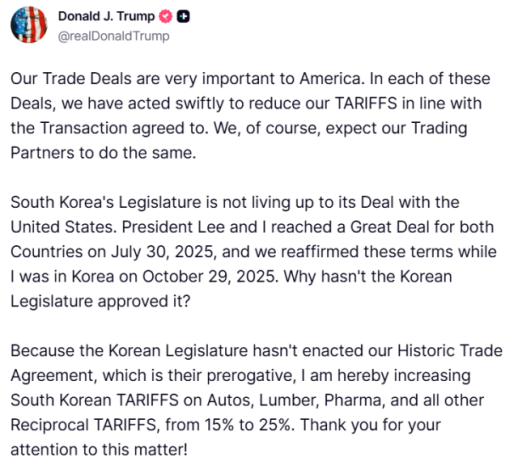 Trump threatens to raise tariffs back to 25%, blaming Seoul for delaying tariff deal SEOUL, January 27 (AJP) -U.S. President Donald Trump said Monday he is raising tariffs on a wide range of South Korean goods from 15 percent to 25 percent, citing delays in South Korea’s National Assembly approving a bilateral trade agreement reached last year. “Because the Korean Legislature hasn’t enacted our Historic Trade Agreement, which is their prerogative, I am hereby increasing South Korean TARIFFS on Autos, Lumber, Pharma, and all other Reciprocal TARIFFS, from 15% to 25%,” Trump wrote in a post on Truth Social. It was not immediately clear when the higher tariffs would take effect. Trump said the decision followed South Korea’s failure to ratify a trade package he described as a “Great Deal” reached with President Lee Jae Myung on July 30, 2025, and reaffirmed during his visit to Korea late October. The White House has yet to confirm Trump's remark. Seoul also has not responded. The October understanding was billed by the White House at the time as a sweeping $350 billion trade and investment framework, aimed at expanding U.S. exports and investment flows while easing tariff and non-tariff barriers between the two allies. The package reportedly covered market access in autos, pharmaceuticals and industrial materials, alongside commitments related to supply chains, energy cooperation and long-term Korean investment in the United States. “South Korea’s Legislature is not living up to its Deal with the United States,” Trump wrote, questioning why the agreement had yet to be enacted despite what he called repeated reaffirmations at the leadership level. The tariff hike directly affects key Korean export sectors. Autos are expected to be among the hardest hit, with Hyundai Motor Group the largest importer of South Korean-made vehicles into the U.S. market. Pharmaceuticals and industrial materials such as lumber were also singled out in Trump’s post. A senior-level U.S. delegation is expected to visit Seoul to negotiate the details to the factsheet released in November that differs in some areas with Seoul's separate announcement on the deal. 2026-01-27 07:34:29