
Journalist

AJP
-
 Court Upholds Order to Disclose Yeongpoong-MBK Deal Papers in Korea Zinc Fight MBK Partners and Yeongpoong remain locked in a legal dispute over whether contract documents tied to their bid to take control of Korea Zinc must be disclosed. According to Yonhap News Agency on May 5, the Seoul High Court’s Civil Division 25-2 rejected an immediate appeal filed by Jang Hyeong-jin, an adviser at Yeongpoong, challenging a court order to submit documents related to a management cooperation agreement. Korea Zinc, through its affiliate KZ Precision, had asked the court to order disclosure of contracts, including a call option agreement, that Yeongpoong and MBK Partners signed while pursuing what Korea Zinc describes as a hostile merger-and-acquisition attempt. After a lower court granted the request in December, the appeals court also concluded that all contract documents between MBK Partners and Yeongpoong must be disclosed. KZ Precision said the court recognized the request as a legitimate exercise of shareholder oversight and noted that Yeongpoong’s potential damages could vary depending on parts of the contracts that have not yet been publicly disclosed. MBK Partners said it signed a shareholder agreement in September 2024 with Yeongpoong and members of Jang’s family to jointly exercise voting rights, and that it would be granted call options on some shares owned by Yeongpoong and related parties. Korea Zinc has alleged that Yeongpoong entered into the call option deal to allow MBK to buy Yeongpoong’s Korea Zinc shares at a low price, raising suspicions including breach of trust. Korea Zinc has filed a shareholder derivative lawsuit seeking about 930 billion won against Jang and Yeongpoong directors. Separately, Yeongpoong said an immediate appeal filed by KZ Precision in another case over a document submission order for a management cooperation agreement was also rejected on April 29, following a lower-court decision. In that case, KZ Precision filed a lawsuit seeking to stop what it calls illegal conduct, arguing the management cooperation agreement amounts to breaches of Yeongpoong directors’ duties of care and loyalty and constitutes breach-of-trust conduct. It also sought a court order requiring submission of related contract documents during the proceedings.* This article has been translated by AI. 2026-05-05 21:03:15
 -
 Iran Foreign Minister Heads to Beijing for Talks With China’s Wang Yi Amid Hormuz Tensions As the United States and Iran entered an armed standoff over the Strait of Hormuz, Iranian Foreign Minister Abbas Araghchi traveled to China on 5 (local time), Iran’s Foreign Ministry said. Yonhap News Agency reported that Iran’s Foreign Ministry said on its Telegram channel that Araghchi would visit Beijing. The ministry said Araghchi plans to exchange views with China’s foreign minister on ways to develop bilateral relations and on rapidly changing regional and international developments. China’s Foreign Ministry also said in an afternoon statement on 5 that Araghchi, responding to an invitation, is scheduled to visit China on 6. A spokesperson said Wang Yi, a member of the Political Bureau of the Communist Party of China Central Committee and China’s foreign minister, will meet with Araghchi. Araghchi and Wang spoke by phone on April 15 to discuss the war situation and other issues. At the time, Wang said that as a coastal state on the Strait of Hormuz, Iran’s sovereignty, security and legitimate rights and interests should be respected and protected, while freedom and safety of navigation through the international waterway must also be ensured. He said efforts to restore normal passage through the strait were “the unified voice” of the international community. Wang added that China supports maintaining momentum toward a ceasefire and negotiations. Earlier, the U.S. military used force on the first day of what it called the “Liberation Project,” deploying Apache helicopters in the Strait of Hormuz and sinking Iranian fast boats that were threatening merchant ships, in an effort to ensure safe passage. Iran also fired missiles and drones toward the United Arab Emirates, about a month after a ceasefire took effect on April 8, keeping the standoff going.* This article has been translated by AI. 2026-05-05 20:54:15
 -
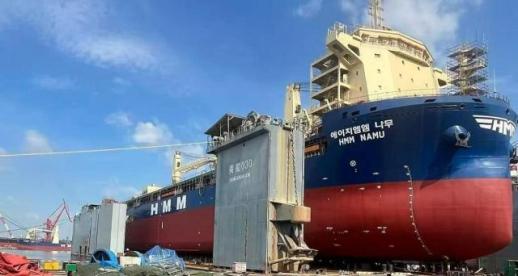 South Korea to Probe HMM Ship Fire After Blast in Strait of Hormuz A process is expected to move forward to determine the cause of a fire that broke out with an explosion aboard the HMM Namu, a vessel operated by South Korean shipping company HMM in the Strait of Hormuz. Yonhap reported on May 5 that the Cheong Wa Dae said it plans to tow the ship to a nearby port and then dispatch personnel from the Dubai office of the Korean Register, investigators from the Central Maritime Safety Tribunal and forensic experts from the National Fire Agency to examine the cause. When a ship cannot navigate under its own power after a fire at sea, it is typically moved to a nearby port by tugboat. The HMM Namu was believed to be unable to sail on its own due to the fire. An emergency backup generator was operating, and food and drinking water were secured, so life aboard the ship was reported to be stable for the 24 crew members, including six South Koreans. Once a tugboat is arranged, the HMM Namu is expected to head to Dubai Port. A full investigation is to begin after the ship berths there. The Korean Register, the Central Maritime Safety Tribunal and the National Fire Agency are among the agencies deployed to investigate the causes of maritime accidents. The Korean Register is a full member of the International Association of Classification Societies and conducts inspections and certification to ensure ship safety and quality. The Central Maritime Safety Tribunal is a quasi-judicial body under the Ministry of Oceans and Fisheries that determines the causes of maritime accidents and issues rulings. The National Fire Agency works with the tribunal on on-site examinations to identify the cause of ship fires. If the incident is confirmed to have resulted from an Iranian attack, it is expected to carry significant diplomatic repercussions.* This article has been translated by AI. 2026-05-05 20:48:15
 -
 WHO Raises Concern of Possible Person-to-Person Hantavirus Spread on Atlantic Cruise Ship The World Health Organization said it suspects a hantavirus outbreak on an Atlantic cruise ship may have involved person-to-person transmission. Maria Van Kerkhove, the WHO’s director for epidemic and pandemic preparedness and prevention, told reporters on May 5 (local time) that “we think there may have been human-to-human transmission among very close contacts,” adding that the first patient may have been infected before boarding. Hantavirus is typically spread through exposure to rodent urine, droppings or saliva. In rare cases, it can also spread between people. According to the WHO, there have been two confirmed cases and five suspected cases linked to the Dutch-flagged cruise ship MV Hondius, which is currently in the territorial waters of Cabo Verde. Three people have died: a Dutch couple, ages 70 and 69, and a German national. Reuters reported that the Dutch couple, the first fatalities, had traveled in South America, including Argentina, before boarding the MV Hondius, which departed from the southern tip of Argentina. The WHO said Spain has decided to accept the ship, which has 147 passengers and crew aboard, and it is heading to Spain’s Canary Islands off West Africa. The MV Hondius is a luxury cruise ship that departed in late March, carrying mainly passengers from the United Kingdom, the United States and Spain, and is reported to have visited remote areas including the Antarctic Peninsula and South Georgia Island. The operator, Oceanwide Expeditions, said that of the seven people confirmed or suspected to be infected, four — including the German who died and other suspected cases — remain on the ship. The Dutch couple died, and a British passenger is hospitalized in an intensive care unit in Johannesburg, South Africa. Hantavirus was first identified in rodents near the Hantan River by the late South Korean virologist Lee Ho-wang. Early symptoms can include fatigue, fever, chills and muscle aches that may feel like the flu. As the virus damages the heart, lungs and kidneys, it can lead to severe respiratory illness and organ failure. * This article has been translated by AI. 2026-05-05 20:36:06
 -
 Iran Foreign Minister Visits China as U.S.-Iran Tensions Rise in Strait of Hormuz Iranian Foreign Minister Abbas Araghchi traveled to China on May 5 local time as the United States and Iran faced off militarily over the Strait of Hormuz. Iran’s Foreign Ministry said on its Telegram channel that Araghchi would visit Beijing that day, according to Yonhap News Agency. The ministry said Araghchi plans to meet China’s foreign minister to discuss ways to develop bilateral ties and to exchange views on rapidly shifting regional and international conditions. Araghchi and Wang Yi, director of the Chinese Communist Party Central Commission for Foreign Affairs and foreign minister, spoke by phone on April 15 to discuss the war situation, the ministry said. Wang said Iran’s sovereignty, security and legitimate rights as a country on the Strait of Hormuz should be respected and protected, while freedom and safety of navigation through the international waterway must also be ensured. He added that efforts to restore normal passage through the strait reflect a unified voice of the international community. Wang also said China supports maintaining momentum toward a ceasefire and negotiations. The report said U.S. forces used force a day earlier, on the first day of what it called the “Liberation Project,” deploying Apache helicopters to sink Iranian fast boats that were threatening merchant ships in the Strait of Hormuz. Iran, in response, launched missiles and drones toward the United Arab Emirates, continuing a standoff about a month after a ceasefire took effect on April 8, the report said.* This article has been translated by AI. 2026-05-05 20:03:15
 -
 HMM cargo ship that caught fire near Strait of Hormuz awaits tow to Dubai An HMM-operated cargo ship that caught fire while anchored in the Strait of Hormuz is running on an emergency generator and waiting to be towed, the company said. Yonhap reported Tuesday that the HMM NAMU remained in waters near the United Arab Emirates, where the fire broke out a day earlier. The blaze triggered an automatic power shutdown, leaving the vessel unable to move under its own power. Once a tug is secured, it is expected to be taken to Dubai port. Six South Korean crew members plan to return home afterward. HMM said all 24 crew members, including the South Koreans, stayed aboard and reported no injuries or other harm from the fire. An HMM official said the crew could disembark immediately if they chose, but appeared to have decided to remain because the fire had been extinguished and there were no additional risk factors. The company said it was seeking tugboats in the UAE and Saudi Arabia, coordinating from its ship operations situation room in Busan. HMM said it could take several days to begin an investigation into the cause, given towing procedures and the sailing schedule. Crew members have not yet entered the area where the fire occurred, it said. An explosion and fire broke out at about 8:40 p.m. Monday (Korea time) on the HMM NAMU in waters near the UAE within the Strait of Hormuz. No casualties were reported.* This article has been translated by AI. 2026-05-05 19:36:15
 -
 Nvidia CEO Jensen Huang backs U.S. government in dispute with Anthropic Nvidia CEO Jensen Huang has sided with the U.S. government in a dispute between U.S. AI company Anthropic and the Department of Defense. According to Yonhap, Huang said at the Milken Global Conference 2026 economic and finance forum held Sunday afternoon local time at the Beverly Hilton in Los Angeles that he “fully believes the government will use technology in the right way.” He praised Anthropic as “an amazing company with a great culture and a deeply rooted belief system,” but added, “I don’t agree with all of their positions.” Huang said his view is that if the U.S. government decides to use technology to protect the country and families, and that use is legal and for national security, “I would hope they wouldn’t ask me whether they can use that technology in wartime.” Noting that “a CEO is not an elected official,” he said people who disagree can vote or protest as citizens, but he would not “stand in the way when the country is trying to protect our families.” Anthropic has provided its AI model, Claude, to U.S. military classified systems. But it has clashed with the Pentagon by saying its model should not be used for large-scale surveillance of Americans or fully autonomous weapons. The Defense Department, in a rare move involving a U.S. company, designated Anthropic as a “supply chain risk to national security.” Defense Secretary Pete Hegseth and President Donald Trump have also sharply criticized Anthropic. * This article has been translated by AI. 2026-05-05 19:24:28
 -
 South Korea Forecast: Sunny Wednesday With Highs Up to 27C, Big Day-Night Swings Wednesday the 6th is expected to be clear nationwide, with a wide gap between daytime highs and overnight lows. The Korea Meteorological Administration forecast morning lows of 7-16C and daytime highs of 21-27C. Under the influence of a high-pressure system moving east from the southern Yellow Sea, inland areas are expected to see day-night temperature differences of around 15C, the agency said. Forecast morning lows in major cities are: Seoul 11C, Incheon 12C, Chuncheon 7C, Gangneung 16C, Daejeon 10C, Daegu 9C, Jeonju 11C, Gwangju 9C, Busan 12C and Jeju 12C. Forecast highs are: Seoul 23C, Incheon 21C, Chuncheon 24C, Gangneung 25C, Daejeon 25C, Daegu 26C, Jeonju 25C, Gwangju 25C, Busan 22C and Jeju 21C. Fog is expected in parts of the mid-Yellow Sea offshore waters, and mariners are advised to use caution. Some islands in South Jeolla province may see dense fog with visibility under 200 meters and light drizzle through the morning. Waves are forecast at 0.5 to 1.0 meters in nearshore waters of the East and Yellow seas and 0.5 to 1.0 meters in the nearshore South Sea. In offshore waters, wave heights are expected at 0.5-2.5 meters in the East Sea, 0.5-2.0 meters in the Yellow Sea and 0.5-1.5 meters in the South Sea. Fine dust levels are expected to range from "good" to "moderate" nationwide. 2026-05-05 19:15:16
 -
 PPP leader warns lawmakers backing independent Han Dong-hoon in Busan by-election People Power Party leader Jang Dong-hyeok said May 5 that lawmakers who entered the National Assembly on a party nomination have “roles and responsibilities” that come with it, in remarks widely seen as a warning to party members backing independent candidate Han Dong-hoon in the Busan Buk-gu Gap by-election. Pro-Han lawmakers pushed back, arguing that conservatives should rally behind strong candidates beyond party lines. The public exchange has raised concerns that factional tensions could flare again ahead of the June 3 local elections and National Assembly by-elections. At a morning news conference at the National Assembly, Jang was asked about Rep. Han Ji-a’s recent actions. He said the party has “principles and standards” and must uphold them to function as a public party. He added that he would clarify the facts behind “various situations” and take necessary steps. The “situations” referred to Han Ji-a’s visit the previous day to Han Dong-hoon’s preliminary candidate registration event. Some in the PPP leadership view support for Han Dong-hoon — who is running as an independent despite the party having its own candidate — as an act of disloyalty. Jang had said on April 23 that the party would take strong action against such conduct. His comments followed remarks a day earlier by floor leader Song Eon-seok that suggested possible disciplinary steps against Han Ji-a. Han Ji-a, however, doubled down at an afternoon news conference, saying she would go to Busan “10 times, 100 times” if it helps rebuild conservatives. She urged the party leadership to stop “attacking from within” and focus on strategy. She said she believes voters will choose those within the conservative camp who “spoke up” and made “the right choice” after the imposition of emergency martial law, adding that conservatives need to unite behind good candidates across party lines. Rep. Bae Hyun-jin, also considered part of the pro-Han faction, weighed in on Facebook. She wrote that Han Dong-hoon, whom she said was pushed out through a forced expulsion, is “a People Power Party person,” and urged the leadership not to interfere with lawmakers’ personal views but to listen to them. With internal divisions deepening, prospects appear dim for a unified conservative candidacy in Busan Buk-gu Gap. Asked about possible cooperation with Han Dong-hoon, Jang drew a line, saying Han is someone the party expelled on principle. Park Min-sik, the former minister of Patriots and Veterans Affairs who was selected that day as the PPP’s candidate for Busan Buk-gu Gap, also dismissed any merger of candidacies. “The possibility is zero,” Park said, adding, “Stop running wishful thinking. If you entered the race, you should face voters’ judgment with confidence.”* This article has been translated by AI. 2026-05-05 19:06:16
 -
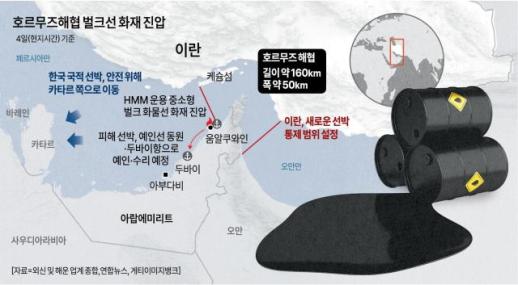 Suspected Iran Attack on Korean Cargo Ship Raises Hormuz Risks, Oil Price Concerns Suspicions that Iran attacked the Korean cargo ship NAMU have sharply raised tensions around the Strait of Hormuz, fueling concerns that South Korea’s crude oil supply strategy could be disrupted if Korean-operated vessels become targets. The renewed Middle East risk is also pushing international oil prices higher, adding another policy variable for Seoul. According to relevant authorities on May 5, a fire broke out in the engine room of the NAMU after an explosion at about 8:40 p.m. the previous day while the ship was anchored in waters north of Sharjah in the United Arab Emirates, inside the Strait of Hormuz. The vessel is Panama-flagged and operated by South Korean shipping company HMM. It had 24 crew members aboard: six South Koreans and 18 foreign nationals. Regional tensions have intensified. Iran has attacked oil export ports and other sites with missiles and drones, and the UAE has warned of retaliation. A ceasefire between the United States and Iran also appeared to be on shaky ground. Iran, strongly opposing the U.S. “Project Freedom,” launched missiles and drones, and U.S. naval vessels have continued intercepting them. As a result, expectations that South Korean tankers could leave the Strait of Hormuz in the near term have largely faded. Seven tankers linked to South Korean refiners — carrying about 14 million barrels — remain stuck in the strait, and rising tensions have further reduced the likelihood they can depart soon. A bigger concern is the possibility of a targeted attack on a Korean shipping operator. If it is confirmed that Iran deliberately targeted a South Korean vessel, disruptions would be difficult to avoid even for crude supplies rerouted via the Red Sea, where the Iran-aligned Houthi rebels remain active, the report said. The situation could also complicate the Industry Ministry’s crude supply planning. Alternative crude secured for this month totals 74.62 million barrels, or 87% of normal import volumes. But if tensions rise simultaneously in the Strait of Hormuz and the Red Sea, bottlenecks could worsen at alternative ports such as Yanbu in Saudi Arabia, making even those volumes harder to bring in. With many tankers already waiting, delays would be hard to avoid, the report said. Higher shipping rates and insurance premiums are another concern. If costs rise as tensions mount, they would likely be passed on to crude prices with a lag. Oil markets reacted immediately. Despite an output increase announced by seven countries in OPEC+, prices kept climbing. At the close, Brent crude futures settled at $114.44 a barrel, up 5.80% from the previous session, while U.S. West Texas Intermediate futures rose 4.39% to $106.42. Still, the impact on spot prices remains unclear. The Dubai crude spot market — a benchmark for South Korea’s Middle East crude imports — has not yet fully reflected the heightened tensions, and the same is true for Singapore’s MOPS oil product prices. With the fifth round of the fuel price-cap system set to take effect May 8, the government’s calculations have become more complicated. A key reason for holding the benchmark steady in the third and fourth rounds was stable international oil prices. But with crude above $100 a barrel and Middle East risks rising, the outlook has become harder to predict, making it difficult to maintain the previous freeze, the report said. Retail prices have continued to rise despite the government’s freeze. As of 2 p.m., Opinet data showed the national average gasoline price at 2,011.42 won per liter and diesel at 2,005.46 won, up 0.38 won and 0.25 won, respectively, from the previous day. * This article has been translated by AI. 2026-05-05 19:03:06