
Journalist

AJP
-
 Toss to End Fractional Investment Service After Three Years, Citing Profit Limits Toss is shutting down its fractional investment-linked service after operating it for about three years, despite the sector’s move into the regulated financial system. The decision reflects a broader assessment of market size and profitability, industry officials said. According to the financial industry on the 19th, Viva Republica, the operator of Toss, will end the fractional investing service in its app starting on the 21st. Toss launched the service in the first half of 2023 and has since brokered related products. It did not issue or manage the products itself, instead introducing or linking offerings from partner firms on its platform. Fractional investing refers to products that split underlying assets into multiple shares so many investors can invest together. The assets can include physical items such as gold, real estate and art, as well as revenue rights tied to copyrights or energy projects. Toss has featured products tied to gold, exchange-traded funds and real estate, along with less common assets such as copyrights, renewable energy, calves and art. But the market cooled quickly, with delays in formal regulation cited as a key factor. Financial authorities announced plans in early 2023 to build rules for new securities businesses such as fractional investing, but related bills only recently passed the National Assembly. On Jan. 15, lawmakers approved amendments to the Act on Electronic Registration of Stocks and Bonds and the Financial Investment Services and Capital Markets Act, a process that took about three years. During that period, momentum weakened. Some operators scaled back or exited, and new product launches fell sharply. Toss’ service was also run in a limited way through specific partners, and there have been no recent new public offerings. Even after regulation, industry participants say conditions remain challenging. On Feb. 13, the Financial Services Commission granted preliminary approval to two exchanges — the NXT consortium and KDX — to handle over-the-counter trading of fractional investment securities. The NXT consortium is led by alternative trading platform Nextrade (NXT) as its largest shareholder, while KDX is a consortium led by the Korea Exchange. With distribution channels likely limited to those exchanges for now, market expansion could be constrained. For a platform operator like Toss, it may be difficult to generate meaningful revenue with a simple referral model under that structure, given the relatively small issuance size of individual products and a narrower investor base than in stock or crypto markets. Analysts said that even as rules are being finalized, the business is entering a transition period that is forcing strategic changes. A Toss official said the company decided to end the service in its current form after reviewing regulatory changes and the business structure. The official added that the fractional investing market is being reshaped as legal and institutional frameworks are completed and distribution and issuance structures are reorganized, and that Toss will closely monitor conditions before deciding whether to pursue a new approach. 2026-02-19 10:45:00
 -
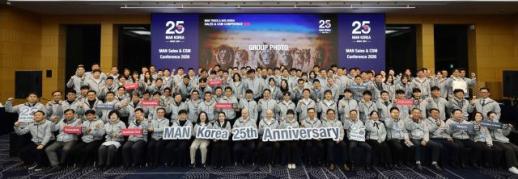 MAN Truck & Bus Korea Holds 2026 Sales and CSM Conference in Cheongju MAN Truck & Bus Korea said it held its “2026 Sales & CSM Conference” on Feb. 11 in Cheongju. The company said the event was designed to mark the start of its 25th year since establishing its Korean unit, review last year’s results and share key tasks for this year. About 160 people attended, including President Peter Andersson, employees, representatives from sales branches and service centers nationwide, and officials from MAN Financial Services. Under the motto “Stronger Together,” the conference reviewed last year’s performance and shared 2026 strategic directions and major tasks across core areas including products, services and finance. The company also held internal networking sessions aimed at strengthening coordination and collaboration. MAN Truck said it surpassed cumulative sales of 15,000 units last year despite a challenging market, which it said demonstrated strong brand competitiveness. It said it strengthened its lineup with new products tailored to the Korean market and announced its “MAN CORE 360” strategy. The company also focused on service capabilities by opening a company-run service center in Busan, launching the “MyMAN Korea” mobile app, and running “MAN Service Day,” a free on-site inspection program. This year, the company said it will continue to develop customer-focused business activities by expanding customer participation programs such as total cost of ownership reduction initiatives and test-drive events. It also plans to pursue the opening of a service center in Icheon and to improve service quality through skills development and structured training under its Ausbildung program. The engine division plans to strengthen its position in marine and energy engines with new engines that apply gas-engine technology and solutions based on MAN Smart Hybrid, the company said. An awards ceremony was also held to recognize top-performing sales staff and service centers from last year. Awards were presented in 21 categories, including top overall sales, top sales by product, highest year-over-year growth in sales, best CXI (customer experience index) service center, and best SSD (service site development) service center. MAN Truck also held a special event to support 18 trainees starting the eighth class of its German-style vocational training program, Ausbildung. The program combines on-the-job training with classroom instruction to develop skilled technical workers. MAN Truck said it has selected a total of 124 trainees since 2018, after signing a business agreement with the Korean-German Chamber of Commerce and Industry. “Over the past 25 years, MAN Truck’s development in the Korean market has been possible thanks to the dedication of our employees across sales, service and headquarters, and our customers’ continued trust,” Andersson said. “This year, we will expand our activities in Korea by introducing new products and services and strengthen customer-centered business solutions.”* This article has been translated by AI. 2026-02-19 10:39:00
 -
 Jeju Air Says Holiday Pet Passengers Rose Up to 26% Jeju Air said the number of passengers flying with pets during major holiday breaks rose by as much as 26% compared with typical periods. The airline said Thursday that about 18,200 passengers flew with pets last year, averaging about 1,500 a month. During holiday periods such as Lunar New Year and Chuseok, and during the August summer vacation season, the figure climbed as much as 26.6% to about 1,900. Jeju Air said pet-travel bookings this month have topped about 2,000. On Feb. 14, the day the holiday travel period began in earnest, 120 passengers flew with pets. The airline attributed the increase to the growing number of “pet parents” who consider animals part of the family and travel with them during holidays and vacations. Jeju Air limits in-cabin pets to six per flight, with a maximum weight of 9 kilograms, including the carrier. Its pet transport service, which assigns a dedicated seat, costs 25,000 won on domestic routes and 70,000 to 100,000 won on international routes depending on the itinerary. The airline said travelers taking pets overseas should carefully check country-specific rules, required documents and vaccination timelines. A Jeju Air official said the company’s pet membership offers unlimited annual pet travel and perks such as an extra 5 kilograms of checked baggage, providing “essential services” at a lower cost. 2026-02-19 10:24:00
 -
 Cheonwoo Motors Wins Lexus Korea’s 2025 Best Dealer Award for Fifth Time Lexus authorized dealer Cheonwoo Motors was named “Best Dealer” at the “2025 Lexus Dealer Convention” selected by Lexus Korea, held on Feb. 10. The honor marked Cheonwoo Motors’ fifth win, the most among Lexus’ eight dealer groups. Cheonwoo Motors first won in 2009 and has since received the award in 2019, 2020, 2023 and 2025. The company said the recognition followed strong results in Lexus Korea’s annual internal evaluation based on objective criteria. Cheonwoo Motors attributed the performance to customer care built around the idea that “the sale is not the end, but the beginning.” The company said it has worked to stay connected with customers after delivery by running invitation programs such as golf, horseback riding, baseball and billiards lessons, as well as a camping festival, to boost retention. CEO Jung Se-rim said the fifth award reflects efforts beyond sales. “This fifth win is the result of Cheonwoo’s work to move beyond simply selling more cars and to delight each customer by meeting their car-life needs,” Jung said. “We will continue to pursue change, improvement and new challenges.” 2026-02-19 10:19:11
 -
 Charlotte Theater Marks 20th Anniversary, Unveils 2026 Musical Lineup Including 'Dream of the Peach Blossom Land' and 'Frozen' South Korea’s first theater dedicated exclusively to musicals, Charlotte Theater, on the 19th announced its 2026 season lineup. Marking its 20th anniversary this year, the venue said it will continue to present a wide-ranging slate of productions from Korea and abroad. The long-running musical ‘Kinky Boots’ will continue through March 29 for its grand finale. Beginning in April, the original Korean musical ‘Dream of the Peach Blossom Land’ will take the stage, which the theater described as a showcase of Korean storytelling and aesthetics. Starting in August, the musical ‘Frozen (FROZEN)’ will open its first run in South Korea. The production is a stage adaptation of the hit film ‘Frozen.’ To mark the 20th anniversary, Charlotte Theater also plans promotions including an in-theater guestbook and photo zone. Using stories and photos submitted online, it will produce and release a “Charlotte Theater poster made by the audience.” The theater also plans to roll out a series of 20th-anniversary limited-edition merchandise items.* This article has been translated by AI. 2026-02-19 10:03:00
 -
 Disney+ ‘Fate War 49’ Producers Say Family Approved Use of Fallen Firefighter’s Story Disney+ variety show ‘Fate War 49’ has drawn criticism for using a fallen firefighter’s death as material for a fortune-reading mission, prompting producers to issue a statement. In a statement released on Feb. 18, the production team said the personal stories featured in the program were provided “based on prior consultation and explanation” and with “understanding and consent” from the individuals involved or their families or representatives. The team said it informed them of the show’s concept and format as a survival program featuring fortune-tellers, and also obtained consent to provide related information and use images. “We fully recognized the sensitivity of the matter and carefully reviewed the content throughout the production process,” it said. ‘Fate War 49’ is a survival entertainment series in which 49 fortune-tellers compete through missions to test their abilities. Controversy centered on the second episode released on Feb. 11, which included a mission titled “Guessing the cause of death.” The show presented clues such as photos of the deceased and the time of birth and death, and shamans were shown inferring the cause of death from that information. Viewers particularly objected after the episode included a fortune-reading segment involving the late firefighter Kim Cheol-hong, who died in the line of duty at a 2001 fire in Hongje-dong, Seodaemun-gu, Seoul. A social media user claiming to be a family member posted a protest message, saying the show “demeans the death of someone who died saving others,” fueling the backlash. Another user who said they are Kim’s nephew wrote that after listening to a recorded call between a writer and the user’s aunt, they understood the show had said a shaman would appear and that the segment would use fortune-telling to show what kind of person Kim was and honor his “noble sacrifice.” But after watching the broadcast, the user said, the shamans were trying to guess how he died while cast members reacted with amazement and laughter. “I don’t understand how this honors my uncle’s sacrifice,” the user wrote.* This article has been translated by AI. 2026-02-19 09:42:00
 -
 Comedian Kim Ji-min Says She Injured Her Face in a Fall Comedian Kim Ji-min said she was injured in a fall. Kim wrote on social media on Tuesday that she fell and hit her face while getting out after taking a half-body bath 10 days earlier, posting photos along with the message. “The bruising has gone down, but maybe my cheek muscle is knotted — a strange spot sinks in like a dimple,” she wrote, asking if anyone knew how it should be treated. Online commenters responded with messages such as “Hope you get well soon” and “Go to the hospital quickly.” Kim married comedian Kim Jun-ho in July last year. The couple has been reported to be preparing to have a child.* This article has been translated by AI. 2026-02-19 09:39:00
 -
 Kim Yo-jong strikes conciliatory tone again over Seoul's regret on drone incursions SEOUL, February 19 (AJP) - Kim Yo-jong, the sister of North Korean leader Kim Jong-un, once again struck a positive note toward South Korea. In a statement carried on Thursday by the state-run Korean Central News Agency (KCNA), Kim said she "highly appreciates" South Korea's Unification Minister Chung Dong-young's expression of regret the previous day over drones allegedly sent by civilians to the North, as well as his pledge to prevent a recurrence. It was Kim's another reply to Chung, who made similar remarks last week. In a briefing on Wednesday, Chung again stressed that the South would take steps to prevent such incidents. He also pledged to pursue the restoration of the 2018 inter-Korean military pact, scrapped in 2024 under the previous administration's hardline stance toward the North, as part of efforts that had aimed to ease military tensions between the two Koreas. But Kim warned that any future violation, regardless of who is responsible, would result in "terrible consequences," calling her words not a threat but a "clear warning." Pundits believe Kim's statement was also intended to justify tougher measures along the border. 2026-02-19 09:27:40
 -
 HYBE America’s Big Machine Label Group Rebrands as Blue Highway Records, Names Jake Basden CEO HYBE America said Tuesday that its label Big Machine Label Group, or BMLG, has rebranded as Blue Highway Records and appointed music and marketing veteran Jake Basden as CEO. The company said Blue Highway Records will keep BMLG’s existing assets, distribution deals and roster. Its artists and songwriters include Thomas Rhett, Brett Young, Justin Moore, Carly Pearce and Preston Cooper. Through Nashville Harbor Records & Entertainment, it handles distribution for Riley Green, The Band Perry and Greylan James. Valory Music is set to be folded into Blue Highway Records, while publishing company Big Machine Music will remain under HYBE America. Basden most recently served as president of Nashville-based Sandbox Management, overseeing artist management and business development. HYBE America said he has worked with artists including Kacey Musgraves, Brandi Carlile, Kate Hudson and Kelsea Ballerini. Basden previously served at BMLG as senior vice president of publicity, working closely with Taylor Swift, Sheryl Crow, Tim McGraw and Steven Tyler, the company said. It also credited him with leading music campaigns for NBC’s “The Voice” and Fox’s “American Idol,” and noted that a song from the documentary “Glen Campbell: I’ll Be Me” earned an Academy Award nomination for best original song. Isaac Lee, HYBE America’s chairman and CEO, said the company prioritized choosing “someone who puts artists first” and called Basden a strong fit with deep ties to Nashville’s music community. Lee said Basden’s experience and “modern sensibility” for the digital era will help Blue Highway Records grow and expand HYBE’s influence in North America. Basden said Blue Highway Records is well positioned to help define the future sound of country and American roots music. He said combining HYBE’s capabilities with global synergy would remove limits on creativity, and that he plans to work with current and future artists on music and projects that resonate with audiences. Scott Borchetta, who led BMLG, recently left the company and reacquired the brand rights to “Big Machine Records” from HYBE America.* This article has been translated by AI. 2026-02-19 09:09:00
 -
 Opera Singer Lim Hyung-joo Calls His Award Certificates His 'Wife, Girlfriend and Child' Opera singer Lim Hyung-joo said he thinks of the award certificates he has received as his wife, girlfriend and child. Lim appeared on TV Chosun’s “Dad and Me,” which aired on Feb. 18. On the show, he opened his “certificate room” and said, “I call certificates babies,” adding, “To me, certificates are a girlfriend, a wife and a child.” Host Jun Hyun-moo sighed and joked, “You’ll never get married.” When Lim said being in the room brings him mental calm, Jun teased, “You’ve got a lot of girlfriends.” Lim said he wants to collect 100 certificates but has 77 so far. He added that his mother does not like them much and has said she wants to get rid of the certificate room, which is why it is located next to the garage. * This article has been translated by AI. 2026-02-19 08:39:00