
Journalist

AJP
-
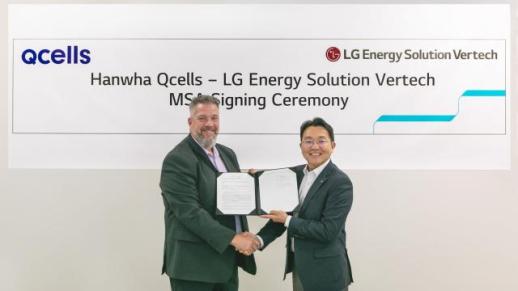 LG Energy Solution, Hanwha Qcells team up to target US energy storage boom SEOUL, February 04 (AJP) - LG Energy Solution (LGES) and Hanwha Qcells have joined hands to strengthen their position in the fast-growing U.S. market for large-scale energy storage systems. Industry sources said Wednesday that Hanwha Qcells plans to procure up to 5 gigawatt-hours of lithium iron phosphate (LFP) batteries from LGES’s plant in Holland, Michigan. The batteries will be deployed in U.S. ESS projects where Hanwha Qcells will oversee engineering, procurement and construction between 2028 and 2030. The arrangement also covers long-term operation and maintenance services, signaling a strategic partnership rather than a one-off supply agreement. The cooperation comes as structural shifts reshape the U.S. power market. Rapid growth in AI-driven data centers and broader electrification are boosting electricity demand, while permitting and transmission constraints slow the addition of new generation capacity. As a result, large-scale storage systems that can balance load fluctuations and support grid stability are emerging as critical infrastructure. Consultancy Wood Mackenzie forecasts nearly 318 GWh of new ESS installations in the United States over the next five years. Hanwha Qcells is emphasizing local sourcing to enhance eligibility for U.S. incentives such as advanced manufacturing and investment tax credits, while strengthening compliance with domestic content requirements. Once its solar manufacturing complex under construction in Georgia — dubbed the Solar Hub — is completed, the company expects to operate a localized production network covering both solar modules and storage solutions. Industry officials describe the partnership as a role-based strategy in which Hanwha Qcells focuses on project development, EPC services and solar supply, while LGES provides U.S.-based battery manufacturing and operational support. LFP batteries are widely viewed as suitable for large-scale ESS due to safety and longer cycle life, making them attractive for grid and data center applications. * This article, published by Aju Business Daily, was translated by AI and edited by AJP. 2026-02-04 11:09:17
 -
 BTS Comeback D-45: homecoming along the royal axis SEOUL, February 04 (AJP) - The comeback of BTS is set trace one of Seoul's most resonant historical lines: the so-called King's road, the ceremonial axis once reserved for Joseon-era monarchs. The route runs from Geunjeongmun through Heungnyemun to Gwanghwamun, culminating at the Weoldae, a stone platform where kings appeared before the public. Built in 1866, the Weoldae was dismantled during the colonial period and remained lost for more than a century before being restored in 2023. In the Joseon court, the axis symbolized sovereign authority and ritual order; today, it anchors one of Seoul’s most visible public spaces. By staging its return along this line, BTS frames its comeback as a modern reinterpretation of a royal entrance — not a reenactment, but a cultural echo that links contemporary pop spectacle with historical memory. According to Seoul city officials, BTS’s team is discussing plans to install the concert stage at the northern end of Gwanghwamun Square, directly facing the Weoldae in front of Gwanghwamun. The venue is expected to accommodate roughly 34,000 spectators, including about 17,000 main seats in front of the stage and another 17,000 side seats in adjacent areas. From parts of the audience, the performance will unfold against views of the Statue of King Sejong or the Statue of Admiral Yi Sun-shin, two figures central to Korea’s historical narrative. The concert will be free of charge, with tickets distributed through advance reservations on BTS’s fan platform, Weverse. Detailed booking information is expected to be announced at a later date. The venue itself sits along a straight north–south urban axis that defines central Seoul. Attendees entering via Gwanghwamun Station, Exit 1 will pass the Statue of King Sejong, a central landmark of Gwanghwamun Square, before reaching the stage area. To the east lies the Uijeongbu Historical Plaza, while the west is bordered by the Government Complex Seoul and the former Office of the Censor-General, situating the concert within the ceremonial and administrative heart of the Joseon era. BTS has also applied for permits to use and film major heritage sites around Gwanghwamun, including Gyeongbokgung Palace gates, the Gwanghwamun–Weoldae area, and Sungnyemun. Reporting indicates that the King’s Road route may be used as the concert’s opening sequence, with footage of the members’ procession shown through pre-recorded segments or partial live broadcast. Meanwhile, Netflix said it will exclusively livestream “BTS Comeback Live: Arirang” to audiences in 190 countries, marking the first time the platform has live-streamed a single artist’s standalone concert on an exclusive, real-time basis. Netflix will co-produce and stage the Gwanghwamun Square performance alongside HYBE, with direction by Hamish Hamilton, known for helming multiple Super Bowl halftime shows since 2010. Following the concert, a documentary film, “BTS: The Return” will premiere on Netflix on March 27, chronicling the making of the group’s new album Arirang. Directed by Vietnamese filmmaker Bao Nguyen, the film traces BTS’s creative journey toward its first full-member release in three years and nine months, with both the live broadcast and documentary produced by Done and Dusted. 2026-02-04 10:45:11
 -
 POSCO to deploy humanoid robots at steel mills in logistics push SEOUL, February 04 (AJP) - South Korean steel giant POSCO Group announced Wednesday it will introduce humanoid robots to handle logistics operations at its steel mills, marking a significant step in the conglomerate's push to bring physical artificial intelligence to heavy industry. POSCO signed a memorandum of understanding on Tuesday with the group's engineering service affiliate POSCO DX and corporate venture capital arm POSCO Investment, along with U.S. humanoid robot startup Persona AI, to jointly develop and deploy industrial robots tailored for steelmaking environments. Under the agreement, the partners will begin a proof-of-concept trial this month at POSCO's steel mills, where humanoid robots will assist workers in managing logistics for steel coils weighing between 20 and 40 tons. The robots will work alongside human operators to fasten crane belts onto massive rolled steel products during unloading operations, a task that currently poses significant safety risks and exposes workers to repetitive strain injuries. POSCO said the collaboration aims to create a safer working environment through human-robot cooperation at its facilities, which handle coils weighing up to several dozen tons. POSCO DX will design and build robot automation systems while co-developing steelworks-specific models. POSCO Investment will support the proof-of-concept process, and Persona AI will be responsible for developing the humanoid robot platform customized for industrial sites. Persona AI, founded in 2024 by prominent roboticists and industry veterans, is developing industrial humanoid robots capable of handling tasks ranging from delicate component assembly to heavy-load operations. The startup has incorporated hand technology from the U.S. National Aeronautics and Space Administration with its proprietary precision control systems. The memorandum of understanding comes just few months after the group announced a total of $3 million investment in the US-based industrial humanoid robot company. The group envisioned a physical AI implemented industrial site, with its AI technology guiding Persona AI's robotics technology. The conglomerate has been exploring humanoid robot applications for terminal logistics operations since 2024, considering the demanding conditions of its heavy industrial sites. 2026-02-04 10:45:01
 -
 BTS Comeback D-45: From humble beginning to a career build on accumulation Editor’s Note — As BTS prepares to return as a full seven-member act with a new album set for March 20 and an open-stage performance at Gwanghwamun on March 21, following a near four-year hiatus for rotational military service, AJP revisits the group’s 13-year trajectory. This series reexamines BTS’s history, music, performance identity and enduring appeal. The first installment traces the group’s roots and early growth. SEOUL, February 04 (AJP) - It took nearly two years after their 2013 debut for BTS — short for Bangtan Sonyeondan, meaning “bulletproof boy scouts” — to secure their first win on a Korean music show. What followed was not a sudden ascent, but a career built through steady accumulation: album by album, market by market, audience by audience. BTS debuted on June 13, 2013, with the single album 2 Cool 4 Skool. The title track “No More Dream” failed to break into the upper tiers of major domestic digital charts and did not earn a music show trophy. The album peaked at No. 5 on the Gaon Album Chart, now known as the Circle Chart. In the early phase, BTS placed less emphasis on short-term chart performance than on momentum through continuous releases. Following O!RUL8,2? later in 2013, the group released Skool Luv Affair and its first full-length album Dark & Wild in 2014, forming what would later be called the “school trilogy.” While these releases remained distant from Korea’s mainstream digital charts, the group’s fan base expanded steadily. Internationally, BTS began to register on niche overseas rankings, including Billboard’s World Digital Song Sales chart. Between 2014 and 2015, BTS embarked on its first solo concert tour, The Red Bullet Tour, which ran from October 2014 to August 2015 across 18 cities in Asia, Australia, North America and South America. The tour is now widely viewed as a precursor to the group’s later global touring scale. The release of “I NEED U” on April 29, 2015, marked BTS’s first music show win. Promotions continued with “RUN” and “Fire,” during which public recognition rose incrementally rather than explosively. In 2016, the group released WINGS, its first million-selling album. The title track “Blood Sweat & Tears” achieved an all-kill on domestic digital charts, topping real-time rankings across Melon, Genie, Mnet and Naver Music shortly after release. The song claimed six music show victories and topped the Gaon Digital Chart. At the 2016 Mnet Asian Music Awards, “Blood Sweat & Tears” won Best Male Dance Performance, while BTS received Artist of the Year — cementing the group’s position at the top of the domestic market and laying the groundwork for expansion into the U.S. charts, including their first entry on the Billboard 200. From 2017, BTS consolidated album-level success with the Love Yourself series — Her, Tear and Answer. During this period, the group repeatedly posted high rankings on the Billboard 200, signaling a sustained presence rather than a one-off crossover. A decisive turning point came on Aug. 21, 2020, with the release of “Dynamite,” which debuted at No. 1 on the Billboard Hot 100. Subsequent singles “Butter” and “Permission to Dance” also topped the chart, establishing BTS as a K-pop act with multiple Hot 100 No. 1 singles. Streaming metrics underscore the group’s reach. As of Nov. 26, 2025, BTS had accumulated 45 billion total streams on Spotify, earning a Guinness World Records title as the most-streamed male group on the platform. Key contributors included “Dynamite,” “Boy With Luv” and “My Universe.” Live performance has been another pillar of growth. BTS expanded into stadium tours across North America and Europe, drawing millions of attendees and consistently ranking among the top artists in global tour revenue. Between 2021 and 2022, the group staged the Permission to Dance on Stage concert series in cities including Seoul and Las Vegas. Earlier, in 2019, the concert film Love Yourself in Seoul was screened exclusively in theaters across 102 countries. Looking ahead, a new world tour spanning 34 cities and 80-plus shows is planned for 2026 and 2027, following the release of the group’s upcoming full-length album ARIRANG. BTS’s lineup has remained unchanged since debut. The group consists of RM (leader), Jin, SUGA, j-hope, Jimin, V and Jungkook — all of whom have songwriting, composition and production credits. Each member has also released official solo albums or singles during the group’s hiatus. The official fan club, ARMY, was established on July 9, 2013. Often described as standing for “Adorable Representative M.C. for Youth,” the fandom has demonstrated organized participation across album sales, streaming and touring — patterns that have consistently aligned with the group’s chart performance. At debut, BTS did not command Korea’s main charts. Over time, however, the group accumulated achievements across albums, touring and streaming, building a record that expanded from domestic recognition to sustained global presence. The next installment will examine the individual career paths and records of each BTS member. 2026-02-04 10:43:10
 -
 BTS Comeback D-45: BTS' 'Save Me' tops Murapop rival match with power of Army SEOUL, February 04 (AJP) - Global sensation BTS has secured its dominance at the top of Murapop, a global K-pop matchup platform, once again underscoring the group’s sustained fandom strength. Murapop is a participatory platform that stages rival matches between K-pop and other globally popular music videos. Winners are determined by combining scores calculated by summing up view counts on the official YouTube music videos and votes casted by global fans within the platform. In the latest matchup, “Save ME” by BTS defeated BABYMONSTER's “HOT SAUCE,” overturning a disadvantage in view counts through overwhelming fan support. Although Save ME trailed Hot Sauce by more than 90,000 views, it secured 93 percent of the fans total votes, finishing with a total score of 3,548 points securing its first place, while Hot Sauce recorded 2,969 points landing at second place, resulting in a 579 point margin between two tracks. Save ME ranked second in both views and votes across the round, but placed first overall in total score. With the result, BTS extended its unbeaten streak on Murapop to 16 consecutive matches. Despite the loss, BABYMONSTER demonstrated strong content performance, with Hot Sauce ranking first in total views and fourth in overall score for the round. The matchup underscored Murapop’s competitive structure, where viewership metrics and fandom mobilization jointly determine outcomes. In other matches from Season 2, Round 4, Stray Kids, ATEEZ, ENHYPEN, Aespa, SEVENTEEN, and rookie group AHOF each secured victories. A total of seven matches were held simultaneously, reflecting a range of competitive patterns, including viewership dominance, concentrated fan voting, and generational matchups. Match results of Murapop are calculated based on the combined total of official YouTube music video views recorded during throughout the match and votes casted by global fan through the app. View counts, vote totals, and combined scores serve as key indicators in determining both match outcomes and overall round rankings. 2026-02-04 10:42:10
 -
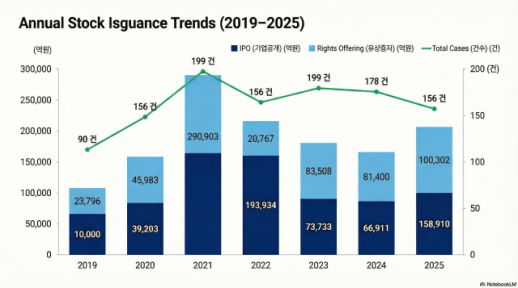 Greater rights offerings and fewer IPOs amid big-cap-led Korean stock boom SEOUL, Feb. 04 (AJP) - South Korea’s equity issuance saw a significant jump of approximately 55 percent last year, fueled by large-scale rights offerings. In contrast, new shares issued through initial public offerings (IPOs) contracted, underscoring a deepening funding freeze for small- and medium-sized enterprises (SMEs) and venture firms. According to the Financial Supervisory Service (FSS) on Wednesday, public equity issuance last year totaled 13.71 trillion won ($9.4 billion), an increase of 55.4 percent from the previous year. Rights offerings accounted for 10.30 trillion won of the total, skyrocketing 113.3 percent compared to 2024. The surge was primarily driven by major conglomerates, with the total value of rights offerings by large corporations alone increasing by nearly 220 percent on year. The number of rights offerings reached 72, an increase of 28.6 percent from the 56 cases recorded in 2024. Reflecting a growth trend skewed toward conglomerates, the push in rights offerings was led by major players. While rights offerings by large firms surged 220 percent versus the previous year, those by SMEs decreased 22.6 percent during the same period. IPO market chills amid tightened regulations Equity issuance through IPOs amounted to 3.68 trillion won, down 10.7 percent from a year ago. The number of IPOs fell 14 percent to 98 cases. By market, 6 cases were listed on the benchmark KOSPI, while 92 cases were on the tech-heavy KOSDAQ. The divergence is attributed to continued strong performances by existing listed giants, while SMEs and venture firms struggled. Furthermore, the government's aggressive moves to exit "zombie companies" and block "split-off listings" have raised the bar for initial public offerings. Corporate bond issuance totaled 276.25 trillion won, a slight decrease of 0.7 percent against the previous year. Compared to 2024, general corporate bonds and ABS increased 6.5 percent and 20.0 percent, respectively, while financial bonds fell 4.0 percent. For general corporate bonds, refinancing accounted for the largest share at 79.6 percent, followed by operating capital (16.4 percent) and facility investment (4.0 percent). By credit rating, high-grade bonds (AA or higher) rose to 70.7 percent, while lower-rated bonds (A or lower) fell to 29.3 percent relative to the year before. By maturity, mid-term bonds continued to dominate at 95.0 percent, with long-term and short-term bonds accounting for 3.4 percent and 1.6 percent, respectively. Among financial bonds, bank bonds and other financial bonds decreased 12.2 percent and 2.4 percent, while bonds issued by financial holding companies jumped 31.3 percent from a year earlier. As of the end of last year, the total outstanding balance of corporate bonds stood at 756.88 trillion won, up 9.3 percent from the prior year. Meanwhile, issuance of commercial paper (CP) and short-term bonds reached 1,663.32 trillion won, marking a 27.6 percent increase over 2024. 2026-02-04 10:28:27
 -
 Seoul sees lowest population outflow last year as fewer move to outskirts SEOUL, February 4 (AJP) - Fewer people moved to the outskirts of Seoul last year, with the capital seeing the lowest outflow in about 35 years. According to data released by the Korean Statistical Information Service (KOSIS) on Wednesday, some 27,000 residents left Seoul last year, down from 35,000 in 2022, 31,000 in 2023, and 45,000 in 2024. The figure was the lowest since 1990, when Seoul first recorded a decline in relevant statistics. KOSIS attributed the drop to an increase in available homes in Seoul, even as the overall housing supply fell across the country. Those who left Seoul mostly relocated elsewhere in the Seoul metropolitan region, with the largest number or about 41,000, moving to Gyeonggi Province. Although fewer residents are leaving, KOSIS said Seoul is unlikely to see an inflow soon because of high housing and living costs. 2026-02-04 10:22:30
 -
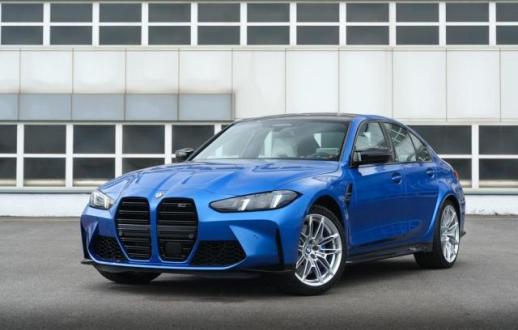 South Korea’s Imported Car Sales Jump 37.6% in January to 20,960, Led by BMW BMW continued to lead South Korea’s imported-car market in January. The Korea Automobile Importers & Distributors Association said Tuesday that new registrations of imported passenger cars totaled 20,960 in January, up 37.6% from a year earlier. The figure was down 26.7% from December. By brand, BMW ranked first with 6,270 registrations, ahead of Mercedes-Benz with 5,121. It was followed by Tesla (1,966), Lexus (1,464), BYD (1,347), Volvo (1,037), Audi (847) and Porsche (702). By engine displacement, vehicles under 2,000cc accounted for 9,711 (46.3%). Models from 2,000cc to under 3,000cc totaled 5,781 (27.6%); 3,000cc to under 4,000cc, 694 (3.3%); and 4,000cc or more, 344 (1.6%). Other categories, including electric vehicles, totaled 4,430 (21.1%). By origin, European brands made up 15,132 registrations (72.2%), followed by the United States with 2,291 (10.9%), Japan with 2,190 (10.4%) and China with 1,347 (6.4%). By fuel type, hybrids led with 13,949 (66.6%), followed by electric vehicles with 4,430 (21.1%), gasoline with 2,441 (11.6%) and diesel with 140 (0.7%). Of the 20,960 vehicles sold, individual buyers accounted for 12,200 (58.2%) and corporate buyers for 8,760 (41.8%). Among individual purchases, registrations were highest in Gyeonggi (3,711, 30.4%), Seoul (2,464, 20.2%) and Incheon (726, 6.0%). For corporate purchases, Incheon led with 2,930 (33.4%), followed by Seoul with 2,678 (30.6%) and South Gyeongsang with 1,335 (15.2%). The best-selling model in January was the Mercedes-Benz E 200 with 1,207 registrations. The BMW 520 (1,162) and Tesla Model Y (1,134) also ranked near the top. KAIDA Vice Chairman Jeong Yun-young said January registrations rose from a year earlier due to increased electric-vehicle sales and the impact of new brands. 2026-02-04 10:12:00
 -
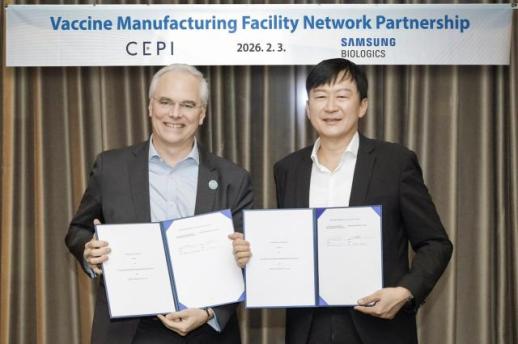 Samsung Biologics joins global vaccine network to bolster pandemic preparedness SEOUL, February 04 (AJP) - Samsung Biologics has signed a partnership agreement with the Coalition for Epidemic Preparedness Innovations (CEPI) to join the Vaccine Manufacturing Facility Network, positioning the South Korean drugmaker as a key player in global pandemic response efforts. Under the deal signed Tuesday, Samsung Biologics will serve as a "preferred" manufacturer for vaccines developed with CEPI support. The company will be capable of producing up to 50 million vaccine doses and drug substances convertible into 1 billion doses of finished vaccine products upon request during a pandemic outbreak. The partnership, backed by an initial investment of about $20 million, forms part of CEPI's "100 Day Mission" initiative, which aims to secure early vaccine approvals and large-scale manufacturing readiness within 100 days of a pandemic declaration. Samsung Biologics will also conduct simulation exercises assuming a wild-type H5 influenza outbreak to verify its rapid response capabilities. "This agreement reflects our commitment to supporting a reliable and agile vaccine supply ecosystem through continued innovation and strong collaboration. It also contributes to Korea's ability to secure timely access to vaccines during urgent public-health situations," said John Rim, CEO of Samsung Biologics. CEPI, headquartered in Norway, was launched at the 2017 World Economic Forum in Davos to develop vaccines against emerging infectious diseases. The coalition counts more than 30 governments, including South Korea, and numerous global pharmaceutical companies among its members. The agreement also stipulates that vaccines produced by Samsung Biologics will be supplied to South Korea on a priority basis at CEPI's request during a pandemic. The company previously demonstrated its manufacturing prowess in 2021 when it became the first in South Korea to produce Moderna's mRNA COVID-19 vaccine, delivering doses just five months after signing a contract. 2026-02-04 10:11:09
 -
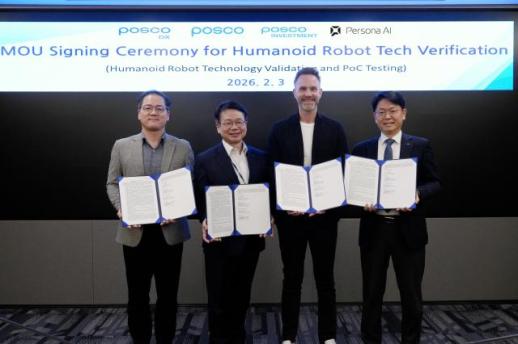 POSCO seeking to deploy Persona AI's humanoid robots for steelworks SEOUL, February 04 (AJP) - POSCO Group is moving to deploy humanoid robots in steel logistics operations in cooperation with U.S.-based startup Persona AI. The group said Wednesday that POSCO, POSCO DX, POSCO Technology Investment and Persona AI signed a memorandum of understanding a day earlier to jointly pursue on-site deployment of industrial humanoid robots. Under the agreement, POSCO will identify steel mill tasks suitable for humanoid robots and assess their operational feasibility. POSCO DX will design automation systems and jointly develop robot models optimized for steelworks, while POSCO Technology Investment will support proof-of-concept testing. Persona AI will develop and supply humanoid robot platforms tailored to harsh industrial environments. Starting in February, the partners plan to conduct a test using Persona AI’s robots to manage logistics for steel coils produced at POSCO plants. Handling finished coils, which can weigh tens of tons, typically requires crane operations. The companies aim to have humanoid robots assist workers in fastening crane belts to coils, enabling safer collaboration between humans and machines. The group said it has been reviewing humanoid robot applications in logistics processes, including transport and material preparation at terminals, since last year, reflecting the labor-intensive nature of heavy industry operations. If the pilot confirms operational safety and effective human-robot collaboration, POSCO plans to expand deployment and introduce the robots across broader logistics operations. Persona AI, founded in 2024 by robotics engineers and industry specialists, is developing industrial humanoid robots combining NASA-derived robotic hand technology with proprietary precision-control systems. POSCO Group invested a total of $3 million in the startup last year ahead of the partnership, aiming to support technologies capable of handling tasks ranging from fine assembly work to moving heavy industrial materials. * This article, published by Aju Business Daily, was translated by AI and edited by AJP. 2026-02-04 09:50:08