
Journalist

AJP
-
 Samsung vs SK hynix HBM4 race, pioneer holds a clear lead -for now SEOUL, January 29 (AJP) - South Korea’s two dominant memory-chip makers, Samsung Electronics and SK hynix, have formally entered the race for next-generation high-bandwidth memory, or HBM4, as demand from artificial-intelligence chipmakers tightens an already constrained market. The companies, which together command roughly 80 percent of high-bandwidth memory used in AI accelerators, held back-to-back earnings conference calls on the same day for the first time, offering competing visions of how the next phase of the AI-driven memory cycle will unfold. Both projected sustained supply tightness this year despite aggressive capacity expansion, following record earnings in 2025. The rivalry centers on HBM4, the next standard for AI memory, where Samsung is newly entering the supply chain of Nvidia after SK hynix enjoyed a near-monopoly position in earlier generations. SK hynix, which pioneered the HBM market and delivered an industry-leading 58 percent operating margin from chip sales in the fourth quarter, expressed confidence that its technological lead would carry into the next cycle. “Our commercialization capabilities and product quality, which have earned customer trust, cannot be overtaken in a short period,” said Song Hyun-jong, president of SK hynix’s corporate center. “As with HBM and HBM3, we aim to secure overwhelming leadership in HBM4.” Samsung, which plans to roll out 11.7-gigabits-per-second HBM4 products as early as next month, said demand is already outstripping supply. Orders for 2026 have exceeded the company’s current capacity, executives said, with key customers seeking advance bookings for 2027 deliveries. “Despite continued expansion, our capacity cannot keep up with demand,” said Kim Jae-june, executive vice president of Samsung’s memory division, adding that HBM revenue this year is expected to more than triple from 2025 levels. Both companies pledged a “significant” ramp-up in capacity this year compared with 2026, though neither disclosed precise figures. SK hynix said it remains comfortable committing capital investment equivalent to roughly 30 percent of this year’s projected revenue. Samsung said it will respond to customer demand through timely shipment of competitive HBM4 products while expanding sales of AI-related memory and addressing rising NAND demand linked to AI workloads. For now, the competitive gap is already visible in financial results. Samsung posted strong operating income and record sales in the fourth quarter and full year of 2025, but lagged SK hynix in profitability. Samsung reported 16.4 trillion won in chip operating profit for the December quarter, while SK hynix generated 19.17 trillion won on sales of 80.8 trillion won, yielding the industry’s highest margin. For full-year 2025, Samsung recorded 24.9 trillion won in chip operating profit, compared with SK hynix’s 47.2 trillion won on sales of 97.15 trillion won, underscoring the advantage of SK hynix’s heavier exposure to AI-related, high-margin memory. Deok-kee Kim, a professor of electronic engineering at Sejong University, said the surge in memory profitability reflects AI-driven demand outpacing supply, but warned that overly rapid investment expansion could reintroduce volatility in a historically cyclical industry. “If capital spending accelerates too quickly, price instability could eventually follow,” he said. Market analysts largely expect SK hynix to retain its lead. Counterpoint Research estimates the company will account for about 54 percent of global HBM4 sales this year, compared with 28 percent for Samsung and 18 percent for Micron. The firm previously held 62 percent of HBM3 shipments as of mid-2025. Goldman Sachs expects SK hynix to maintain a comfortable lead in HBM3 through at least 2026, while UBS forecasts the company could capture around 70 percent of the HBM4 market tied to next-generation AI platforms, including Nvidia’s Rubin architecture. Samsung Electronics shares closed down 0.7 percent at 161,300 won on Thursday, while SK hynix climbed 2.7 percent to 864,000 won, reflecting investors’ contrasting reactions to the two chipmakers’ earnings and outlook. For now, Samsung’s entry marks a meaningful escalation in competition. But in the early stages of the HBM4 cycle, investors and customers alike appear to see the pioneer as remaining firmly in front. * AJP Yuna Ryu and Yoo Joonha contributed to this story. 2026-01-29 17:43:00
 -
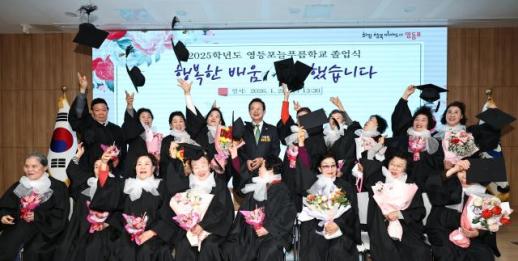 Age is just numbers - especially in learning SEOUL, January 29 (AJP) -Laughter, careful steps and handwritten diplomas filled the annex building of Yeongdeungpo District Office on Jan. 28, as graduates of Neulpureum School gathered for a ceremony years — sometimes decades — in the making. Neulpureum School is an adult literacy institution that grants officially recognized elementary and middle school diplomas. Its classrooms are filled with senior citizens who missed the chance for formal schooling earlier in life, often due to poverty, war or family obligations. For them, education arrived late — but not too late. At the ceremony, graduates from both the elementary and middle school programs walked across the stage one by one, many gripping their certificates with quiet pride. Some wore formal suits or hanbok; others leaned on canes or the arms of classmates who had become friends through shared homework and long afternoons of practice. 2026-01-29 17:25:55
 -
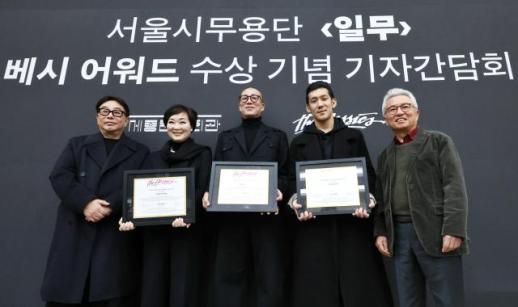 Seoul metropolitan dance theater's 'One Dance' wins Bessie award in New York SEOUL, January 29 (AJP) - The Seoul Metropolitan Dance Theater's "One Dance" won the Outstanding Choreographer/Creator award at the New York Dance & Performance Awards, known as the Bessie Awards, in New York on Jan. 20 (local time). This marks the first time a Korean public arts organization has received a Bessie Award. The Bessie Awards selection committee described "One Dance" as "a visually captivating contemporary reinterpretation of Korean traditional ritual dance" that "demonstrates a perfect harmony of stillness and movement while reaching its climax with explosive and dynamic choreography." "One Dance" is a contemporary reinterpretation of ritual dance from "Jongmyo Jeryeak," a National Intangible Cultural Heritage and UNESCO Masterpiece of the Oral and Intangible Heritage of Humanity. The work premiered in 2022 and drew attention when it sold out all performances at New York's Lincoln Center in 2023. 2026-01-29 17:23:28
 -
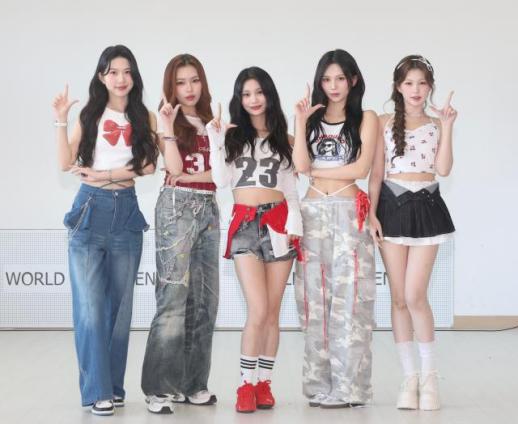 Bling One CN holds photo shoot in World K-pop center SEOUL, January 29 (AJP) - Bling One CN held a photo shoot and interview at the World K-pop Center in Jung-gu, Seoul, on the 28th. Bling One CN is a five-member group consisting of leader Cassie, Katrina, Ranee, Allie, and Chloe, selected from China as part of the Click the Star project spanning 32 countries worldwide. The group continues its idol activities in Korea and China with a focus on K-pop. 2026-01-29 17:23:07
 -
 LG Chem posts operating loss in Q4 but logs 35% profit jump for 2025 SEOUL, January 29 (AJP) - South Korea's largest chemical company LG Chem swung to an operating loss in the fourth quarter as its petrochemical and battery materials divisions struggled, though full-year operating profit surged 35 percent on improved performance at its energy solutions subsidiary. The company reported a consolidated operating loss of 413.3 billion won ($289.7 million) for the October to December period, reversing from a 680 billion won profit in the prior quarter. Revenue came in at 11.2 trillion won, largely flat from the third quarter but down 8.8 percent from a year earlier. For full-year 2025, operating profit jumped 35 percent to 1.18 trillion won on revenue of 45.93 trillion won, down 5.7 percent on year. The improvement was driven primarily by LG Energy Solution, which posted operating profit of 1.35 trillion won, more than double the 575 billion won recorded in 2024. "We maintained positive cash flow by advancing our business portfolio, exercising strict capital expenditure discipline, and monetizing assets amid challenging market conditions," said Cha Dong-seok, LG's chief financial officer. The petrochemicals division recorded an operating loss of 239 billion won in the fourth quarter, weighed down by narrowing spreads from regional capacity additions and one-time costs at overseas operations. The advanced materials unit also turned to a 50 billion won loss as battery materials customers adjusted year-end inventories and electronics demand entered a seasonal lull. LG Chem set its 2026 revenue target at 23 trillion won excluding LG Energy Solution, down from 23.8 trillion won in 2025, reflecting continued headwinds in the petrochemical sector from China-driven oversupply. The company plans to reduce losses through cost cuts and expansion into high-value-added products. Shares of LG Chem closed 2.97 percent lower at 343,500 won on Thursday. 2026-01-29 17:22:34
 -
 Asian shares struggle for direction amid Fed signals, Middle East tensions SEOUL, January 29 (AJP) - Asian markets closed mixed on Thursday as investors struggled to find direction amid conflicting signals from corporate earnings, central bank policy and rising geopolitical tensions, a combination that kept volatility elevated across the region. Currency markets reflected the uncertainty. The South Korean won was quoted at 1,428.9 per dollar at 4:40 p.m., down 4.6 won from the previous close. While the won pared earlier losses as the U.S. dollar weakened in late trading, it remained volatile amid competing global factors. Market sentiment was initially buoyed by comments from U.S. Treasury Secretary Scott Bessent, who dismissed the possibility of intentional intervention to weaken the Japanese yen, alongside the U.S. Federal Reserve’s decision to hold rates at 3.5–3.75 percent with a hawkish tone. The dollar later reversed course after media reports said President Donald Trump was weighing military options against Iran. The U.S. Dollar Index fell 0.16 percent to 96.20 by late afternoon. The benchmark 10-year U.S. Treasury yield rose 3.9 basis points to 3.557 percent, reflecting investor unease over the Fed’s stance and heightened geopolitical risks. South Korean stocks recovered from early losses, with the benchmark KOSPI closing up 0.98 percent at 5,221.25, supported by strong earnings and corporate investment announcements that offset macroeconomic concerns. Samsung Electronics fell 1.05 percent to 160,700 won despite reporting fourth-quarter operating profit of 20.1 trillion won ($14 billion). Investors were cautious after the company warned that rising memory prices could weigh on demand for smartphones and personal computers, while losses in its home appliances business also dampened sentiment. SK hynix climbed 2.38 percent to 861,000 won after overtaking Samsung in semiconductor profitability for the first time. The chipmaker posted quarterly operating profit of 19.2 trillion won and announced a shareholder return plan that includes the cancellation of 15.3 million treasury shares. Shares in SK Square, a major shareholder, jumped 5.36 percent. Hyundai Motor surged 7.21 percent to 528,000 won, extending gains that have lifted the stock more than 150 percent from late January last year. Investors welcomed the automaker’s commitment to complete real-world testing of its humanoid robot “Atlas” and smart-car prototypes by late 2026, despite a nearly 20 percent year-on-year decline in operating profit. LG Energy Solution fell 3.36 percent to 416,500 won after confirming a fourth-quarter operating loss of 122 billion won. Weakness in its energy storage system business and recent contract cancellations weighed on the stock, pushing it out of the top three by market capitalization. The tech-heavy KOSDAQ outperformed, rising 2.73 percent to 1,164.41, driven by technology shares and government-backed “value-up” initiatives. Rainbow Robotics jumped 9.35 percent following Samsung’s pledge to accelerate robotics investments, while EcoPro BM gained 7.42 percent. Biotech firm Alteogen slipped 1.15 percent ahead of its planned move to the KOSPI. In Japan, the Nikkei 225 ended flat at 53,375.60 after a volatile session. Early losses linked to yen strength were offset by gains in automakers, though safe-haven demand for the yen amid Middle East tensions capped the index’s advance. The yen was quoted at 153.30 per dollar late in the day. Toyota Motor rose 3.02 percent after reporting record sales for 2025, while Honda gained 2.17 percent on strong guidance led by hybrid vehicles. Chip tester Advantest climbed 5.17 percent after posting an earnings beat. Taiwan’s TAIEX fell 0.82 percent to 32,536.27 on profit-taking and concerns over the impact of a weaker dollar on foreign exchange reserves. TSMC slipped 0.82 percent, Foxconn fell 0.67 percent, and MediaTek ended flat after erasing early gains. Mainland Chinese markets were steadier, with the Shanghai Composite edging up 0.16 percent to 4,157.98. In Hong Kong, the Hang Seng Index reversed early losses to trade 0.36 percent higher at 27,928 in late afternoon dealings, supported by gains in gold-related shares. 2026-01-29 17:08:02
 -
 Korea's homegrown satellite to fly on NASA's Artemis 2 to study space radiation SEOUL, January 29 (AJP) - South Korea’s homegrown CubeSat, K-RadCube, will fly aboard NASA’s Artemis 2 crewed moon mission to observe the space radiation environment, marking the first time a South Korean satellite will directly measure the high-energy radiation belts encountered by astronauts. The Korea AeroSpace Administration (KASA) said on Thursday that the satellite will study Earth’s Van Allen radiation belts at multiple altitudes, generating data that could support the safety of future crewed deep-space missions. K-RadCube will be launched mounted on the Orion spacecraft’s stage adapter during Artemis 2, a crewed test flight that will send four astronauts on a lunar flyby and return them to Earth — the first such mission in about 50 years since the Apollo program. The CubeSat is scheduled to be deployed about five hours after launch, when it will begin measuring radiation levels in high-Earth orbit. “Securing direct measurements of space radiation is critical, as radiation exposure remains one of the biggest risks for human space exploration,” Kang Kyung-in, head of space science and exploration at KASA, said at a briefing in Seoul. He noted that while radiation can already cause errors in highly integrated semiconductors on Earth, radiation levels in space are far more intense. Data from K-RadCube could be used in the design of future crewed spacecraft and in mission safety planning, he said. The project involves several South Korean companies, including Nara Space Technology, Samsung Electronics and SK hynix. Nara Space Technology said the CubeSat had to meet stringent NASA safety requirements not typically applied to small satellites, including battery standards, thermal runaway testing and hazard-control destruction tests. KASA Administrator Yoon Young-bin said the mission would serve as an important international validation of South Korea’s ability to develop and operate deep-space CubeSats, as well as safety and reliability technologies relevant to human spaceflight. He added that the project could help expand South Korea’s technical contributions and role in future lunar and deep-space exploration efforts. * This article, published by Aju Business Daily, was translated by AI and edited by AJP. 2026-01-29 16:40:43
 -
 Hyundai Motor vows aggressive capex, share reward program; stock up 7% SEOUL, January 29 (AJP) - Hyundai Motor Company said Thursday it will spend 17.8 trillion won ($12.47 billion) throughout 2026—more than it earned last year—on new-growth areas including robotics, autonomous driving and hydrogen technology, front-loading nearly a quarter of its five-year investment plan into a single year. The South Korean automaker announced a 77.3 trillion won investment plan for 2026–2030 at its CEO Investor Day in New York last September. The 2026 outlay alone accounts for about 23 percent of the total, signaling an aggressive push to gain ground in emerging mobility sectors. "We plan to concentrate investment in 2026 and 2027," said Lee Seung-jo, Hyundai's chief financial officer, during a conference call following the release of its fourth-quarter and full-year 2025 earnings. "Spending will peak during this period, though the overall investment envelope remains unchanged." The 2026 investment will comprise 9 trillion won in capital expenditure, 7.4 trillion won in research and development, and 1.4 trillion won in strategic investments—up 20.4 percent from 14.5 trillion won spent in 2025. Hyundai has been pivoting toward future-mobility businesses as it grapples with slowing electric-vehicle demand and intensifying global competition. The company is leaning on hybrid vehicles as a bridge, with hybrids accounting for 16.3 percent of its global sales mix. Hybrid and SUV models powered Hyundai's first-ever breach of the 1-million-vehicle mark in North America last year. To bolster its artificial intelligence capabilities, Hyundai struck a deal with Nvidia to deploy 50,000 graphics processing units, with installations set to begin in the second half of this year. Lee said the company is "currently finalizing plans" for the GPUs, adding that "once specifics are set, we will communicate them to the market." On robotics, Lee said proof-of-concept testing of Boston Dynamics' Atlas humanoid robot at Hyundai's Metaplant facilities in Georgia would conclude in the second half of this year. The company unveiled a production-ready version of Atlas at CES 2026 earlier this month and plans to deploy robot fleets at the Georgia plant by 2028 for tasks such as parts sequencing and assembly. Hyundai also said its software-defined vehicle could roll out as early as the second half of 2026. The platform features a high-performance vehicle computer architecture designed to enable faster autonomous-driving functions and over-the-air software updates. On shareholder returns, Hyundai said it will begin buying back 400.7 billion won worth of its own shares starting Friday over the next three months, with plans to cancel them within the year—a shareholder-friendly move after the stock nearly tripled from its April low. The company reiterated its commitment to a total shareholder return of more than 35 percent through 2027, including a minimum dividend of 10,000 won per share and a quarterly dividend of 2,500 won. Hyundai projected wholesale sales of 4.158 million vehicles in 2026, up 0.5 percent from the previous year, with revenue growth of 1 to 2 percent. It guided for an operating profit margin of 6.3 to 7.3 percent, citing an improved vehicle mix and cost efficiencies as offsets to persistent macroeconomic uncertainty. "We will continue to pursue future investments," Lee said. "We believe these efforts are now being reflected in our share price." Shares of Hyundai Motor closed 7.21 percent higher at 528,000 won on Thursday, as investors welcomed the company's front-loaded spending on AI-driven growth initiatives. *AJP Kim Yeon-jae contributed to this story. 2026-01-29 16:17:01
 -
 South Korea weighs ownership caps in crypto exchanges under new law SEOUL, January 29 (AJP) - South Korea’s Financial Services Commission (FSC) is again pushing to limit major shareholders’ stakes in cryptocurrency exchanges, arguing the platforms function as public infrastructure as they move into a fully regulated licensing system. The proposal has drawn attention over whether it will be reflected in the Digital Asset Basic Act being prepared by the ruling Democratic Party, as industry groups warn that forcing large shareholders to sell would infringe on property rights. FSC Chairman Lee Eok-won said at a news briefing on Tuesday that regulators are considering ownership caps in connection with the Digital Asset Basic Act, citing the “public-infrastructure nature" of crypto exchanges and their entry into the regulated system through an approval-based licensing regime. “How we design the new framework is important,” Lee said. Lee added that concentrated control by a specific shareholder could create conflicts of interest, saying regulators and the ruling party share a sense of the need for reform and are in close discussions on how to proceed. The government and the ruling party plan to use the Digital Asset Basic Act to broadly overhaul digital-asset regulation, including rules for stablecoins, the classification of digital-asset businesses, and licensing and approval requirements. Crypto exchanges currently operate under a partial regulatory framework based on a three-year reporting system. Under a new approval-based regime, exchanges would gain permanent operating status. Regulators say they want to establish a more dispersed ownership structure as exchanges are formally brought into the regulated system, in order to strengthen public accountability and responsible management. With regulators reviving the ownership-cap proposal, attention is focused on whether they can reach consensus with the Democratic Party. Lawmakers across party lines have previously raised concerns that government intervention in the governance of private companies could be excessive. Lee Jung-moon, a lawmaker who leads the Democratic Party’s digital-asset task force, said on Tuesday that while there is broad agreement on the principle of limiting major shareholders’ stakes, there are differing views on whether such limits should be written directly into legislation. He said he would gather opinions within the party. If the plan is legislated, all five major won-denominated cryptocurrency exchanges would be required to reduce major shareholders’ stakes. The FSC has proposed capping such holdings at 15 to 20 percent. The Digital Asset eXchange Alliance (DAXA), an industry body representing major exchanges, has strongly opposed the proposal. * This article, published by Aju Business Daily, was translated by AI and edited by AJP. 2026-01-29 15:26:49
 -
 Samsung hosts gala in Washington amid tariff threat from Trump SEOUL, January 29 (AJP) -Samsung Electronics Co. hosted a gala event on Jan. 28 at the Arts and Industries Building in Washington, D.C., in partnership with the Smithsonian’s National Museum of Asian Art, to mark the successful run of Korean Treasures: Collected, Cherished, Shared, the first U.S. exhibition of masterpieces from the late Samsung Chairman Lee Kun-hee’s art collection. Main hosts were the Lee founding family, including Hong Ra-hee, Director Emerita of the Leeum Museum of Art, Lee Boo-jin, President & CEO of Hotel Shilla, Lee Seo-hyun, President of Samsung C&T, and Kim Jae Youl, President of Samsung Global Research. Among the 250 guests were Secretary of Commerce Howard Lutnick, Senator Tim Scott, Senator Ted Cruz, Senator Andy Kim, Governor Wes Moore and Ambassador Kang Kyung-wha. Hyundai Motor Group Chairman Euisun Chung also in Washington attended the gala. The event took place amid heightened trade tensions after U.S. President Donald Trump warned of sweeping tariff hikes of up to 25 percent on South Korean exports, citing delays in Seoul’s legislative procedures supporting a bilateral trade agreement reached last year. The timing has drawn attention as Samsung Electronics' Lee was in Washington during the same week, raising questions over whether the tycoon could serve as an informal channel of communication at a sensitive moment in U.S.–Korea trade relations. The tariff issue was underscored Wednesday by remarks from South Korea’s Industry Minister Kim Jung-kwan, who said he would meet Lutnick the following day for talks on Trump’s recent threat to raise so-called “reciprocal” tariffs and additional levies on Korean automobiles, lumber and pharmaceuticals to 25 percent from 15 percent. Speaking upon arrival near Washington, Kim said the Trump administration appeared dissatisfied with the pace of Korea’s domestic legislative process. “As far as I understand, (the Trump administration) appears to be dissatisfied with how the domestic legislative process has been progressing,” he said, adding that Lutnick shared that view. Kim said he planned to “provide sufficient explanation to ensure that there will be no misunderstandings” and to reaffirm Seoul’s commitment to cooperation and investment in the U.S. Under the bilateral agreement, Korea pledged to invest $350 billion in return for Washington lowering reciprocal tariffs to 15 percent. An investment-support bill submitted by the ruling Democratic Party in November has yet to pass the National Assembly, a delay Trump has publicly criticized. Meanwhile, the Washington exhibit featured more than 200 works selected from a personal collection of over 23,000 pieces amassed by the late chairman and was organized jointly by the National Museum of Asian Art, the National Museum of Korea, and the National Museum of Modern and Contemporary Art, Korea. At the gala, Lee thanked the organizing institutions and highlighted Washington as the first stop of the exhibition’s global tour. He also paid tribute to U.S. veterans of the Korean War, crediting their sacrifice with enabling South Korea’s postwar development and the preservation of its cultural heritage. “Memory and history are important to Koreans. That is part of why this exhibit means so much to me,” Lee said. “Despite the hardships of colonial rule and the Korean War, my father and grandfather believed it was their duty to safeguard the future of our culture. It was a tremendous honor to share this collection with you. I believe it’s our small contribution to bringing the American and Korean people closer together.” 2026-01-29 15:26:48