
Journalist

AJP
-
 Mobile Appliance Adds Aerospace, Science and Technology Experts to Board Mobile Appliance, a KOSDAQ-listed company, is accelerating its future strategy by bringing in top experts in aerospace and science and technology. The company said it held a board meeting on the 13th and disclosed that it decided to appoint key figures in national science and technology policy and aerospace as registered directors, including two former vice ministers of the Ministry of Science and ICT, a Seoul National University aerospace engineering professor and a former senior official from a national intelligence agency. The newly appointed directors are Lee Sang-mok, former first vice minister of the Ministry of Science and ICT; Choi Jae-yu, former second vice minister of the ministry; Jeon Sang-hoon, a professor in the Department of Aerospace Engineering at Seoul National University; Kim Jong-su, former director at a national agency; and Moon Kyung-ju, a representative tax accountant at Wooridle Tax Corp. The company said forming a science-and-technology-focused board that includes senior officials who oversaw government science, technology and satellite policy, along with aerospace specialists, is rare among listed companies in South Korea. Industry observers said the appointments appear to be a strategic move aimed at entering next-generation technology businesses. A company official said the board overhaul was a strategic decision to move beyond its existing businesses and become an advanced technology company, adding that it plans to pursue new businesses step by step in areas including aerospace, advanced technology and global projects. An industry official called it highly unusual to have both government science and technology policy figures and aerospace experts on the same board, saying it signals a strong intent to expand beyond its existing automotive electronics and IT solutions business into major new ventures such as satellite communications, AI-based advanced solutions, and space and aviation-related technology. The official said market attention to the company’s new-business strategy is expected to rise. Separately, the company said its current management will be replaced at a regular shareholders meeting at the end of this month. It said it plans to strengthen an independent, professional manager-led management system based on an advanced governance structure that clearly separates the roles of major shareholders and management. * This article has been translated by AI. 2026-03-13 16:21:18
 -
 Celltrion, Daewoong, HLB and Hugel Highlight Biosimilars, Digital Health and Oncology Updates Celltrion expects biggest gains as global biosimilar rules ease Celltrion said March 13 that as global regulators roll out policies to ease requirements for biosimilar development, it will immediately apply the changes across its biosimilar pipeline to cut costs and shorten timelines. The U.S. Food and Drug Administration recently issued a fourth revision to its Q&A guidance on biosimilar development aimed at streamlining the process. The update recommends more efficient approaches to pharmacokinetic (PK) testing typically conducted in Phase 1, when scientific requirements are met. The revision also relaxes reference-product requirements. Previously, companies seeking entry into the U.S. market had to run direct PK comparative studies against a U.S.-licensed reference product. Under the updated approach, equivalence may be supported using clinical data comparing a reference product approved outside the United States. Celltrion said its immuno-oncology biosimilar programs face high reference-product costs and could reduce total clinical trial expenses by up to 25%. Daewoong Pharmaceutical wraps up “Digital Health Week 2026” Daewoong Pharmaceutical said March 13 it has concluded “Digital Health Week 2026,” which it described as the domestic pharmaceutical industry’s first intensive seminar week composed solely of digital health care products. The event ran March 3-6 as a series of live online seminars on the medical-professionals platform Dr.Ville. The program spotlighted eight Daewoong digital health care products, covering practical clinical-use cases, shifts in patient management, and strategies for more efficient hospital operations. The company said it held eight sessions in total, with two sessions each day at lunchtime and in the evening, featuring clinicians who prescribe and use the products. Daewoong said it plans to continue offering academic programs designed to provide operational insights for medical professionals. HLB Group to present cancer pipeline results from two affiliates at AACR 2026 HLB Group said March 13 it will present new research findings on key cancer pipeline programs at the AACR 2026 Annual Meeting, to be held April 17-22 in San Diego. AACR is one of the world’s three major cancer conferences, alongside the American Society of Clinical Oncology and the European Society for Medical Oncology, bringing together researchers and pharmaceutical and biotech companies to share the latest findings. Verismo Therapeutics, a U.S. subsidiary of HLB Innovation, plans to present interim results from a U.S. Phase 1 trial of SynKIR-110, a chimeric antigen receptor T-cell (CAR-T) therapy for solid tumors. HLB said the trial design and progress have been introduced at several global conferences, but this will be the first time clinical data are disclosed. Hugel joins Thailand’s largest dermatology meeting, citing expanded academic exchange Hugel said March 13 it participated in Thailand’s largest dermatology conference to promote its botulinum toxin and hyaluronic acid (HA) filler products and strengthen its presence in Southeast Asia. The company attended the annual meeting of the Dermatological Society of Thailand, held March 11-13 at Centara Grand at CentralWorld in Bangkok, together with its local partner. Marking its 50th edition this year, the DST meeting is Thailand’s largest dermatology conference, drawing local medical experts and aesthetics industry participants to share research updates and procedure trends. During the meeting, Hugel promoted its botulinum toxin Botulax, exported in Thailand under the name Estox, along with its HA filler The Chaeum, exported as Revolax. The company also ran a separate academic program to share Revolax’s global clinical experience and procedural know-how.* This article has been translated by AI. 2026-03-13 16:18:00
 -
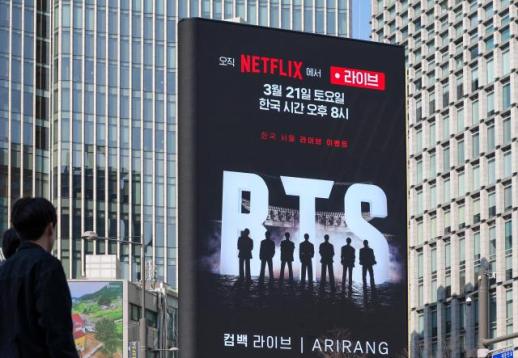 Gwanghwamun redresses to play the host for BTS show SEOUL, March 13 (AJP) -An electronic billboard near Gwanghwamun Square flashes the announcement: BTS is coming back. The towering digital screen lights up the intersection in central Seoul with promotions for “BTS Comeback Live: ARIRANG,” the group’s highly anticipated concert scheduled for March 21 — just eight days away. Around the historic square, the city is already wearing the band’s colors. Towering buildings along the Gwanghwamun boulevard are draped in BTS banners while giant screens cycle through images of the group, turning the capital’s ceremonial avenue into a preview of the global spectacle to come. Streets that usually carry office workers and tourists now play host to growing crowds of fans stopping to photograph the banners and billboards. The transformation is part of the buildup to BTS’s return as a full group after about three years and nine months. The concert, titled “BTS Comeback Live: ARIRANG,” will take place at 8 p.m. on March 21 at Gwanghwamun Square, bringing one of the world’s biggest pop acts back to the heart of Seoul. The concert, titled “BTS Comeback Live: ARIRANG,” will take place at 8 p.m. on March 21 at Gwanghwamun Square, bringing one of the world’s biggest pop acts back to the heart of Seoul. A day before the performance, the group will release its fifth full-length album, “ARIRANG,” worldwide at 1 p.m. on March 20. The album features 14 tracks, including the title song “SWIM,” with leader RM participating in writing the lyrics. Authorities expect the comeback concert to draw one of the largest crowds ever assembled in the historic district. Police estimate that around 230,000 people could gather near Daehanmun Gate of Deoksugung Palace, while as many as 260,000 spectators may line the boulevard toward Sungnyemun Gate, turning the entire area into a vast open-air concert venue. For fans unable to attend in person, the event will be livestreamed globally on Netflix in more than 190 countries, extending the spectacle far beyond Seoul. 2026-03-13 15:55:21
 -
 HD Hyundai Heavy Industries Moves to Sell Gunsan Shipyard to Ecoprime Marine Pacific Ecoprime Marine Pacific, which has HJ Shipbuilding & Construction as a subsidiary, and HD Hyundai Heavy Industries have signed a memorandum of agreement for the transfer of assets at the Gunsan shipyard. Industry officials said on the 13th that the two companies signed the agreement at Ecoprime Marine Pacific’s headquarters in Yongsan. The assets to be transferred include all tangible assets related to the Gunsan shipyard, including real estate and movable property. The contract amount will be finalized after due diligence, based on a basic asset value set through an appraisal and then confirmed through negotiations between the parties. A final contract is expected to be signed after the due diligence process. HD Hyundai Heavy Industries built the Gunsan shipyard in 2010 on a 1.8 million-square-meter site in the Gunsan National Industrial Complex in North Jeolla Province. Operations were suspended in 2017 as orders fell amid a downturn in the shipbuilding industry. Since 2022, the yard has been partially restarted and has produced ship blocks. The shipyard spans 1.8 million square meters and is equipped with a 1.3 million-metric-ton dock, a 1,650-metric-ton Goliath crane and other facilities. With an annual assembly capacity of 250,000 metric tons, it can build 12 bulk carriers of 180,000 tons each, the company said. Ecoprime Marine Pacific said HD Hyundai Heavy Industries agreed to place orders for its block production at the Gunsan shipyard (tentative name) for the next three years to help revitalize the facility. It also said HD Hyundai Heavy Industries will provide design services, handle raw-material purchasing on its behalf, and support automation and smart-shipyard technologies. An HD Hyundai Heavy Industries official said the asset transfer is expected to make new shipbuilding possible at the Gunsan shipyard. The official added that HD Hyundai Heavy Industries will continue to receive ship blocks at the same level as it does now even after the transfer, calling it a win-win for HD Hyundai Heavy Industries, Ecoprime Marine Pacific and the city of Gunsan.* This article has been translated by AI. 2026-03-13 15:19:10
 -
 Hanwha Aerospace Completes Phase 2 Expansion of Australia Plant, Begins Redback IFV Production Hanwha Aerospace said on the 13th it has completed a Phase 2 expansion of its plant in Australia. The company secured production facilities about two years after signing a contract with the Australian government in December 2023 to supply 129 Redback infantry fighting vehicles. The Phase 2 buildout includes a second production building, what it described as the Southern Hemisphere’s largest electromagnetic compatibility (EMI/EMC) test chamber, a large washing facility and a finished-goods storage building. Key facilities, including the second production building, were completed about a month and a half ahead of schedule. Since opening its Phase 1 facilities in 2024, the plant has produced the AS9 self-propelled howitzer and the AS10 ammunition resupply vehicle. The Phase 2 expansion added about 32,000 square meters (about 344,000 square feet) of space, establishing a system that allows simultaneous production of howitzers and armored vehicles. Hanwha said the site can now accommodate more than 250 office and production workers. It has two production buildings, a 1.2-kilometer (0.75-mile) driving test track with slope and deep-water test facilities, a system integration lab and painting facilities. Cumulative investment totals about 225 million Australian dollars (about 236.7 billion won), it said. The plant is expected to serve as a strategic production and maintenance, repair and overhaul hub for Australia and South Korea, as well as the Indo-Pacific region. The facility, known as H-AC, is in Geelong and was completed in August 2024 as the first overseas production base built by a South Korean defense company, Hanwha said. The site covers about 150,000 square meters and consists of 11 facilities, including a main building, production buildings, an assembly area, a driving test track and a firing range. A Hanwha Aerospace official said, “Through the Australia plant, we will contribute to the local defense ecosystem and develop it into a key production hub for land defense in the Indo-Pacific region.” * This article has been translated by AI. 2026-03-13 15:18:19
 -
 Washington slaps another Section 301 probe on South Korea SEOUL, March 13 (AJP) -South Korea has been drawn into another U.S. trade investigation as Washington launched a new probe under Section 301 of the Trade Act of 1974 targeting forced-labor imports, only a day after opening a sweeping investigation into global manufacturing overcapacity. The back-to-back actions suggest the United States is assembling multiple Section 301 cases in an effort to rebuild the legal basis for tariffs after the U.S. Supreme Court recently struck down a key foundation used to justify earlier duties imposed under the International Emergency Economic Powers Act (IEEPA). The Office of the United States Trade Representative (USTR) said Wednesday it had initiated investigations into 60 economies, including South Korea, China, the European Union, Japan, India, Mexico, Taiwan and Vietnam. The probe will examine whether governments have failed to impose or effectively enforce bans on the importation of goods produced with forced labor — a gap Washington argues allows products made under coercive labor conditions to circulate through global supply chains and gain an artificial cost advantage. “Despite the international consensus against forced labor, governments have failed to impose and effectively enforce measures banning goods produced with forced labor from entering their markets,” U.S. Trade Representative Jamieson Greer said in a statement. “For too long, American workers and firms have been forced to compete against foreign producers who may have an artificial cost advantage gained from the scourge of forced labor.” The latest investigation shifts attention away from domestic labor practices within the targeted economies and instead focuses on whether governments are adequately preventing forced-labor goods from entering their own markets. U.S. officials argue that if countries allow such products to be imported and re-exported through their supply chains, they effectively undermine international efforts to eliminate forced labor and distort global trade. The investigation will examine government policies, customs enforcement practices and regulatory frameworks governing import bans on forced-labor goods. The move builds on a broader trend in U.S. trade policy that increasingly links supply-chain transparency, labor standards and national economic security. In recent years Washington has tightened restrictions on imports tied to forced labor, most notably through the Uyghur Forced Labor Prevention Act, which blocks products linked to alleged forced labor in China’s Xinjiang region unless companies can prove otherwise. Section 301 of the Trade Act of 1974 authorizes the U.S. government to investigate foreign government practices deemed “unreasonable or discriminatory” and to impose retaliatory trade measures, including tariffs. Trade analysts say the forced-labor probe — coming only a day after a separate Section 301 investigation into structural excess capacity in global manufacturing — indicates Washington is increasingly relying on the statute to underpin its tariff policy. The strategy follows a recent Supreme Court ruling that invalidated tariffs imposed under the International Emergency Economic Powers Act, forcing the administration to explore alternative legal authorities to sustain its trade enforcement agenda. By launching multiple Section 301 investigations addressing different types of trade distortions, Washington could potentially establish new legal grounds for tariffs if the probes conclude that foreign practices are harming U.S. commerce. Under the Section 301 procedure, USTR must seek consultations with the governments under investigation before determining whether trade actions are warranted. The agency has scheduled a public hearing for April 28, while written comments and requests to testify must be submitted by April 15, according to a Federal Register notice. After reviewing submissions and consultations, the interagency Section 301 Committee will assess whether the targeted policies burden or restrict U.S. commerce and recommend potential remedies. Those remedies could include tariffs, import restrictions or negotiated commitments by the affected economies to tighten enforcement against forced-labor goods. Seoul was included a day earlier in the separate Section 301 probe examining global industrial overcapacity in manufacturing — a case widely seen as targeting government subsidies and production surpluses in major export economies. While the forced-labor probe does not specifically accuse South Korea of using forced labor, the investigation could examine whether Korean customs authorities adequately prevent imports of goods linked to forced labor from entering domestic supply chains. 2026-03-13 15:03:07
 -
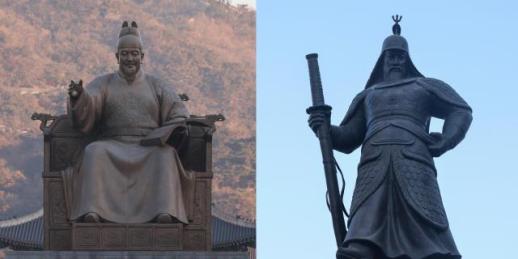 BTS Comeback D-8: Gwanghwamun's oldest residents - a Joseon king and admiral SEOUL, March 12 (AJP) - At the heart of Seoul stands Gwanghwamun Square, often called the symbolic center of South Korea. The broad boulevard stretching from the ancient gates of Gyeongbokgung Palace has witnessed centuries of history — from the royal administration of the Joseon Dynasty to modern civic gatherings. Next Saturday, the historic square will host another moment in that long timeline: a comeback performance by global K-pop group BTS. In this space where history and modern culture intersect, two towering figures already stand watch — Admiral Yi Sun-sin, the naval commander who defended Joseon during the 16th century, and King Sejong, the monarch who created the Korean alphabet. Their statues face south along the grand avenue, anchoring a square where the legends of the past and icons of the present converge. Standing at the center of Gwanghwamun Square is the imposing statue of Admiral Yi Sun-sin, one of Korea’s most revered military heroes. The 17-meter monument was erected in 1968 and remains one of Seoul’s most recognizable landmarks. The bronze statue itself rises 6.5 meters above a 10.5-meter pedestal, depicting the admiral in armor overlooking the capital he once helped defend. Around the statue are symbolic reminders of his naval victories — a model of the famed turtle ship, one of the world’s earliest iron-clad warships, and two large drums representing signals used during naval battles. Rather than focusing on a precise likeness, the monument emphasizes Yi’s role as a national symbol — the steadfast commander who protected the nation during the Japanese invasions of the 1590s. About 250 meters north of Yi’s monument sits another defining symbol of Korean history: the statue of King Sejong the Great, the fourth ruler of the Joseon Dynasty. The seated statue measures 6.2 meters in height and 4.3 meters in width. Unlike the commanding posture of the admiral, Sejong appears calm and contemplative. One hand holds a book while the other gestures gently forward, reflecting his reputation as a ruler devoted to the welfare of his people. Models of King Sejong’s inventions — the honcheonsi, cheugugi and angbuilgu — are displayed at Gwanghwamun Square in Seoul. AJP Han Jun-gu Displayed before the statue are scientific instruments from the 15th century that flourished under Sejong’s reign — the honcheonsui armillary sphere, the cheugugi rain gauge, and the angbuilgu sundial. Along the flowing water channel surrounding the plaza, a timeline carved in stone traces the history of the Joseon Dynasty. The stories of the two figures continue beneath the plaza. Underground exhibition halls known as “Story of Sejong” and “Story of Admiral Yi Sun-sin” allow visitors to explore the lives and achievements of the two historical icons. The Sejong exhibition introduces the king’s philosophy of governance, his scientific innovations and his most enduring legacy — the creation of Hangul, the Korean alphabet. Displays include replicas of astronomical charts, traditional musical instruments used in the royal court and interactive exhibits explaining Sejong’s technological achievements. The Yi Sun-sin gallery focuses on the admiral’s leadership during the Imjin War. Artifacts and multimedia displays recreate the naval battles of the seven-year conflict, including models of Joseon warships and immersive visual installations illustrating the admiral’s strategies. Above ground, Gwanghwamun Square remains a living civic space where history continues to unfold. The statues of Yi Sun-sin and King Sejong overlook the plaza while their stories live on below — a reminder of the country’s past layered into the fabric of modern Seoul. Soon another chapter will be added.On March 21, the square will transform into a stage for BTS, the global music phenomenon whose influence now carries Korean culture across the world. In one place stand the legendary king who gave Korea its alphabet, the admiral who defended the nation’s shores, and a modern group whose music has carried Korean culture to global audiences. At Gwanghwamun, centuries of Korean history — and the future of its culture — meet on the same stage. 2026-03-13 14:33:20
 -
 Korea's crackers edges toward shutdown as Hormuz blockade chokes naphtha supply SEOUL, March 13 (AJP) - South Korea's petrochemical plants are rapidly running out of naphtha as the closure of the Strait of Hormuz cuts off a major supply route, forcing producers to declare force majeure and slash operating rates to bare-minimum levels to avoid a full shutdown that could ripple through the country's manufacturing economy. Yeocheon NCC, LG Chem, Lotte Chemical and Hanwha Solutions have all warned customers of potential force majeure on product deliveries. GS Caltex, which shares the Yeosu industrial complex with several affected petrochemical producers, has postponed a scheduled maintenance turnaround at its Yeosu refinery from March to May in order to keep supplying naphtha to neighboring plants, industry officials said. The move underscores the urgency gripping the sector: halting refining operations now would almost certainly trigger a cascade of shutdowns downstream. About 54 percent of South Korea's naphtha imports and roughly 70 percent of its crude oil normally transit the Strait of Hormuz. Since Iran closed the waterway on Feb. 28 following joint U.S.–Israeli strikes, tanker traffic through the chokepoint has largely halted. "NCC operating rates across the region continue to decline as the Strait of Hormuz remains impassable, while prices of basic feedstocks such as butadiene and styrene monomer are surging on tighter supply and rising naphtha costs," said Kang Dong-jin, an analyst at Hyundai Motor Securities. "A recovery in NCC utilization hinges on the reopening of the strait." Naphtha prices have surged since the conflict escalated, hitting $883.40 per metric ton on Monday, up from $568.55 on Feb. 23, before easing slightly to $812.29 on Thursday, according to the S&P Global Platts Fujairah cargo assessment. Asia's steam cracker industry is overwhelmingly naphtha-based and structurally dependent on imports. Major petrochemical producers across the region — including India, Thailand, Indonesia, Malaysia, China, Japan, Singapore and South Korea — collectively imported 86.6 million tons of naphtha in 2025, according to Independent Commodity Intelligence Services (ICIS). As the supply shock spreads, petrochemical plants across Asia have begun cutting operating rates. Singapore's Petrochemical Corporation of Singapore has declared force majeure, citing disrupted naphtha deliveries, while Indonesia's PT Chandra Asri Pacific has followed with its own declaration. Korea's Yeocheon NCC has taken the same step. In China, the CNOOC and Shell Petrochemicals Company Limited has halted operations after crude supply to its integrated refinery was disrupted. Nearly 9 million tons per year of South Korean ethylene capacity is non-integrated and heavily reliant on imported naphtha, according to ICIS data. The price spike compounds an already dire situation for Korean producers, who are struggling to pass higher feedstock costs on to customers. Persistent oversupply from China has depressed ethylene and downstream product prices, compressing the ethylene spread — the margin between naphtha costs and ethylene selling prices — to about $100 per ton, far below the roughly $300 needed to break even. Korean petrochemical firms typically source about half of their naphtha from domestic refiners and import the rest. With the strait sealed off, those seaborne cargoes have stopped arriving and inventories are rapidly dwindling, leaving producers little choice but to conserve feedstock. Operating rates have been cut to what the industry calls "zombie mode." Yeocheon NCC, a 50-50 venture between Hanwha Solutions and DL Chemical, has reduced utilization to 60 percent and is reportedly considering a further cut to 50 percent, its turndown limit. Lotte Chemical has lowered utilization to 70 percent, while LG Chem has trimmed operations at its Daesan complex to about 54 percent. Once a plant falls below its turndown ratio — the minimum operating rate at which equipment can safely function — it must shut down entirely. Restarting a steam cracker typically takes up to two weeks. Domestic producers currently hold only about two weeks of naphtha inventories, according to the Ministry of Trade, Industry and Energy. A full shutdown would send shockwaves far beyond the chemical sector. Ethylene and propylene are core feedstocks for a wide range of industries, from automotive plastics and consumer electronics components to construction materials such as PVC piping and insulation, as well as synthetic fibers used in textiles. Logistics networks are already beginning to buckle. HMM, South Korea's largest shipping line, suspended new bookings on Middle East routes on Wednesday, while Korean Air has extended the suspension of its Incheon–Dubai flights through March 28. Rising freight and fuel costs are adding pressure to industries already weakened by a prolonged downturn, including steel, batteries and cement. The crisis has also complicated a government-led restructuring effort aimed at addressing structural overcapacity in the petrochemical sector. The Ministry of Trade, Industry and Energy and creditor institutions led by the Korea Development Bank had set an end-of-March deadline for companies in the Yeosu complex to submit voluntary ethylene capacity reduction plans. The war, however, has injected deep uncertainty into those negotiations. Analysts say the situation echoes the early stages of the 2022 Russia-Ukraine conflict, though the impact on Asia could prove more severe given the region's far heavier reliance on Middle Eastern feedstock. If the Hormuz blockade drags on, utilization rates at South Korea's three major petrochemical hubs — Yeosu, Daesan and Ulsan — could fall below 60 percent across the board, with ripple effects spreading through electronics, automotive, construction and consumer goods industries nationwide. 2026-03-13 14:30:45
 -
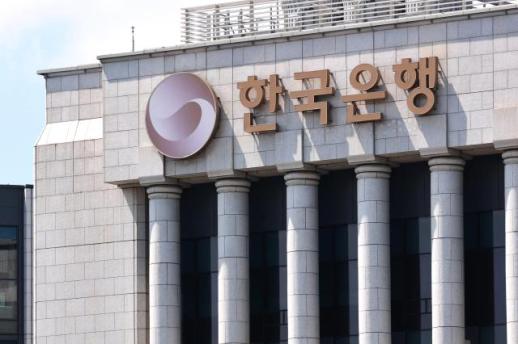 Korea's M2 rise picks up in Jan as stock invest and dollar savings pile up SEOUL, Mar 13 (AJP) —South Korea’s M2 money supply grew at a faster pace in January than previous months on strong stock market and U.S.-dollar-denominated savings on expectations of continued greenback strength. According to a Bank of Korea (BOK) release on Friday, the M2 money supply grew 0.7 percent month-on-month in January to reach 4,108.9 trillion won ($2.83 trillion). Under the previous M2 standard (used prior to November statistics), the figure rose 1.2 percent to 4,521.1 trillion won, indicating an even sharper upward trend. The M2 money supply grew by 4.5 percent throughout 2025 (under the new standard) and 7.4 percent (under the previous standard), a marked acceleration from the 3.3 percent and 5.6 percent growth rates recorded in 2024. Compared to January of last year, M2 increased by 4.6 percent (new) and 8.4 percent (previous). While the growth rate under the new standard—which excludes ETFs and long-term deposits—narrowed by 0.1 percentage points, the previous standard showed an expansion of 0.4 percentage points. The expansion was largely fueled by a stellar performance in the South Korean stock market in January. The benchmark KOSPI surged more than 21 percent in a single month, rising from 4,309.63 on Jan. 2 to close at 5,224.36 on Jan. 30. The tech-heavy KOSDAQ followed suit, jumping over 20 percent to finish the month at 1,149.21. KOSPI was trading down 1.3 percent at 5,510 Friday. After hitting an all-time high of 6,307.27 on Feb. 26, the index suffered a 20 percent plunge in early March, triggered by the Middle East crisis and the blockade of the Strait of Hormuz. Liquidity in other financial institutions, including asset management firms, increased by 15.2 trillion won, reflecting the January market boom. Demand deposits, which typically serve as a cash pool for equity investment, grew by 15.5 trillion won, more than doubling the 7 trillion won increase seen the previous month. The period was also marked by a significant buildup in foreign currency liquidity. Other monetary products, primarily foreign currency deposits with maturities of less than two years, surged by 21 trillion won—double the 10 trillion won increase in the prior month. The won, which stood at 1,445 per dollar on Jan. 2, weakened to 1,453 by Jan. 30, a depreciation of approximately 0.6 percent. Amid the ongoing Hormuz crisis, the currency has since plummeted to the 1,490 level as of 11:15 a.m. Friday. Bond prices also retreated. The yield on the 10-year government bond rose from 3.386 percent on Jan. 2 to close at 3.607 percent on Jan. 30, an increase of 22.1 basis points. While yields briefly dipped in February on safe-haven demand, the Hormuz shock pushed them back up, with the 10-year yield closing at 3.649 percent on Thursday, up 4.1 basis points. 2026-03-13 14:26:52
 -
 North Korea-China passenger train resumes service ahead of Trump's visit to Beijing SEOUL, March 13 (AJP) - A passenger train linking North Korea and China arrived in Beijing on Friday, resuming service for the first time in six years shortly after Pyongyang closed its border due to the outbreak of the coronavirus pandemic. The train, which departed Pyongyang at around 10:30 a.m. the previous day, arrived at a railway station in Beijing the next morning after its lengthy journey of about 25 hours. Another passenger train from Beijing to Pyongyang also departed at around 5:30 p.m. the same day. According to state-run China Railway, passenger trains linking the two countries' capitals operate four times a week in both directions, on Mondays, Wednesdays, Thursdays and Saturdays. Another passenger train service linking Pyongyang and the Chinese border city of Dandong also operates twice daily. With the resumption of these railway services, Pyongyang is expected to increase exchanges to restore relations with its traditional ally, which had been strained amid its deepening military ties with Russia. Despite the North's full reopening of its borders in 2023, passenger railway services remained suspended, although cargo trains connecting the two countries' border towns of Dandong and Sinuiju were partially resumed in 2022. The resumption follows North Korean leader Kim Jong-un's attendance at a military parade in Beijing last September and comes just weeks ahead of U.S. President Donald Trump's planned visit to the city later this month. 2026-03-13 14:26:09