
Journalist

AJU PRESS Business Team
-
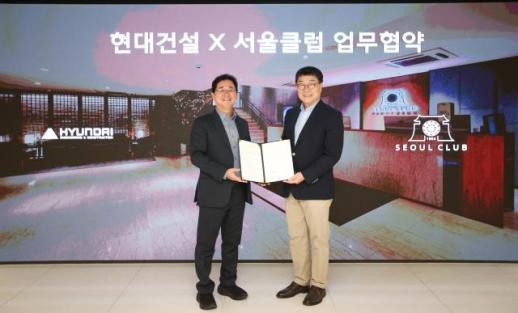 Hyundai Engineering Applies 120 Years of Expertise from Seoul Club to Apgujeong Hyundai Engineering announced on May 18 that it has signed a business agreement with the Seoul Club to apply the club's operational expertise to the Apgujeong Hyundai community. Established in 1904, the Seoul Club is the only international social club in South Korea, fostering social exchanges among diplomats and both domestic and foreign members for 120 years. Hyundai Engineering reported that this marks the first time the club has formed a strategic partnership with an external entity. Under the agreement, the Seoul Club will propose community spaces that enhance social interactions and develop operational scenarios to facilitate exchanges among residents. Signature areas will feature the Seoul Club's certification mark. Additionally, community programs will be implemented to encourage natural interactions among residents, including activities in music, art, sports, and charitable initiatives that embody the principle of 'noblesse oblige.' A representative from Hyundai Engineering stated, "We are collaborating to transform the Apgujeong redevelopment area into a 'private social town' where global leaders can connect and find inspiration, rather than just a residential space. We aim to demonstrate a unique residential value that only Apgujeong residents can enjoy by combining the history of the Seoul Club with Hyundai Engineering's technological expertise." Meanwhile, Hyundai Engineering highlighted that at the promotional center for Apgujeong District 5, located near Apgujeong Station on Line 3 in Gangnam, visitors can enjoy a 420-meter circular walking path comfortably throughout the year, regardless of the season. The facility will also include a fitness center, all-day dining, a wellness spa, a sauna, and a premium two-story golf course with a 35-meter driving range.* This article has been translated by AI. 2026-05-18 20:42:22
 -
 Nexon Partners with Naver to Enhance User Experience and Expand Gaming Ecosystem Nexon is teaming up with Naver to enhance user convenience and expand the gaming and streaming ecosystem. On May 18, Nexon announced a transition event for 'Naver Login Members' and introduced the Chijijik 'N Connect' project. Naver Login Members can use their Naver ID to log into Nexon and make payments through Naver Pay. Nexon users aged 14 and older who have completed identity verification can convert their existing accounts to a Naver ID. After switching to a Naver Login Member, users will retain their previous gaming records, and all transactions within Nexon will be processed via Naver Pay. Additionally, Nexon is launching the N Connect project to promote the creation of broadcast content based on Nexon IP through Naver's live streaming platform, Chijijik. N Connect aims to connect users, creators, and games. It will offer rewards based on activity, growth, and impact, reflecting viewer participation in Chijijik broadcasts. A content support center will also assist creators in producing Nexon-related content. Nexon plans to support Chijijik partners, pro, and rookie streamers in creating and broadcasting content based on Nexon games. The collaboration will enhance the experience for users, allowing them to seamlessly transition from watching their favorite streamers to playing games. The Chijijik N Connect will operate in a preseason phase until September 22, with the regular season set to begin in October. Through this collaboration, the two companies aim to strengthen user data connections and organically combine Nexon's game intellectual property with Naver's services, providing personalized content and an expanded gaming experience for users. To celebrate the opening of the Naver Login Member application page, Nexon will offer benefits to participants. Users who switch their login account to a Naver ID by July 20 can choose a coupon pack for one Nexon game, such as Dungeon & Fighter, MapleStory, or Mabinogi Mobile. Participants in the FC Online 8th anniversary event will also receive rewards. Last September, Nexon and Naver signed a strategic partnership agreement to combine 'playing games' and 'watching games' using AI and data to provide new content. This project marks the first linked service introduced since the agreement was signed. The account integration is expected to facilitate mutual user inflow between Nexon's gaming audience and Naver and Chijijik's platform users, enhancing the lock-in effect where gaming and content consumption occur simultaneously.* This article has been translated by AI. 2026-05-18 20:39:22
 -
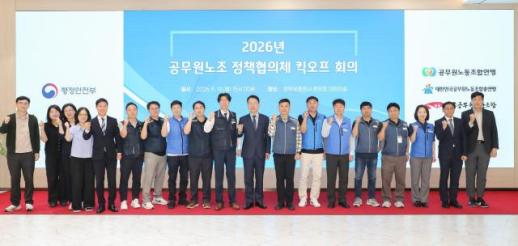 Government Launches Policy Council to Address Public Employee Issues The South Korean government is initiating serious discussions to improve the treatment of public employees involved in 24-hour disaster response and various emergency duties. On May 18, the Ministry of Interior and Safety held the first meeting of the "2026 Public Employee Union Policy Council," chaired by Deputy Minister Kim Min-jae. About 20 representatives from three major public employee unions—the Korean Public Service and Transport Workers' Union, the Federation of Korean Public Service Workers' Unions, and the National Public Service Workers' Union—attended the meeting to discuss improvements in working conditions for local public employees, including personnel and service matters. Established in 2018 and operating annually, the policy council serves as a crucial communication channel for discussing institutional improvements related to personnel, service, and compensation for local public employees. This year, the unions proposed a total of 20 agenda items reflecting practical challenges in the public sector, categorized into organization and personnel (four items), service and allowances (eight items), budget (three items), and training (two items). Key discussion topics included improving treatment for emergency responders, abolishing the part-time public employee system, and reforming the duty work system. Other issues related to public employees' work environment, such as mandatory labor education and raising the upper limit for negotiated contracts, were also addressed. The policy council plans to conduct detailed practical discussions on each agenda item following this initial meeting, with final results expected to be confirmed in December. Deputy Minister Kim stated, "Each agenda item presented to the policy council reflects the real voices from the field of policy implementation. We will actively work to ensure that the difficulties faced by frontline public employees are effectively resolved through in-depth discussions."* This article has been translated by AI. 2026-05-18 20:36:55
 -
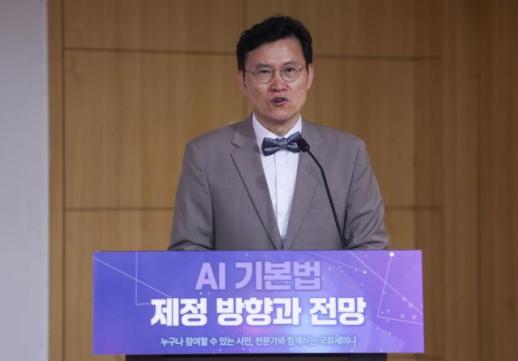 South Korea's AI Safety Institute Faces Scrutiny Over Lack of Results The Korea AI Safety Institute (AISI), established to evaluate the risks associated with artificial intelligence (AI) models, has come under fire for failing to report any assessments related to the potential use of AI in terrorism and various crimes. Concerns have been raised about the effective use of approximately 15 billion won (about $13 million) in taxpayer money, especially as the institute's website has been down for several days. As of May 18, the AISI's website has been inaccessible for several days. Since its inception, the institute has received a government budget of around 15 billion won. The AISI was created with several objectives, including responding to AI risks, leading global AI norms and policies, supporting domestic AI companies, and fostering specialized personnel and technology. Among these, the most critical task is the CBRN (Chemical, Biological, Radiological, and Nuclear) assessment, which evaluates the highest risk levels associated with whether AI models can provide information related to the synthesis of chemical weapons, design of pathogens, or assembly of nuclear devices. It is reported that a significant portion of the 15 billion won budget was allocated for these assessments. However, in its third year of operation, there have been no public disclosures of CBRN assessment results for domestic AI companies. In contrast, the UK's AI Security Institute tested over 30 advanced AI models last year and has enhanced its capabilities in cyber, chemical, and biological assessments. In 2024, it publicly conducted CBRN assessments on five AI frontier models. The U.S. AISI has also conducted pre-release evaluations on OpenAI's models and disclosed CBRN assessments for OpenAI's o1 model. Due to the strengthened CBRN evaluations in the U.S. and Europe, major tech companies like Anthropic, OpenAI, and Google DeepMind conduct CBRN assessments for their models upon release and publicly share detailed results. Among domestic companies, Kakao is the only one that has publicly disclosed safety assessment results for its AI models. In December of last year, Kakao announced the safety assessment results for its self-developed language model, Kanana-1.5-9.8B. However, the assessment focused on general risk factors such as violence and discriminatory expressions, and did not include CBRN-specific items. No safety assessment reports have been made public by major AI developers such as Naver, SKT, and LG, and it has been confirmed that none are currently undergoing safety evaluations with the AISI. The AISI stated that it engages in many confidential collaborations with various governments, which limits what it can disclose. When asked about specific results, an AISI official responded, "Various projects and results of AISI are disclosed on our website." However, the website's inaccessibility made verification impossible. Given the substantial budget of 15 billion won, the explanation that collaboration with foreign governments is a primary task is difficult to accept. An official from the Electronics and Telecommunications Research Institute (ETRI), which oversees the AISI, explained, "AISI's major projects include national policy development and collaboration with foreign governments. Most matters are confidential, so there may not appear to be many public results."* This article has been translated by AI. 2026-05-18 20:34:25
 -
 CU and GS25 Expand 24-Hour Convenience Store Delivery with Coupang Eats Convenience store chains CU and GS25 are partnering with Coupang Eats to expand their 24-hour delivery services. This move comes as demand for late-night deliveries increases, prompting the convenience store sector to enhance its quick commerce capabilities.According to industry sources, CU will begin offering 24-hour delivery through Coupang Eats starting May 19. Previously, CU provided delivery services from 6 AM to 3 AM the following day via platforms like Pocket CU and Coupang Eats.With the extended hours, customers will now be able to order products from nearby CU stores during the previously unavailable hours of 3 AM to 6 AM.The 24-hour delivery service will be available at stores already operating with Coupang Eats. The service will cover areas including Seoul, Incheon, Gyeonggi, Gwangju, Busan, and Daejeon, where Coupang Eats has partnered with stores for around-the-clock delivery. Customers in these regions can order from approximately 8,000 items, including lunch boxes, ramen, desserts, beverages, and daily necessities, without time restrictions through the CU tab in the Coupang Eats shopping menu.GS25 will also launch its 24-hour delivery service through Coupang Eats on the same day, targeting around 1,000 stores in parts of Seoul, Gyeonggi, and six major metropolitan cities. GS25 plans to expand its service range to allow consumers to purchase necessary items during late-night and early morning hours.The convenience store industry's shift to 24-hour delivery is driven by the rising demand for late-night services. CU's overall delivery sales growth rates were 142.8% in 2024, 65.4% in 2025, and 91.6% in the first four months of 2026. During the same period, late-night delivery sales from 10 PM to 3 AM outpaced overall delivery growth, with increases of 167.5%, 86.6%, and 120.0%, respectively. GS25 has also been operating late-night delivery services until 3 AM at about 2,500 stores since November of last year, with late-night delivery sales at these locations increasing by 42.7% over the past six months. Shin Hak-dong, head of GS Retail's O4O (Online for Offline) business strategy team, stated, "We expect that expanding the 24-hour delivery service will provide greater convenience for customers and additional revenue opportunities for franchisees."Meanwhile, demand for quick commerce is expected to continue growing. Global market research firm Statista predicts that South Korea's quick commerce market will reach 5.9 trillion won by 2030.* This article has been translated by AI. 2026-05-18 20:32:16
 -
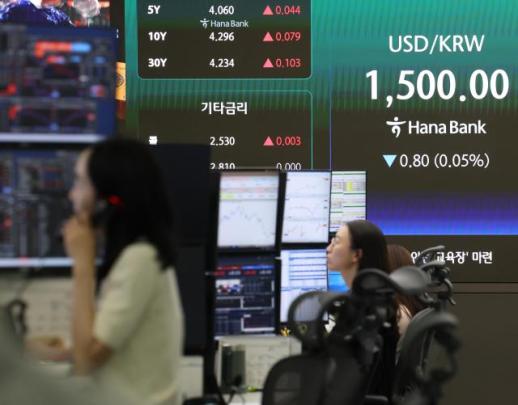 Korean Won Surpasses 1500 Mark Amid Strong Dollar and Foreign Investor Exodus The won-dollar exchange rate has surpassed the 1500 mark for the first time in a month, reflecting heightened volatility in the foreign exchange market. This surge is attributed to a combination of strong dollar pressures, significant foreign investor capital outflows, and rising international oil prices. On May 18, the weekly closing rate for the won against the U.S. dollar in the Seoul foreign exchange market was recorded at 1500.3 won, down 0.5 won from the previous trading day. Despite this slight decline, the rate remains firmly above the 1500 won level. Earlier this month, on May 6, the rate had dipped to 1439.6 won, suggesting a brief period of stability, but volatility has since intensified. The recent spike in the exchange rate is rooted in deteriorating global macroeconomic conditions. The sharp decline of the British pound has contributed to upward pressure on the dollar. Additionally, the recent U.S.-China summit ended without significant outcomes, increasing market uncertainty surrounding conflicts in the Middle East. Concerns over inflation in the U.S. have also heightened expectations of further tightening by the central bank. Furthermore, rising international oil prices due to escalating tensions in the Middle East have raised fears of worsening trade balances for South Korea, which is heavily reliant on energy imports, thereby exerting downward pressure on the won. From a supply and demand perspective, the outflow of foreign investment has been a primary driver of the rising exchange rate. Foreign investors have sold a net 23.55 trillion won in the stock market over the past seven trading days. Cumulatively, the net selling during the trading days of May 15 and 18 reached 9.23 trillion won. The rise in domestic bond yields, coupled with internal issues at major companies like Samsung Electronics, has significantly dampened investor sentiment toward South Korean assets. This has led to increased demand for currency exchange related to foreign stock sales, directly pushing up the exchange rate. Despite the won surpassing the 1500 mark, there has been no visible intervention from foreign exchange authorities. The Governor and Deputy Governor of the Bank of Korea have maintained a cautious stance, asserting that exchange rates should be determined by market forces and that artificial intervention is inappropriate. In fact, during the surge in March, any verbal or actual intervention by authorities was limited. However, the recent exchange rate decline has been interpreted as a response to growing expectations of intervention by foreign exchange authorities. Financial market experts believe that the current exchange rate level presents significant pressure, suggesting that the potential for further sharp increases is limited. Moon Da-un, a researcher at Korea Investment & Securities, stated, "Given the current level of 1500 won, which is a significant figure, and the previous peak of 1536 won after the war, this range carries a high likelihood of government intervention, indicating limited room for further increases."* This article has been translated by AI. 2026-05-18 20:30:00
 -
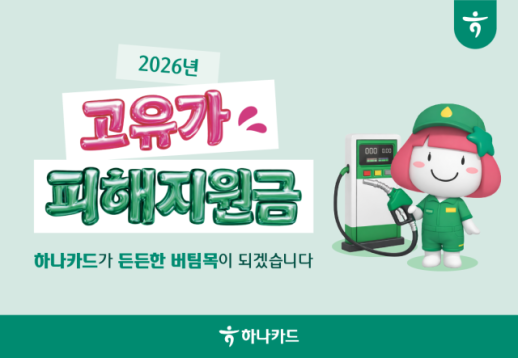 Hana Card Begins Second Round of Applications for High Oil Price Relief Fund Hana Card announced on May 18 that it has begun accepting applications for the second round of the "2026 High Oil Price Relief Fund."This second round is aimed at approximately 32.56 million citizens in the bottom 70% income bracket, as well as vulnerable groups who missed the first application period. The application window is open from today until July 3.During the first week of applications, from May 18 to 22, a birth year-based system will be implemented to ensure smooth processing.The relief fund will be distributed based on the recipient's address and income level, with amounts ranging from a minimum of 100,000 won to a maximum of 600,000 won as of March 30, 2026. Recipients must use the funds by August 31, 2026, or any unused balance will automatically expire.The funds will be provided in the form of credit and debit card points, which can be used at offline merchants with annual sales of less than 3 billion won. Key spending locations include traditional markets, neighborhood marts, restaurants, beauty salons, and optical shops. However, usage is restricted at certain establishments, such as large supermarkets, department stores, and franchise outlets.Applicants using Hana Card can access their funds immediately without waiting, and the funds can be utilized across all Hana Card credit and debit cards. The amount spent from the relief fund will also count towards the card's usage record, allowing recipients to maintain existing card benefits and additional services.The Hana Pay app features a function to help users find merchants that accept the relief fund. Users can search by region and store name to locate eligible vendors.Applications can be submitted through the Hana Card website, mobile web, Hana Pay app, dedicated ARS, customer service center, and branches of Hana Bank nationwide. Customers without a Hana Card can obtain a debit card at Hana Bank branches to apply.* This article has been translated by AI. 2026-05-18 20:27:20
 -
 Bithumb Celebrates Bitcoin Pizza Day with Promotions for New Customers Bithumb announced on May 18 that it will hold an event in celebration of Bitcoin Pizza Day, offering Bitcoin and pizza sets to new customers making their first deposit. Any new customer without a deposit history at Bithumb can participate. After completing the application on the event page, customers who make a net deposit of 50,000 won or more during the event period will be automatically entered. The event runs until May 31. There are three main benefits. All participating customers will receive Bitcoin worth 10,000 won. Additional rewards will be given based on the amount of net deposits. The top 2,026 customers based on net deposit amounts will receive a gift card for a large Grilled Patty Cheeseburger Pizza and hot wings from Domino's Pizza, along with a cola. The top 10 customers will enjoy a fee waiver on trading amounts up to 100 million won. This benefit will be valid for 30 days from the date of issuance. Net deposits are calculated by subtracting withdrawal amounts from total deposits during the event period. The value of virtual asset deposits and withdrawals is based on the market price at the time of completion, and internal transfers between members are not counted. To receive the benefits, customers must maintain their balance and ranking until June 5, the date of issuance. Moon Sun-il, head of service management, stated, "Bitcoin Pizza Day is a symbolic day that proves the value of virtual assets in everyday life. We hope this event provides customers with a special opportunity to reflect on the significance of Pizza Day along with their first deposit experience at Bithumb." Bitcoin Pizza Day commemorates the day in 2010 when an investor in Florida purchased two pizzas for 10,000 Bitcoins.* This article has been translated by AI. 2026-05-18 20:25:17
 -
 Vietnam Expands Trade and Investment Cooperation with Busan A Vietnamese business delegation is visiting Busan to explore entry into the Korean market. The Busan Economic Promotion Agency (BEPA) hosted an export consultation meeting in Vietnam last October and reached an agreement with the Consul General of Vietnam in Busan in November on a joint business plan for 2026. This forum is expected to yield results from a year of collaborative groundwork. On May 17, the Overseas Market Development Bureau of Vietnam's Ministry of Industry and Trade announced that it will send a business delegation to Busan and southern Korea from May 19 to 22 to promote trade. This visit is part of the 2026 trade promotion program, aimed at identifying import demand and growth potential in Busan and southern Korea, understanding product quality standards, packaging, and distribution systems, and detailing strategies for promising export items such as agricultural products, processed foods, furniture, household goods, and OEM cooperation. Vietnamese companies plan to introduce their products and explore trading possibilities by meeting directly with local import partners at the 'Vietnam-Korea Business Networking Workshop' in Busan. ◆ Meeting Between Consul General and BEPA Director in November 2022: Agreement on Joint Business Plans for 2026 This forum is a continuation of the cooperation established over the past year. On November 17, 2022, Consul General Doan Phuong Lan met with BEPA Director Song Bok-cheol in Busan to discuss future cooperation directions. Lan highlighted Vietnam's economic development status, market potential, and prospects for collaboration between Vietnamese local governments and Busan, officially proposing the dispatch of reciprocal trade promotion delegations, investment attraction, technology cooperation, and expansion of startup collaboration. In response, Director Song praised Vietnam's development potential and the possibilities for Korea-Vietnam economic, trade, and investment cooperation, expressing BEPA's commitment to actively support trade and investment promotion events and assistance for small and medium-sized enterprises and startups. He also shared the results of BEPA's ongoing trade promotion programs in the Vietnamese market during the meeting. BEPA is a nonprofit organization jointly established by the city of Busan and the Ministry of SMEs and Startups of Korea. Additionally, in October 2022, BEPA dispatched a trade delegation consisting of 10 local SMEs to Vietnam using the Busan Economic Revitalization Support Fund (BEF). Vietnam is Busan's fourth-largest export destination, accounting for approximately 6.9% of the city's total exports. To support the somewhat sluggish recovery of exports to Vietnam, BEPA held export consultation meetings in Hanoi and Ho Chi Minh City, the economic centers of Vietnam. Through pre-matching, 60 local buyers were selected for consultations on various products, including cosmetics, health supplements, industrial welding machines, and dental implants, resulting in a total consultation performance of $12 million (approximately 18 billion won) and contract negotiations worth $8 million (approximately 12 billion won). The trade volume between the two countries is rapidly growing. As of last year, the trade volume exceeded $90 billion, and from January to April this year, trade reached $37.2 billion, continuing a strong growth trend. Exports to Korea amounted to $11.1 billion, a 22.9% increase compared to the same period last year, while imports rose to $26.1 billion, up 40.8%. As of the end of March this year, Korea's cumulative registered investment in Vietnam was approximately $99 billion, with 10,450 active projects, accounting for 23% of all projects and 18% of total foreign direct investment (FDI). * This article has been translated by AI. 2026-05-18 20:22:26
 -
 Global Executions Reach Record High in 2025, Driven by Iran and China The number of executions worldwide exceeded 2,700 last year, marking the highest level in 44 years. According to a report from Amnesty International cited by the German news agency dpa on May 18, 2025 saw 2,707 executions carried out across 17 countries. This figure represents a 78% increase from the previous year's total of 1,518 executions, the highest since Amnesty began tracking these statistics in 1981. The report attributes the significant rise in executions to an increase in punitive measures related to the war on drugs, with 1,257 drug-related executions recorded last year. Agnes Callamard, Secretary General of Amnesty International, stated that “a small number of repressive countries have significantly increased their use of the death penalty,” criticizing these nations for weaponizing capital punishment to instill fear and suppress dissent. Amnesty highlighted Iran as a key example, noting that at least 2,159 executions were carried out there last year, more than doubling the previous year's total. China is also mentioned as one of the countries with the highest number of executions, with thousands reportedly carried out last year. Some nations are even attempting to reinstate the death penalty; for instance, Burkina Faso has adopted a draft bill to revive capital punishment for crimes such as treason, terrorism, and espionage. Despite these alarming trends, Amnesty International acknowledged the progress made by human rights organizations advocating for the abolition of the death penalty, noting that more than half of the countries worldwide have abolished it.* This article has been translated by AI. 2026-05-18 20:19:51