
Journalist

Abe Kwak
-
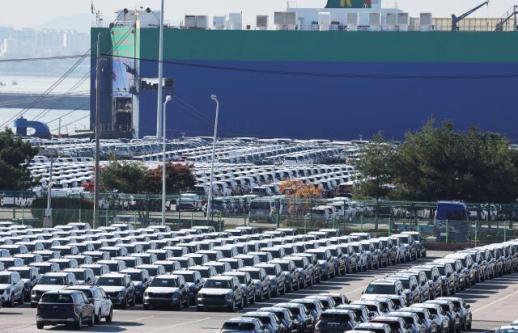 Korean Automakers Reach 76 Million Exports After 50 Years in Global Markets Korea's automotive industry has achieved a significant milestone, reaching a cumulative export total of 76 million vehicles after 50 years in international markets. This accomplishment reaffirms the industry's vital role in the nation's economic growth. According to the Korea Automobile Mobility Industry Association (KAMA), as of last month, a total of 76,548,569 vehicles have been exported. This record comes 50 years after Hyundai Motor Company exported its first domestic passenger car, the Pony, to Ecuador in June 1976. Korean automobile exports surpassed the 10 million mark for the first time in 1999, with 11,073,814 vehicles shipped. The rise of Hyundai and Kia as top-tier global automotive brands has significantly elevated the status of the Korean automotive industry. Since then, exports have increased by approximately 10 million units every three to four years, with figures of 51,098,839 in 2015, 61,093,781 in 2019, and 70,087,640 in 2023. Industry insiders suggest that if the current trend continues, cumulative exports could exceed 80 million next year. As competition intensifies in the global market, the automotive sector continues to expand. A recent report from HMG Strategy Institute forecasts that the global automotive market will grow by 0.2% year-on-year to approximately 87.93 million units. While growth in advanced markets like the U.S. and Western Europe is expected to slow, emerging markets such as India are anticipated to gain momentum. The domestic automotive production sector also reached a historic milestone this year. Cumulative production, which totaled 129,110,000 vehicles last year, surpassed 130 million with an additional 1,387,043 units produced from January to April this year. On the same day, KAMA and the Korea Automobile Industry Cooperative (KAICA) held the 23rd annual Automotive Day ceremony in Seocho-gu, Seoul, honoring 36 individuals for their contributions to the development of the automotive industry. The highest honor, the Gold Tower Industrial Medal, was awarded to Jae-hoon Chang, Vice Chairman of Hyundai Motor Group. The Silver Tower Industrial Medal went to Sang-sik Ham, CEO of MR Infra Auto, while the Bronze Tower Industrial Medal was awarded to Ki-young Hwang, CEO of KG Mobility. This year's awards focused on individuals who have strengthened the competitiveness of future vehicles through initiatives such as attracting domestic production of eco-friendly cars, technological development, innovations in AI, software, and autonomous driving technologies, advancements in smart manufacturing, building a future vehicle industry ecosystem, and exploring new markets through cooperative efforts. Jung Dae-jin, President of KAMA, stated, "The 50 years of automotive exports reflect the history of South Korea's economic growth. To maintain our lead in the global future vehicle competition, we need to secure domestic production bases and expand research and development and investment through public-private cooperation."* This article has been translated by AI. 2026-05-12 08:33:27
 -
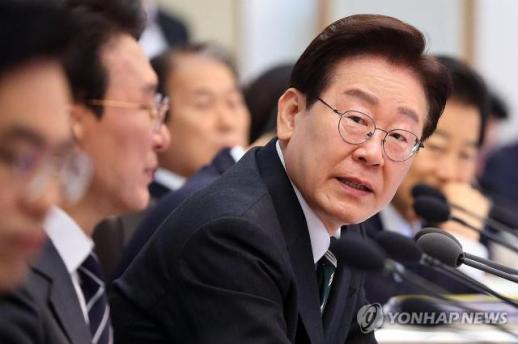 Lee Jae-myung's Inclusive Finance and the Challenges for Financial Leaders President Lee Jae-myung described the achievements of the Financial Services Commission in inclusive finance as "remarkable" during a Cabinet meeting, highlighting a significant shift in approach. Banks are reducing the external sale of delinquent debts, a long-standing practice, and are expanding internal debt restructuring and collection efforts. This change marks a transition from a focus on debt recovery to supporting economic recovery, reflecting a broader change in the perception of finance's role. Supporting data backs this shift. The number of self-managed debt restructuring cases among the five major banks rose dramatically from 989 in the first quarter of 2025 to 3,456 in the fourth quarter of the same year. In contrast, external sales of delinquent debts plummeted from approximately 35,000 cases in 2025 to just 11 in the first quarter of 2026. The completion and disposal of long-term delinquent debts have also seen significant increases in both number and amount. The trend indicates a clear movement within the financial sector to manage bad debts internally rather than outsourcing to external collection agencies. President Lee's perspective is clear. His statement that "squeezing every last penny is not desirable" signifies a commitment to viewing finance not merely as a debt collection system but as a pathway for economic rehabilitation. This reflects a determination to reintegrate those excluded from the financial system due to long-term delinquency. Some policy effects are already evident. A total of 2.928 million people have received credit forgiveness, with 154,000 of them resuming normal financial transactions such as new loans or credit card issuance. This indicates a meaningful change as some previously marginalized groups are returning to economic activity. However, it is essential to approach this trend with caution rather than viewing it as a mere success. Finance is fundamentally an industry that manages risk. Changes in the management of delinquent debts will inevitably lead to shifts in risk management structures. This is where the role of financial leadership becomes crucial. For financial leaders such as Jin Ok-dong of Shinhan Financial, Yang Jong-hee of KB Financial, Ham Young-joo of Hana Financial, Im Jong-ryong of Woori Financial, and Lee Chan-woo of NH Nonghyup Financial, this change is not just a policy response. It presents a managerial challenge of balancing public interest, profitability, inclusivity, and soundness, which are often in tension with one another. Historically, the external sale of delinquent debts was the fastest and most certain means of risk elimination for financial institutions. In contrast, internal debt restructuring and collection come with the potential for lower recovery rates and increased costs, which can negatively impact short-term performance. This creates a structure where financial institutions bear the burden internally. Nonetheless, the shift in the financial sector can be viewed as a result of the government's inclusive finance policy aligning with structural necessities. Neglecting long-term delinquents could expand the financially vulnerable population, ultimately returning the burden to the entire financial system. Inclusive finance is not merely a welfare measure; it can serve as a pillar for maintaining financial stability. The challenge lies in achieving balance. If inclusive finance devolves into indiscriminate debt relief or superficial performance competition, it could lead to moral hazard. Issues of fairness may arise for borrowers who have diligently repaid their debts. It is crucial to remember that trust in finance is rooted in fairness. President Lee's remarks on the evaluation and incentive systems for financial institutions are also significant in this context. The goal should not be merely to expand the quantitative metrics of inclusive finance but to ensure that it operates effectively for borrowers with genuine potential for recovery. Mechanisms are needed to prevent financial institutions from pursuing excessive adjustments for short-term results. The Financial Services Commission's institutionalization plans must be approached with caution. While public disclosure of delinquent debt management performance and incentive systems can be positive measures, excessive intervention could undermine the autonomous risk assessment capabilities of financial institutions. Striking a balance between policy and market dynamics is essential. Ultimately, the essence of this change lies in redefining the role of finance. It tests whether finance can transcend its traditional role as a mere intermediary of funds to become a foundation for economic recovery and rehabilitation. At the same time, it will also be evaluated whether the fundamental principles of soundness and responsibility in finance can be maintained throughout this process. If President Lee has set the direction, financial leaders like Jin Ok-dong, Yang Jong-hee, Ham Young-joo, Im Jong-ryong, and Lee Chan-woo must implement that direction in practice. Balancing inclusivity and soundness, support and accountability, is the core challenge. Inclusive finance is necessary. However, to be sustainable, it must operate within the bounds that do not undermine the fundamental order of finance. A structure that aids recovery without compromising accountability and a system that supports while maintaining trust are essential. The success of this transition ultimately hinges on achieving that balance.* This article has been translated by AI. 2026-05-12 08:20:50
 -
 High-Level Strategic Coordination Needed Amid U.S.-South Korea Tensions As a summit between U.S. President Donald Trump and Chinese President Xi Jinping approaches, tensions in Northeast Asia and global supply chains are rising. The U.S. and China continue to clash over tariffs, rare earth elements, semiconductors, and security issues, while also accelerating efforts to manage their conflicts. Amid this shifting global order, concerns are growing that South Korea is failing to assert clear leadership in coordinating key issues with the United States. Currently, sensitive topics are piling up between South Korea and the U.S., including defense cost-sharing, the transfer of wartime operational control, adjustments to the role of U.S. troops in South Korea, restructuring supply chains with China, cooperation in the semiconductor and battery industries, and coordination on North Korea policy. Given President Trump's repeated emphasis on the costs of alliances, it is difficult to predict the intensity of future U.S. pressure. In particular, there is an increasing demand within the U.S. for allied nations to expand their defense responsibilities. Many analysts believe that South Korea will not be exempt from this trend of American exceptionalism. The issue is that these changes are likely to extend beyond just defense. The matters of defense spending and the U.S. military presence in South Korea are closely linked to trade, industry, and technological cooperation. In fact, the U.S. has consistently highlighted the strategic role of its allies in the context of semiconductor supply chains, battery investments, and advanced technology collaboration. For South Korea, it has become challenging to separate security from economic considerations. The U.S. market is a crucial export destination for South Korean companies, while China remains its largest trading partner. The U.S. is demanding a restructuring of supply chains, and China is increasing its countermeasures. In this context, if South Korea responds to individual issues without a clear strategy, it will inevitably face greater diplomatic burdens and industrial uncertainties. A more significant problem is that discussions on U.S. strategy are fragmented amid domestic political schedules and conflicts. What is needed now is a high-level strategic dialogue that can calmly identify differences in perception between South Korea and the U.S. and coordinate based on national interests. While trust between leaders is important, it is essential that the diplomatic, security, and industrial lines operate organically to continuously reconcile differences with the U.S. Take the issue of wartime operational control, for example. This is not merely a matter of transferring military command; it is directly related to the South Korea-U.S. combined defense system. It could also be linked to changes in the role of U.S. troops in South Korea. Defense cost negotiations are not just about numbers; they must be viewed within the broader context of restructuring alliance frameworks and strategic roles. With semiconductors, artificial intelligence, and the battery industry now considered security assets, the boundaries between industrial policy and diplomatic strategy have effectively disappeared. In such times, the diplomatic capabilities of the South Korean government become even more crucial. It is necessary to maintain cooperation with the U.S. while conducting meticulous negotiations that can protect South Korea's industrial and security interests. Alliances are important, but they cannot take precedence over national interests. Conversely, national interests should not be used as an excuse to neglect strategic communication. Ultimately, the key lies in the ability to coordinate at a high level based on trust. The international order is rapidly being reshaped. The U.S.-China conflict is becoming protracted, and alliance systems are operating differently than before. In such a period, South Korea must avoid revealing diplomatic vacuums or strategic absences. As sensitive issues pile up between South Korea and the U.S., what is needed is not louder political rhetoric but calm and meticulous high-level consultations. National interests are safeguarded not through slogans but through negotiation and coordination. 2026-05-12 08:06:05
 -
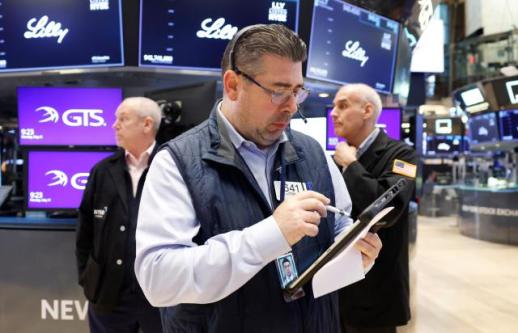 U.S. Stocks Rise Amid Middle East Tensions, S&P 500 Surpasses 7400 for First Time Donald Trump, the President of the United States, highlighted the precarious nature of the ceasefire with Iran, bringing renewed attention to tensions in the Middle East. Despite this, U.S. stocks closed slightly higher, buoyed by a rally in artificial intelligence (AI) stocks. On May 11, the Dow Jones Industrial Average finished up 0.19%, or 95.31 points, at 49,704.47. The S&P 500 index, which is heavily weighted toward large-cap stocks, rose 0.19%, or 13.91 points, to close at 7,412.84, marking its first-ever close above 7,400. The tech-heavy Nasdaq Composite Index increased by 0.10%, or 27.05 points, to finish at 26,274.13. Earlier, President Trump responded to questions about the ceasefire with Iran, stating, "It’s unbelievably weak, in the weakest state. It’s heavily reliant on life support, and the doctor says there’s about a 1% chance of survival." As tensions in the Middle East escalated, international oil prices also rose. Brent crude futures closed at $104.21 per barrel, up 2.9% from the previous trading day, while West Texas Intermediate (WTI) crude futures rose 2.8% to $98.07 per barrel. Despite geopolitical uncertainties, semiconductor and technology stocks showed strength. Qualcomm surged by 8.42%, while Micron Technology (6.5%), Western Digital (7.46%), and Seagate (6.56%) continued their upward momentum from the previous week. The Philadelphia Semiconductor Index increased by 2.6%. The performance of the seven major tech stocks, known as the "Magnificent 7 (M7)," was mixed. Nvidia (1.97%) and Tesla (3.89%) saw gains, while the other five—Alphabet, Amazon, Apple, Meta, and Microsoft—experienced declines. Jay Hatfield, founder and CEO of Infrastructure Capital Advisors, told CNBC, "The tech boom is so strong that rising energy prices are not allowed to affect the U.S. economy or the U.S. stock market. Everyone is tuning out the Middle East issues."* This article has been translated by AI. 2026-05-12 08:04:20
 -
 Lotte World Enhances Theme Park Experience with Unique Attractions in Seoul and Busan Lotte World is enhancing its competitiveness in the theme park market by introducing tailored content in Seoul and Busan. Lotte World Adventure in Seoul has attracted 100,000 visitors through its collaboration with the game franchise MapleStory, while Busan is expanding its experiential spaces with a series of new media-based attractions. ◆ Seoul's MapleStory Experience Attracts Over 100,000 Visitors According to Lotte World on May 12, the MapleStory collaboration "Create Your Own Character" at Lotte World Adventure in Songpa-gu, Seoul, has surpassed 100,000 visitors since its launch on March 14. This achievement comes just two months after the experience opened. This interactive space allows visitors to scan QR codes to create game characters resembling themselves, which can then be displayed on a 10-meter-tall media tree. The experience is linked to Nexon's "MapleHands+" app, enabling users to bring their in-game characters to life offline, attracting the attention of existing fans. Lotte World has transformed the entire area to resemble the game world, featuring photo zones with characters like Orange Mushrooms and Slimes. Additionally, a parade featuring a MapleStory-themed unit from "Ludibrium" takes place daily at 2 PM. This spring festival will continue until June 14. ◆ Busan Unveils New Attraction 'Forbidden Castle' During the same period, Lotte World Adventure Busan is focusing on hardware expansion. On May 16, it will introduce the new media-based attraction "Forbidden Castle." This follows the launch of the large Viking ride "Pirates Swing Ship" on April 18, marking the second new facility introduced this year. Forbidden Castle combines a 38-meter-long curved screen with a motion simulator. The vehicles carrying guests synchronize with videos of dinosaur island explorations, featuring up-and-down movements and sharp turns. This design enhances immersion by simulating the experience of dodging or colliding with massive dinosaurs. Lotte World Busan is consistently expanding its attractions to meet visitor demand. After introducing three family attractions (Bang & Drop, Dancing Morris, Cookie Swing) in the second half of last year, it has added thrill and experiential facilities this year, bringing the total lineup to 18 attractions. Lotte World officials stated, "We plan to increase the number of attractions to 20 in the future to strengthen our competitiveness as a theme park in the Busan area."* This article has been translated by AI. 2026-05-12 07:58:55
 -
 Search Continues for Missing Elementary Student in Juwangsan National Park 경북 청송 주왕산국립공원에서 산행에 나섰던 초등학생이 실종돼 수색 당국이 사흘째 수색에 나섰다. On May 12, Yonhap News reported that the Gyeongbuk Provincial Police Agency, Gyeongbuk Fire Department, and the Korea National Park Service are continuing large-scale search efforts in Juwangsan National Park for a missing elementary student, identified as A. On May 11, authorities deployed 80 personnel, including 40 police officers, 28 firefighters, and 12 national park staff, along with five drones equipped with thermal imaging cameras and search dogs to locate A. Search teams are focusing their efforts along the hiking trails from the last known sighting of A near Giam Bridge to the summit of Juwangsan, which stands at an elevation of 720.6 meters, as well as other key trails and steep areas in the national park. A Cheongsong County official told Yonhap News that nighttime searches continued until 11 p.m. the previous night, but no significant findings were reported. A, who lives in Daegu, visited a temple in Juwangsan National Park with his parents on May 10. He was last seen around noon that day near Giam Bridge, telling his parents he would "just go up the mountain for a bit" before disappearing. When A did not return for an extended period, his parents reported him missing to emergency services at 5:53 p.m. on the same day. At the time of his disappearance, A was described as approximately 145 cm tall with a slight build, wearing a Samsung Lions uniform and cap. It was reported that he did not have a mobile phone with him.* This article has been translated by AI. 2026-05-12 07:57:23
 -
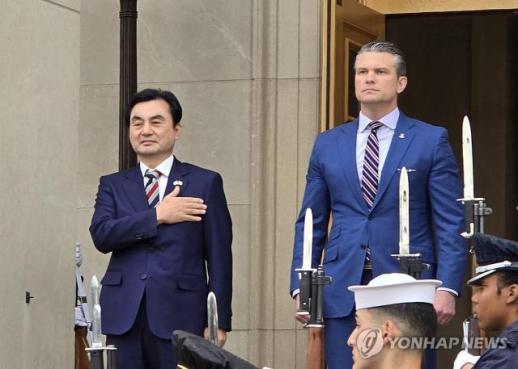
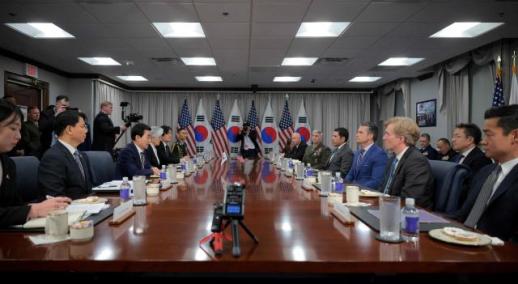 Seoul walks tightrope at Korea-U.S. defense talks amid Hormuz crisis SEOUL, May 12 (AJP) - South Korea and the United States used their first defense ministerial meeting in six months to steady alliance coordination at a moment when the widening Iran conflict and mounting U.S. pressure over the Strait of Hormuz are testing Seoul’s strategic balancing act. The talks between South Korean Defense Minister Ahn Gyu-back and U.S. Secretary of War Pete Hegseth at the Pentagon came as Washington intensifies calls for allies, including Seoul, to play a more proactive role in reopening the Strait of Hormuz following attacks on commercial shipping and escalating Iranian threats. The backdrop to the meeting was the recent strike on the Korean-operated bulk carrier HMM Namu near Hormuz, which Seoul concluded was caused by an “external strike” involving unidentified airborne objects. While South Korea strongly condemned the attack and vowed a response, it has stopped short of publicly naming Iran as the perpetrator despite repeated pressure from U.S. President Donald Trump. Trump earlier alleged Iran attacked the vessel and publicly urged South Korea to support U.S.-led efforts to secure maritime routes through Hormuz, arguing that countries benefiting from Gulf energy shipments should contribute more directly to reopening the strategic waterway. Hegseth used the Pentagon meeting to sharpen Washington’s message on burden-sharing and a greater South Korean security role within the alliance framework, linking the Korean Peninsula more directly to broader global security challenges. “Our meeting today arrives at a pivotal moment for the U.S.-ROK Alliance,” Hegseth said in opening remarks. “Together, our nations are taking strong actions to ensure our combined readiness and to defend vital national security interests.” Referring to the U.S. military campaign against Iran, dubbed “Operation Epic Fury,” Hegseth said the operation demonstrated “this administration's unwavering commitment to confronting threats and defending those interests.” “In this current global threat environment, the strength of our alliance is critical, and we look to our partners to stand shoulder-to-shoulder with us,” he added. Hegseth also renewed pressure on Seoul over defense burden-sharing, praising South Korea’s pledge to raise defense spending and assume greater responsibility for peninsula security. The Pentagon later explained that greater allied burden-sharing forms one of the four core pillars of the 2026 U.S. National Defense Strategy alongside homeland defense, deterring China in the Indo-Pacific and strengthening the U.S. defense industrial base. “As I noted during my visit to Seoul last November, Republic of Korea's commitment to increase defense spending and your leadership in assuming primary responsibility for the security of the Korean Peninsula is very important,” Hegseth said. “Real burden-sharing is the foundation of a resilient alliance, and it is essential for effectively deterring our mutual adversaries.” Though the official Pentagon and Defense Ministry readouts did not explicitly mention Hormuz, officials in Seoul acknowledged the regional crisis and maritime security concerns formed part of the broader consultations surrounding Ahn’s Washington trip. Seoul has so far attempted to calibrate its response carefully. The presidential office condemned attacks on civilian shipping as unacceptable and pledged continued participation in international efforts to ensure freedom of navigation, while avoiding direct attribution to Tehran pending further analysis. That cautious approach reflects Seoul’s concern over being drawn deeper into a U.S.-Iran confrontation while still preserving close alliance coordination with Washington. South Korea remains heavily dependent on Middle Eastern crude imports and has historically sought to maintain working diplomatic channels with Iran. Ahn, while avoiding direct references to Iran, stressed alliance unity amid what he described as “difficult conditions.” “Just because we get to see familiar faces today, it really epitomizes what an alliance truly is,” Ahn said. “It's a big honor to have such a good meeting between the two countries, despite the difficult conditions that we're facing today.” At the same time, Seoul continued emphasizing its long-term objective of a more autonomous defense posture. “We are also keeping pace, putting our utmost efforts into achieving a ROK-led defense of the Korean Peninsula by acquiring critical national defense capabilities through measures such as increasing defense spending,” Ahn said. According to the joint readout, the two ministers discussed wartime operational control transition and “Alliance modernization,” while agreeing to strengthen cooperation moving forward. The issue remains one of the alliance’s most sensitive fault lines. U.S. Forces Korea Commander Gen. Xavier Brunson recently referred to the first quarter of 2029 as a possible timeline for OPCON transition during congressional testimony, exposing differences in expectations between the allies. The Lee Jae Myung administration is understood to be seeking progress before the current administrations in Seoul and Washington end in 2028. The ministers reaffirmed the importance of this week’s Korea-U.S. Integrated Defense Dialogue (KIDD) in Washington, describing it as a key mechanism for advancing alliance cooperation and national interests. The three-day meeting through Wednesday is being led by South Korean Deputy Defense Minister for Policy Kim Hong-cheol and U.S. Assistant Secretary of Defense for Indo-Pacific Security Affairs John Noh, with senior officials from both defense and foreign affairs agencies participating. The KIDD agenda is expected to cover broader alliance security issues including OPCON transition, combined defense posture and alliance modernization. “I believe this meeting is a significant opportunity to assess the achievements of the joint fact sheet between the presidents last year and the 57th Security Consultative Meeting, and to communicate about the alliance's direction moving forward,” Ahn said. “As a ROK-U.S. alliance has stood together upon a bedrock of unwavering trust even through hard times, we remain committed to close cooperation in the future in one voice.” At the same time, Seoul expanded its defense outreach beyond the traditional alliance framework. South Korea and North Atlantic Treaty Organization held their second defense industry consultative meeting Monday as Seoul seeks to deepen coordination with Western partners amid growing links between Indo-Pacific and European security following the Ukraine war and Middle East instability. The consultative body was launched after South Korea and NATO agreed during the 2025 NATO summit in The Hague to establish a working-level framework for defense industrial cooperation. The first session was held at NATO headquarters in Brussels in September last year. At the second meeting held eight months later, the two sides shared information on potential cooperation areas and discussed concrete defense industrial collaboration. South Korea stressed that access to NATO standards was essential to improve interoperability of Korean weapons systems, while NATO requested Seoul’s participation in multilateral projects in areas such as ammunition and space cooperation. DAPA Commissioner Lee Yong-chul said Seoul hopes to establish itself as “a reliable IP4 partner nation,” referring to NATO’s Indo-Pacific partners of South Korea, Japan, Australia and New Zealand. He added that the Indo-Pacific and NATO security environments have become “more closely connected” following Russia’s war in Ukraine and pledged continued coordination with NATO’s international staff to develop concrete cooperation frameworks. The NATO delegation’s visit followed a trip last month by ambassadors from 30 NATO member states to South Korea, during which they toured major defense firms including HD Hyundai Heavy Industries and Hanwha Aerospace, underscoring growing European interest in South Korea’s defense manufacturing capabilities. 2026-05-12 07:51:42
 -
 KOSPI Hits Record High Amid Samsung and SK Hynix Surge, Deepening 'K-Shaped' Market ◆Ajou Economic Major News ▷KOSPI reaches all-time high as semiconductor stocks rally - The KOSPI index has once again set a record high. - A rally in major semiconductor stocks, led by Samsung Electronics and SK Hynix, has pushed the KOSPI index close to the 7,900 mark. - However, the upward trend is concentrated on these two large-cap semiconductor stocks, leading to a pronounced 'K-shaped' divergence in stock performance. - Analysts are expressing optimistic forecasts, with domestic brokerages suggesting that the KOSPI could surpass 8,000 and even reach 9,000. Foreign investment bank JP Morgan has projected that the KOSPI could exceed 10,000. - The recent surge is primarily driven by the semiconductor sector. - On this day, Samsung Electronics and SK Hynix saw their shares rise by 6% and 13%, respectively, as expectations for increased demand for AI semiconductors grow, effectively leading the market's rise. ◆Key Reports ▷Impact of high oil prices expected to intensify by August - As the U.S.-Iran conflict drags on, the actual frequency of price increases will be determined by the secondary effects of rising oil prices. - The secondary effects are theoretically significant due to demand, and with South Korea's economic growth rate likely to rise to the upper 2% range this year, concerns are heightened. - The challenge is that the recent economic upturn is largely attributed to the semiconductor cycle, making it difficult to isolate the intensity of 'demand-side' inflation. - However, despite the current growth rate, particularly in private consumption, being lower than in the past, the actual extent of economic sluggishness is not as severe compared to the reduced potential growth rate, warranting careful monitoring of inflation trends. ◆Major Announcements After Market Close (May 11) ▷Lotte Shopping reports Q1 operating profit of 252.9 billion won, a record for department stores. ▷S-Oil posts Q1 operating profit of 1.2311 trillion won, influenced by rising oil prices. ▷Hanwha Ocean secures an additional order for an LNG carrier worth 363.2 billion won. ▷IS Dongseo signs a construction contract worth 63.5 billion won with SK Eco Plant for a new project in Cheongju. ▷KR Motors decides on a 5-for-1 stock consolidation to maintain appropriate circulating shares. ▷Korea Electric Power Corporation (KEPCO) reports Q1 operating profit of 37 billion won, up 374.6% year-on-year. ▷TYM announces Q1 operating profit of 35 billion won, a 131.5% increase year-on-year. ▷Kia changes its CEO, with Song Ho-sung becoming the sole representative director. ▷Samsung Securities reports Q1 operating profit of 609.5 billion won, an 82.1% increase year-on-year. ◆Fund Trends (as of May 8, excluding ETFs) ▷Domestic equity funds: -197.9 billion won ▷Overseas equity funds: -26.4 billion won ◆Key Schedule for Today (May 12) ▷China: Automobile sales (April) ▷Germany: Consumer Price Index (final, April), ZEW Economic Sentiment Index (May) ▷United States: Small Business Optimism Index (April), Consumer Price Index (April)* This article has been translated by AI. 2026-05-12 07:33:07
 -
 Trump Says Iran Ceasefire is Fragile, Considers Resuming Project Freedom On May 11, Donald Trump, President of the United States, stated that the ceasefire with Iran is tenuous and indicated he is considering the resumption of the halted "Project Freedom." During a press briefing at the White House, Trump described the ceasefire as "incredibly weak, in the weakest state." He elaborated, saying, "The ceasefire is heavily reliant on life support, and the doctor says there’s about a 1% chance of survival." Trump emphasized that he finds Iran's proposals unacceptable and foolish, asserting that he has a very simple plan to end the war with Iran and that the country cannot possess nuclear weapons. He also claimed that Iran had initially agreed to transfer highly enriched uranium to the U.S. but later changed its mind. "Two days ago they said yes, then they changed their minds because it wasn’t specified in the documents," he said. Trump urged attendees at a White House event not to speak for too long, noting, "Many generals are waiting for me. This is important, and it concerns the lovely country of Iran." While meant as a joke, his comment hinted at a potential review of military operations against Iran. Meanwhile, Trump had previously been pushing for a declaration to end the war with Iran before his planned visit to China from May 13 to 15, but it now appears that a resolution before the trip is unlikely. As a result, Trump may ask Chinese President Xi Jinping for assistance in persuading and pressuring Iran during his visit, aiming to resolve the conflict with Iran through Xi's cooperation.* This article has been translated by AI. 2026-05-12 06:15:24
 -
 U.S. and South Korea Defense Ministers Discuss Strengthening Cooperation On May 11, South Korean Defense Minister An Gyu-baek met with U.S. Secretary of Defense Pete Hegseth in the United States. According to Yonhap News, the two ministers held talks at the Pentagon near Washington, D.C. This meeting marked the first time the defense ministers have convened since their discussions during the 57th Korea-U.S. Security Consultative Meeting (SCM) in Seoul on November 4 of the previous year. In his opening remarks, Hegseth referenced the U.S. military operation against Iran, dubbed 'Epic Fury,' emphasizing the importance of the alliance's strength and urging partners to stand shoulder to shoulder with the U.S. He further stated that South Korea's commitment to increasing its defense budget and taking a leading role in the defense of the Korean Peninsula is "very important," adding that it is essential for all U.S. partners to demonstrate true burden-sharing to build a resilient alliance and effectively deter regional adversaries. Regarding South Korea's promise to increase its defense spending, the U.S. Department of Defense noted in a press release that expanding defense cost-sharing with allies and partner nations is one of four key priorities outlined in the 2026 U.S. National Defense Strategy (NDS), alongside homeland defense, deterring China through strength in the Indo-Pacific region, and strengthening the U.S. defense industrial base. In his subsequent remarks, An highlighted the 'peace through strength' approach of the Trump administration and the need to enhance military capabilities in line with this philosophy. He stated, "We are making every effort to secure core national defense capabilities through increased defense spending to realize our leadership in the defense of the Korean Peninsula." An emphasized, "The Korea-U.S. alliance has been a reliable foundation even in difficult times, and we will continue to work closely together with one voice in the future." In a joint press release summarizing the meeting, both ministers discussed the security situation on the Korean Peninsula and reaffirmed that the upcoming Korea-U.S. Integrated Defense Consultative Body (KIDD) meeting in Washington this week will play a significant role in enhancing alliance cooperation and advancing the national interests of both countries. They agreed to maintain close communication and enhance cooperation in areas of mutual security interest. The release also noted that Hegseth stressed the importance of adopting a realistic and practical approach to modernizing the alliance, deterring threats, and strengthening the Korea-U.S. combined defense posture. Additionally, An explained South Korea's recent efforts to increase defense spending, secure core military capabilities, and take the lead in the defense of the Korean Peninsula. The joint press release concluded that both ministers discussed key alliance issues, including the transfer of wartime operational control and alliance modernization, and agreed to strengthen future cooperation.* This article has been translated by AI. 2026-05-12 06:12:38