

Journalist

CGTN
-
 KOSPI Hits Record High Amid Strong Institutional Buying, Closes at 8476 The KOSPI index reached a new record high, closing at 8476.15, driven by strong institutional buying. The index maintained its upward momentum, buoyed by gains in semiconductor and large-cap stocks. According to the Korea Exchange, the KOSPI rose by 290.86 points (3.55%) from the previous trading day. It opened at 8384.31, up 199.02 points (2.43%), and fluctuated throughout the day, surpassing the previous high of 8457.09 at one point. In terms of trading activity, individuals and foreign investors sold a net 1.4 trillion won and 1.07 trillion won, respectively, while institutions bought a net 2.36 trillion won, leading the index's rise. Lee Kyung-min, a researcher at Daishin Securities, noted, "The KOSPI's strength was fueled by the existing upward trend of leading stocks and the anticipation surrounding Jensen Huang, CEO of NVIDIA, visiting South Korea. Although foreign and individual investors were net sellers, the increased buying from institutions and financial investors exerted upward pressure on the index." Most of the top stocks in the securities market showed strong performance. Samsung Electronics rose by 5.51%, SK Hynix by 2.05%, SK Square by 0.65%, Samsung Electro-Mechanics by 14.82%, Hyundai Motor by 6.79%, LG Energy Solution by 3.39%, Samsung Life by 8.81%, and Samsung C&T by 8.01%. In contrast, the KOSDAQ index struggled, closing at 1074.80, down 29.56 points (2.68%). It opened at 1112.15, up 7.79 points (0.71%), but reversed course as selling pressure from foreign and institutional investors increased. In the KOSDAQ market, individuals bought a net 310.1 billion won, while foreign and institutional investors sold a net 17.4 billion won and 300.5 billion won, respectively, contributing to the index's decline. The top stocks in the KOSDAQ also generally performed poorly. EcoPro BM fell by 0.46%, Alteogen by 0.14%, EcoPro by 3.52%, JUSUNG Engineering by 3.85%, Kolon TissueGene by 4.54%, Rino Technology by 1.72%, and Peptron by 5.00%. However, Rainbow Robotics rose by 0.71%, Samchundang Pharm by 0.30%, and HLB by 0.59%. Meanwhile, interest in single-stock leverage exchange-traded funds (ETFs) continued, marking their third trading day alongside the KOSPI's strength. According to Koscom ETF Check, four of the top ten ETFs by trading volume were single-stock leverage ETFs for Samsung Electronics and SK Hynix. The KODEX SK Hynix Single-Stock Leverage ETF recorded a trading volume of 27.48 trillion won, ranking second overall, while the TIGER SK Hynix Single-Stock Leverage ETF ranked fourth with 16.60 trillion won. The KODEX Samsung Electronics Single-Stock Leverage ETF and TIGER Samsung Electronics Single-Stock Leverage ETF recorded trading volumes of 15.39 trillion won and 9.88 trillion won, respectively. However, returns varied by stock. The KODEX Samsung Electronics Single-Stock Leverage ETF and TIGER Samsung Electronics Single-Stock Leverage ETF rose by 12.05% and 12.58%, respectively, thanks to Samsung's strong performance. In contrast, the KODEX SK Hynix Single-Stock Leverage ETF and TIGER SK Hynix Single-Stock Leverage ETF only increased by 3.19% and 2.57%.* This article has been translated by AI. 2026-05-29 16:36:00
 -
 Korea's memory giants hit new ceiling ahead of visit by their biggest client SEOUL, May 29 (AJP) - South Korea's memory-chip giants climbed to fresh records Friday as investors turned euphoric ahead of next week's visit by their biggest customer, Nvidia Chief Executive Officer Jensen Huang, fueling hopes of deeper AI partnerships and new orders for next-generation memory chips. The world's most valuable company's CEO Jensen Huang is set to visit South Korea next week, a trip expected to transform his high-profile camaraderie with the country's conglomerate chiefs into broader business alliances that could reshape parts of the domestic technology sector. According to industry sources, Huang will travel to Seoul following his keynote address at the GTC Taipei 2026 AI conference, which runs from June 1 to 4. The upcoming visit, occurring just seven months after his widely publicized "Gganbu" gathering with South Korean business leaders, signals Nvidia's intent to expand its footprint beyond its existing semiconductor supply chain into broader industrial ecosystems spanning physical AI, cloud infrastructure and industrial automation. Investors wasted little time positioning for that possibility. Samsung Electronics rose 5.5 percent to a record closing high of 316,000 won, lifting its market capitalization to 1,853.3 trillion won ($1.35 trillion), while SK hynix climbed 2.23 percent to an all-time high of 2.34 million won, bringing its market value to 1,662.7 trillion won. Together, the two memory giants were worth more than 3,500 trillion won, accounting for nearly half of the KOSPI's total market capitalization and underscoring how deeply South Korea's stock market has become tied to the global artificial intelligence boom. Market watchers expect Huang to hold a series of strategic meetings with major South Korean business leaders, including LG Group Chairman Koo Kwang-mo and executives from internet giant Naver. Discussions with LG are expected to center on physical AI collaboration, potentially involving affiliates such as LG AI Research, LG Innotek and LG Uplus, combining hardware sensing technologies with AI software capabilities for next-generation industrial applications. The visit also coincides with a critical moment in the race for high-bandwidth memory, a key component powering Nvidia's AI accelerators. Earlier Friday, Samsung Electronics announced shipments of the industry's first 12-layer HBM4E memory samples. Huang is reportedly coordinating a meeting with Jun Young-hyun, head of Samsung's Device Solutions division, a discussion that could directly influence the qualification process and supply timeline for Samsung's next-generation HBM products. Any sign of progress would be closely watched by investors seeking evidence that Samsung is narrowing the gap with SK hynix, Nvidia's primary supplier of HBM chips and one of the biggest beneficiaries of the AI spending frenzy. The industry is also betting on the possibility of a second "Gganbu Meeting" involving Samsung Electronics Chairman Lee Jae-yong, Hyundai Motor Group Executive Chair Chung Euisun and SK Group Chairman Chey Tae-won. Chey is scheduled to meet Huang separately at Computex 2026 in Taiwan before the Nvidia chief's arrival in Seoul, marking their fourth encounter in seven months and highlighting the increasingly strategic relationship between Nvidia and South Korea's corporate elite. Analysts say such high-level networking carries growing economic significance in a technology industry where supply chains, product development and market access increasingly depend on close cooperation among a handful of global leaders. "In a global supply chain where mutual cooperation is essential rather than a single company's monopoly, building closer relationships naturally leads to increased exchanges and stronger partnerships," said Kang Sung-jin, a professor of economics at Korea University. "It gives a positive signal to investors that these companies will cooperate and support one another," Kang added. "These meetings go beyond simple socializing and help reinforce confidence in future business opportunities." 2026-05-29 16:35:41
 -
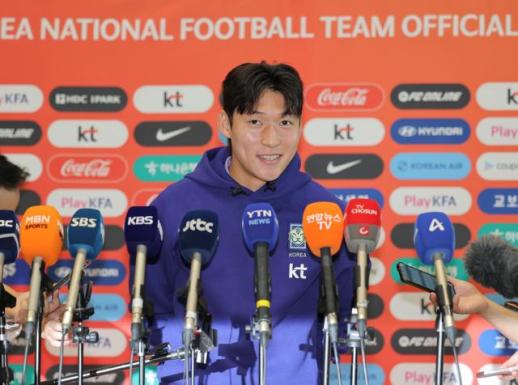 The Wildcard in Team Taegeuk Warriors SEOUL, May 29 (AJP) - When Hong Myung-bo named his squad for the 2026 FIFA World Cup last month, most of the coverage landed in the same place: Son Heung-min, captain, icon, almost certainly making his fourth and final appearance at the tournament. The farewell tour angle wrote itself. But scroll past the familiar names — Son, Lee Kang-in, Kim Min-jae, Hwang Hee-chan — and one entry reads differently. Bae Jun-ho, 22, Stoke City, attacker. Not a household name. Not yet a guaranteed starter. Precisely the kind of player that tends to get overlooked in squad announcements and remembered long after the tournament ends. Hong's selection problem is not obvious talent. South Korea has that. The problem is predictability. Opponents at this level have full dossiers on Son's movement, Lee's left foot, Hwang's runs in behind. They have watched the film. Against a Korea side that has historically leaned on its established stars, a younger attacking player creates a different equation — less data, less certainty, more space for something unexpected to happen. Bae can operate as an attacking midfielder or wide player, drift between lines, receive in tight spaces and link play in the final third. None of that sounds revolutionary. What matters is the context: in a squad where the attack announces itself in advance, he is the variable that doesn't. His path here has been methodical rather than meteoric. Three years ago he wore the No. 10 shirt for South Korea at the FIFA U-20 World Cup, contributing a goal and an assist across six matches as the team reached the semifinals. That was enough to accelerate his move from Daejeon Hana Citizen in the K League 1 to Stoke City in the Championship — English football's second tier, a division that tests character as much as quality. At Stoke he adapted without fanfare. In his first full season he logged 2,553 minutes across all competitions, scored twice and set up six more, and was named the club's player of the season. This season he has remained a regular. In Asian qualifying for the World Cup, he made 11 appearances and contributed two goals and four assists as South Korea punched through. The resume is solid without being spectacular. That, in a way, is the point. Korean football has a particular history with this kind of player — the young attacker who arrives without expectation and leaves with a moment the country doesn't forget. Lee Dong-gook was 19 at the 1998 World Cup in France when South Korea were hammered by the Netherlands. Most of that night is better forgotten. His long-range shot is not. Park Ji-sung was 21 in 2002 when he scored the goal against Portugal that helped send South Korea into the knockout rounds — and eventually the semifinals — under Guus Hiddink. Son himself was the youngest player in the 2014 squad when he scored against Algeria in Brazil, a footnote at the time and a origin point in retrospect. In Qatar in 2022, Hwang Hee-chan came off the bench against Portugal and scored in stoppage time to send Korea through. None of those moments were scripted. Bae is not a direct heir to any of them. But he is playing the same structural role: the player whose value lies partly in what opponents don't yet know about him. South Korea will enter Group A against Mexico, Czechia and South Africa, making their 11th consecutive World Cup appearance since 1986. The ambition, as ever, is to go further than the group stage — something the team has managed only once since that 2002 semifinal run. Hong's squad carries the usual weight of a nation's expectations on a small number of shoulders. What it also carries, quietly, is Bae — a 22-year-old who is not being asked to be the story, but who might end up being part of one. That is the thing about wildcards. You don't know which hand they'll fall in until the game is already being played. 2026-05-29 16:34:12
 -
 President Lee Casts Early Vote in Incheon for Local Elections President Lee Jae-myung cast his vote on May 29 at a polling station in Samcheong-dong, Jongno-gu, near the Blue House, on the first day of early voting for the local elections.According to the Blue House, President Lee and First Lady Kim Hye-kyung participated in an "out-of-district vote" for their registered address in Incheon’s Gyeyang-eul district.Dressed in a gray tie, President Lee headed to the polling station, intentionally avoiding colors associated with any specific political party to prevent misunderstandings.After presenting his identification and completing the verification process, President Lee entered the voting booth with his ballot. He soon stepped outside to ask, "Where is the election official? Is it okay if the circle is only partially filled in?"Concerned that his ballot might be invalid due to an incomplete mark, he sought clarification from an election official, who assured him that it would not be considered a spoiled ballot. President Lee then returned to the booth to complete his voting.Outside the polling station, dozens of members from the disability rights group "Korea People First" staged a protest, demanding the introduction of illustrated ballots and voting assistants. One individual with a developmental disability handed President Lee a handwritten letter outlining their demands.President Lee inquired about the number of voters with developmental disabilities and whether they were requesting that candidates' photos be included on the ballots to facilitate their voting process. He observed a demonstration of assistive tools that would allow for the addition of photo overlays on ballots.He stated, "I will consider whether this can be implemented in the official voting process," and requested his aides to report on the associated costs.President Lee also took time to pose for photos and shake hands with individuals from the disability community and nearby citizens.Following their voting, the presidential couple moved to a nearby restaurant for lunch, enjoying dishes such as barley bibimbap, handmade dough soup, stir-fried webfoot octopus, mung bean pancakes, and kimchi pancakes.Deputy Spokesperson Ahn Gyu-ryeong explained in a written briefing that the couple's early voting schedule was designed to encourage public participation in the electoral process and emphasize that democracy is completed through citizen engagement.Meanwhile, the People Power Party raised concerns about potential violations of election law, asserting that ballots should not be disclosed to others. Song Eon-seok, co-chair of the party's election committee, stated on Facebook, "According to Article 167 of the Public Official Election Act, no voter may disclose their ballot to another person, and any disclosed ballot should be considered invalid."* This article has been translated by AI. 2026-05-29 16:33:00
 -
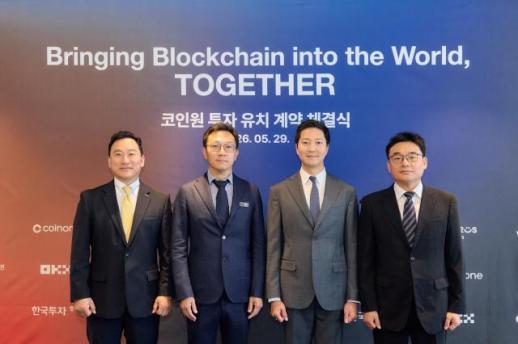 Coinone Secures Investment from Hanwha Investment & Securities and OKX Coinone, a South Korean cryptocurrency exchange, is expanding its collaboration with Hanwha Investment & Securities, OKX Ventures, and Com2uS Holdings in the digital asset sector. On May 29, Coinone announced that it had signed a strategic equity investment agreement with Hanwha Investment & Securities and OKX Ventures. The investment involves the acquisition of existing shares held by Cha Myung-hoon, CEO of Coinone, and Com2uS Holdings, along with newly issued shares. As a result, Hanwha Investment & Securities and OKX Ventures will each secure a 20% stake in Coinone, making them the third-largest shareholders after Cha (30.36%) and Com2uS Holdings (24.54%). Coinone stated that Cha will retain management control following the investment. Coinone plans to leverage this investment to enhance cooperation between traditional finance and the blockchain industry. Hanwha Investment & Securities aims to integrate Coinone's blockchain technology with its financial services in line with the ongoing institutionalization of digital assets, including token securities and stablecoins. The company also intends to share its expertise in internal controls and risk management to bolster trading stability and trust. In collaboration with OKX Ventures, Coinone will continuously strengthen its response capabilities through the exchange of insights in user protection, operational stability, security systems, and risk management. Com2uS Holdings expressed optimism that the entry of these strategic investors will enhance Coinone's corporate value and support its global business expansion. Cha stated, "We are collaborating with key partners across various sectors to seize the blockchain-based digital finance infrastructure market. We will also contribute to enhancing the credibility of the cryptocurrency industry by establishing a responsible equity structure." The four companies plan to hold a joint press conference next month to explain the background of this strategic investment and their future business directions.* This article has been translated by AI. 2026-05-29 16:33:00
 -
 Labor Ministry Accelerates Preparations for Public Workers Committee Launch in September The Ministry of Employment and Labor is ramping up efforts to establish the operational framework for the Public Workers Committee ahead of its launch in September. Government officials, labor representatives, and experts have reached a consensus on the draft enforcement ordinance that outlines the committee's structure and operational guidelines, and they plan to begin detailed discussions on policy agendas and committee composition.On May 29, the Ministry held the second plenary meeting of the 'Preliminary Consultation Body' at the Government Complex Sejong to discuss the establishment of the operational framework necessary for the implementation of the Public Workers Committee Act.Since its inception in March, the Preliminary Consultation Body has conducted over ten working-level discussions in two months, focusing on a multi-layered decision-making structure and role-sharing plan that includes the Public Workers Committee, working committee, development council, and sector-specific councils.The Ministry explained that the draft enforcement ordinance includes the basic framework for committee operations to ensure that discussions on improving the working conditions of public workers and enhancing public services can commence immediately after the law takes effect. The draft includes provisions on the size of various committees, secretariat roles, meeting convening procedures, and the processes for proposing, presenting, and voting on agenda items.The Ministry plans to proceed with subsequent legislative procedures, including a legislative notice next month, based on the prepared draft ordinance.With the framework for committee operations established in this meeting, the Consultation Body will now focus on detailed discussions regarding policy agendas, committee composition, and operational rules.Lee Hyun-ok, head of the Labor Policy Office at the Ministry, stated, "This draft ordinance is the first result of close communication among labor representatives, experts, and the government from the preparation stage. We will accelerate follow-up discussions to ensure effective discussions on improving working conditions can take place immediately upon the committee's launch."* This article has been translated by AI. 2026-05-29 16:33:00
 -
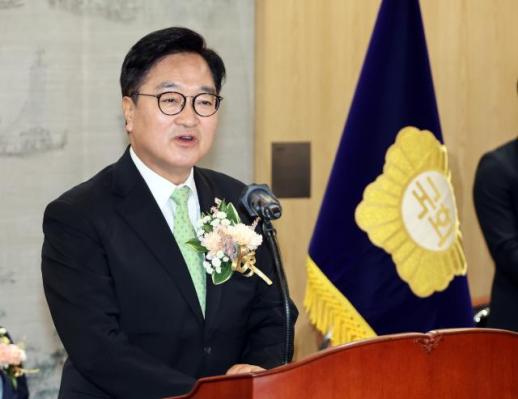 National Assembly Leadership Concludes Term; Woo Won-sik Emphasizes Unity The leadership of the 22nd National Assembly, including Speaker Woo Won-sik and Deputy Speakers Lee Hak-young and Joo Ho-young, officially concluded their terms during a retirement ceremony on May 29. Speaker Woo reflected on the past two years, stating, "The National Assembly must always prioritize the people." During the ceremony held in the National Assembly, Woo remarked, "I believe we have worked to protect democracy and, through that democracy, to safeguard the lives of the people." He emphasized the need for the National Assembly to continuously operate for the benefit of the public, stating, "There are many barriers in the National Assembly, including conflicts, political strife, and partisanship. If the Assembly becomes stalled due to these barriers while the people's lives continue without pause, it will only make life harder for the public and widen the gap between the Assembly and the people." Woo added, "I will return to being a regular member starting tomorrow. I will persistently work to ensure that democracy, proven through the lives of the people, becomes the strongest weapon for those who are weak. It has been a great honor to serve as Speaker during such a complex and critical time over the past two years." Deputy Speaker Lee expressed gratitude, saying, "Speaker Woo led us exceptionally well over the past two years. We faced historical challenges together and overcame them. It has been a tremendous honor for me, and I sincerely thank everyone who shared this honor with us." Deputy Speaker Joo noted, "The first half of the National Assembly has seen many events, but as the opposition, there were many regrets. I question whether we have properly checked the executive branch under the principle of separation of powers, as the ruling party has unilaterally supported the government." He added, "Successful democracies are based on tolerance and restraint. I have worried that we might be going astray due to ignorance and arrogance."* This article has been translated by AI. 2026-05-29 16:27:00
 -
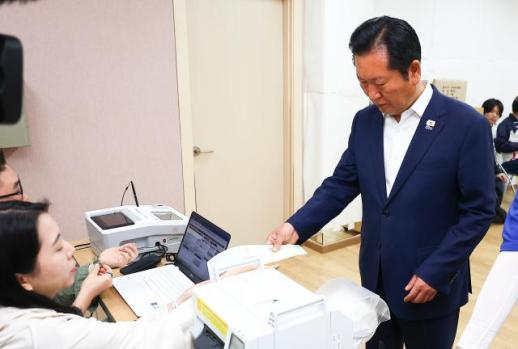 Early Voting Begins for June 3 Local Elections in South Korea 6·3 지방선거와 국회의원 재·보궐선거 사전투표가 29일부터 이틀간 실시되는 가운데 여야 지도부 및 후보들은 적극적으로 사전투표에 나서며 시민들의 참여를 독려했다.Early voting for the June 3 local elections and the National Assembly by-elections began on May 29 and will continue for two days. Leaders and candidates from both major parties actively participated in early voting and encouraged public participation.Jung Cheong-rae, the head of the Democratic Party's election campaign committee, cast his vote at a local community center in Mapo-gu, Seoul, on May 29. After voting, he told reporters, "If we win in Seoul, we win the nation," expressing his desire to secure a victory in the capital. He added, "If you want the person you hope for to win, please vote. I hope to show the forces that have attacked our democracy the seriousness of the Constitution through the power of your vote."Meanwhile, People Power Party leader Jang Dong-hyuk participated in the main voting, while floor leader Song Eon-seok planned to vote early on the second day, May 30, in his constituency of Gimcheon, North Gyeongsang Province.Candidates for local leadership positions also began their schedules with early voting and encouraged voter turnout. Both Jung Won-o, the Democratic Party candidate for Seoul mayor, and Oh Se-hoon, the People Power Party candidate, participated in early voting.Jung completed his vote at the early voting site in the administrative complex of Sogong-dong, Jung-gu, and told reporters, "The citizens' demand for new energy and new leadership will be revealed in this election. The results may be close, but I will strive for victory with that hope."Oh visited the early voting site at the Hanam-dong community center in Yongsan-gu, where he stated, "Seoul stands at a crossroads of whether to move toward the future or regress, and whether Korea's democracy will advance or fall into dictatorship. I hope voters will deeply consider how to lead President Lee Jae-myung with a more humble approach through this election."In Busan, a key battleground, Democratic Party candidate Jeon Jae-soo and Ha Jung-woo, a candidate for the Busan North District by-election, both participated in early voting. Jeon stated, "I will complete the vision of Busan as a maritime capital with the citizens of Busan," emphasizing the need for representation, as there are currently no ruling party members among the 18 Busan National Assembly members.Ha added, "If I become a representative who has worked with the government, ruling party, and the Blue House in my district, we can quickly overcome the shortcomings of the past 20 years of development," appealing for votes.Independent candidate Han Dong-hoon, who voted early, criticized Ha, saying, "A candidate who cannot even vote alone cannot lead the North District," and expressed sympathy for Jeon, stating, "Ha is becoming a significant burden for Jeon." People Power Party candidate Park Min-sik also completed early voting on the same day.* This article has been translated by AI. 2026-05-29 16:24:00
 -
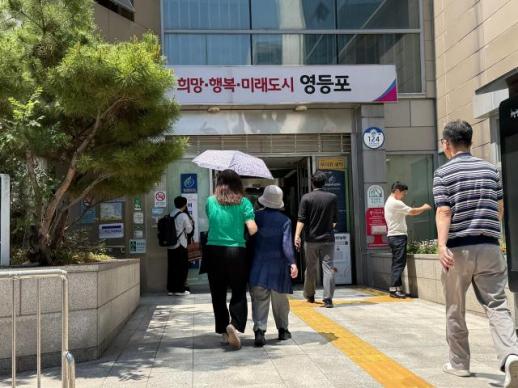 Early Voting Kicks Off for Local Elections Amid Calls for Housing Solutions On the first day of early voting for the June 3 local elections, the early voting site at the Yeouido Community Center in Yeongdeungpo, Seoul, was bustling with voters during lunchtime. Many citizens voiced their concerns, calling for solutions to the housing crisis as they participated in the voting process. Located in Yeouido, where many office workers are employed, the community center saw long lines forming outside the polling station by 11:30 a.m., reflecting the high interest in this local election. Office workers arrived wearing their employee badges or dressed in business attire and work uniforms. Additionally, military personnel, visually impaired individuals, and seniors received assistance to cast their votes. As noon approached, the line stretched approximately 150 meters from the entrance. Some voters, upon hearing that the wait would exceed 30 minutes, decided to leave and return after lunch. The unusually hot weather prompted many to use umbrellas, hand fans, and portable fans to stay cool. After voting, citizens uniformly expressed their desire for the next mayor of Seoul to address the housing issue. A man in his 60s, who voted for Jung Won-oh of the Democratic Party, stated, "The most important issue in this election is real estate," emphasizing the need for more opportunities for younger generations. A woman in her 20s who supported Oh Se-hoon of the People Power Party echoed similar sentiments, saying, "I hope a living environment can be created for those in their 20s to live alone in Seoul. The burden of rent and housing prices is too high." A man in his 40s who also voted for Oh remarked, "While we need to expand housing supply through reconstruction and redevelopment, it should be done in a balanced way to avoid price instability." He noted that the political discourse has been overshadowed by allegations and conflicts rather than policy competition. Interestingly, despite earlier polls favoring Jung, there were signs of momentum for Oh among voters, who cited his experience as a four-term mayor as a reason for their support. A woman in her 30s, identifying as undecided, said, "There aren't any standout candidates, but I chose Oh. It's important whether he can check the Blue House and the ruling party. I hope he works for the country." Both the woman and the man who supported Oh highlighted his current position as mayor, believing he has a better understanding of city governance, and praised his extensive administrative experience. By 12:30 p.m., the long lines that had extended outside the entrance had noticeably diminished. A polling station official reported that approximately 1,600 people had voted by that time, an increase of about 300 from 11:42 a.m. According to the National Election Commission, the national average voter turnout by 3 p.m. was recorded at 8.15%, which is 0.9 percentage points higher than the early voting rate of 7.25% at the same time during the 2022 local elections. Early voting will continue for two days, from 6 a.m. to 6 p.m., at 3,571 locations nationwide. Voters aged 18 and older must present a government-issued ID that includes their date of birth and photo, such as a resident registration card, passport, or driver's license. Mobile IDs are also accepted, but screenshots or image files are not valid. Voters casting ballots at polling stations in their registered districts will receive a ballot, mark it, and place it directly into the ballot box. However, voters at polling stations outside their registered districts must receive both a ballot and a return envelope, mark the ballot, place it in the envelope, seal it, and then submit it into the ballot box. Detailed locations of early voting sites can be found on the election commission's website or by calling their hotline at 1390.* This article has been translated by AI. 2026-05-29 16:24:00
 -
 Kia and Hyundai Face Tensions as Wage Negotiations Begin As Hyundai Motor Group enters the wage and collective bargaining phase this year, tensions are rising in the automotive industry. While Hyundai has already accelerated negotiations, Kia has shown differences even before scheduling its initial meeting, increasing pressure on the group.According to industry sources on May 29, Kia plans to hold its first meeting between labor and management as early as next week to kick off this year's negotiations. The Kia union had initially proposed to meet on this day, but the meeting did not take place.The management sent a formal notice to the Kia union two days earlier, on May 27, suggesting a postponement of the schedule. The management cited that the overall timeline for this year's negotiations was progressing faster than expected as the reason for the delay. Consequently, Kia's negotiations will be slightly delayed.Recently, the Kia union finalized its demands for this year's negotiations during a delegate meeting. Key demands include a basic salary increase of 149,600 won, a bonus equal to 30% of operating profit, inclusion of average wages in the bonus calculation, increases in production line and service allowances, hiring new employees to match the number of retirees this year (1,830), and the abolition of the dual wage system.Regarding the revision of the collective agreement, the union's core demands include hiring new employees through domestic factory investments, increasing bonuses from 750% to 800%, reducing weekly working hours to 4.5 days, introducing new models at domestic factories, and extending retirement age linked to national pension eligibility.The management's attempt to delay the negotiation schedule is interpreted as a strategy to minimize group-level pressure, especially with ongoing negotiations at Hyundai. Recently, labor disputes over issues like the so-called 'N% bonuses' have spread among companies like Samsung Electronics and SK Hynix, raising expectations for increased tensions over bonuses and wage structures in the automotive sector during this year's negotiations.Hyundai has already shown significant differences in positions during its negotiations this year. The eighth round of negotiations is scheduled for next week, and the union continues to present its demands to the management. However, the management reportedly finds it challenging to realistically accept the major demands. The Hyundai union is demanding that 30% of last year's net profit be distributed as bonuses to union members and employees of partner companies.During the seventh round of negotiations held on May 27, substantial differences in views between labor and management were noted regarding these demands. Industry insiders predict that as Kia enters the negotiation phase, the intensity of labor disputes in the automotive sector this year could be higher than in previous years, with the possibility of both Hyundai and Kia resorting to strikes.An industry source stated, "While Hyundai's negotiations are ongoing, we are still in the explanation phase, and there are significant differences in opinions between labor and management."* This article has been translated by AI. 2026-05-29 16:24:00